.webp)
Why aftersales is the right place to start with AI customer service automation
Most brands evaluating AI for customer service start with sales chat or top-of-funnel deflection. The gains there are real but small. The big gains live in aftersales, where every case carries structured data (order, product, serial, evidence) that AI can read. Returns, warranty, repair, and refund cases are exactly where AI customer service automation pays back fastest.
This piece covers what AI customer service automation means specifically for aftersales in 2026, the five core use cases, the implementation pattern, the ROI signals, and the limits. For broader context, contact center automation technologies, benefits, and implementation and customer service automation software platforms for modern support teams cover the general category.
- Aftersales is the highest-ROI starting point for AI customer service automation because every case carries structured data the AI can read.
- The five core use cases are intake triage, returns and warranty decisioning, repair routing, refund and credit memo automation, and customer communication.
- The pattern is AI-first, human-second: the AI handles the predictable cases, agents handle exceptions and escalations. Headcount stays flat, volume grows.
- Claimlane's AI Agent runs all five use cases on one platform, with MaxGaming reporting 77% faster resolution on complex RMA cases.
What AI customer service automation means in 2026
AI customer service automation is the use of large language models, vision models, and rules engines to handle parts of the customer service workflow that previously required a human agent. In 2026, the technology is mature enough that the question is not whether to automate, but which use cases to automate first.
Three things changed since 2023
First, vision models can read product photos with accuracy that matches a trained agent. Second, language models can follow brand-specific policy and tone, not just generic chat responses. Third, structured tool use lets the AI call APIs, update records, and trigger workflows directly, not just reply with text.
Aftersales specifically
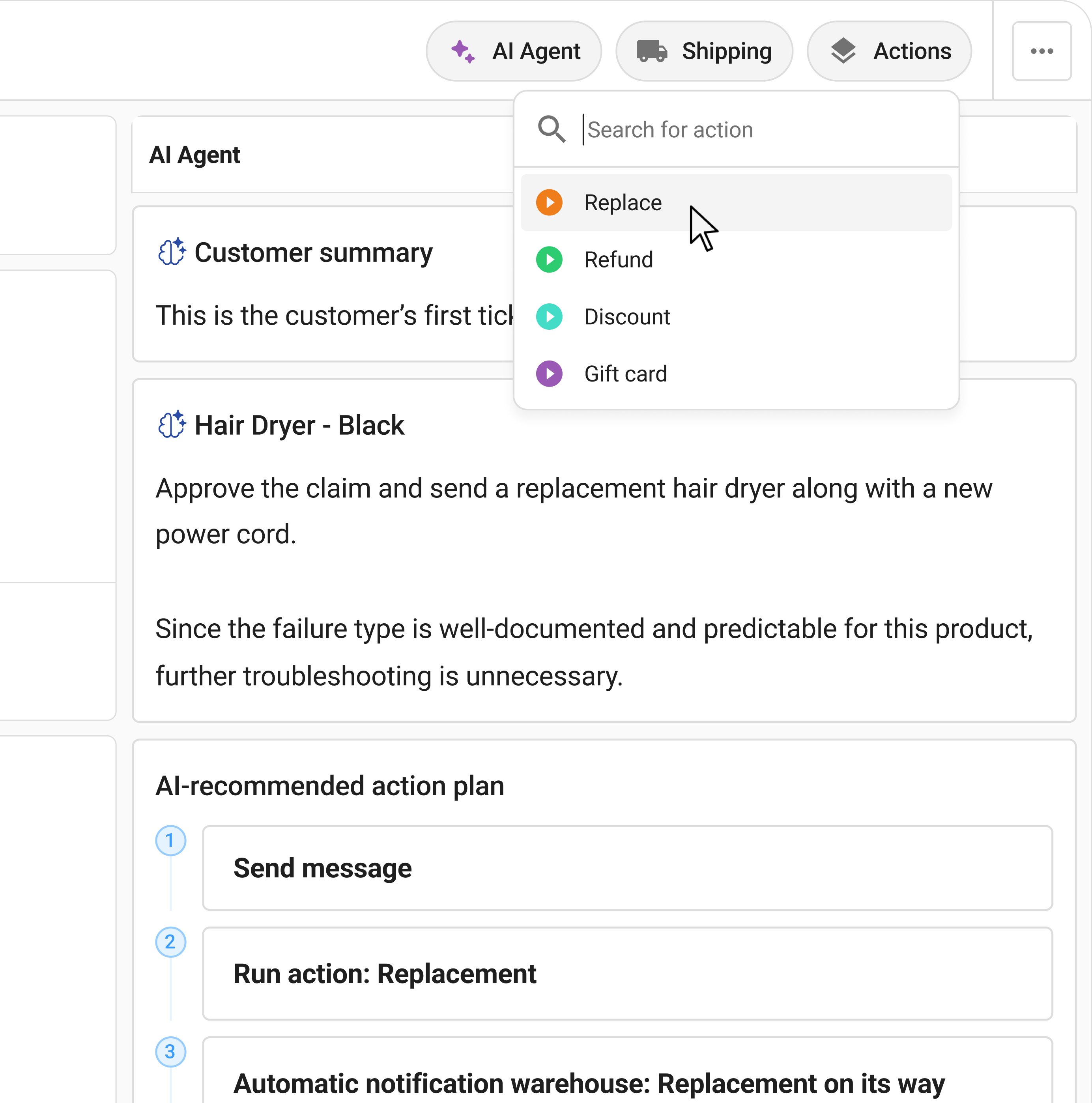
Aftersales cases (returns, warranty, repair, refund) carry the data AI needs: order ID, product SKU, serial, photos, issue type, and timestamps. The AI reads the case, applies the brand's rules, and recommends a resolution. The agent reviews and approves, or the platform auto-approves under defined thresholds.
The 5 use cases for AI in aftersales customer service
Use case 1: Intake triage
The customer files a claim. The AI reads the order, the product, the issue description, and the evidence (photos and short video). It classifies the issue, scores the evidence, and routes the case to the right lane. The agent sees the classification and decides in seconds, not minutes.
This is where most of the volume sits. Brands handling 1,000+ cases a month see 60 to 80% of cases land in predictable categories that the AI can triage correctly on first read. The pattern is covered in AI warranty claims automation and the in-batch piece on warranty claim form templates (Article 1) covers the intake structure.
Use case 2: Returns and warranty decisioning
Decisioning means applying brand-specific rules to the case. Is the product in warranty? Is the issue covered? Is the customer entitled to a refund, replacement, or repair? The AI reads the rules per SKU and supplier, applies them to the case, and recommends a resolution.
The AI returns management for ecommerce piece covers the returns side. The AI RMA automation piece covers the RMA lane. The repair vs replace warranty claims piece covers the resolution choice.
Use case 3: Repair routing
For categories with a repair path (electronics, appliances, sporting goods), the AI matches the unit to the right repair partner or in-house workflow. The serial maps to the component. The component maps to the repair process. The in-batch piece on serial number tracking software (Article 3) covers the serial layer that drives this routing.
The repair workflows for EU compliance and best repair management software pieces cover the repair operations side.
Use case 4: Refund and credit memo automation
Below defined thresholds, the AI auto-approves refunds and credit memos. The customer receives the refund within minutes. Above the threshold, the case routes to a human for review. The ecommerce refund automation tools piece covers the broader category. The business central credit memo returns piece covers the ERP-side credit memo flow.
Fraud detection runs in parallel. The in-batch piece on warranty fraud explained (Article 2) covers the fraud surface that auto-approval has to guard against.
Use case 5: Customer communication
The AI drafts status updates, resolution notes, and explanation copy in the brand's voice and the customer's language. The agent reviews and sends. For predictable updates (automatic status emails), the AI sends without human review.
The communication layer pairs with reduce customer effort claims and returns and why warranty claim process builds customer loyalty on the retention side.
AI in claim approval workflow
Claimlane's AI Agent, the first AI agent purpose-built for warranty claims and returns, runs the full claim approval workflow on a single platform. It reads images and videos, applies warranty rules per product and supplier, and recommends or auto-approves resolutions.
The Claimlane AI Agent for returns and warranty piece covers the agent in more depth. The AI agents for post-purchase support and ecommerce AI agents pieces cover the broader agent category.
AI vs traditional chatbots
Traditional chatbots run on decision trees and intent matching. They handle FAQ-style queries (where is my order, what is your return policy) and break on anything that requires reading evidence or applying a brand-specific rule.
AI customer service automation is fundamentally different. The AI reads the case, applies the policy, and takes action. The AI chatbots for ecommerce piece covers the chatbot category, and voice AI customer service covers the voice side. Brands running AI customer service automation in aftersales sit a layer above both.
77% fasterComplex RMA cases resolved faster after switching to AI-led intake. Agents stopped needing months of product training to handle the long tail of categories.— MaxGaming, largest gaming and e-sports ecommerce in Scandinavia (case study)
Implementation pattern
The brands that get the most out of AI customer service automation in aftersales follow a four-stage rollout.
Stage 1: Triage only
The AI reads cases and classifies them. The agent decides on every case. Goal: validate the AI accuracy against the brand's data before giving it action.
Stage 2: Recommend
The AI reads, classifies, and recommends a resolution. The agent approves or rejects with one click. Goal: build agent trust and refine the rules engine.
Stage 3: Auto-approve under thresholds
The AI auto-approves cases below a value threshold (typical: $50 refund, sealed-box returns, registered warranty within standard SLA). Above the threshold, the agent reviews. Goal: get the volume win without bypassing risk control.
Stage 4: AI-led, human-exception
Most cases run through AI from intake to resolution. Agents handle exceptions, escalations, and complex repair routing. Goal: scale without headcount growth.
ROI signals brands measure
The number that matters most to ops leaders is volume per agent. Brands running AI customer service automation in aftersales typically handle two to three times the case volume per agent without losing quality. The how to reduce claim resolution time piece covers the cycle-time side, and the ecommerce returns time to resolution piece covers the broader returns benchmark.
Limits of AI customer service automation
Three places where AI does not replace the agent.
Edge cases
Products the AI has not seen, defects with unusual evidence, multi-product cases with conflicting issues. The agent handles these and feeds the data back to the model.
Escalations
Angry customers, regulatory edge cases, public-facing complaints. Human empathy and judgement carry the case.
Strategy and quality programs
The AI handles cases. Defining what "good" looks like is still a human job. The warranty management best practices, customer-centric warranty analytics, and warranty analytics for product quality pieces cover the analytics-driven quality side.
Industry view: where AI customer service automation sits in 2026
The broader category is moving fast. Customer service workflows for returns and workflows for the customer service team cover the workflow layer that the AI plugs into. The customer service automation software platforms for modern support teams and AI customer success ecommerce pieces cover the platform-level view.
For brands evaluating their stack, the lens is whether the AI lives inside the workflow or beside it. AI that lives inside the platform (intake to resolution) drives the ROI. AI that lives beside the platform (chatbot in front, ticketing in back) drives a small deflection win and not much else.
Claimlane's AI Agent runs inside the workflow. The self-service portal captures the intake. The AI product page covers the agent in detail. Analytics closes the loop with the data the AI generates, and forward-to-supplier handles the recovery side. The in-batch piece on AI supplier management (Article 5) covers the supplier-side AI layer.
Frequently asked questions
Conclusion
Aftersales is where AI customer service automation pays the highest ROI. The cases carry structured data, the workflows are repeatable, and the volume is high enough for the gains to compound. Brands that follow the four-stage rollout (triage, recommend, auto-approve, AI-led with human exception) hit 40 to 70% AI-handled cases inside a year, with two to three times the case volume per agent and shorter time-to-resolution across the board.
To see how Claimlane's AI Agent runs intake, decisioning, routing, refund, and communication on one platform, book a demo or watch the live setup on the interactive demo.