.webp)
Most ecommerce support teams spend the bulk of their time answering the same questions: Where is my order? How do I return this? Is my warranty still valid? AI chatbots for ecommerce now handle these queries automatically, resolving routine requests in seconds and freeing human agents for problems that actually need judgment. The conversational commerce market hit $8.8 billion in 2025 and is projected to reach $32.6 billion by 2035, a signal that brands are betting heavily on automation at every stage of the customer journey.
But not all chatbots are created equal. A general-purpose chatbot that answers product questions is a different tool from a purpose-built AI agent that handles warranty claims and returns. The distinction matters for brands processing hundreds or thousands of post-purchase requests every month.
- • AI chatbots automate up to 80% of routine support queries including order tracking, returns, and product questions.
- • General chatbots work for pre-purchase; post-purchase workflows like warranty claims need specialized tools.
- • Best implementations combine conversational AI with workflow automation, image analysis, and OMS integrations.
- • Claimlane's AI Agent is the first AI agent purpose-built for warranty claims and returns.
What Is an AI Chatbot for Ecommerce?
An AI chatbot for ecommerce is software that uses natural language processing and machine learning to interact with online shoppers through text or voice. Unlike older rule-based bots that follow rigid scripts, modern AI chatbots understand context, learn from past conversations, and handle nuanced requests.
These tools sit across the entire shopping journey:
- Pre-purchase: Product recommendations, size guides, stock availability
- During purchase: Cart recovery, checkout assistance, payment troubleshooting
- Post-purchase: Order tracking, return initiation, warranty claims, delivery exceptions
The post-purchase category is where most support volume lands. WISMO ("where is my order?") queries alone account for 30-40% of all ecommerce support tickets. Add returns, exchanges, and warranty claims, and post-purchase requests often represent 60-70% of total customer service workload.
How AI Chatbots Differ from Rule-Based Bots
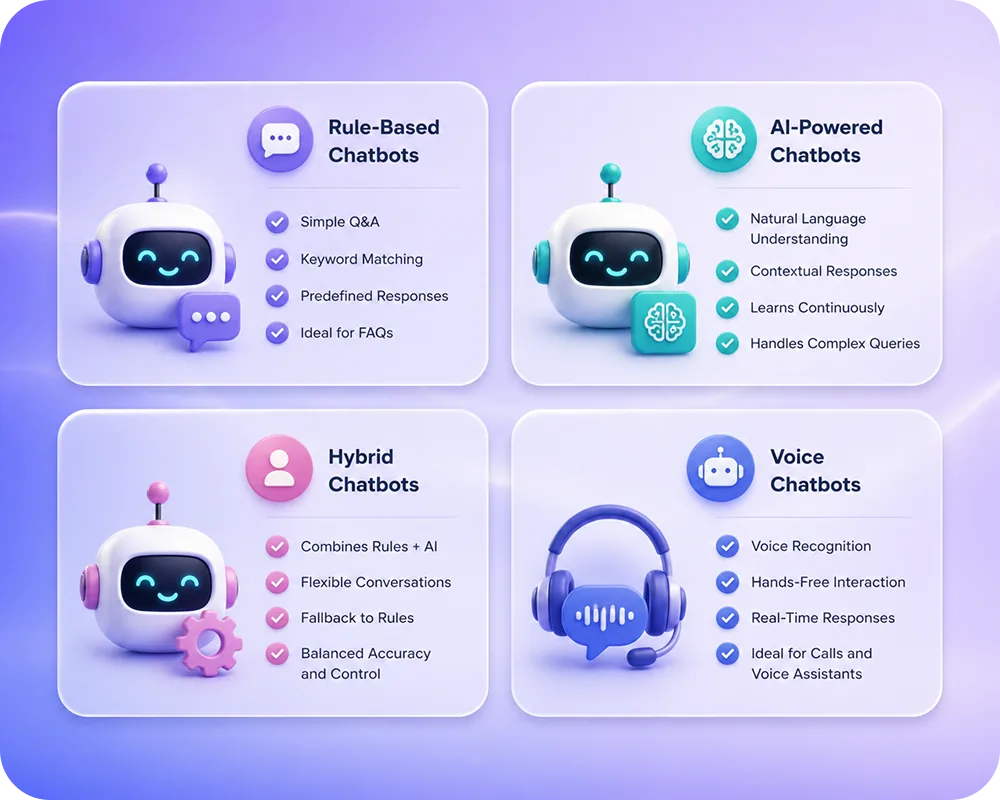
Rule-based bots follow decision trees. If a customer says "return," the bot routes to the return flow. If the customer phrases it differently, the bot fails.
AI chatbots parse intent. They recognize that "I want to send this back," "this product is broken," and "how do I get a refund" all point to the same underlying need. They also improve over time as they process more conversations.
Why Ecommerce Brands Are Adopting AI Chatbots in 2026
Rising Support Volumes
Online retail keeps growing, and every additional order creates potential support interactions. Brands that scaled from 1,000 to 10,000 monthly orders often see support tickets grow even faster because post-purchase issues compound.
Customer Expectations for Speed
Shoppers expect instant responses. A study from HubSpot found that 90% of customers rate an "immediate" response as important. AI chatbots deliver that speed 24/7 without staffing night shifts.
Cost Pressure on Support Teams
Hiring and training support agents is expensive. For brands handling complex after-sales operations, the cost per resolved ticket can run $5-$15 for human agents. AI chatbots reduce that to a fraction.
The Shift Toward Conversational Commerce
Conversational commerce is becoming the default. AI chatbots make it possible to serve thousands of simultaneous conversations without queuing. The market is growing at over 14% CAGR, projected to reach $32.6 billion by 2035.
Types of AI Chatbots for Ecommerce
General-Purpose Conversational AI
Platforms like Tidio, Zendesk AI, and Intercom offer broad customer service automation. They handle FAQs, route tickets, and provide basic workflow automation. Strong for pre-purchase queries and order tracking.
Product Recommendation Chatbots
Tools like Rep AI and Octane AI focus on guided selling. They ask shoppers about preferences and suggest products. Their goal is conversion optimization, not support resolution.
Post-Purchase and Returns-Focused AI
This category handles the operational side: return initiation, refund automation, warranty claim processing, and shipping issue resolution. These tools integrate directly with order management systems and warehouse modules.
Purpose-Built AI Agents for Warranty and Claims
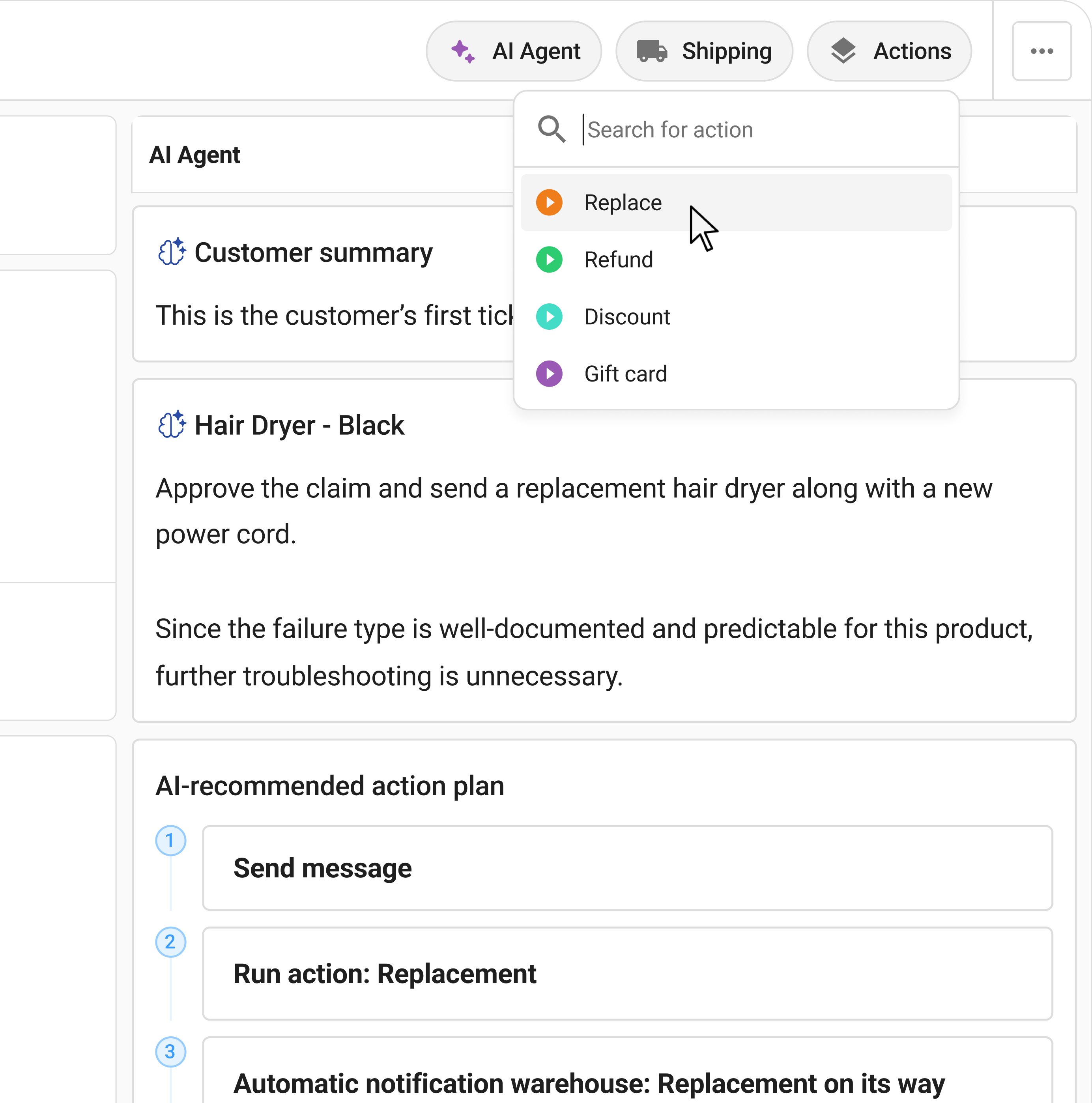
Claimlane's AI Agent, the first AI agent purpose-built for warranty claims and returns, represents a specialized approach. Rather than handling all queries, it focuses on the warranty and returns workflow: analyzing product images and videos, applying warranty rules per product and supplier, and recommending or auto-approving resolutions. Claimlane is rated 4.8/5 on G2.
How AI Chatbots Handle Returns and Warranty Claims

General chatbots can tell a customer "your return has been initiated." A purpose-built warranty AI agent can look at a photo of a cracked product, check whether the damage falls under warranty coverage for that model, verify the purchase date against the warranty period, and either approve a replacement or route the case to a human with a recommendation.
Here is the typical process with specialized tools:
- Customer submits a claim through a self-service portal with photos, videos, order details, and a description.
- AI analyzes the evidence. Image recognition identifies the type of damage.
- Rules engine applies policies. The system checks warranty terms, product-specific rules, and supplier agreements.
- Resolution is recommended or auto-approved. Clear-cut cases get instant approval. Borderline cases route to agents.
- Actions execute automatically. Refunds, replacements, repair orders, or supplier forwarding happen without manual work.
MaxGaming, the largest gaming and e-sports ecommerce in Scandinavia with 30,000+ SKUs, resolved complex RMA cases 77% faster using Claimlane's AI agents.
Before Claimlane, every case required manually digging around to find the best solution. Now we move faster and with real confidence. You can feel the impact within our support team and in every customer interaction.
Nick Magnusson · Head of Customer Service, MaxGaming
Comparing AI Chatbot Platforms for Ecommerce
| Platform | Best For | Returns/Warranty | AI Depth | Price |
|---|---|---|---|---|
| Claimlane | Warranty & returns | Purpose-built: image analysis, rules, auto-resolution | Deep | Custom |
| Tidio | SMB support | Basic returns | Moderate | $29/mo |
| Zendesk AI | Enterprise | Ticket routing only | High (general) | $55/agent |
| Gorgias | Shopify CS | Macro-based | Moderate | $10/mo |
| DigitalGenius | High-volume retail | Returns + WISMO | High (ecommerce) | Custom |
General-Purpose Chatbots vs Purpose-Built AI Agents
When a General Chatbot Works
General chatbots fit when most queries are simple and informational:
- Order status updates
- Product availability questions
- Shipping time estimates
- Basic FAQ responses
Platforms like Tidio, Gorgias, and Zendesk handle these well. They integrate with Shopify and other ecommerce platforms to pull order data.
When a Purpose-Built AI Agent Is Necessary
General chatbots hit a wall when interactions require judgment, evidence analysis, and multi-step workflows:
- A customer submits a warranty claim with a photo of a defective product. The system needs to assess coverage, check the warranty period, and determine the correct resolution based on product and supplier rules.
- A retailer forwards a claim to a supplier with supporting documentation.
- A brand processes 500+ claims monthly across multiple product categories with different warranty terms.
This is where Claimlane's AI Agent operates, handling the warranty and returns workflow end-to-end.
Key Features to Evaluate in AI Chatbot Platforms
Natural Language Understanding
The chatbot should handle varied phrasing, typos, and multi-language inputs. Look for models trained on ecommerce-specific language.
Integration Depth
A chatbot that can't pull order data or process refunds is a fancier FAQ page. Deep integrations with Shopify, WooCommerce, ERP systems, and payment processors are non-negotiable. Claimlane offers 75+ integrations.
Image and Video Analysis
For warranty and damage claims, the ability to analyze photos and videos is critical. AI image recognition for warranty claims can identify defect types and assess damage severity.
Workflow Automation
The chatbot should trigger actions: issuing refunds, creating return labels, scheduling repairs, or routing complex cases to the right team.
Analytics and Reporting
Every interaction generates data. The best platforms turn that into actionable analytics: which products generate the most tickets, which issues resolve automatically, and where bottlenecks exist.
ROI of AI Chatbots for Ecommerce
- Ticket deflection: 40-80% of routine queries resolved without humans. At 5,000 tickets/month and $8/ticket, 50% deflection saves $20,000/month.
- Faster resolution: Average time drops from hours to seconds for automated queries.
- Reduced training costs: New agents need 2-4 weeks of training. AI handles routine volume.
- Revenue retention: AI chatbots that suggest exchanges instead of refunds retain 20-30% of revenue.
Use Cases Across the Customer Journey
Pre-Purchase: Product Discovery
AI chatbots guide shoppers toward the right product. Stores using AI-powered recommendations report 12-35% conversion rate improvements.
During Purchase: Cart Recovery
Abandoned cart rates hover around 70%. Chatbots trigger personalized messages when shoppers hesitate, answering last-minute questions about shipping or return policies.
Post-Purchase: Order Tracking
WISMO queries represent the single largest category of support tickets. AI chatbots resolve these instantly by pulling tracking data from carrier APIs.
Post-Purchase: Returns and Exchanges
Return initiation is the second-largest volume driver. AI chatbots walk customers through eligibility, generate return labels, and process refunds or store credit.
Post-Purchase: Warranty Claims
Warranty claims are the most complex post-purchase interaction. They require evidence collection, policy verification, and resolution logic. Predictive analytics can even flag products likely to generate claims before customers report issues.
Common Mistakes When Deploying AI Chatbots
Automating Everything from Day One
Brands that automate 100% of support on launch day usually see satisfaction drop. Start with high-volume, low-complexity queries and expand gradually.
Ignoring Post-Purchase Workflows
Many brands deploy chatbots focused on pre-purchase conversion and neglect the post-purchase experience. Returns and warranty claims generate more volume and have bigger impact on lifetime value.
Choosing a One-Size-Fits-All Tool
A chatbot that excels at product recommendations might struggle with complex return workflows. Pairing a general chatbot with a specialized tool like Claimlane often outperforms forcing one tool to do both.
Not Measuring the Right Metrics
Track satisfaction after AI-resolved interactions, escalation rates, repeat contact rates, and resolution accuracy. A chatbot that resolves 90% of tickets but gets 30% wrong creates more problems than it solves.
Implementation Roadmap
- Map support volume by category to determine general vs specialized needs.
- Define automation rules: fully automated, AI-assisted, or human-only categories.
- Connect the tech stack: ecommerce platform, OMS, payment processor, carriers. For brands using Shopify or WooCommerce, check native integration support.
- Train on your data: general chatbots need product and policy training. Purpose-built tools need warranty rules and workflow configuration.
- Monitor and optimize: track resolution rates and use analytics on claim patterns to improve.
The Future of AI Chatbots in Ecommerce
Agentic AI
The next wave goes beyond conversational AI to autonomous agents that take actions independently. Rather than answering questions, these agents manage entire returns workflows: analyzing evidence, making decisions, executing actions. Claimlane's AI Agent already operates in this mode.
Multi-Modal Input Processing
Chatbots are moving beyond text. Processing images, videos, and voice enables richer interactions. For warranty claims, customers can send a video of a malfunctioning product and receive an instant assessment.
Predictive Support
AI systems will predict issues before customers report them. By analyzing product quality trends and shipping patterns, brands proactively reach out to affected customers.
How to Choose the Right AI Chatbot
The selection comes down to three questions:
- Where does most support volume come from? Pre-purchase queries need a general chatbot. Post-purchase issues need specialized tools.
- How complex are post-purchase workflows? Simple return policies work with general tools. Multi-brand warranty management with supplier-specific rules needs purpose-built automation.
- What's the integration stack? Check compatibility with existing platforms. Claimlane supports 75+ integrations including Shopify, WooCommerce, Zendesk, and Business Central.
For many brands, the answer is both: a general chatbot for broad interactions and a specialized claims platform for warranty and returns.