After years of building Claimlane we've seen the same challenges across every customer: support teams spend too much time on repetitive work, decisions vary between agents, knowledge is not properly documented & shared and extensive training is required for new joiners.
We’re launching a feature to help with that, our own AI Agent.
What the AI Agent solves
PROBLEM 01
Repetitive work that drains agent time
PROBLEM 02
Inconsistent decisions across the team
PROBLEM 03
Knowledge stuck with senior agents, lost when they leave
PROBLEM 04
Long onboarding for new joiners
PROBLEM 05
Fraud patterns that humans miss
The Problem
The root cause remains the same, support teams are overwhelmed when handling returns and warranty claims. A few of the causes are:
Agents spend too much time reading long descriptions. Customers write extensively about their problem and it takes time to read and figure out what the problem is and what resolution to offer.
Inconsistent decisions across the team. Different departments may have different views over the same issue which prolongs the time until the ticket is closed.
In most cases, experienced agents have a lot of knowledge about the brand, the product and could observe patterns over time. This becomes a problem if they decide to leave and, oftentimes, this is not documented for everyone to access. Moreover, suppliers have different rules and it can prove difficult to make them well known across the team.
Known common issues with a product can be identified faster by using our new AI Agent, knowledge that a human agent might not have without prior research.
Fraud. This seems to be an ever evolving issue in our society and retail makes no exception. Oftentimes, customers with fraudulent behavior patterns are hard to detect. Our AI Agent has an overview over the ticket history of a customer and can identify abusive behavior and saves time and money for the brand.
Where agent time actually goes today
- Reading long customer descriptions to identify the actual problem
- Cross-checking warranty terms and supplier rules per case
- Asking colleagues "how have we handled this before?" on Slack
- Hunting for past tickets to spot fraud patterns
- Onboarding new agents through tribal-knowledge transfer
Our Solution
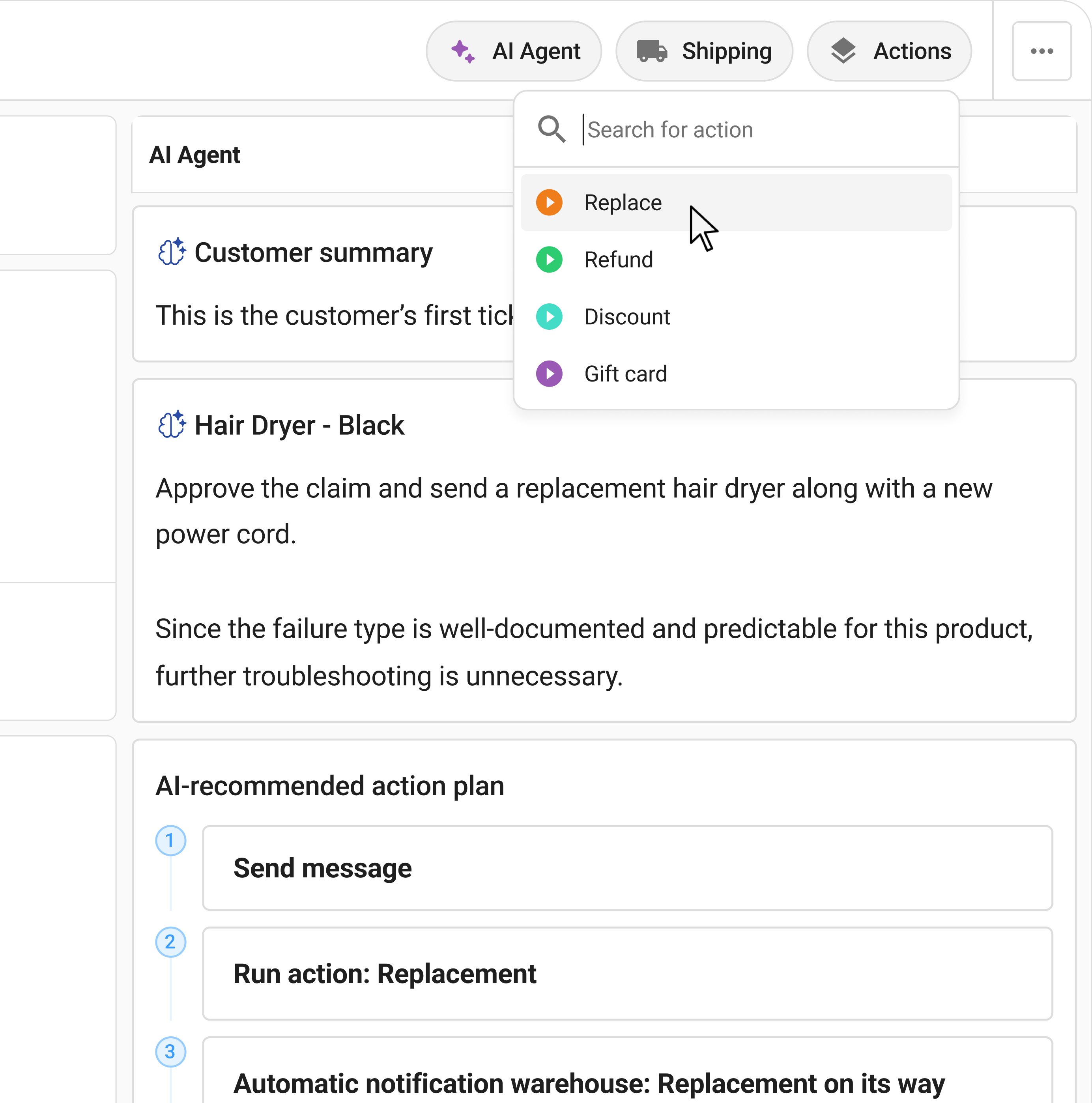
The Claimlane AI Agent will live inside our portal, on every ticket. It will understand the context, know your products, suppliers and customers. This knowledge is used when suggesting the correct outcome for your customer service agent.
When your team opens a ticket, it is instantly analyzed and key information is shown:
Customer summary - full history, behavior patterns and previous tickets
Suggested action - refund, replace or manual review
Reasoning - why this action makes sense based on your rules and data
Execution at the click of a button - if your agent agrees with what is being suggested, a button can simply be pressed and the action made in the background
01
Customer summary
Full history, behavior patterns, and previous tickets in one view.
02
Suggested action
Refund, replace, or manual review, decided per ticket.
03
Reasoning
Why this action makes sense, based on the brand's rules and data.
04
One-click execution
Agent agrees, presses the button, action runs in the background.
An example based on a real situation would be:
A customer reports their electric toothbrush won't charge. The AI shows:
Example: an electric toothbrush that won't charge
Customer summary
"The customer has only one previous ticket, reported for the exact same product with the same charging-related failure. Their history is very limited and focused on a single item, with no broader pattern of claims or inconsistent story."
Suggested action
"Approve the claim and send a replacement toothbrush including a new charger."
Reasoning
"This model has a very consistent history of charging and power-failure defects, and the customer's description aligns exactly with those recurring issues. Because the failure type is already well-documented and highly predictable for this product, additional troubleshooting or back-and-forth is unnecessary."
How it works
We have built the AI Agent on three core concepts:
Concept 01
Rules
Your policies in plain markdown. Easy to read, easy to edit, used to guide every decision.
Concept 02
Knowledge bases
Customer, product, and supplier knowledge that build themselves from your historical Claimlane data.
Concept 03
Actions
Refund, replace, or manual review. AI suggests, agent decides.
1. Rules
These are your policies for handling claims, returns, shipping damage, delivery issues, etc. The guidelines you'd normally tell agents during onboarding. You write these in plain markdown, making them easy to read and edit. The AI uses them to guide every decision.
2. Knowledge bases
Customer knowledge
- Claim history per customer
- Behavior patterns over time
- Fraud signals: frequency, inconsistencies, cross-customer patterns
Product knowledge
- Common defects per SKU
- Resolutions that worked
- Knowledge that previously lived only with senior agents
Supplier & brand knowledge
- Supplier-specific requirements
- Format and evidence rules per supplier
- Response patterns and quality history
A key detail to note here is that these knowledge bases build themselves. As you handle tickets, the AI learns in the background. Based on the decisions you take and rules you set, it automatically adapts the output.
3. Actions
Based on your rules and knowledge, the AI suggests one of three outcomes:
💰
Refund
Issue a full or partial refund
📦
Replace
Send a replacement product
👤
Manual review
Complex cases route to a human
This allows you to stay in control, but saving time on each ticket. We make the suggestions, you decide the outcome.
Want to see AI-powered warranty automation in action? Watch our webinar on how to automate warranty and repair cases with AI agents.
The business impact
Building your own AI takes 6-12 months and requires data science expertise. You need to integrate with your systems, create prompts for every scenario, train on your data, and maintain it as things change. Our AI Agent does all of this out of the box, allowing you to be live in days, not months.
What you need
Build your own
Claimlane AI Agent
Time to live
6-12 months
Days
Data science expertise
Required in-house
Not needed
Integrations
Custom-built per system
Out of the box
Training data
Manual labeling
Built from your history automatically
Maintenance
Ongoing engineering cost
Included
What makes us different?
It's a copilot, not a chatbot.
We're not adding a chat interface. The AI Agent works inside your existing ticket workflow - analyzing every case and suggesting the right action based on your rules and knowledge bases.
It learns from YOUR data, automatically.
The knowledge bases build themselves from your historical Claimlane data. Every ticket you've handled teaches the AI about your customers, your products, and your suppliers.
You control the intelligence through rules.
Want to change how the AI behaves? Update your rules (written in plain markdown).
The rollout will happen in three phases across 2026
Phase 1: Summary & Suggestions (Q1 2026)
This is our starting point. The AI Agent will be present and make suggestions, but a human will stay in full control.
Summary & Suggestions
AI summarises cases, suggests actions, builds knowledge bases. Human stays in full control.
Reasoning & Actions
AI executes actions automatically with permission. Tech-stack integrations expand.
Agentic Workflows
End-to-end automation for standard cases. Cross-department workflows: customer service, finance, suppliers.
Alongside it, you will be able to build workflows across departments (customers service, finance, suppliers)
Frequently asked questions
What does Claimlane's AI Agent actually do?
It lives inside every ticket in Claimlane and analyses the case automatically. For each ticket, it shows a customer summary, a suggested action (refund, replace, or manual review), and the reasoning behind that suggestion. The agent can execute the action with one click if they agree.
How is the AI Agent different from a chatbot?
A chatbot adds a chat interface for the customer. The Claimlane AI Agent is a copilot for the support team. It works inside the existing ticket workflow and helps the agent decide faster, rather than handling customer conversations itself.
Where does the AI Agent learn from?
From your historical Claimlane data. The AI builds three knowledge bases automatically: customer behavior, product defect patterns, and supplier requirements. Every ticket the team handles teaches the AI about your specific operation.
How does the AI Agent detect fraud?
It tracks claim frequency per customer, looks for inconsistent stories across tickets, and identifies suspicious patterns across multiple customers. Patterns that take a human agent hours of historical research to spot show up automatically on the ticket.
Can we control how the AI behaves?
Yes. The AI is guided by rules written in plain markdown — your policies for how to handle claims, returns, shipping damage, and delivery issues. To change how the AI decides, update the rules.
Does the AI Agent replace customer service agents?
No. The AI suggests, agents decide. Complex cases route to manual review. The goal is to remove repetitive work and inconsistent decisions, not headcount.
When will the AI Agent be available?
Phase 1 (case summaries and suggestions) and Phase 2 (action execution and tech-stack integrations) roll out across Q1 2026. Phase 3 (full agentic workflows across departments) follows in Q2-Q3 2026.
How does this compare to building our own AI?
Building in-house typically takes 6-12 months and requires data science expertise, custom integrations, manual training data, and ongoing maintenance. The Claimlane AI Agent ships with all of this out of the box and goes live in days.
Claimlane's AI Agent is the first AI agent purpose-built for warranty claims and returns. To see how it analyses real cases on your data, [book a demo](/book-demo) or read more on the [AI Agent product page](/product/ai).
Book a demo to see the AI Agent in action. We'll walk you through real examples and show you how it would work for your business.
Book a demo

.webp)