.webp)

Reverse logistics is the process of moving products from the customer back to the seller or manufacturer. It covers returns, repairs, recycling, refurbishing, and product recalls, everything that happens after a product leaves your warehouse but needs to come back.
With ecommerce return rates sitting around 17%, reverse logistics has moved from a back-office concern to a core operational function. Handle it well and you recover value, keep customers, and reduce waste. Handle it badly and every return eats into the margin you spent ads to earn.
The scale behind this is significant. The global reverse logistics market is projected to grow from $731.9B in 2023 to $1.2 trillion by 2033, a 5.4% CAGR, driven by rising ecommerce return rates, sustainability rules, and the cost of waste (Allied Market Research).
What is Reverse Logistics?
As mentioned above, reverse logistics refers to the process of moving goods from the customer back to the seller or manufacturer. It encompasses returns, repairs, recycling, refurbishing, and disposal.
In practice, reverse logistics is the full process of handling a returned product, from the moment the customer initiates the return to the moment the item is restocked, refurbished, resold, or disposed of.
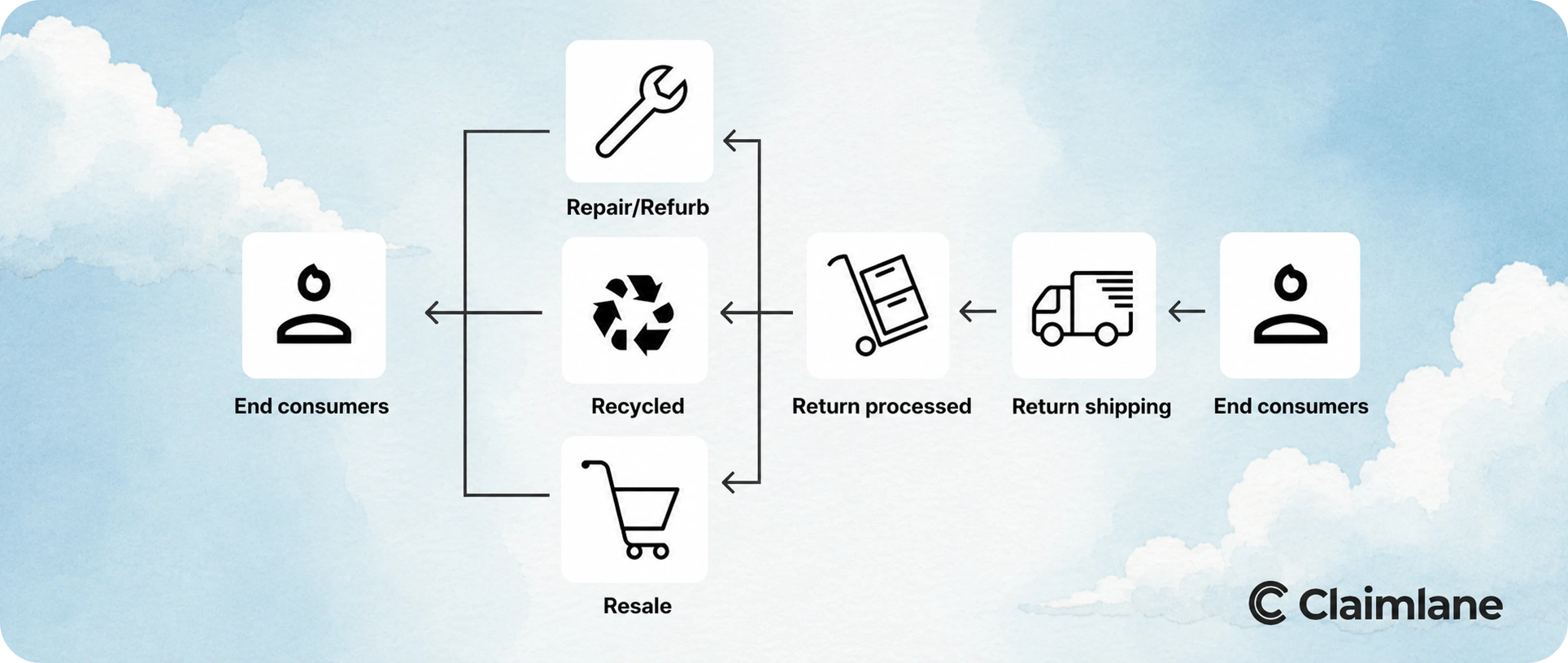
Examples of Reverse Logistics:
- A customer returns a product bought online.
- A defective item is sent back for repair under warranty.
- A company recalls a product due to a safety issue.
- Old electronics are recycled through a take-back program.
While forward logistics focuses on delivering products, reverse logistics manages what happens when things come back - and most importantly how businesses can recover value from them.
The Reverse Logistics Process
A smooth reverse logistics process ensures that returns are handled efficiently and cost-effectively.
Typical Steps in Reverse Logistics:
- Return Initiation – The customer requests a return or warranty claim.
- Return Authorization – The business issues an RMA (Return Merchandise Authorization) and provides return instructions.
- Return Shipping – The product is shipped back to the warehouse or repair center.
- Inspection and Sorting – Items are inspected and sorted for restocking, refurbishing, recycling, or disposal.
- Resolution – Refunds, replacements, or repairs are processed.
- Inventory Management – Restockable products are added back to inventory, while others are recycled or disposed of.
A well-designed reverse logistics process reduces cost per return, speeds up recovery, and turns a cost centre into a source of customer retention data.
How do you optimize the reverse logistics process?
There are many ways to improve how you handle product returns, from training your customer service team to tightening your return policy.
If you want to completely change how returns work, the bigger leverage is software, a warranty management system or return management system. Either removes the manual data entry, routes the return automatically, and gives you real-time visibility on every open claim.
This lets you collect returns from customers without chasing email threads, and gives you a complete overview of every in-flight return, exchange, repair, and credit note across your operation.
The 5 R’s of Reverse Logistics
To optimize reverse logistics, businesses often follow the 5 R’s of reverse logistics. This is a framework for managing returns sustainably and efficiently:
How to improve reverse logistics
Brands looking to upgrade an existing program typically work through these moves:
- Simplify the customer-facing returns process. Branded self-service portal, clear instructions, prepaid labels or drop-off options.
- Automate return rules and approvals. Auto-approve low-risk returns, route complex cases to agents. Workflow automation typically resolves 60 to 80% of returns without human review.
- Add structured intake. Photo-required returns, fixed reason categories, required order info. Reduces fraud and speeds inspection.
- Use analytics to identify root causes. Break return rate down by SKU, supplier, and reason. Feed insights back into product design and supplier quality reviews. Analytics dashboards in modern platforms handle this automatically.
- Set up disposition routing. Restock if resalable, refurbish if recoverable, recycle if end-of-life. Manual routing decisions are slow and inconsistent.
- Coordinate with suppliers for chargeback recovery. Manufacturing defects should not be absorbed by the brand. Use supplier forwarding to push claims back with documentation.
- Track the right KPIs. Return rate, cost per return, cycle time, recovery rate, supplier defect rate. See the full returns and warranty KPIs framework.
Reverse Logistics for retailers
For ecommerce retailers specifically, reverse logistics is dominated by one issue: product returns.
Challenges in Reverse Logistics retail:
- Higher return rates compared to brick-and-mortar stores.
- Complex international returns and cross-border logistics.
- Increased risk of return fraud.
- Difficulty in reselling returned or opened products.
- Bulky products are not easy to handle and there can be a lot of costs involved.
Optimising reverse logistics for ecommerce isn't optional, but the difference between margin-positive and margin-negative fulfilment.
Any retailer tackling their reverse logistics has two areas they should focus on: Customer experience and Internal operations.
Benefits of a Reverse Logistics management software
Managing returns manually is time-consuming and error-prone. That’s where reverse logistics management software comes in.
A manual returns process usually involves:
- Email communication with customer: A lot of back-and-forth communication to get the right information.
- Spreadsheets with manual data input.
- For ecommerce: manually reaching out to suppliers for credit notes.
%201.webp)
Key Benefits of Reverse Logistics Software:
- Automates return authorizations (RMAs) and shipping label creation.
- A return portal removing unnecessary communication.
- Provides analytics to optimize the reverse supply chain.
- Streamlines communication between customers, warehouses, and suppliers.
Good reverse logistics software cuts return cost per claim, shortens processing time, and gives customer service a full view of every return in flight.
Different ways to solve reverse logistics issues
How Claimlane works
What you should look for in a Reverse Logistics Software
Selecting the right reverse logistics solution can make or break your return process.
What to Look For:
- Automation – Streamlines returns, repairs, and recycling.
- Integration – Connects with ecommerce platforms, ERPs, and inventory systems.
- Scalability – Handles increasing return volumes as your business grows.
- Analytics – Provides insights into return trends and product defects.
- Customer Experience – Simplifies the return process for customers.
For a full comparison of named platforms across the reverse logistics chain, see our reverse logistics software comparison.
Claimlane covers all five criteria, automation, direct integration with ERPs and ecommerce platforms, scalability across B2C and B2B return flows, deep analytics on return reasons, and a branded self-service portal.
You can also check out review sites such as G2 for either the best rated Warranty Management Software or Return Management Systems.