.webp)
The buying experience gets all the attention. Product pages, checkout flows, personalized recommendations. Billions of dollars go into making people click "buy." But what happens after they buy? That's where most brands still rely on email threads, manual ticket sorting, and overworked support teams.
AI agents are starting to change that. Not chatbots that spit out canned responses. Actual AI agents that can read images, apply business rules, approve returns, and resolve warranty claims without a human touching the ticket. For ecommerce brands handling hundreds or thousands of post-purchase requests per week, this shift is already underway.
What AI Agents Actually Do in Post-Purchase
The term "AI agent" gets thrown around loosely, so it helps to define what it means in a post-purchase context. An AI agent in post-purchase support is software that can independently take actions to resolve customer issues. It doesn't just suggest answers. It executes decisions.
Here's what that looks like in practice:
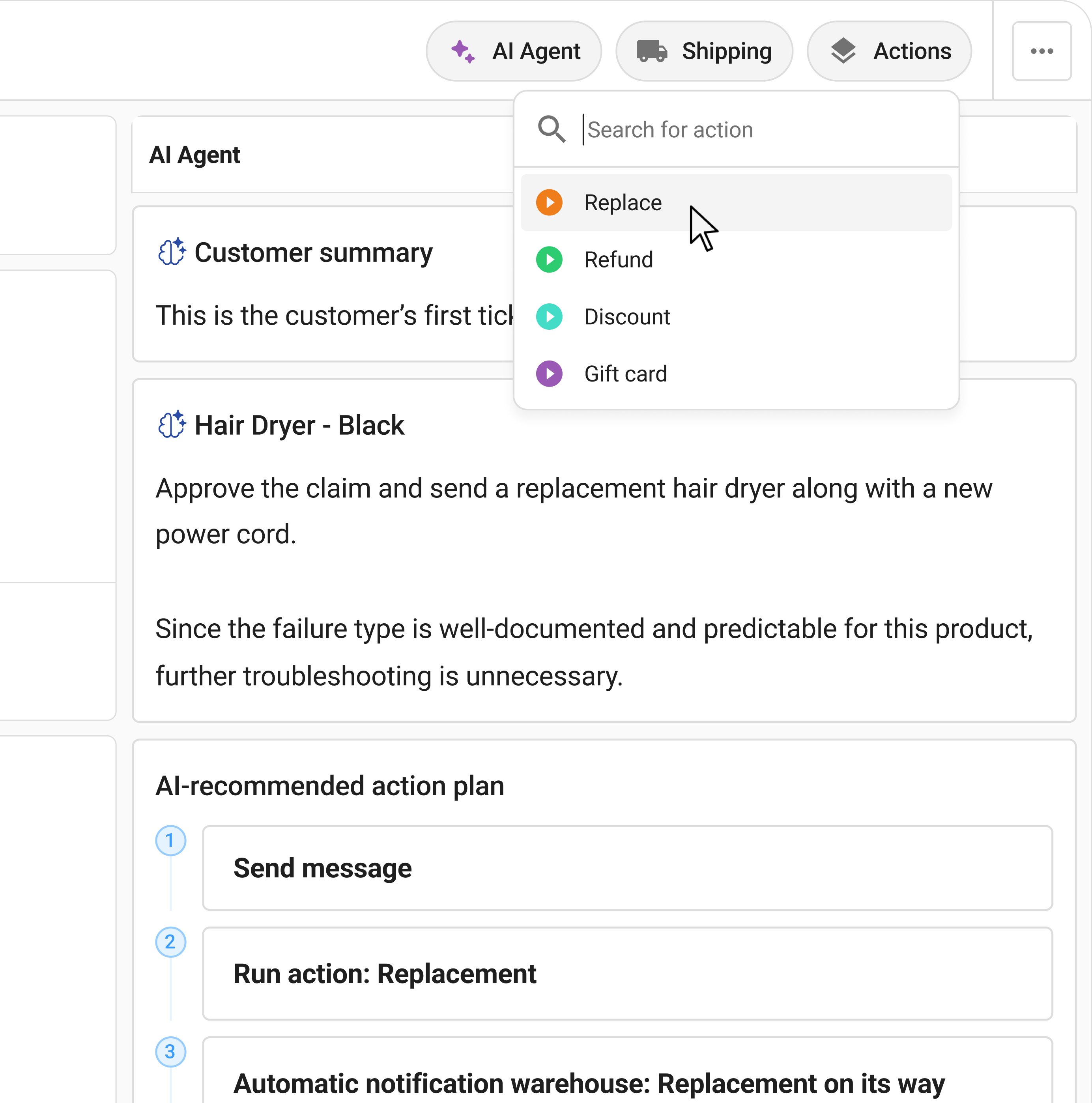
- A customer submits a warranty claim with a photo of a cracked product
- The AI agent analyzes the image, identifies the damage type, and checks it against the product's warranty rules
- Based on the rules, it approves a replacement, schedules a repair, or requests more information
- The customer gets a resolution without waiting for a human agent to review the case
This is fundamentally different from a traditional chatbot that can answer "what's your return policy?" and nothing else.
The Difference Between Chatbots and AI Agents
Why Post-Purchase Is the Perfect Use Case for AI
Post-purchase support is repetitive, rules-based, and data-heavy. That makes it ideal for AI agents.
Consider the typical support workload after a sale:
- "Where is my order?" (tracking lookups)
- "I want to return this" (policy checks, label generation)
- "This product arrived damaged" (image review, warranty verification)
- "Can I get a replacement part?" (spare parts lookup and fulfillment)
- "My product broke after three months" (warranty claim assessment)
Each of these follows a pattern. The customer provides information, the agent checks it against rules, and a resolution is generated. Humans are good at this, but they're also expensive, slow during peak periods, and inconsistent. An AI agent can handle the same workflow in seconds, 24/7, with the same rules applied every time.
The Scale Problem
For brands processing 500+ returns or warranty claims per month, manual handling hits a ceiling. Hiring more agents takes time. Training them takes longer. And seasonal spikes (post-holiday returns, for example) mean either overstaffing year-round or scrambling during peak.
Davidsen, a major DIY and hardware retailer, went from needing 5 agents to handle claims down to 1-2 agents after implementing automated workflows. That's not a marginal improvement. That's a fundamental change in how after-sales teams operate.
Five Ways AI Agents Transform Post-Purchase Operations
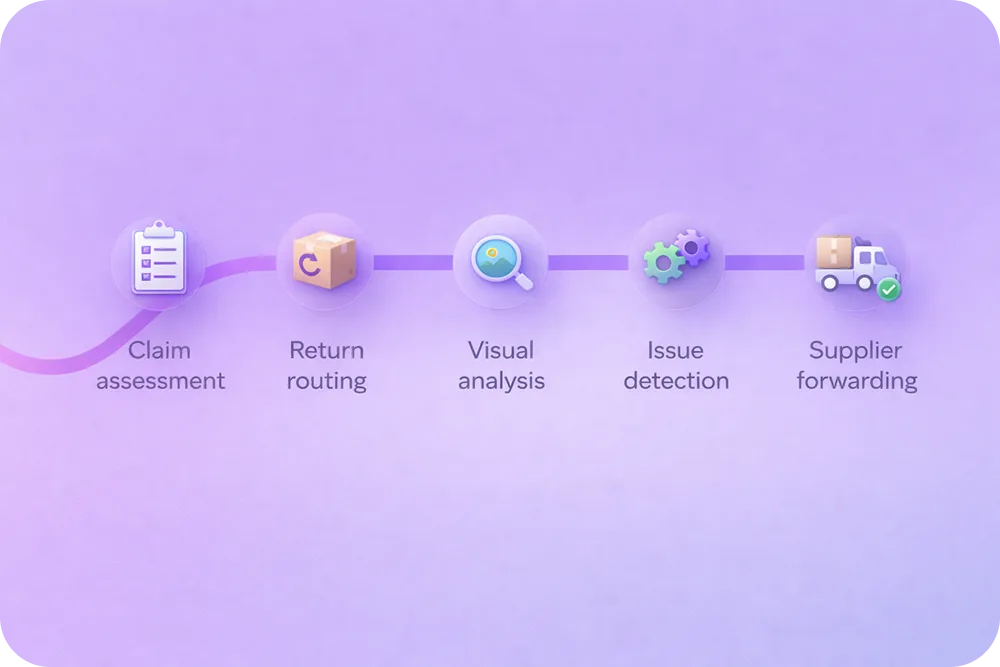
1. Automated Warranty Claim Assessment
Traditional warranty processing looks like this: customer emails photos, a support agent opens the email, compares the damage against warranty terms, checks purchase dates, and makes a judgment call. Multiply that by hundreds of claims per week and it's easy to see where bottlenecks form.
AI agents handle the entire assessment. They analyze product images to identify defect types (cracks, discoloration, material failures), cross-reference against warranty policies per product and supplier, and either approve, deny, or escalate.
MaxGaming, the largest gaming and e-sports e-commerce company in Scandinavia with 30,000+ SKUs across 200+ brands, resolved complex RMA cases 77% faster using Claimlane's AI agents. The AI reviews images, checks business rules, and recommends actions, which means support agents no longer need months of product training to handle claims accurately.
2. Intelligent Return Routing
Not every return is the same. A size exchange needs a different workflow than a defective product claim. A B2B return from a retailer has different rules than a B2C return from a consumer.
AI agents can classify returns by type, apply the correct policy, and route them to the right resolution path automatically. Defective items go to the warranty track. Size issues go to the exchange track. Buyer's remorse returns get the standard return process.
This routing happens instantly. No human needs to read the request, figure out the category, and assign it manually.
3. Visual Damage Analysis
This is where AI agents pull ahead of any rule-based automation tool. When a customer submits a photo of a damaged product, an AI agent can:
- Identify the product from the image
- Classify the type of damage (cosmetic vs. functional)
- Compare against known defect patterns
- Determine if the damage falls within warranty coverage
- Decide on a resolution (repair, replace, refund)
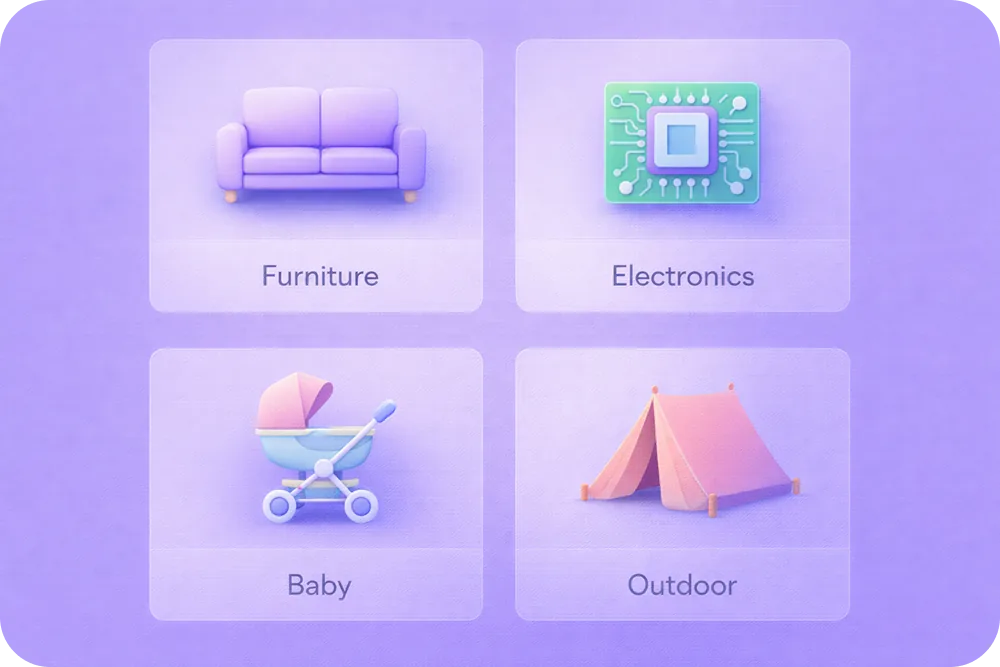
For industries like furniture, electronics, and outdoor gear, where damage assessment requires product expertise, this capability removes a massive training burden from support teams.
Claimlane's AI Agent, the first AI agent purpose-built for warranty claims and returns, is built specifically for this. It analyzes product images and videos, applies warranty rules per product and supplier, and recommends or auto-approves resolutions. Unlike generic AI customer service tools, it understands the full claims workflow from submission to resolution.
4. Proactive Issue Detection
AI agents don't just react to incoming tickets. They can spot patterns before they become problems.
If a specific product suddenly generates a spike in warranty claims, the AI can flag it to the operations team. If a certain supplier's products consistently fail after 60 days, that data feeds into analytics and helps brands make better sourcing decisions.
This kind of returns analytics used to require manual reporting. Now it happens in real time.
5. Supplier Claim Forwarding
When a defective product needs to be claimed back from the supplier, the process typically involves a separate email chain, different documentation, and a lot of back-and-forth. AI agents can automate supplier forwarding by packaging the claim with all required documentation (images, purchase data, defect classification) and routing it to the correct supplier contact.
Konges Sløjd, a children's brand, improved data quality and automation on retailer claims by centralizing this process. Instead of agents manually formatting supplier claims, the system handles it.
What to Look for in an AI Post-Purchase Agent
Not all AI tools are built for post-purchase. Many "AI customer service" platforms are really just chatbots with better natural language processing. Here's what separates a true AI agent for post-purchase from a generic tool:
Must-Have Capabilities
- Image and video analysis. The agent must be able to evaluate product photos and videos, not just text.
- Per-product business rules. Different products have different warranty terms, return windows, and resolution paths. The AI must apply the right rules to the right product.
- Multi-step workflow execution. A warranty claim might require: receive submission, analyze images, check warranty status, approve resolution, notify customer, update inventory, forward to supplier. The AI should handle the full chain.
- Integration with ecommerce platforms. The agent needs access to order data, product data, and customer history. Shopify, WooCommerce, and ERP integrations are table stakes.
- Human escalation with context. When the AI can't resolve an issue, it should pass the full context (images, analysis, attempted actions) to a human agent, not start from scratch.
- Audit trail. Every decision the AI makes should be logged and reviewable. This is especially important for warranty claims where disputes can arise.
Nice-to-Have Features
- Self-service portal where customers submit claims with guided photo uploads
- Automatic status emails that keep customers informed without agent involvement
- B2B claim flows for retailer-to-brand claims
- Warranty registration integration to verify coverage instantly
The ROI of AI Agents in Post-Purchase
The business case is straightforward:
Time Savings
THG Luxury cut resolution time from 7-10 days down to 3-5 days and avoided hiring an extra FTE. When a single claim takes 15-20 minutes of manual work, and an AI agent handles it in under a minute, the math adds up quickly across hundreds of weekly claims.
Consistency
Human agents make different calls on similar claims. One agent might approve a replacement while another denies it for the same type of damage. AI agents apply the same rules every time, which reduces disputes and improves the customer experience.
Scalability
GrejFreak achieved ROI almost immediately after implementation. That speed-to-value matters because post-purchase volume is unpredictable. AI agents scale with demand without requiring new hires.
Data Quality
Every claim processed by an AI agent generates structured data: defect type, product category, supplier, resolution type, time to resolution. This feeds into analytics dashboards that help brands spot trends, negotiate with suppliers, and improve products.
Industry-Specific Applications
Furniture and Home Goods
Furniture returns are notoriously complex. Products are large, shipping is expensive, and damage assessment often requires in-home inspection. AI agents can evaluate photos of damaged furniture, determine if the issue is a manufacturing defect or shipping damage, and route the claim accordingly without scheduling a physical inspection for every case.
Electronics and Gaming
With thousands of SKUs and technical specifications, electronics claims require product knowledge that takes months to build. AI agents with access to product databases can verify serial numbers, check firmware versions, and identify known defect patterns without requiring every support agent to be a product expert.
Baby and Nursery Products
Safety is paramount in baby products. AI agents can flag potential safety-related claims for immediate human review while handling routine warranty claims (fabric wear, minor cosmetic issues) automatically. Luksusbaby built fast, reliable claims handling in baby retail using this approach.
Outdoor and Sporting Goods
Black Diamond automated warranty claim and repair workflows for outdoor and sporting gear. Products in this category often have repair options alongside replacement, and AI agents can recommend the right path based on the type and severity of damage.
Common Concerns About AI in Post-Purchase
"Will AI make mistakes?"
Yes, sometimes. That's why good AI agents have confidence thresholds. If the agent isn't confident in its assessment, it escalates to a human. The goal isn't to replace humans entirely. It's to handle the 60-80% of cases that are straightforward so humans can focus on the complex 20-40%.
"Will customers accept AI handling their claims?"
Customers care about speed and outcomes, not who (or what) is processing their request. A warranty claim resolved in 2 hours by an AI agent is a better experience than one that takes 5 days because it's stuck in a human queue.
"What about edge cases?"
Edge cases are exactly where the human-AI handoff matters. The AI handles the routine volume. Humans handle the exceptions. Over time, as the AI encounters more edge cases, its accuracy improves.
"Is it hard to set up?"
Modern platforms like Claimlane are designed for fast implementation. The AI agent plugs into existing Shopify or WooCommerce stores, imports product data and warranty rules, and starts processing claims. Most brands see results within weeks, not months.
The Future: AI Agents Across the Full Post-Purchase Journey
Right now, most AI agents in post-purchase focus on returns and warranty claims. But the technology is expanding into:
- Repair scheduling and tracking. AI that coordinates repair logistics, books service appointments, and updates customers automatically.
- Predictive returns. Flagging orders likely to result in returns based on past patterns, product data, and customer behavior.
- Cross-channel support. As new sales channels like AI shopping assistants emerge (think Shopify selling inside ChatGPT), post-purchase AI needs to work across all of them.
- Supplier performance scoring. Using claim data to score suppliers and inform procurement decisions.
The brands that invest in AI-powered after-sales now will have better data, faster resolution times, and happier customers than those that wait.