.webp)
What Are Ecommerce AI Agents?
Ecommerce AI agents are autonomous systems powered by large language models and integrated tools that can perceive context, make decisions, and take actions across an online retail stack.
They differ from traditional automation in one key way:
They reason before acting.
AI Agents vs Traditional Automation
Traditional automation:
- Rule-based
- If/then logic
- Static workflows
- Limited context
AI agents:
- Context-aware
- Use memory
- Access tools dynamically
- Make multi-step decisions
Chatbot vs AI Agent
A chatbot responds.
An AI agent:
- Understands intent
- Retrieves relevant data
- Evaluates options
- Executes actions
- Confirms outcomes
A chatbot might answer “Where is my order?”
An AI agent can:
- Retrieve order
- Check shipping API
- Evaluate delay
- Offer compensation
- Trigger refund if needed
That’s the difference.
Why Ecommerce Is Ideal for AI Agents
Ecommerce has:
- Structured data
- Defined workflows
- Repetitive interactions
- Measurable outcomes
This makes it perfect for autonomous systems.
How Ecommerce AI Agents Work
Under the hood, modern AI agents combine language models with memory and tool access.
Core Components
1. Large Language Models (LLMs)
These power reasoning and understanding.
Production agents access these directly through APIs, while teams testing or comparing models for ad-hoc work often use AI aggregator platforms like Lorka AI.
2. Memory Systems
Store customer context, previous conversations, preferences.
3. Tool Use
Agents connect to APIs, databases, CRMs, ERPs, inventory systems.
4. Decision Logic
Agents evaluate goals and constraints before acting.
Without tool integration, AI is just text. With tools, it becomes operational.
Integration With Ecommerce Stack
AI agents integrate with:
- Shopify
- Magento
- WooCommerce
- Headless commerce setups
- CRM and ERP systems
- Payment gateways
- Carrier APIs
The deeper the integration, the more autonomous the agent becomes.
Data Sources Agents Use
- Product catalogs
- Customer purchase history
- Inventory data
- Pricing models
- Return policies
- CRM interactions
AI agents do not guess. They retrieve and reason.
Types of Ecommerce AI Agents
Guide customers through product discovery. Ask clarifying questions, recommend products, compare options, handle conversational checkout. Increases conversion and reduces bounce rates.
Handle order tracking, refunds, returns, policy explanations, shipping updates. Unlike static bots, they resolve complete workflows by retrieving context and executing actions.
Monitor behaviour and trigger contextual actions: upsell suggestions, dynamic bundling, cart recovery with personalised incentives.
Analyse conversion rates, inventory velocity, and margin data, then adjust product placement, tagging, and pricing recommendations automatically.
Work behind the scenes managing demand forecasting, inventory rebalancing, supplier reordering triggers. Autonomous ecommerce systems are emerging from this layer.
Claimlane AI Agent, first for warranty claims & returns
Most ecommerce AI agents focus on the front end: sales, marketing, product discovery. But one of the most expensive and complex operational areas gets almost no AI attention: post-purchase.
Warranty claims. Repair requests. Delivery damage. Supplier disputes. These tickets require product knowledge, supplier rules, customer history, and images or video of the issue. Context that no chatbot has.
This is where support teams spend the most time. And it's where decisions vary the most between agents. One approves a replacement, another asks for more documentation. With thousands of SKUs, it can take years for an agent to learn how to handle every product confidently.
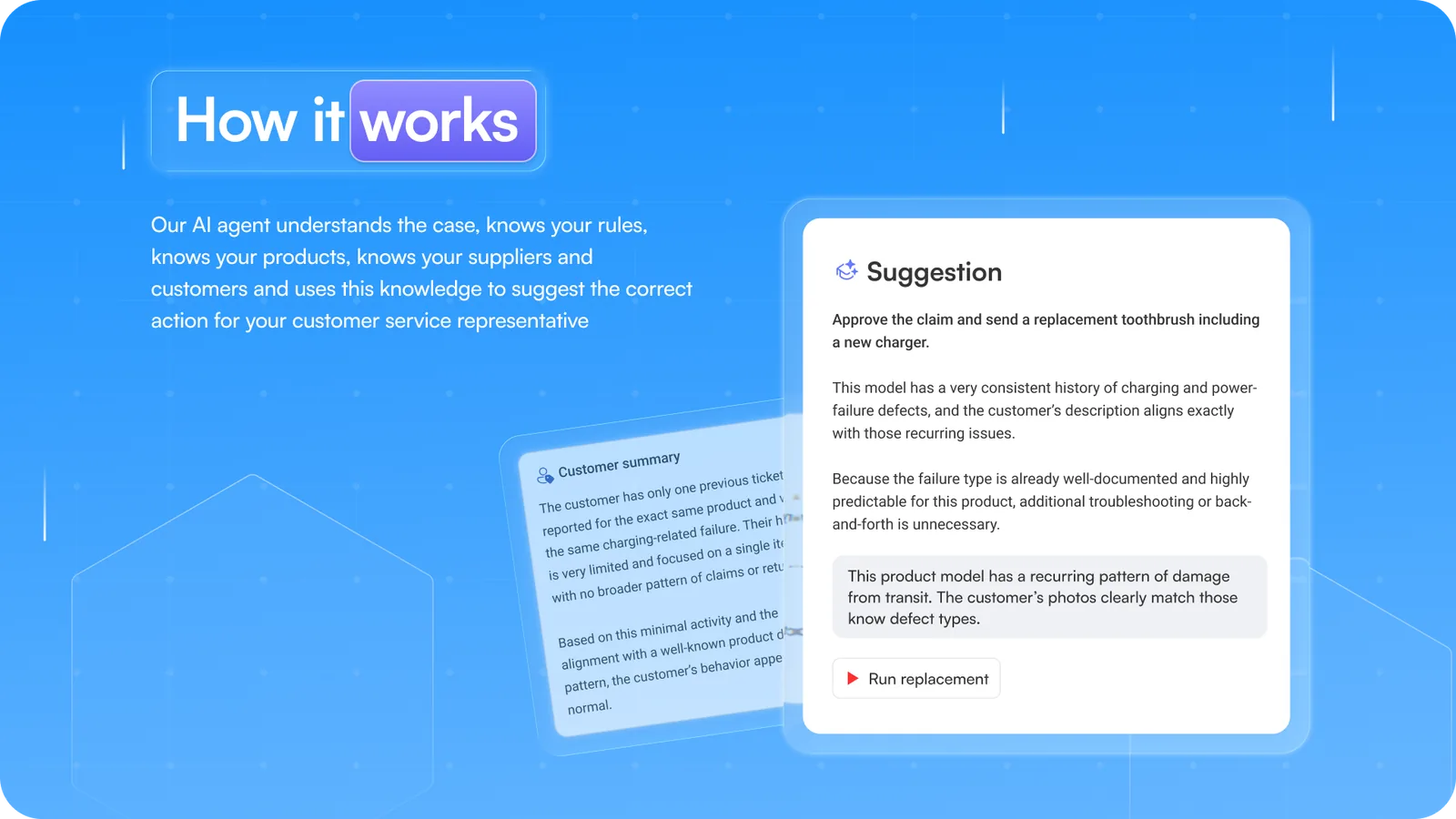
The Claimlane AI Agent is the first AI Agent built specifically for this problem.
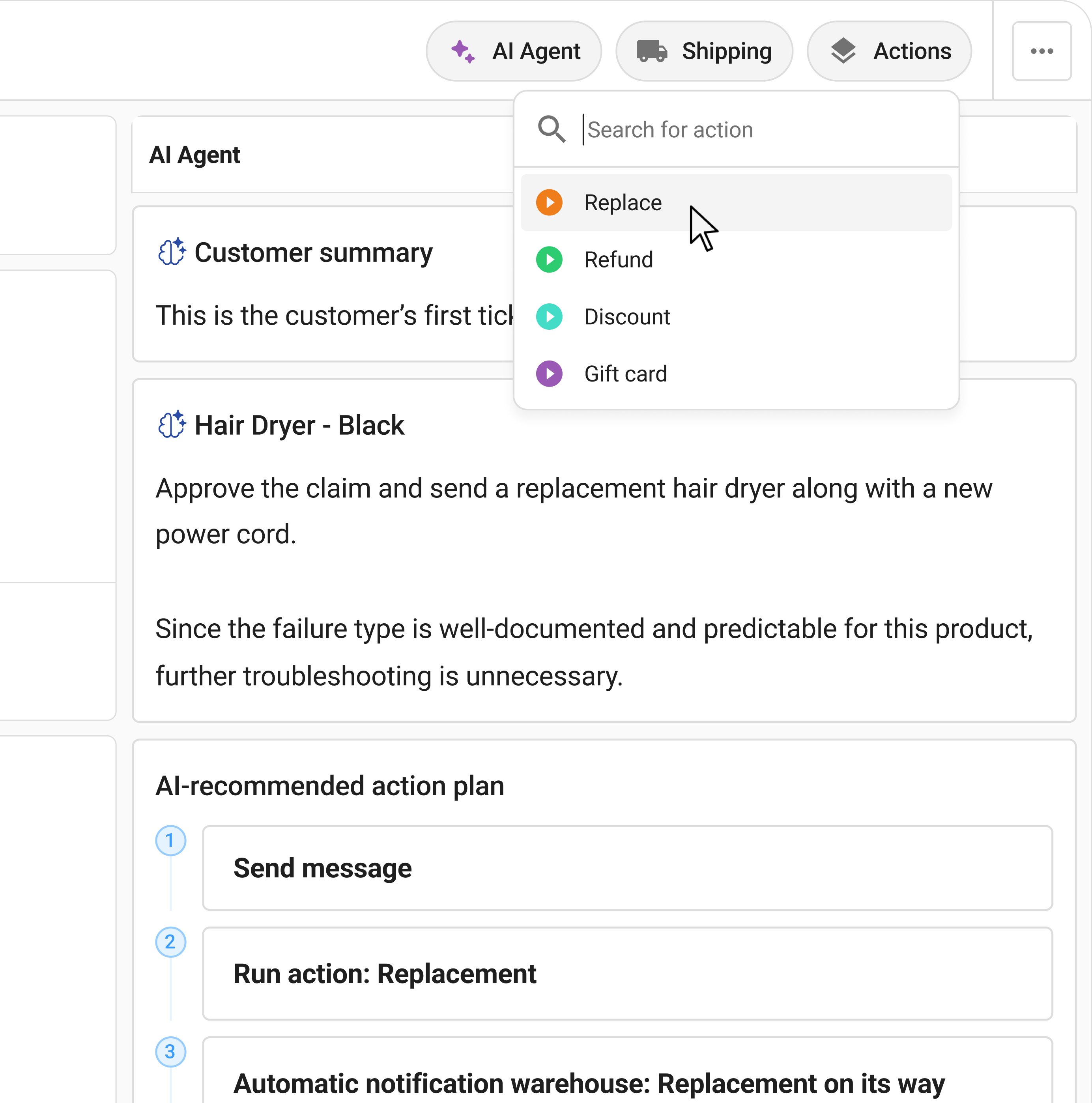
It operates inside structured returns and warranty workflows. Not as a chatbot, not as a separate tool, but directly inside the ticket view where agents already work.
How it's trained:
All past conversations, including text, images, and video. The model learns from how the team has actually resolved cases.
Your overall rules for claims, repairs, and delivery damage. Sets the policy frame.
Specific rules for specific products and suppliers. Captures the institutional knowledge that experienced agents carry in their head.
What it delivers on every ticket:
Return history, previous tickets, behaviour patterns, and fraud signals. The agent gets the full customer context before responding.
Known issues with that specific SKU, supplier requirements, and what's worked before. The collective experience of the team available on every ticket.
Replace, refund, or repair, with clear reasoning and one-click execution. The agent suggests the action your most experienced agent would take.
The agent doesn't guess. It retrieves context, applies rules, and suggests the action your most experienced agent would take, on every single ticket.
It also detects [return fraud patterns](https://www.claimlane.com/resources/blog/return-fraud-in-ecommerce) across customers, something nearly impossible when agents only see one ticket at a time.
AI-powered self-service takes it further: when customers submit a claim, the AI can assess the case and resolve straightforward claims before they ever reach your team.
Because it operates inside a defined case management system with full integration into [Shopify](https://www.claimlane.com/product/integrations), ERPs, and supplier workflows, it reduces manual resolution time without removing human control.
This is where ecommerce AI agents stop being a marketing feature and become operational infrastructure.
Benefits of Ecommerce AI Agents
Increased Conversion Rates
Personalized conversations drive higher purchase confidence.
Reduced Customer Acquisition Costs
Better onsite conversion lowers paid traffic dependency.
24/7 Engagement
AI agents don’t sleep.
Operational Efficiency
Support deflection reduces ticket load.
Hyper-Personalization at Scale
Agents adapt in real time.
Data-Driven Decisions
They analyze patterns humans miss.
AI Agents vs Traditional Automation
Rule-based workflows break when scenarios change.
AI agents adapt.
Chatbots read scripts.
AI agents retrieve context.
Automation executes predefined steps.
Agents reason through new ones.
ROI compounds as complexity increases.
Real-World Use Cases
- Personalized shopping journeys
- Automated returns processing
- Smart product bundling
- Dynamic pricing adjustments
- AI-triggered email flows
- Autonomous ad budget optimization
Post-purchase automation is particularly high leverage.
Top Ecommerce AI Agent Platforms in 2026
PlatformStrengthBest ForShopify MagicNative Shopify AISMB brandsSalesforce Einstein GPTEnterprise AILarge retailersGorgias AISupport automationDTC brandsTidio AIConversational botsSmaller storesCustom LLM AgentsDeep autonomyComplex operations
Each differs in flexibility and integration depth.
Technical Architecture of an Autonomous Agent
Key components:
- LLM (OpenAI, Anthropic, etc.)
- Retrieval-Augmented Generation (RAG)
- Vector databases
- API orchestration
- Monitoring & guardrails
Without guardrails, autonomy becomes risk.
Risks & Challenges
- Hallucinations
- Data privacy issues
- Bias in recommendations
- Over-automation
- Brand voice inconsistency
- Integration complexity
Governance is essential.
ROI & Financial Impact
AI agents impact:
- Conversion rate
- Average order value
- Support cost per ticket
- Revenue per visitor
Support deflection rates of 30–50% are common in structured workflows.
Break-even depends on traffic and ticket volume.
How to Implement Ecommerce AI Agents
Start narrow. Pick one specific workflow where AI can add measurable value, not a vague "let's add AI" mandate.
Identify integration gaps. AI agents are only useful if they can read from and write to the systems where work actually happens.
Native platform AI, third-party SaaS, or custom build. Match the choice to in-house engineering capacity and how specific the use case is.
Product catalogue, policies, brand tone, historical tickets. Quality and breadth of training data sets the ceiling on agent performance.
Monitor errors. Run with human-in-the-loop oversight before letting the agent execute autonomously. Catch the edge cases early.
Gradually increase decision authority based on what the data shows. Start supervised, move to assisted, end with autonomous on the cases that earn it.
KPIs to Measure Success
- Conversion lift
- AOV increase
- Ticket reduction
- CSAT
- Revenue influenced by AI
- Engagement time
Measure continuously.
Conversational Commerce & AI Agents
Chat-based shopping
WhatsApp AI commerce
Voice commerce
In-app embedded agents
Commerce is becoming conversational by default.
Industry-Specific Applications
Fashion: style matching
Electronics: technical comparisons
Beauty: personalized routines
B2B: automated quote generation
Each category benefits differently.
The Future of Ecommerce AI Agents
Expect:
- Fully autonomous storefront optimization
- AI-driven pricing systems
- Multi-agent ecosystems
- AI-powered supply chain coordination
- Embedded resale and repair agents
The storefront will become partially self-managing.
The bottom line
Ecommerce AI agents aren't a feature. They're an infrastructure shift.
The brands adopting structured, integrated AI agents first will compound efficiency, personalisation, and operational control. The question is no longer whether AI will run parts of ecommerce. It's which parts you're willing to automate first.
For brands looking at AI agents on the post-purchase side specifically (warranty claims, returns, repairs, supplier coordination), book a Claimlane demo to see how the AI Agent operates inside structured workflows.