.webp)
Why AI matters in supplier management now
Supplier performance has always been hard to measure. The data sits in three places (claims, returns, finance), the suppliers vary in size and reporting maturity, and the signal-to-noise ratio is low. Brands relying on quarterly business reviews and gut feel often discover supplier issues months after they hit customers. AI changes the data layer first, then the decision layer.
This piece covers what AI supplier management does in 2026, the five core use cases, the data layer it requires, the implementation pattern, and the ROI signals. For broader context, supplier management for ecommerce covers the operations side, and AI supplier quality scoring covers the narrow scoring use case.
What AI supplier management does
AI supplier management is the use of vision models, language models, and pattern detection to support supplier-related decisions across the warranty, returns, and quality workflow. It is not a replacement for procurement or supplier compliance tools. It is the layer that turns case data into supplier intelligence.
Four functions
First, it ties every defect back to a specific component and supplier. Second, it scores supplier performance from objective claim and return data instead of survey data. Third, it predicts which suppliers are about to become risk drivers based on early signals. Fourth, it supports the recovery side by assembling supplier-claim files at scale.
What it does not do
It does not negotiate contracts. It does not select new suppliers. It does not replace human relationship management. The strategic side of supplier work still sits with people. The data and execution side moves to AI.
Use case 1: AI matching claims to suppliers
A single SKU often carries components from three or more suppliers. When a customer files a claim, the brand needs to know which component failed and which supplier owns the cost. Manual mapping is slow and inconsistent.
AI vision reads the claim photo and identifies the failing component. The system matches that component to the bill of materials and the supplier record. The case routes to the right supplier file automatically. The piece on serial number tracking software covers the serial layer that pairs with this. The AI image recognition for warranty claims and serialized product defect tracking pieces cover the vision and serial sides.
Use case 2: Automated supplier scorecards
Manual supplier scorecards rely on quarterly inputs from buyers and operations leads. The data is months stale and biased toward recent memory. AI scorecards run continuously off the claim and return data.
Score components
Defect rate by SKU, claim rate per unit shipped, recovery rate on chargebacks, response time on supplier-side cases, and disputed claim ratio.
Score outputs
A composite score per supplier, refreshed weekly, with the underlying signals visible. The supplier quality issue reporting guide and quality issue reporting tool for returns pieces cover the reporting layer that feeds the scorecard.
Use case 3: Predictive supplier risk
The most expensive supplier issues hit the brand 60 to 120 days before they show up in the chargeback file. Predictive risk models read the early signals (initial claim spikes, returning customers, language patterns in claim descriptions) and flag suppliers before the impact compounds.
The pattern pairs with predictive warranty analytics and predictive returns analytics for ecommerce. The customer-centric warranty analytics reducing claims piece covers how the same data feeds product quality decisions.
Use case 4: AI-assisted supplier recovery
Recovery is where the money sits. Brands without automation file 30 to 50% of eligible supplier claims. The rest get missed because the case data is incomplete, the recovery window expires, or the buyer forgets.
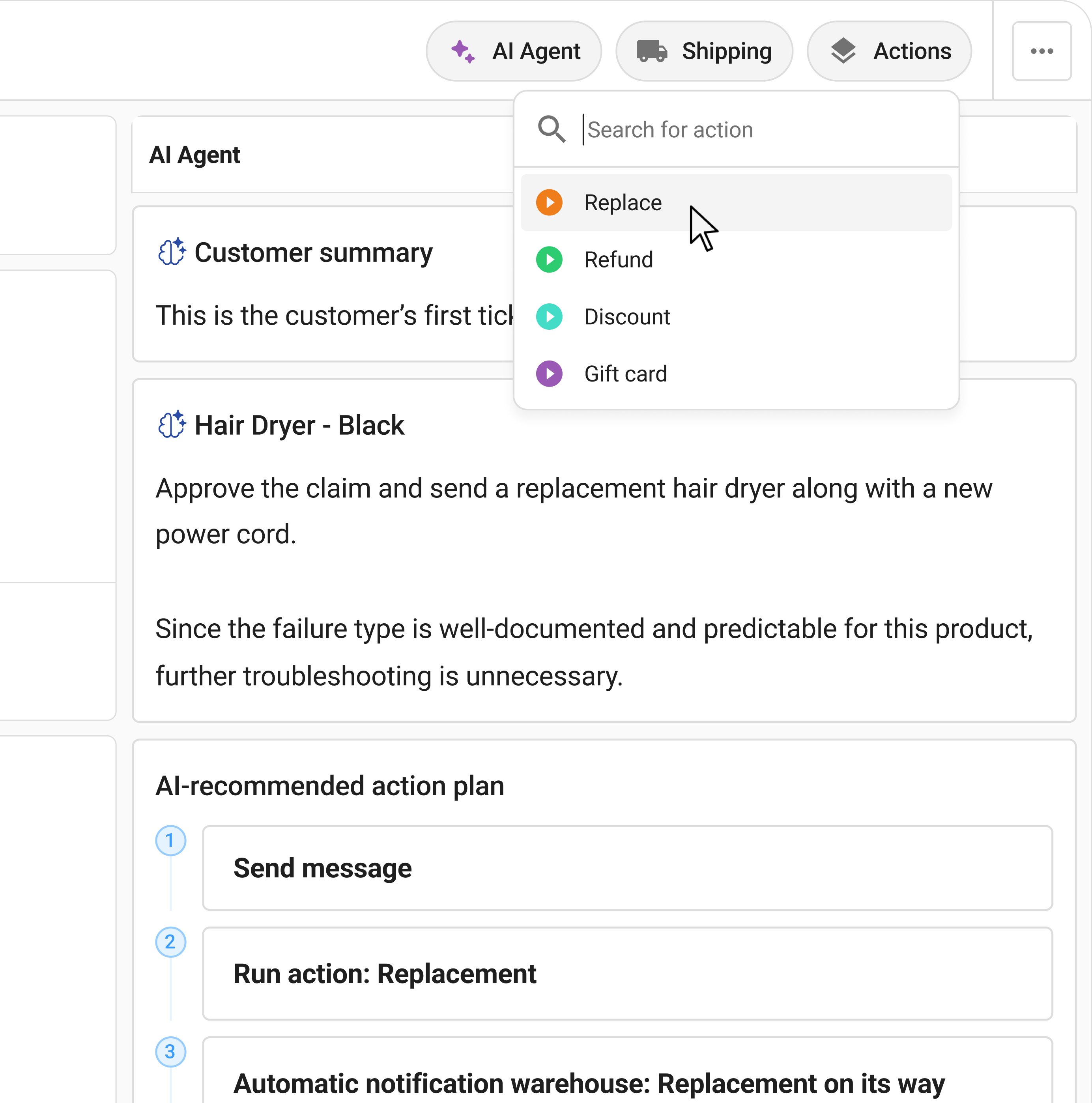
Claimlane's AI Agent, the first AI agent purpose-built for warranty claims and returns, assembles the supplier-claim file as the case progresses. By the time the case closes, the supplier file is ready. The agent files it within the recovery window, follows up automatically, and tracks the credit memo against the case. The in-batch piece on AI customer service automation for aftersales (Article 4) covers the broader AI workflow.
The supplier chargebacks recovering warranty costs and supplier recovery how to get credit notes faster pieces cover the operational pattern. The retailer challenges with supplier claims piece covers the friction.
Use case 5: Integration with QIS and PIM
AI supplier management is not a standalone system. It plugs into the Quality Information System (QIS) and the Product Information Management (PIM) platform.
QIS integration
QIS holds the quality processes, NCR records, and CAPA workflows. The supplier scorecards feed QIS so the corrective actions land on the right supplier. The best NCR and CAPA tools and quality issue reporting tools for supplier feedback pieces cover the QIS layer.
PIM integration
PIM holds the product taxonomy and the SKU master. The supplier-claim mapping needs the PIM to know which suppliers ship which components per SKU.
ERP and finance
The ERP closes the loop. Credit memos from suppliers feed back into the financial reconciliation. The ERP handle warranty claims and ERP finance system integration for returns pieces cover the ERP side. Purchase order management process covers the upstream side.
The data layer needed for AI supplier management
Three datasets have to be present for AI supplier management to work.
Brands missing any one of the three datasets get partial AI value. Brands with all three see the compound effect.
AI vs traditional supplier management tools
Traditional supplier management tools handle onboarding, contracts, compliance documents, and audit records. They do not handle claim data, defect data, or recovery automation at any scale. The AI supplier management layer sits above the traditional tools.
The traditional tool answers "is the supplier compliant?" The AI layer answers "is the supplier costing the brand more than it should, and where is the money?" Both questions matter. The cost question is where AI adds the most.
Implementation pattern
The brands that move fastest follow a three-stage rollout.
Stage 1: Data foundation
The brand consolidates claim and return data on one platform. Until the data lives in one place, no AI layer above it can score suppliers reliably.
Stage 2: Scorecard live
The brand turns on supplier scorecards. The data refreshes weekly. Buyers and quality teams start reviewing the scores in supplier reviews.
Stage 3: Predictive and recovery
Predictive risk models flag suppliers ahead of issues. AI-assisted recovery files chargebacks within the window. The brand runs both with the same platform handling intake and resolution.
The supplier recovery side paid back fast. The team stopped missing chargeback windows because the AI assembles the file as the case progresses. Recovery rate went up sharply in the first months.GF— GrejFreak, outdoor and fishing retailer
ROI signals brands measure
Four numbers tell the story.
Recovery rate on supplier chargebacks
Baseline 30 to 50%. With AI matching and assembly, brands lift to 65 to 85%. The biggest single ROI lever.
Time-to-credit-memo
Baseline 60 to 120 days. With AI-assisted filing inside the recovery window, brands close credit memos in 30 to 60 days.
Disputed chargeback ratio
Fewer suppliers dispute the chargeback when the file is complete and well-evidenced. AI assembly drops disputes by 20 to 40%.
Supplier-driven defect rate
With better supplier scorecards and corrective action loops, suppliers improve over time. Defect rate per supplier drops 10 to 25% over 12 to 18 months on average.
Limits of AI supplier management
Three places where AI does not replace the human.
Strategic supplier choice
Selecting new suppliers, terminating relationships, or expanding to new markets is human work. AI surfaces the data. The decision still sits with procurement and operations leads.
Relationship work
Supplier relationships are still relationships. AI does not handle the quarterly business review, the contract negotiation, or the joint product development conversation.
Data quality at the edges
Smaller suppliers often have weak reporting and inconsistent data. AI struggles where the data is sparse. The fix is broader claim data on the brand side, not better AI.
Industry view: where AI supplier management sits in 2026
The broader supply chain AI category is moving fast. Most platforms focus on demand forecasting, inventory optimisation, or procurement workflows. AI supplier management for warranty and quality is a younger category that sits next to all of them.
The AI demand forecasting for reverse logistics, AI predictive spare parts inventory, and AI reverse logistics optimization pieces cover adjacent AI use cases. The AI returns management for ecommerce and AI warranty claims automation pieces cover the customer-facing side that pairs with the supplier side.
Claimlane runs the AI supplier management layer on the same platform as warranty and returns. The self-service portal captures intake. The AI product page covers the agent. Forward-to-supplier handles the recovery side. Analytics reports on the supplier scorecards. The in-batch pieces on warranty fraud explained and warranty claim form templates cover the related fraud and intake layers.
Frequently asked questions
Conclusion
AI supplier management is the layer that turns claim data into supplier intelligence. Claim matching closes the routing gap. Scorecards replace stale quarterly reviews. Predictive risk surfaces issues ahead of the chargeback file. AI-assisted recovery files chargebacks inside the window. None of this replaces the procurement team. It gives them the data and the execution layer that manual processes cannot.
To see how Claimlane runs AI supplier management on the same platform as warranty and returns, book a demo or watch the live setup on the interactive demo.