.webp)
Spare parts inventory is one of the most expensive guessing games in aftersales operations. Order too many parts, and capital sits on shelves gathering dust. Order too few, and warranty repair cases stall for weeks while customers wait.
The problem is that traditional spare parts planning relies on historical averages and gut feeling. A product manager looks at last quarter's repair data, adds a buffer, and places an order. That approach falls apart when product lines change, seasonal demand shifts, or a batch defect spikes claims overnight.
AI changes the math. Machine learning models trained on warranty claims data, product lifecycle patterns, and supplier lead times can predict which parts will be needed, in what quantities, and when. The result: fewer stockouts, lower holding costs, and faster resolution times for customers waiting on a repair.
This article breaks down how predictive spare parts inventory works, what data feeds the models, and how brands are using AI to turn their parts operations from a cost center into a competitive edge.
- Traditional spare parts planning relies on averages and guesswork, leading to either excess stock or repair delays.
- AI models use warranty claims data, defect patterns, product age curves, and supplier lead times to forecast parts demand with far greater accuracy.
- Brands that adopt predictive spare parts inventory typically reduce holding costs by 15-30% while cutting repair wait times in half.
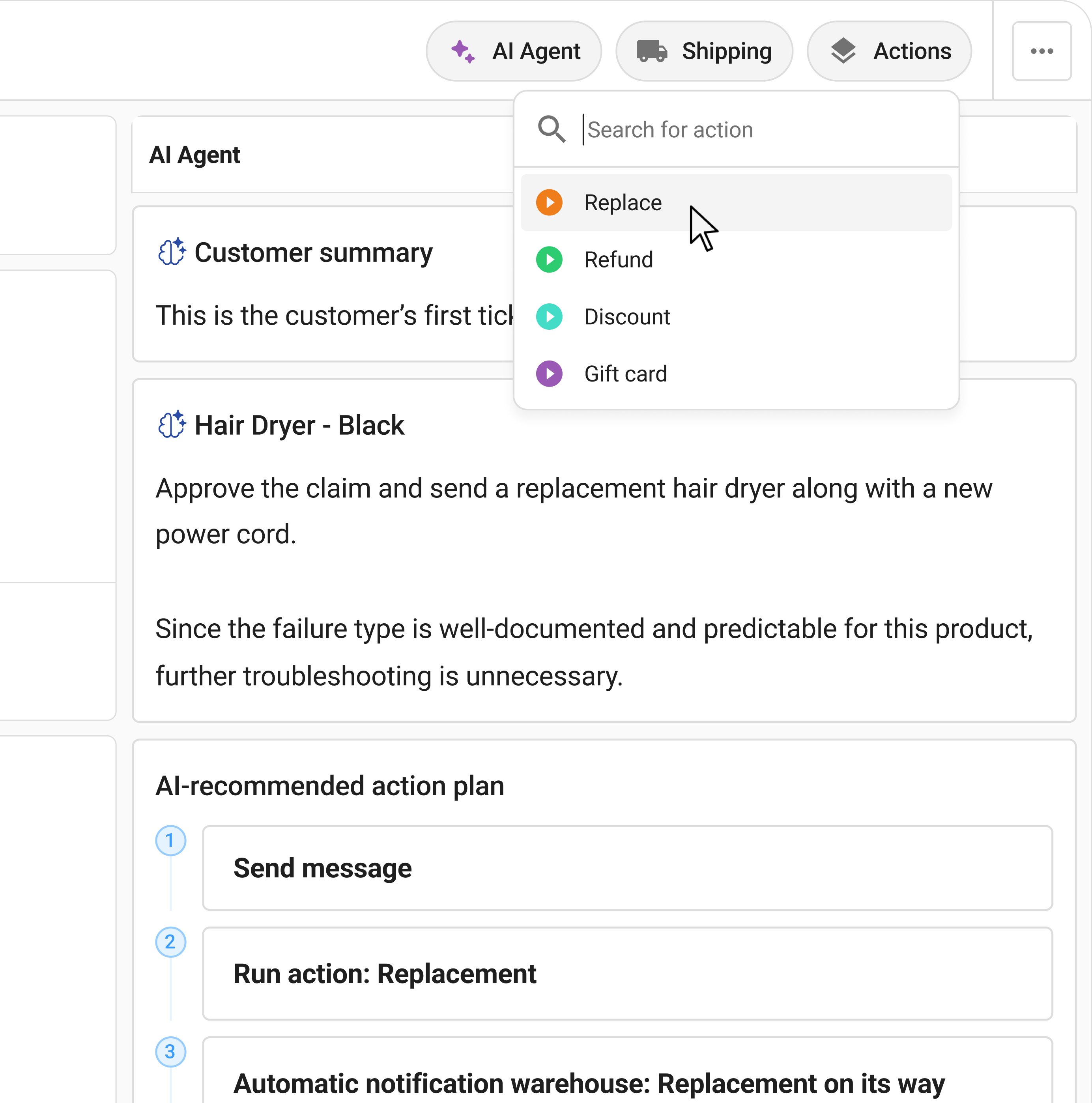
- Claimlane's AI Agent, the first AI agent purpose-built for warranty claims and returns, feeds real-time defect and claims data into spare parts planning so brands can act on signals before stockouts happen.
Why Spare Parts Inventory Is So Hard to Get Right
Spare parts sit in a strange category. They are not finished goods that generate direct revenue. They are not raw materials that feed production. They exist purely to support products that have already been sold, and their demand is driven by something unpredictable: when things break.
The Core Challenges
Most brands face the same set of problems:
- Intermittent demand. A specific replacement screen or motor might see zero orders for three months, then 50 in a single week after a batch issue surfaces. Traditional forecasting models built for steady demand curves cannot handle this.
- Long tail SKUs. A brand with 500 products and 15 replaceable components per product is looking at 7,500 potential spare part SKUs. Most will barely move. A few will spike unpredictably.
- Supplier lead times. Some parts take 8-12 weeks from order to delivery. If a defect pattern emerges today, the parts needed to fix it won't arrive for months unless they're already in stock.
- Cost of being wrong. Excess parts tie up cash and warehouse space. Missing parts mean extended warranty claim resolution times, unhappy customers, and potential regulatory issues under EU consumer protection rules.
The result is that most operations teams either overstock (expensive) or understock (slow). Neither is acceptable when customer expectations keep rising.
What Traditional Planning Gets Wrong
Spreadsheet-based spare parts planning typically uses one of two approaches:
- Historical average: Look at last year's usage, assume this year is similar, add a 20% buffer.
- Min/max thresholds: Set a reorder point based on average lead time and consumption rate.
Both methods assume the future looks like the past. They break down when:
- A new product launch has zero historical data
- A manufacturing defect creates a demand spike
- Seasonal patterns shift (outdoor gear claims surge in spring, electronics in holiday returns season)
- A product is approaching end-of-life and demand is tapering off
AI doesn't replace human judgment. It replaces the spreadsheet with a model that can process thousands of signals simultaneously and update predictions in real time.
How AI Predicts Spare Parts Demand
Predictive spare parts inventory uses machine learning models that ingest multiple data sources, identify patterns humans would miss, and output demand forecasts at the SKU level.
The Data That Feeds the Model
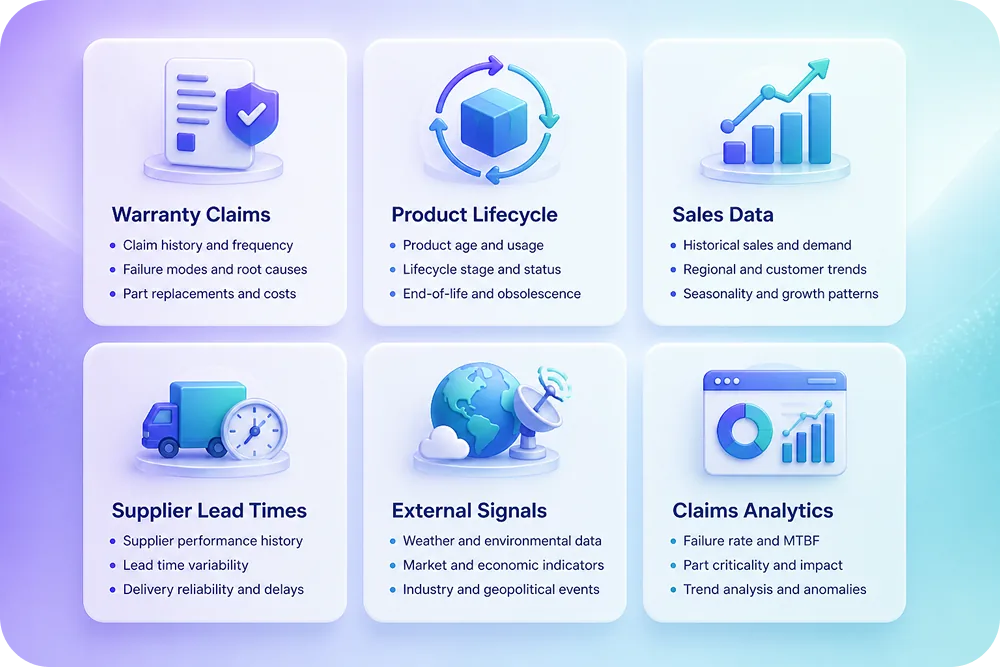
The accuracy of any AI prediction is only as good as the data behind it. For spare parts forecasting, the most valuable inputs include:
Warranty and claims data
Every warranty claim is a signal. The defect type, product SKU, customer location, product age at failure, and resolution method (repair vs. replace) all tell the model something about future parts demand. Platforms like Claimlane capture this data in a structured format, making it immediately usable for predictive models.
Product lifecycle data
Products follow a predictable failure curve. Early failures (infant mortality) spike right after launch, stabilize during useful life, then climb again as products age. The model needs to know where each product sits on that curve.
Sales and distribution data
More units sold means more potential claims. If a brand sold 10,000 units of Product X in Q1, the model can estimate the expected claim rate and parts demand based on similar products' historical failure rates.
Supplier lead times
Knowing that Part A takes 4 weeks to arrive while Part B takes 12 weeks changes the reorder trigger point. The model factors in lead time variability, not just averages.
External signals
Weather patterns (outdoor gear), regulatory changes (right to repair legislation), seasonal shifts, and even social media complaints about specific products can be early indicators of parts demand.
The Machine Learning Approach

Predictive spare parts inventory models typically use a combination of techniques:
Time series forecasting handles the baseline demand pattern. Models like ARIMA, Prophet, or LSTM neural networks capture seasonality, trends, and cyclical patterns in historical parts consumption.
Classification models predict which products are most likely to fail next. By analyzing the characteristics of products that have already generated claims (age, batch, manufacturing facility, component supplier), the model estimates failure probability for products still in the field.
Anomaly detection catches sudden demand shifts. If warranty claims for a specific component jump 300% in two weeks, the model flags it immediately and adjusts the forecast before a stockout occurs.
Survival analysis models the time-to-failure for each product category. This is particularly useful for products with known wear patterns, like mechanical components in outdoor and sporting goods or moving parts in electronics.
Real-Time Claims Data as a Forecasting Signal
The single most valuable input for predictive spare parts models is real-time warranty claims data. Every claim that comes through a system like Claimlane contains structured information that traditional planning ignores.
Why Claims Data Matters More Than Sales Data
Sales data tells a brand how many products are in the field. Claims data tells them how many are breaking, what's breaking, and how fast.
Consider a brand that sells 50,000 units of a kitchen appliance. Based on a historical 3% claim rate, they stock 1,500 replacement heating elements. But if a supplier changed a component in the latest production batch, the actual claim rate might be 8%. Without real-time claims visibility, the brand discovers the gap when they run out of parts and customer wait times balloon.
Claimlane's AI Agent, the first AI agent purpose-built for warranty claims and returns, analyzes product images and videos, applies warranty rules per product and supplier, and recommends or auto-approves resolutions. This structured claims data, with defect types classified by AI rather than manually categorized by support agents, creates a much cleaner signal for parts demand forecasting.
From Reactive to Proactive Parts Management

The shift from reactive to proactive spare parts management looks like this:
- Reactive (traditional): Customer reports a defect. Support team creates a claim. Operations checks stock. Part is out of stock. Customer waits 6-8 weeks.
- Proactive (AI-powered): Claims analytics detects a 40% increase in motor failures for Product X. The model adjusts the demand forecast. A purchase order is triggered automatically. Parts arrive before the next wave of claims.
Brands using Claimlane's analytics can monitor defect patterns in real time, broken down by product, supplier, region, and defect type. When those analytics feed into a spare parts planning model, the result is a closed loop: claims data drives parts forecasting, and parts availability drives faster claim resolution.
The Business Case for AI-Powered Parts Forecasting
The financial impact of better spare parts forecasting shows up in four areas.
Reduced Holding Costs
Excess spare parts inventory carries real costs: warehouse space, insurance, capital tied up in non-revenue-generating stock, and eventual write-downs when products are discontinued. According to Deloitte's research on inventory optimization, holding costs typically run 20-30% of inventory value annually.
AI-powered forecasting reduces safety stock requirements by improving prediction accuracy. Instead of blanket 20% buffers on every SKU, the model calculates the optimal safety stock per part based on demand variability and lead time uncertainty.
Fewer Stockouts
Stockouts in spare parts have a cascading effect. A missing part means a repair can't be completed. The customer waits longer. Support tickets pile up. Customer satisfaction drops. In B2B contexts, SLA breaches trigger financial penalties.
AI models catch demand signals earlier than manual methods. A 15% uptick in a specific defect category this week might not trigger a manual reorder, but it's exactly the kind of signal that a trained model uses to adjust future demand estimates.
Faster Warranty Repair Resolution
When parts are in stock, repairs happen fast. When they're not, the entire repair vs. replace decision gets skewed. Brands end up replacing entire products because the repair part won't arrive for two months, even when a repair would have been cheaper.
This is especially relevant for categories like furniture, where replacement parts (legs, hinges, fabric panels) are large, expensive to ship, and hard to source quickly. Or DIY hardware, where a single missing motor or blade can render a power tool unusable for weeks.
Better Supplier Management
Predictive models also improve supplier relationships. Instead of panic orders when stock runs out, brands can give suppliers longer lead times on forecasted demand. Longer lead times often mean lower per-unit costs and higher fill rates.
When claims data reveals that a specific supplier's components are failing at above-average rates, brands can proactively increase parts stock for those SKUs while also initiating a supplier chargeback or quality review.
Building a Predictive Spare Parts System
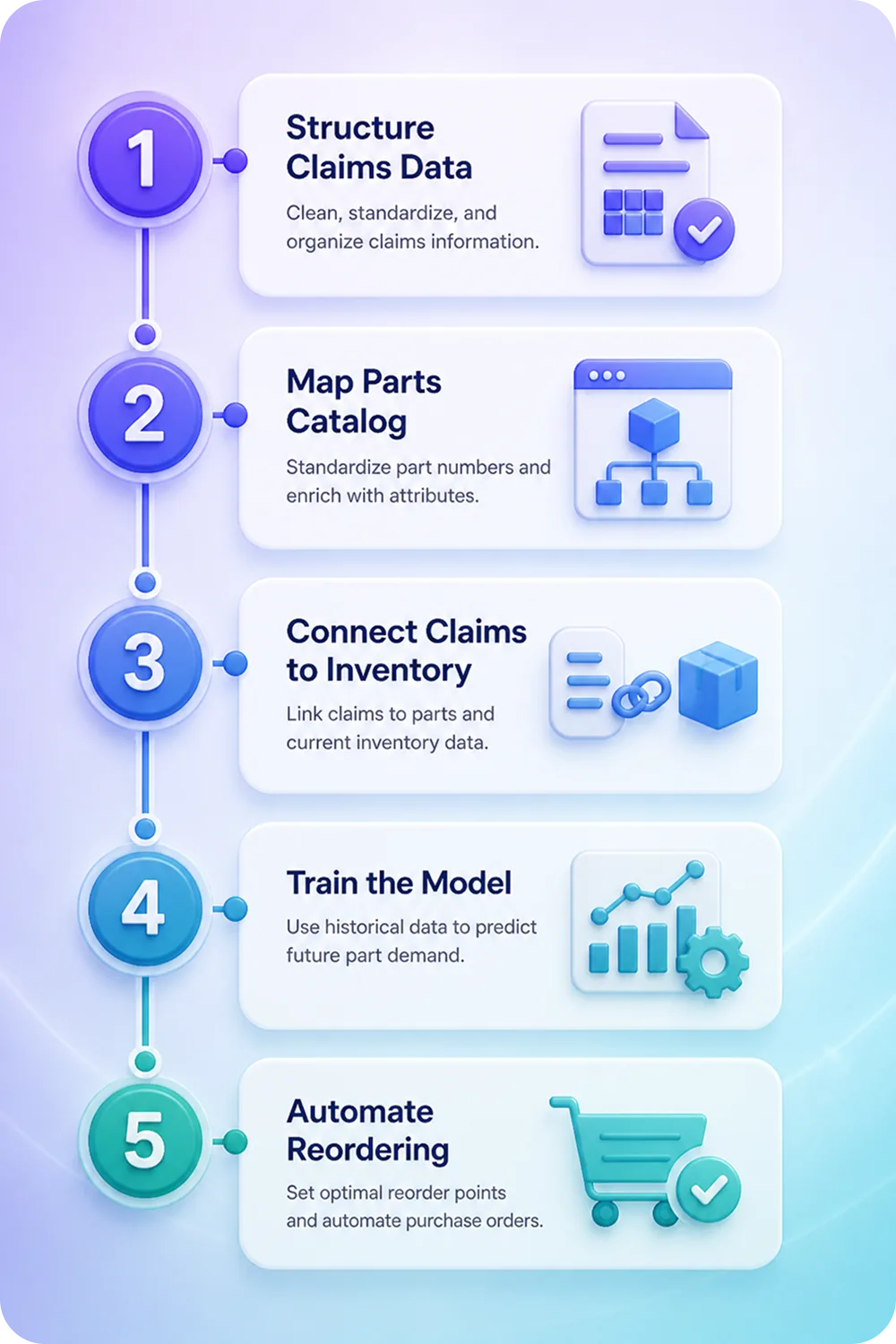
Most brands don't need to build a machine learning platform from scratch. The key is having the right data infrastructure and connecting it to forecasting tools.
Step 1: Structure Your Claims Data
The foundation is structured, consistent claims data. Every warranty claim should capture:
- Product SKU and serial number
- Defect type (classified consistently, not free-text)
- Product age at failure
- Resolution method (repair, replace, refund)
- Parts used in repair
- Supplier and manufacturing batch
Claimlane's self-service portal collects this data from customers at submission, including photos and videos that the AI Agent classifies into defect categories. The result is a clean, structured claims dataset that's ready for forecasting models without months of data cleanup.
Step 2: Map Your Parts Catalog to Products
Create a bill of materials (BOM) for spare parts at the product level. Each product should map to its replaceable components, with information about:
- Part number and description
- Supplier and lead time
- Unit cost
- Current stock level
- Historical consumption rate
This mapping lets the model translate a predicted failure rate for Product X into a specific parts demand forecast.
Step 3: Connect Claims to Inventory
The claims management system needs to feed data to the inventory planning system. With Claimlane's 75+ integrations, claims data can flow into ERP systems like Business Central, NetSuite, or SAP, where inventory planning modules consume it.
The connection should be automated and near real-time. Batch exports once a month won't catch demand shifts fast enough.
Step 4: Train and Validate the Model
Start with historical claims and parts consumption data. Split it into training data (80%) and validation data (20%). Train the model on past patterns, then check its predictions against actual demand in the validation period.
Key metrics to track:
- Forecast accuracy (MAPE): Mean Absolute Percentage Error should be under 25% for most SKUs
- Stockout rate: Percentage of times a needed part was out of stock
- Inventory turnover: How many times parts stock is consumed and replenished per year
- Service level: Percentage of repair requests completed within the SLA window
Step 5: Implement Automated Reordering
Once the model is validated, connect it to procurement workflows. When the model predicts that Part A will be needed in 6 weeks and the current stock covers only 4 weeks of demand at the predicted rate, it triggers a purchase order automatically.
This is where the full loop closes: claims data flows in, the model forecasts demand, purchase orders go out, parts arrive, and repairs get completed faster.
Industry-Specific Applications
Predictive spare parts inventory applies differently across industries, but the core principles are the same.
Electronics and Consumer Tech
Electronics brands deal with rapid product cycles and component obsolescence. A smartphone accessory brand might have 200 active SKUs with an average product life of 18 months. AI models here focus on:
- Early failure detection in new product launches (catching defective batches within weeks, not months)
- End-of-life parts planning (ordering the last batch of parts before a component is discontinued)
- Seasonal demand spikes (holiday gifting leads to January warranty claims)
MaxGaming, Scandinavia's largest gaming e-commerce company with 30,000+ SKUs across 200+ brands, uses Claimlane's AI agents to process warranty claims 77% faster. That structured claims data becomes a natural feed for parts demand models.
Furniture and Home Goods
Furniture brands face a unique spare parts challenge: large, heavy, expensive-to-ship components with long lead times. A replacement table leg or sofa cushion cover can cost more to ship than to manufacture.
Predictive models for furniture spare parts focus on:
- Material fatigue patterns (fabric wear, wood splitting, hardware loosening)
- Regional climate effects on material degradation
- Assembly error rates (parts needed for customer-assembled furniture where pieces were damaged during setup)
Swoon Furniture uses Claimlane to capture every customer issue and feed that data back to the supply chain for continuous improvement, exactly the kind of closed loop that predictive spare parts systems need.
Outdoor and Sporting Goods
Products in outdoor and sporting goods face extreme conditions. Zippers, buckles, waterproof seals, and fabric coatings all have predictable failure modes that accelerate with use intensity.
Black Diamond, which makes climbing gear, harnesses, and headlamps, automated warranty claim and repair workflows through Claimlane. For a brand where product reliability is literally a safety issue, predictive spare parts inventory means having the right repair components on hand when a claim comes in.
B2B and Industrial Products
B2B brands often have contractual SLAs that require repair completion within specific timeframes. Missing a repair SLA because of a parts stockout can trigger financial penalties and damage the customer relationship.
Predictive models for B2B spare parts incorporate SLA requirements as constraints. If a part has a 95% SLA target and an 8-week lead time, the model sets safety stock levels that maintain that service level with high confidence.
AI for Defect Pattern Detection and Early Warning
One of the highest-value applications of AI in spare parts planning isn't forecasting steady-state demand. It's catching anomalies early.
Batch Defect Detection
When a manufacturing batch has a quality issue, it often shows up as a cluster of similar claims arriving within a narrow time window. AI anomaly detection models monitor incoming claims for:
- Sudden spikes in claims for a specific product SKU
- Clusters of the same defect type across different customers
- Geographic concentrations that might indicate a regional distributor or warehouse issue
When the model detects a pattern, it adjusts the spare parts forecast for affected SKUs immediately, not at the next monthly planning cycle.
Supplier Quality Monitoring
Supplier quality scoring is another area where AI shines. By tracking defect rates per supplier over time, the model can predict which suppliers are likely to produce higher-than-average failure rates, and pre-position spare parts accordingly.
If Supplier A's defect rate is trending upward for the past three months, the model increases safety stock for parts tied to Supplier A's components before the claims actually materialize in large numbers.
Product Recall Preparedness
In extreme cases, defect patterns escalate to product recalls. Predictive models that monitor claims velocity and severity can flag recall risks early, giving operations teams time to secure parts for the expected surge in repair or replacement requests.
Connecting Claims Management to Parts Planning
The technology stack for predictive spare parts inventory connects three systems:
Claims Management Platform
This is the data source. Claimlane captures structured claims data including defect types, product details, resolution methods, and supplier information. The AI Agent classifies claims consistently, which is critical for accurate forecasting. Manual classification by support agents introduces inconsistency that degrades model performance.
ERP / Inventory Management System
This is where parts stock levels, purchase orders, and supplier information live. Whether it's Business Central, NetSuite, SAP, or a standalone WMS, the ERP holds the inventory truth.
Forecasting Engine
This can be a dedicated demand planning tool (like Lokad, Blue Yonder, or Kinaxis), a custom ML model, or even advanced features within the ERP. The forecasting engine consumes data from both the claims platform and the ERP, runs predictions, and outputs demand forecasts and reorder recommendations.
Claimlane's integration capabilities support connections to all major ERP systems, making the claims-to-inventory data pipeline straightforward to set up.
Claimlane's Role in Predictive Spare Parts Operations
Claimlane is rated 4.8/5 on G2 and serves as the claims data backbone for brands that want to move from reactive to predictive spare parts management.
Here's how Claimlane fits into the predictive spare parts picture:
Structured claims data from day one. The self-service portal collects photos, videos, serial numbers, and defect descriptions in a structured format. No more parsing free-text emails to figure out what broke.
AI-powered defect classification. Claimlane's AI Agent analyzes customer-submitted images and automatically classifies defect types. This creates consistent, machine-readable defect categories that forecasting models can consume directly.
Real-time analytics on claim patterns. The analytics dashboard shows trending defects by product, supplier, and time period. Operations teams can spot emerging patterns and adjust parts orders before stockouts occur.
Supplier forwarding with evidence. When a defect is traced to a supplier, Claimlane forwards the claim with all evidence attached. This accelerates supplier recovery and quality improvement.
Spare parts management built in. Claimlane's spare parts features track which parts are used in each repair, building the consumption data that feeds forecasting models.
ERP integration. 75+ integrations connect claims data to inventory systems where parts planning happens.
To see how Claimlane handles spare parts and claims, try the interactive demo.
Measuring the Impact of Predictive Parts Inventory

Once a predictive spare parts system is live, track these KPIs to measure impact:
Service Level
The percentage of repair requests where the needed part was in stock. Target: 95%+ for critical parts.
First-Time Fix Rate
The percentage of repairs completed on the first attempt, without needing to reorder parts. This should increase significantly with better parts forecasting.
Mean Time to Repair (MTTR)
The average time from claim submission to repair completion. With parts in stock, this drops dramatically. Brands using Claimlane for claims management report resolution times dropping from days to hours.
Inventory Turnover
How many times spare parts inventory is consumed and replaced per year. Higher turnover means less capital tied up in slow-moving stock.
Dead Stock Rate
The percentage of spare parts that have not been used in 12+ months. Predictive models should reduce this by better matching stock to actual demand.
Forecast Accuracy
Track the Mean Absolute Percentage Error (MAPE) of the model's predictions versus actual demand. A well-tuned model should achieve under 25% MAPE for most part categories.
Common Pitfalls to Avoid
Predictive spare parts inventory isn't plug-and-play. Here are the most common mistakes brands make:
Starting Without Clean Data
If claims are categorized inconsistently (one agent calls it "broken screen," another calls it "display damage," a third calls it "LCD issue"), the model can't learn meaningful patterns. Fix data quality first. Tools like Claimlane's AI Agent handle this by classifying defects automatically.
Ignoring Slow-Moving Parts
Most spare parts follow an intermittent demand pattern. Standard forecasting methods designed for fast-moving consumer goods don't work here. Use models specifically designed for intermittent demand, like Croston's method or its variants.
Over-Relying on the Model
AI provides better predictions, not perfect predictions. Keep human oversight in the loop, especially for high-value or safety-critical parts. The model should recommend; a human should approve large purchase orders.
Not Closing the Feedback Loop
If the model predicts demand and places an order, but nobody checks whether the prediction was accurate, the model doesn't improve over time. Build regular accuracy reviews into the process.
Treating All Parts Equally
Not all spare parts deserve the same level of forecasting sophistication. Apply an ABC analysis: A-parts (high value, high impact) get detailed AI forecasting. C-parts (low value, low impact) might be fine with simple reorder points.
The Future of AI in Spare Parts Management
Several trends are pushing predictive spare parts inventory forward in 2026 and beyond.
IoT-Connected Products
As more products ship with sensors and connectivity, brands will have real-time usage data, not just claims data. A smart appliance reporting elevated motor temperature is a leading indicator of failure, giving the model even earlier warning to adjust parts forecasts.
Right to Repair Legislation
The EU's right to repair directive, which must be transposed by July 2026, requires brands to make spare parts available for extended periods. AI forecasting becomes essential for managing the long-tail parts obligations this creates.
Digital Twins for Parts Planning
Digital twin technology creates virtual replicas of products that simulate wear and failure over time. Combined with real claims data, digital twins can predict component-level failure probabilities with increasing accuracy.
Generative AI for Supplier Negotiations
AI-generated demand forecasts with confidence intervals give procurement teams stronger positions in supplier negotiations. Instead of "we need about 500 units," the conversation becomes "we need 480-520 units with 95% confidence, delivered by Week 12."
FAQ: AI Predictive Spare Parts Inventory
Conclusion: Stop Guessing, Start Predicting
Spare parts inventory doesn't have to be a guessing game. AI-powered forecasting models turn warranty claims data into accurate demand predictions, cutting holding costs while making sure the right parts are available when customers need repairs.
The foundation is clean, structured claims data. That's where Claimlane fits in. By capturing every claim through a self-service portal, classifying defects with the AI Agent, and connecting to ERP systems through 75+ integrations, Claimlane gives brands the data pipeline they need to move from reactive to predictive.
Book a demo to see how Claimlane's claims data can power smarter spare parts decisions.