
The EU's General Product Safety Regulation went into full force on 13 December 2024. Most retailers read the headline as one more safety rule and routed it to the compliance inbox. That is half the story.
GPSR is also a warranty regulation. It changes how serial numbers get stored, how customer contact data gets collected, how recall remedies get offered, and how documentation gets retained for a decade after a sale. The warranty system is where most of that data already lives. Treating GPSR as a safety problem alone misses where the actual work happens.
This guide covers what GPSR is, the parts of it that land on warranty and claims operations, the new recall rules, and the practical checklist for getting compliant. Brands handling warranties through Claimlane's warranty management software already collect most of the data GPSR asks for, which makes compliance a side effect of normal claim handling rather than a separate project.
What GPSR Is
The General Product Safety Regulation (EU 2023/988) replaces the General Product Safety Directive from 2001. It creates one common set of safety rules across all EU member states for almost every consumer product.
The scope is wide. New goods, used goods, repaired or reconditioned items, items sold online, items sold in store. Exemptions are narrow and mostly cover products already regulated by other EU rules, such as medicines, food, and live animals.
The regulation covers four types of economic operators: manufacturers, importers, distributors, and online marketplaces. Each role has its own obligations. A retailer can be more than one at the same time, depending on what they sell and how they sell it.
The full text sits in EUR-Lex. The headline obligations are risk assessment, traceability, contact information on products, recall procedures, and incident reporting. None of that sounds new. The detail in each is.
Why GPSR Lands on the Warranty Team
Most retailers assume product safety is the quality team's job and after-sales is customer service's job. GPSR pulls the two together. Five parts of the regulation only work if the warranty system is set up for them.
Traceability and 10-Year Documentation
GPSR requires retailers to keep technical documentation for 10 years after the last unit was placed on the market. That includes batch numbers, serial numbers, and supplier records.
A warranty system that already captures serial numbers and batches on every claim turns this into a search query. A spreadsheet does not. Capturing the data at the point of sale through warranty registration is the cleanest way to build the record.
Customer Contact Data for Safety Notifications
If a product gets recalled, GPSR expects retailers to contact affected customers directly where possible. That means having a clean list of who bought what and how to reach them.
The regulation also requires retailers running registration programs or loyalty schemes to ask customers for a separate contact channel used only for safety notifications. The warranty database is the natural home for that field.
Used and Repaired Goods Now in Scope
GPSR explicitly applies to used, repaired, or reconditioned goods sold by businesses. The same safety rules, the same traceability, the same recall obligations as new goods.
For brands handling reverse logistics and refurbishment, this matters. A repaired unit going back into the market needs the same documentation as a new one.
Online Listings Must Show Safety Information
Before a sale closes online, the listing has to show the manufacturer or responsible person, product identification, warnings, and instructions. A vague product page is not compliant.
This affects how claims get handled too. If a customer files a claim citing a safety issue mentioned in the listing, the listing becomes part of the claim record. The self-service portal needs to capture that detail at intake.
Recall Remedy Choice
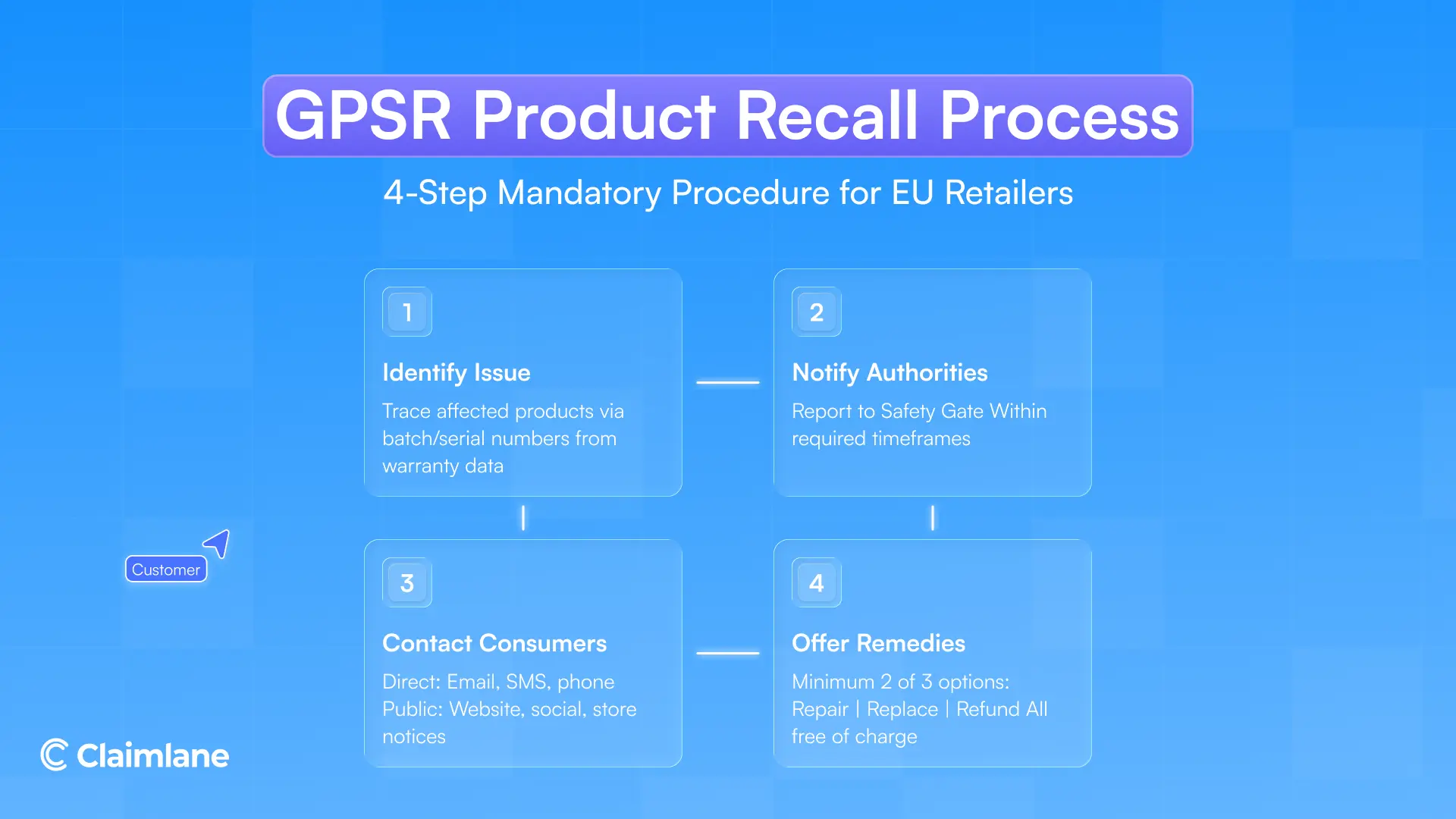
In a recall, GPSR requires the retailer to offer at least two of three remedies: repair, replacement, or refund. Single-remedy policies are no longer compliant unless the other options are genuinely impossible.
Most warranty terms were written before this rule existed. They need updating. The rules around warranty claim denials need to fit alongside the safety remedy obligations.
The New Product Recall Rules
GPSR rewrites how recalls get handled. The old "post a notice on the website" approach does not meet the bar.
Direct Consumer Notification
When a product is recalled, the retailer has to contact affected customers directly. Email, SMS, in-account alerts, whatever channels they have. Public notices through websites and press releases are still required, but only as a backup for customers the retailer cannot reach directly.
For ecommerce brands, this rule pushes registration up the priority list. Without registration data, direct contact is not possible. The full operational side of running a recall sits in the product recalls in retail and ecommerce guide.
The Recall Notice Template
GPSR requires a structured recall notice when communicating with customers in writing. The European Commission publishes a template. Use of that template is not mandatory, but the notice has to contain the same information either way.
Required fields:
- Product identification, including images
- A plain description of the hazard
- The action the customer should take
- The remedies on offer
- Contact information for the responsible person
Certain words are banned in recall notices because they soften the perceived risk. "Voluntary", "precautionary", "discretionary", and "in rare or specific situations" are all off the list. The wording matters legally, not editorially.
The Remedy Choice Rule
The customer chooses from at least two of repair, replacement, or refund. Remedies must be free of charge. The process the customer has to follow must be as simple as possible. DIY repair is only acceptable if the repair is easy and safe for a consumer to carry out.
There is no statutory deadline by which the customer must claim. A recall stays open. Spare parts availability becomes a compliance asset under this rule, because it makes repair a viable second option for years after the original sale.
What Changes for Online Retailers and Marketplaces
Online marketplaces have their own GPSR obligations on top of the rules for retailers selling through them. Marketplaces must:
- Maintain a single contact point for member-state authorities and consumers on safety matters
- Report dangerous products through the EU Safety Gate
- Notify affected buyers directly when a product they purchased gets recalled
- Publish recall information on the marketplace
- Cooperate with authorities, including allowing data scraping to identify other dangerous goods
For brands selling on their own site and on marketplaces, the obligations stack. The warranty data captured through the brand's own return management system covers direct customers. Marketplace orders need a separate flow, often through the marketplace's compliance interface.
A Compliance Checklist for Warranty and Claims Teams
The list below covers the warranty-adjacent parts of GPSR. The product safety side has its own checklist.
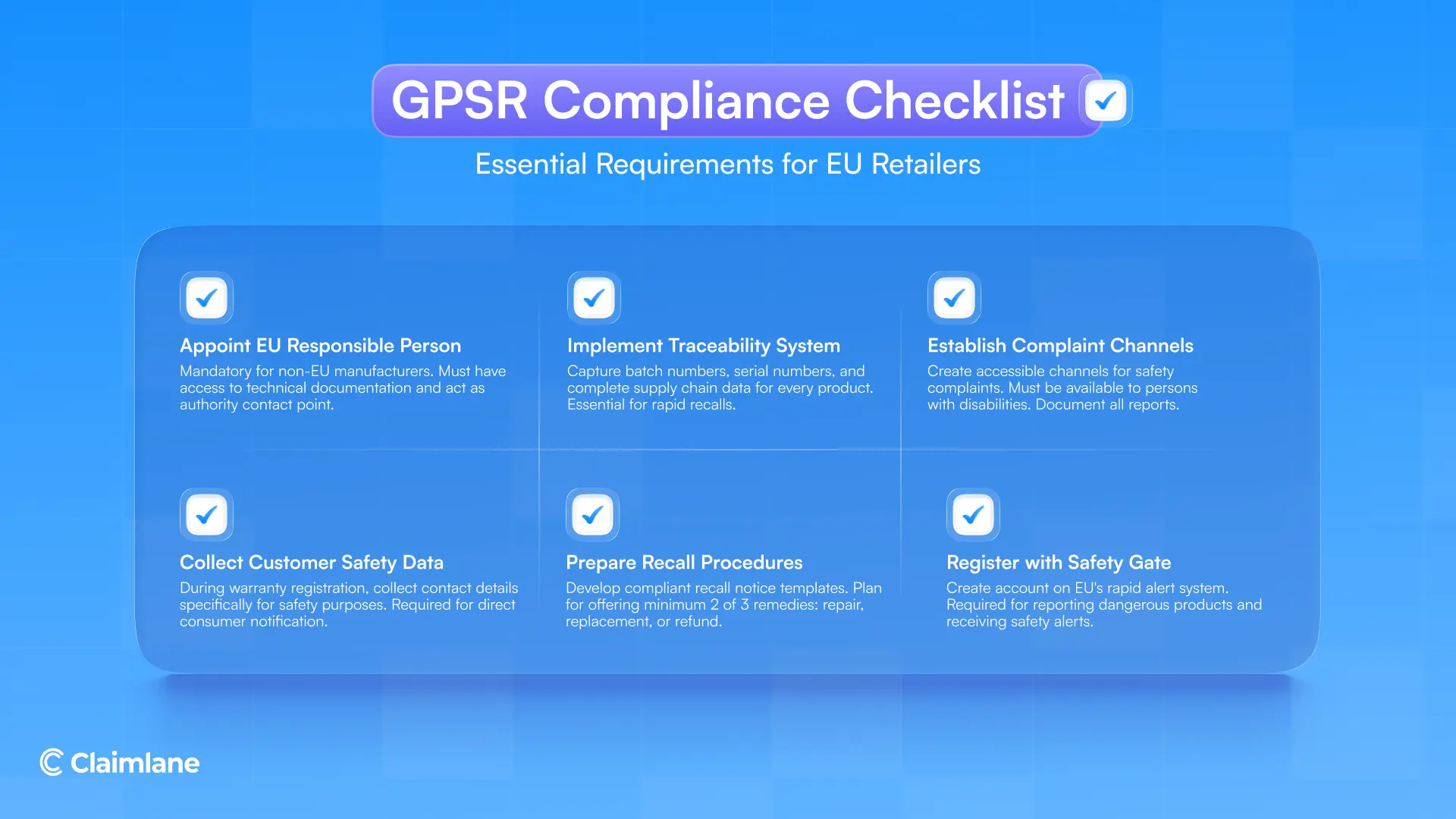
- Map every role the brand plays per product line: manufacturer, importer, distributor, marketplace
- Update warranty registration to capture serial number, batch, purchase date, and a safety-notification contact channel
- Confirm warranty terms include repair, replacement, and refund as remedy options
- Pull online product listings to verify manufacturer or responsible person information appears before checkout
- Set up a recall workflow that pulls affected customer records, generates the notice, and tracks remedy delivery
- Document a 10-year retention plan for technical and warranty records
- Train customer service on the banned words in recall notices and the two-remedy minimum
- Audit used and refurbished inventory for the same labeling and documentation as new stock
Brands using Claimlane's workflows already have steps 2, 5, and 6 running. Adding the safety-notification field and the two-remedy default closes most of the remaining gap.
Common Mistakes Retailers Make Under GPSR
The errors below are the ones showing up most often in early enforcement.
- Treating used and refurbished goods as outside the regulation. They are not.
- Online product pages missing manufacturer contact details. The omission alone makes the offering non-compliant.
- Warranty terms that only offer refund or only offer replacement. Single-remedy policies fail the two-remedy rule.
- Recall notices using softening words like "precautionary" or "voluntary". These are explicitly banned.
- Spreadsheet-based traceability that breaks at the supplier handoff. GPSR expects records that survive 10 years and one ERP migration.
- Assuming the marketplace handles GPSR for the brand. It handles its own obligations, not the brand's.
- Old inventory sold after 13 December 2024 without checking labeling. GPSR applies from that date forward, regardless of when the goods were made.
How Modern Warranty Systems Carry the GPSR Load
The warranty platform is where the GPSR data lives. A system designed for it makes compliance a query instead of a project.
Every claim filed through Claimlane's self-service portal captures the order, the product, the serial number, the batch where applicable, and the customer contact details. That builds the recall list automatically.
Claimlane's AI Agent, the first AI agent purpose-built for warranty claims and returns, reviews submitted images and video, applies warranty rules per product and supplier, and recommends or auto-approves resolutions. For safety-related claims, the same review surfaces hazard data that feeds into incident reporting. The AI side of the platform shortens the gap between a customer reporting a problem and the safety team seeing it.
Supplier records sit alongside customer records. When a recall is needed, the supplier forwarding flow pushes the issue upstream with the evidence attached. The analytics layer flags recurring defect patterns before they reach recall scale.
Brands handling both B2C and B2B claims keep the same record discipline on both sides. Trade customers need traceability too. Black Diamond automated its warranty claim and repair workflows on Claimlane, which is the same record-keeping discipline GPSR rewards.