.webp)
Size-related returns are the single biggest cost driver in online fashion. According to Shopify research, fit issues account for over 50% of apparel returns. Customers order a Medium, receive it, find it too tight across the shoulders, and send it back. Multiply that by millions of orders and the cost becomes staggering.
AI size recommendation engines solve this by predicting which size will fit a specific customer based on their body measurements, purchase history, and fit preferences. Instead of guessing between a Medium and a Large, the customer sees a personalized recommendation: "Based on your measurements, we recommend size L for a regular fit."
Brands using AI size prediction report 10-25% reductions in size-related returns. This article covers how the technology works, which approaches deliver the best results, and how to measure the impact on return rates.
- Size issues cause over 50% of apparel returns. AI predicts the right fit using body data, history, and garment specs.
- Three approaches: questionnaire, body scan, and purchase history. Different accuracy and adoption tradeoffs.
- Brands report 10-25% reductions in size-related returns after implementing AI sizing.
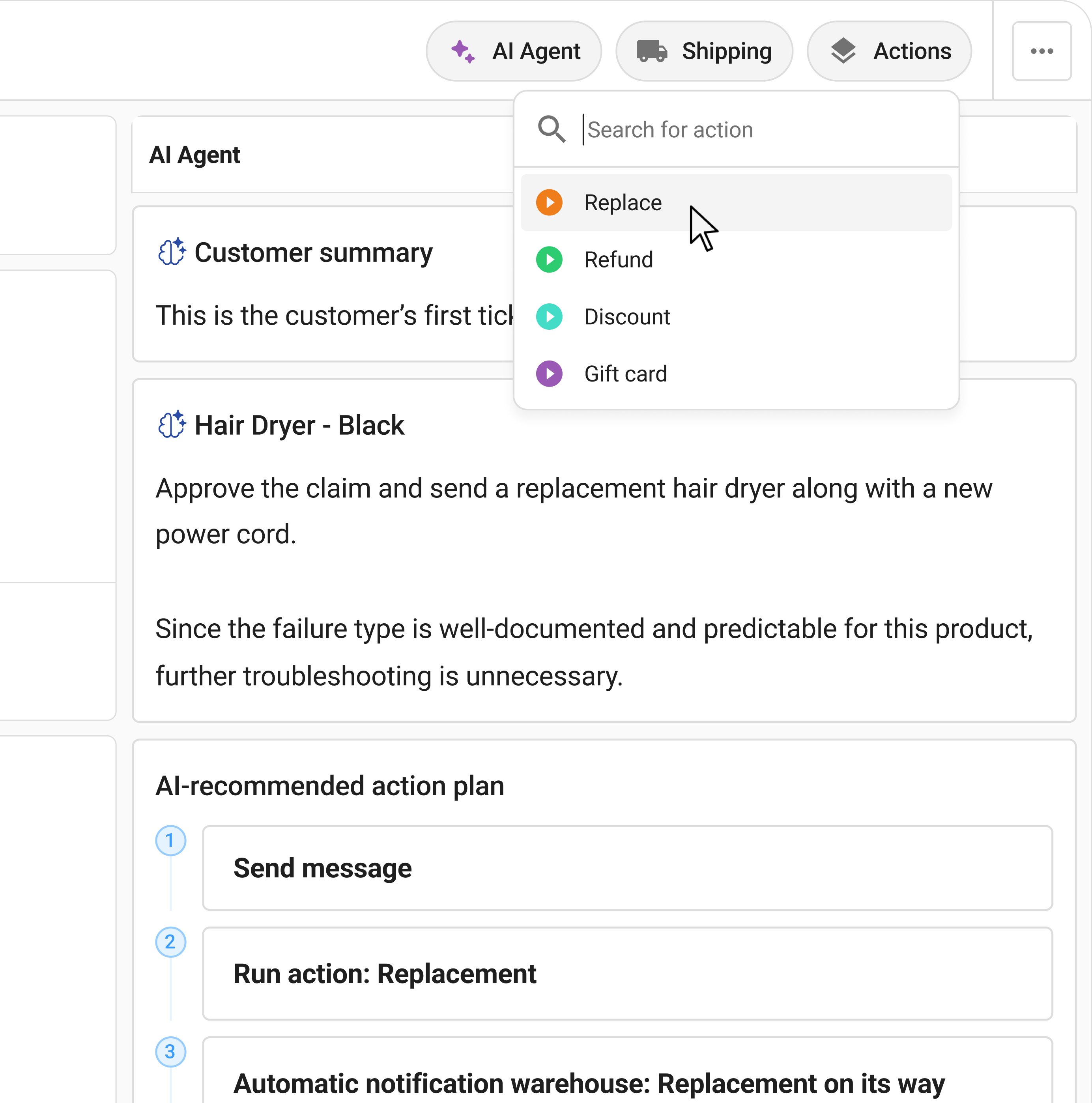
- Claimlane's AI Agent captures structured return reason data to isolate size-related returns from other reasons.
How AI Size Recommendations Work
AI size engines match customers to products using three types of data: the customer's body, the garment's specifications, and patterns from millions of other purchases.
Customer Body Data
The engine needs to know the customer's body measurements. Collection methods range from simple (height and weight questionnaire) to advanced (smartphone body scanning). More accurate body data produces more accurate recommendations.
Garment Specification Data
Every garment has a size chart, but size charts vary wildly between brands. An "M" from Brand A is different from an "M" from Brand B. AI size engines build a garment database that maps actual measurements per size per product, not just generic S/M/L labels.
Purchase and Return History
The most powerful signal: what the customer has bought before and whether they kept it. If a customer bought three shirts in size L from different brands and kept all three, the model has strong evidence for future L recommendations. If they returned two of them for being too small, it adjusts toward XL.
Three Approaches to AI Size Prediction

Questionnaire-Based
The customer answers 3-5 questions: height, weight, body shape preference, fit preference (tight/regular/loose), and age. The model maps these inputs to size recommendations.
Pros: Low friction. No camera or measurement tools needed. Works on any device.
Cons: Self-reported data is imprecise. Customers often don't know their exact measurements or body shape category.
Accuracy: Moderate. Reduces size returns by 10-15% compared to no recommendation.
Body Scan-Based
The customer takes a photo or video with their smartphone camera. AI extracts body measurements: chest, waist, hips, inseam, shoulder width, arm length. These measurements are matched against the garment's specification data.
Pros: More accurate than questionnaires. Uses actual measurements, not self-reports.
Cons: Higher friction. Some customers won't take a body photo. Privacy concerns. Requires good lighting and camera angle.
Accuracy: High. Reduces size returns by 15-25% when customers actually use it.
Purchase History-Based
For returning customers, the model analyzes past purchases and returns to predict sizing for new products. No customer input needed. The recommendation appears automatically on the product page.
Pros: Zero friction for returning customers. Gets more accurate over time. No privacy concerns from body scanning.
Cons: Doesn't work for first-time customers. Requires significant order history data to be accurate.
Accuracy: High for repeat customers. Improves with each purchase. Combined with questionnaire data for new customers, this approach delivers the strongest results.
The Business Impact of AI Sizing
Fewer Returns, Better Margins
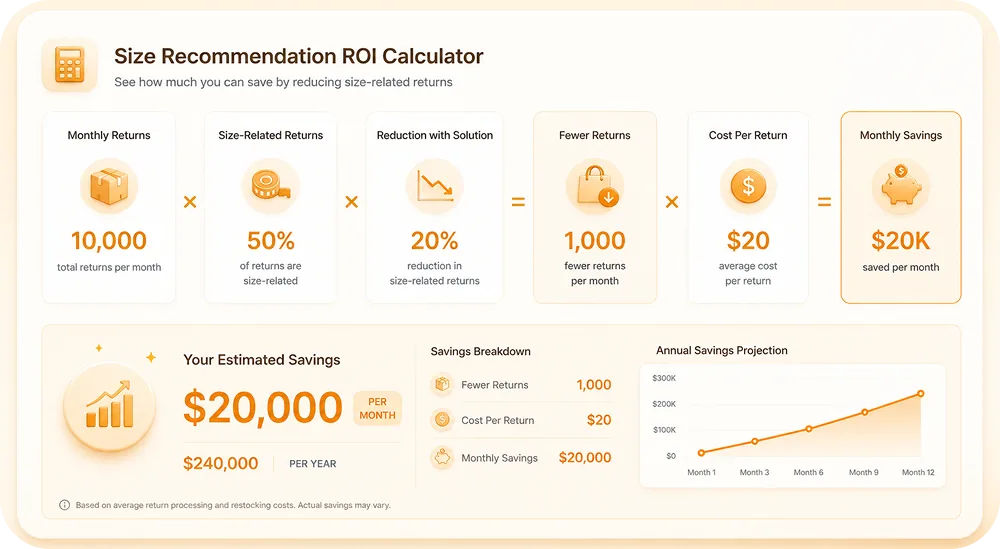
Size-related returns are expensive. Each return costs the brand $15-30 in shipping, processing, and restocking. For a brand processing 10,000 returns per month where 50% are size-related, a 20% reduction in size returns saves $15,000-30,000 monthly.
That's before accounting for the products that can't be resold at full price after being returned and processed. The true cost of returns is almost always higher than the direct shipping cost.
Reduced Bracketing
Bracketing behavior (ordering 2-3 sizes of the same item and returning the ones that don't fit) is driven by sizing uncertainty. When a customer trusts the size recommendation, they order one size. Bracketing drops, and so do the associated processing costs.
Higher Conversion Rates
Sizing uncertainty is a conversion killer. "I'm between a M and L, I'll skip this one" happens millions of times per day. A confident size recommendation removes that hesitation. Brands report 5-15% conversion rate increases for products with AI sizing enabled.
Measuring Size Recommendation Impact
Size recommendation tools only prove their value when return data confirms they're working. This requires structured return reason data that separates size-related returns from quality issues, buyer's remorse, and other reasons.
The Measurement Challenge
Most ecommerce platforms capture basic return reasons ("too small," "too large," "didn't like"). But these categories are often too broad or inconsistently applied. A customer who received the right size but didn't like the style might select "wrong size" because it's the closest option.
Using Claimlane for Accurate Measurement
Claimlane's AI Agent, the first AI agent purpose-built for warranty claims and returns, captures detailed return reason data through the self-service portal. Customers provide specific feedback, photos, and descriptions. The AI classifies return reasons consistently, distinguishing "too small in shoulders" from "too long in sleeves" from "didn't like the color."
This granularity is essential for measuring size recommendation ROI. Claimlane's analytics breaks down return rates by product, reason, and customer segment, making it possible to compare return rates for customers who followed the AI size recommendation vs. those who chose their own size.
Claimlane is rated 4.8/5 on G2.
Implementation Guide
Step 1: Audit Size-Related Return Data
Before implementing AI sizing, understand the current problem. What percentage of returns cite size/fit? Which products have the highest size-related return rates? Which sizes are returned most often?
Brands using Claimlane can pull this directly from analytics. For others, audit return reason data from the ecommerce platform or returns management system.
Step 2: Choose an AI Sizing Provider
Major providers include True Fit, Fit Analytics (now part of Snap), 3DLOOK, Virtusize, and Bold Metrics. Each takes a different approach (questionnaire, scan, history) and integrates differently with ecommerce platforms.
Evaluate based on: accuracy claims (ask for category-specific data), Shopify/WooCommerce compatibility, garment data onboarding process, and pricing model.
Step 3: Onboard Garment Data
The AI needs accurate garment specifications for every size of every product. This means measuring actual garments (not just the design specs) and entering the data into the sizing platform. For brands with thousands of SKUs, this is the most time-consuming step.
Step 4: Launch and A/B Test
Roll out AI sizing on a subset of products. A/B test: show AI size recommendations to 50% of visitors, standard size chart to the other 50%. Track return rates, conversion rates, and customer lifetime value for both groups over 60-90 days.
Step 5: Refine With Return Feedback
After launch, the AI model needs feedback. When a customer follows the recommendation and still returns for size reasons, that's a signal the model needs adjustment for that product. Connect return reason data from Claimlane back to the sizing engine to improve future predictions.
Categories Beyond Apparel
Footwear
Shoe sizing is even more variable than clothing. Length, width, arch support, and brand-specific last shapes all affect fit. AI sizing for shoes typically uses foot measurements (from scanning or questionnaire) plus brand-specific fit data.
Baby and Nursery
Children's sizing is particularly challenging because kids grow fast. AI sizing tools for children's wear factor in the child's age, current measurements, and growth rate to recommend sizes that will fit for the expected wear period.
B2B Workwear
Workwear and uniform sizing at scale (equipping hundreds of employees) benefits enormously from AI sizing. Instead of costly sample try-on programs, employees answer a questionnaire and receive the right size on the first try.
Common Pitfalls
Over-Promising Accuracy
No AI size engine is 100% accurate. Setting customer expectations correctly matters. "We recommend size L for the best fit" is better than "Your perfect size is L, guaranteed." Overpromising leads to extra frustration when the recommendation is wrong.
Ignoring Fit Preferences
Two customers with identical body measurements may prefer different fits. One wants a slim fit, the other wants relaxed. AI sizing must account for fit preference, not just body dimensions.
Not Updating Garment Data
Suppliers change fabrics and cuts between seasons. If the garment data in the AI system reflects last season's measurements, recommendations will drift. Regular measurement audits are essential.
Forgetting Mobile UX
Most shoppers are on mobile. The sizing questionnaire or scan experience must work smoothly on a small screen. If it's clunky or slow, adoption drops and the return reduction never materializes.
FAQ: AI Size Recommendations
Conclusion: Right Size, First Time
AI size recommendations attack the biggest cost driver in online fashion returns: fit uncertainty. The technology is mature, the ROI is proven, and the implementation path is clear.
The key to proving impact: structured return reason data that separates size issues from other return reasons. Claimlane provides exactly this through its AI Agent and analytics dashboard, giving brands the feedback loop needed to continuously improve sizing accuracy.
Book a demo to see how Claimlane's return analytics can measure AI sizing impact.