.webp)
Inaccurate product photos are one of the top reasons customers return online purchases. The color looked different. The size wasn't what they expected. The texture seemed smoother on screen. Every one of those mismatches traces back to a gap between what the product page showed and what arrived in the box.
AI is closing that gap. From automated color calibration and background removal to 3D product rendering and virtual try-on overlays, AI-powered photography tools help ecommerce brands create product visuals that are accurate, consistent, and detailed enough to set proper customer expectations.
The payoff: fewer returns driven by "not as described" complaints, lower reverse logistics costs, and higher customer satisfaction. This article covers the specific AI photography techniques that reduce returns, the data behind them, and how brands are implementing them.
- "Not as described" is one of the top return reasons in ecommerce, and it starts with product photography that doesn't match reality.
- AI photography tools automate color calibration, generate 360-degree views, and create consistent lighting across thousands of SKUs.
- Brands using AI-enhanced product visuals report 20-40% reductions in photography-related returns.
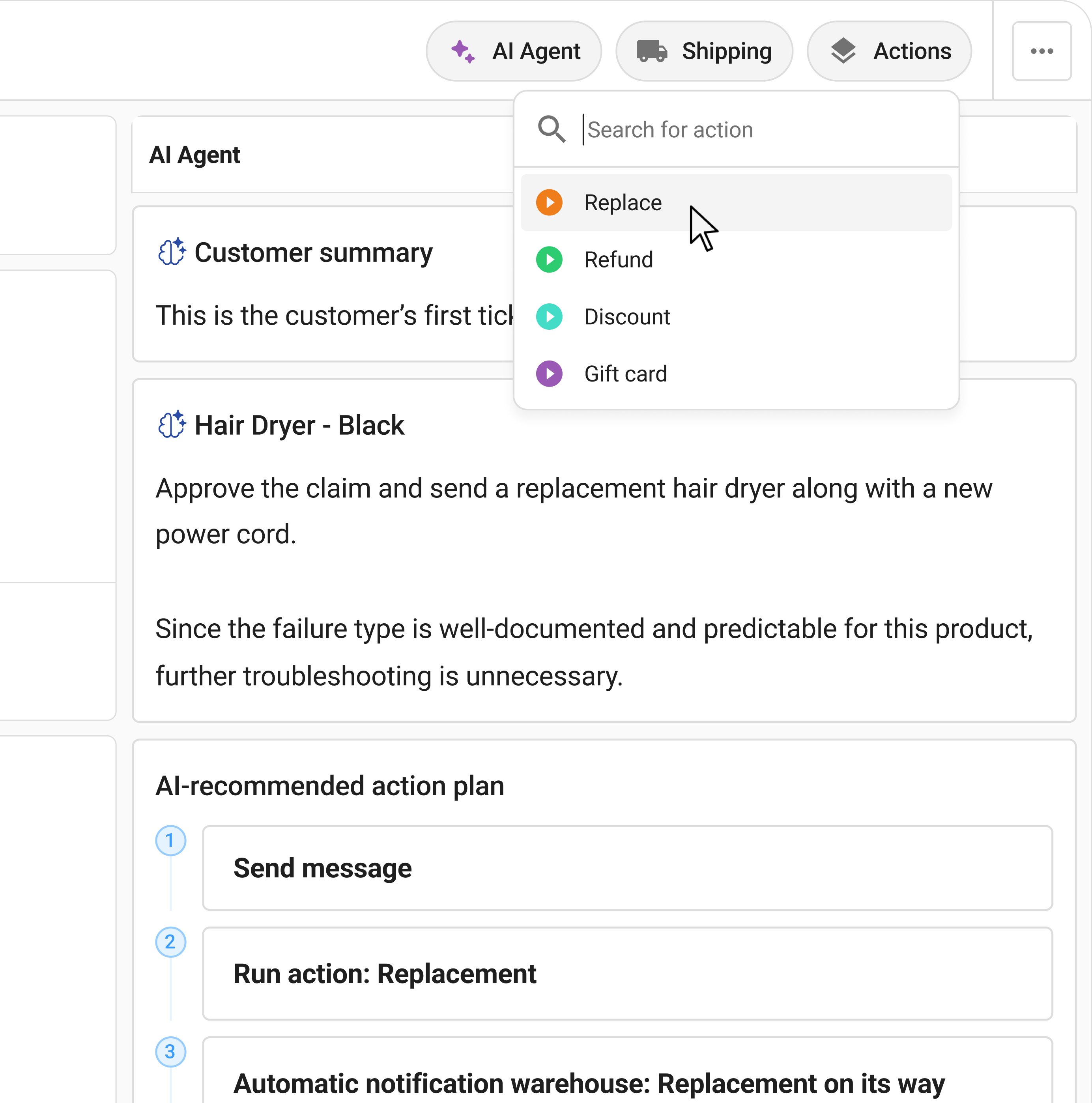
- When returns do happen, Claimlane's AI Agent analyzes return reason data to identify which products have the biggest photo-to-reality gaps.
Why Product Photos Drive Returns
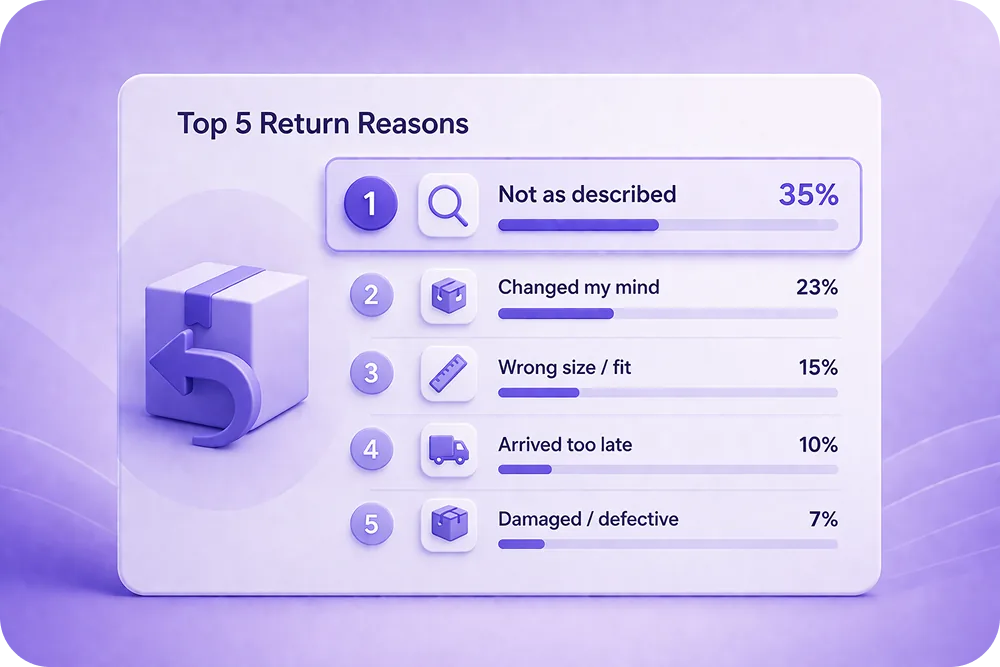
Online shoppers can't touch, hold, or try a product before buying. Product photos are the primary source of expectations. When those expectations don't match reality, returns follow.
The Data Behind Photo-Related Returns
According to research from the National Retail Federation, "item not as described" and "item looked different than photos" consistently rank among the top 5 return reasons across categories. For apparel, color and fit mismatches account for up to 40% of returns. For home goods and furniture, material texture and size perception issues drive a significant share.
The psychology behind product returns is clear: customers feel deceived when reality doesn't match what they saw online. That feeling doesn't just cause a return. It erodes trust in the brand.
What Traditional Photography Gets Wrong
- Inconsistent lighting. Different product shoots use different setups, creating color inconsistencies across the catalog.
- Over-retouching. Heavy post-processing makes products look "better" than reality, setting unrealistic expectations.
- Limited angles. A single front-facing photo doesn't communicate size, depth, texture, or how a product looks from different perspectives.
- Color inaccuracy. Monitor calibration differences between the photographer's screen and the customer's device create color perception gaps.
- No context. Products shot on a white background give no sense of scale or real-world appearance.
How AI Improves Product Photography
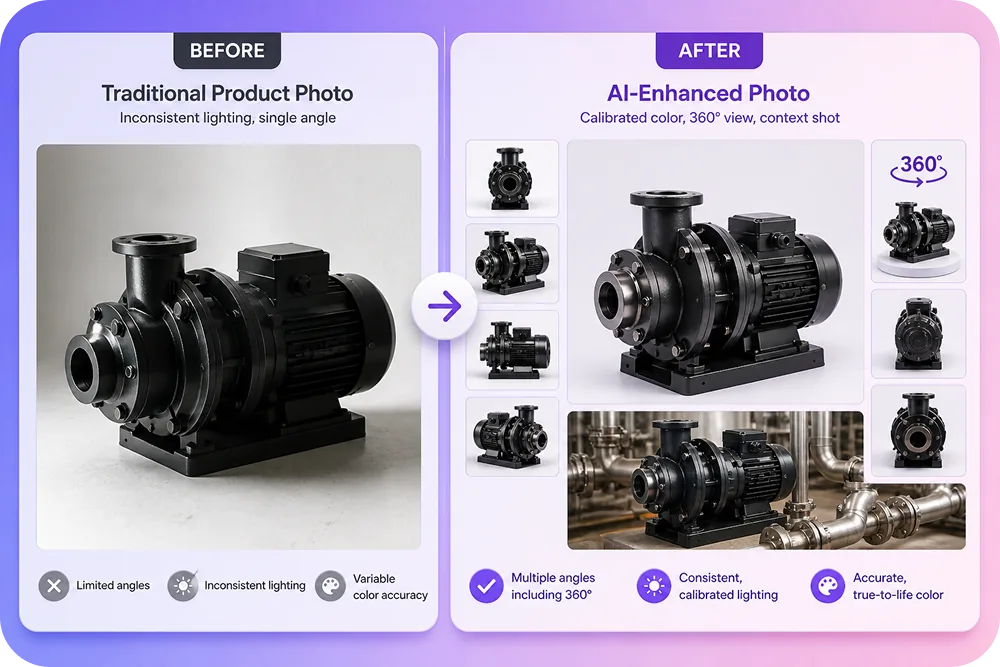
AI doesn't replace photographers. It augments the photography workflow to produce more accurate, consistent, and detailed product visuals at scale.
Automated Color Calibration
AI color calibration tools analyze product images against a reference color profile (usually captured with a physical color chart during the shoot). The software adjusts hue, saturation, and brightness to match the true product color, regardless of lighting conditions during the shoot.
This eliminates the most common "not as described" complaint: "The color was completely different in person."
AI-Generated 360-Degree Views
Traditional 360-degree photography requires a turntable, controlled lighting, and dozens of individual shots per product. AI tools can now generate smooth 360-degree views from as few as 4-8 photos by interpolating between angles using neural radiance fields (NeRF) or similar techniques.
More angles mean fewer surprises for the customer. A shoe that looks great from the front might have a design detail on the heel that the customer doesn't like. Showing it upfront prevents the return.
Consistent Background and Lighting
AI background removal and relighting tools standardize the look across thousands of SKUs. Every product gets the same clean background, consistent shadow direction, and uniform lighting temperature. This matters for catalogs with products sourced from multiple suppliers, where original photography quality varies wildly.
Scale and Context Generation
AI can place products into realistic room scenes or lifestyle contexts, giving customers a sense of actual size and appearance. A furniture brand can show a sofa in a living room setting without a physical photoshoot for every SKU. An electronics brand can show a product next to common objects for scale reference.
Texture and Material Rendering
Advanced AI photography tools capture and render material textures more accurately. Matte vs. glossy finishes, fabric weave patterns, and wood grain details show up clearly in AI-enhanced images, reducing returns from customers who expected a different feel or finish.
Closing the Loop: Returns Data Feeds Better Photography
AI product photography prevents returns on the front end. But when returns still happen, structured returns data tells the photography team which products need better visuals.
Using Claims Data to Identify Photo Gaps
When a customer returns a product and selects "not as described" or "looks different than expected," that's a signal. Aggregated across hundreds of returns, it reveals exactly which products have the biggest gap between their online representation and reality.
Claimlane's AI Agent, the first AI agent purpose-built for warranty claims and returns, captures structured return reason data through the self-service portal. When customers submit returns, they provide photos, select return reasons, and describe the issue. The AI classifies these reasons consistently, creating a clean dataset that reveals patterns.
Claimlane's analytics can show which SKUs have the highest "not as described" return rates, which is a direct indicator that the product photography needs improvement.
The Feedback Loop
The most effective approach combines AI photography with structured returns data:
- Launch products with AI-optimized photos (calibrated color, multiple angles, context shots)
- Monitor return reason data through a platform like Claimlane for "not as described" patterns
- Identify high-return SKUs where the issue is visual mismatch, not product quality
- Re-shoot or update product images for those specific SKUs
- Track whether return rates drop after the photo update
This is the same closed-loop principle used in predictive returns analytics: use data from past returns to prevent future ones.
AI Photography Tools and Techniques by Category
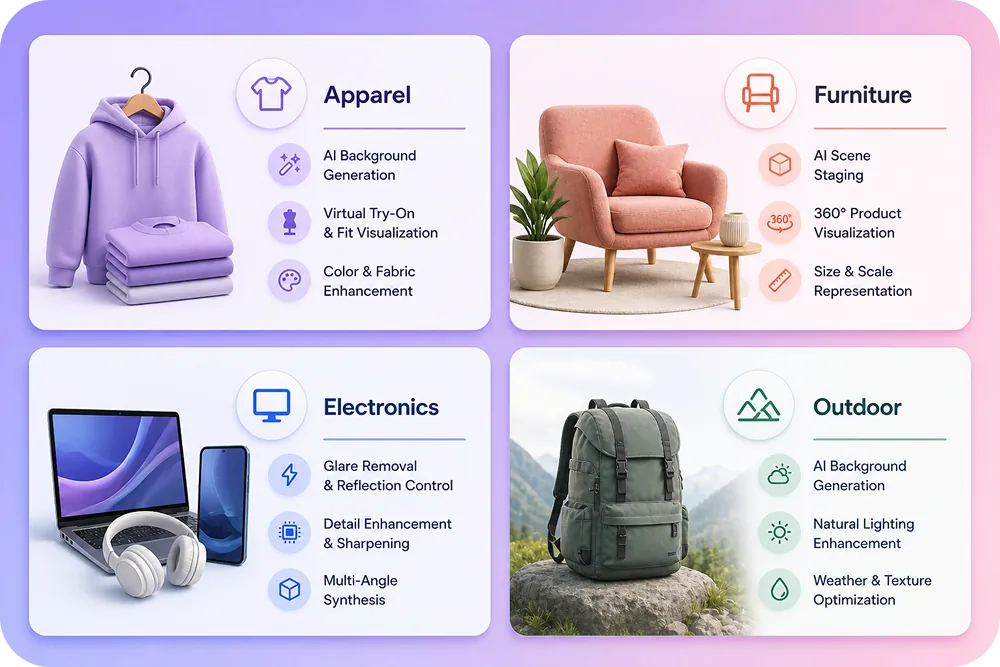
Apparel and Fashion
Apparel has the highest return rates in ecommerce, and fit/color issues drive most of them. AI photography techniques that matter most:
- Virtual try-on overlays that show how garments look on different body types
- Fabric texture rendering that communicates whether a material is sheer, thick, stretchy, or stiff
- True-to-life color matching across the full size range (a navy shirt should look the same navy in size S and size XXL)
- Flat-lay AI composition that creates consistent, magazine-quality flat-lay shots automatically
Furniture and Home Goods
Furniture returns are expensive because the products are large and heavy. AI photography prevents them by:
- Room scene generation that shows furniture at actual scale in realistic room settings
- Material close-ups that reveal wood grain, fabric texture, and hardware finish
- Dimension overlays that display measurements directly on product images
- Color-accurate rendering across different lighting conditions (daylight, warm light, cool light)
Electronics and Gadgets
Electronics brands deal with returns from customers who didn't understand the product's size, port layout, or finish. AI helps with:
- Scale comparison shots (product next to a hand, a coin, or common objects)
- Port and connection detail renders showing every input/output clearly
- Finish accuracy (distinguishing matte black from glossy black, brushed aluminum from polished)
- Unboxing sequence renders that show exactly what's included
Outdoor and Sporting Goods
Outdoor gear customers need to understand durability, weather resistance, and technical features. AI photography assists with:
- In-context action shots generated from studio photos (showing a tent in a forest setting, a jacket in rain)
- Technical feature callouts with AI-generated annotation overlays
- Color accuracy under different lighting (outdoor gear often looks different in daylight vs. indoor lighting)
Implementing AI Product Photography
Step 1: Audit Current Return Reasons
Before investing in AI photography tools, audit existing return reason data. What percentage of returns cite "not as described," "wrong color," or "looks different than expected"? If it's above 15%, product photography is a clear improvement target.
Brands using Claimlane can pull this data directly from the analytics dashboard, filtered by return reason and product category.
Step 2: Choose the Right AI Tools
The AI photography market includes tools for different stages:
- Capture: AI-assisted cameras and lighting rigs that optimize exposure and color in real-time
- Post-processing: Automated background removal, color correction, and consistency tools
- Generation: AI-rendered 3D views, room scenes, and lifestyle contexts from minimal input photos
- Quality assurance: Automated checks for image consistency, color accuracy, and minimum angle coverage
Step 3: Establish Photography Standards
AI tools need guidelines. Define minimum requirements per product category:
- Number of angles (minimum 4-6 per product)
- Required detail shots (close-ups of materials, labels, key features)
- Color accuracy tolerance (Delta E < 3 from the physical product)
- Context requirements (at least 1 lifestyle/scale image per product)
Step 4: Connect Photography to Returns Data
This is the step most brands skip. Set up a feedback loop between the returns management system and the photography team. When Claimlane's analytics show a spike in "not as described" returns for specific SKUs, the photography team gets notified to review and reshoot those products.
Step 5: Measure the Impact
Track return rates for products that get AI-enhanced photography versus those that don't. Key metrics:
- "Not as described" return rate per SKU (before and after photo upgrade)
- Overall return rate for AI-photographed products vs. standard products
- Customer satisfaction scores for product accuracy
- Photography cost per SKU (AI tools typically reduce this by 30-60%)
Claimlane's Role in the Photography-Returns Feedback Loop
Claimlane is rated 4.8/5 on G2 and provides the returns data infrastructure that makes AI product photography a closed-loop improvement system.
Structured return reason capture. The self-service portal collects detailed return reasons with photos from customers. No more guessing why a product was returned.
AI-classified return data. Claimlane's AI Agent classifies return reasons consistently, distinguishing "color mismatch" from "size issue" from "defective product" with machine precision.
Product-level analytics. The analytics dashboard breaks down return rates by SKU, return reason, and time period. Brands can instantly identify which products have the highest "not as described" rates.
Integration with ecommerce platforms. Through 75+ integrations with Shopify, WooCommerce, and other platforms, Claimlane connects return data back to the product catalog.
Book a demo to see how Claimlane's return analytics can identify products that need better photography.
Common Mistakes to Avoid
Over-Enhancing Images
The goal of AI photography is accuracy, not beauty. AI tools that make products look better than reality will increase returns, not reduce them. Configure tools for color accuracy, not color enhancement.
Ignoring Mobile Rendering
Over 70% of ecommerce browsing happens on mobile. Product photos must look accurate on small screens with varying display quality. AI optimization should include mobile-specific crops and detail views.
Not Testing With Customers
A/B test AI-enhanced product images against standard photos. Track not just conversion rates (which may dip slightly as expectations become more realistic) but return rates (which should drop significantly). The net impact on profitability is what matters. Use returns-adjusted profitability as the north star metric.
Failing to Update Photos for Product Changes
Suppliers change materials, colors, and components without notice. If the product page shows an old photo but the customer receives an updated version, returns follow. Tie product change notifications to photo update triggers.
The Future: Generative AI and Product Visualization
Generative AI is pushing product photography into new territory.
AI-Generated Product Videos
Short product videos convert better than static images and set more accurate expectations. AI tools now generate smooth product rotation videos from a handful of photos, eliminating the need for video shoots.
Personalized Product Visuals
AI can show products in contexts relevant to the specific customer. A customer in a modern apartment sees a sofa in a modern setting. A customer with a traditional home sees the same sofa in a traditional room. Personalized context reduces the "will it fit my space?" uncertainty that drives furniture returns.
Real-Time Defect Detection in Photography
AI quality assurance tools now scan product photos for defects, inconsistencies, and accuracy issues before they're published. A slightly off-color image, a missing detail shot, or an inconsistent background gets flagged automatically.
FAQ: AI Product Photography and Returns
Conclusion: Better Photos, Fewer Returns
AI product photography isn't just about making products look good. It's about making products look real. Accurate colors, multiple angles, context shots, and detailed texture rendering set proper customer expectations and reduce the "not as described" returns that eat into margins.
The smartest brands pair AI photography with structured returns data from Claimlane to create a feedback loop: returns data shows which products need better visuals, and better visuals reduce future returns.
Book a demo to see how Claimlane's return analytics can identify your highest-impact photography improvement opportunities.