.webp)
When something breaks or wears out on a product, the customer wants one thing: the right replacement part, fast.
For most brands selling durable goods (furniture, electronics, baby products, outdoor gear, appliances), giving customers that simple answer is anything but simple. The team has to figure out which part fits, whether it's in stock, what the customer is actually trying to fix, and how to ship it without creating a paperwork mess. The result is endless back-and-forth, slow resolutions, and frustrated customers who often give up and ask for a full replacement instead.
This article covers how spare parts management actually works in retail and ecommerce aftersales, the operational patterns that scale, and how Claimlane's new Spare Part Workflow handles the parts most teams get stuck on.
What is spare parts management?
Spare parts management is the operational discipline of tracking, identifying, ordering, and shipping replacement components for products already in customer hands. In retail and ecommerce, it usually shows up inside the warranty and returns workflow: a customer reports a broken part, the brand identifies the right replacement, ships it, and closes the case.
It's adjacent to but separate from inventory management. Inventory management cares about finished goods. Spare parts management cares about the components inside those goods, which are often sold separately (or shouldn't be sold at all, just sent under warranty).
For brands selling complex products, spare parts management is one of the highest-friction parts of the broader returns and warranty process.
Why spare parts are operationally painful
Three structural problems make spare parts harder to handle than standard returns:
Customers don't know what the part is called. They describe it ("the leg under the cabinet," "the round thing on top") and the agent has to translate that into a SKU. Multiple emails, often photos, sometimes wrong guesses.
The same product model can have different components depending on production batch, year, or region. Sending the wrong-version part is a guaranteed second support ticket.
A single damaged product often needs more than one replacement part. Manual workflows make it almost impossible to handle multi-part requests cleanly without creating separate tickets that lose context.
When the team is processing 50, 100, or 200+ spare part requests a month, all three problems compound. The brand either ships full replacements (expensive) or absorbs hours of agent time on coordination (also expensive).
The cost of getting spare parts wrong
Cost of full replacement vs sending the right spare part
Agent time per spare part request on email + spreadsheet
Average back-and-forth emails to identify the right part
Typical resolution time for a single spare part request
For a brand selling furniture or baby products, the gap between a working spare parts workflow and a broken one is meaningful. Brands at scale often discover that spare parts represent a disproportionate share of the hidden costs of returns and claims, even though they're a small share of the ticket volume.
What good spare parts management looks like
The brands handling spare parts well share four patterns:
Visual aids (assembly diagrams, exploded views, photos) inside a self-service portal let the customer point to the exact part they need. The agent doesn't have to translate "the round thing on top."
When a product needs three parts, the customer should be able to request all three in one go, with quantities and reason codes per part. Splitting into separate tickets loses context and creates duplicate work.
Traditional spare parts systems require months of setup before they're useful. Modern workflows let the database build itself as customers submit requests, with agents enriching it over time. No big bang upload required.
Spare parts shouldn't live in a separate system from warranty claims. They're part of the same resolution path. The same platform should handle the customer intake, the part identification, the warehouse coordination, and the supplier credit recovery.
Spare parts software vs spare parts as a feature
A common decision point: do brands need dedicated spare parts software, or a returns and warranty platform that includes spare parts as a feature?
For a furniture brand or baby products retailer, dedicated spare parts software is overkill. The volume isn't high enough to justify it, and the workflow is fundamentally a sub-step of the warranty claim process. A claims platform with proper spare parts handling is almost always the right fit.
For an industrial MRO operation or aerospace supplier, dedicated spare parts software starts to make sense. Different use case, different decision.
The Spare Part Workflow in Claimlane
Claimlane's Spare Part Workflow is built specifically for retail and ecommerce brands handling spare parts as part of warranty and returns operations. Four pieces:
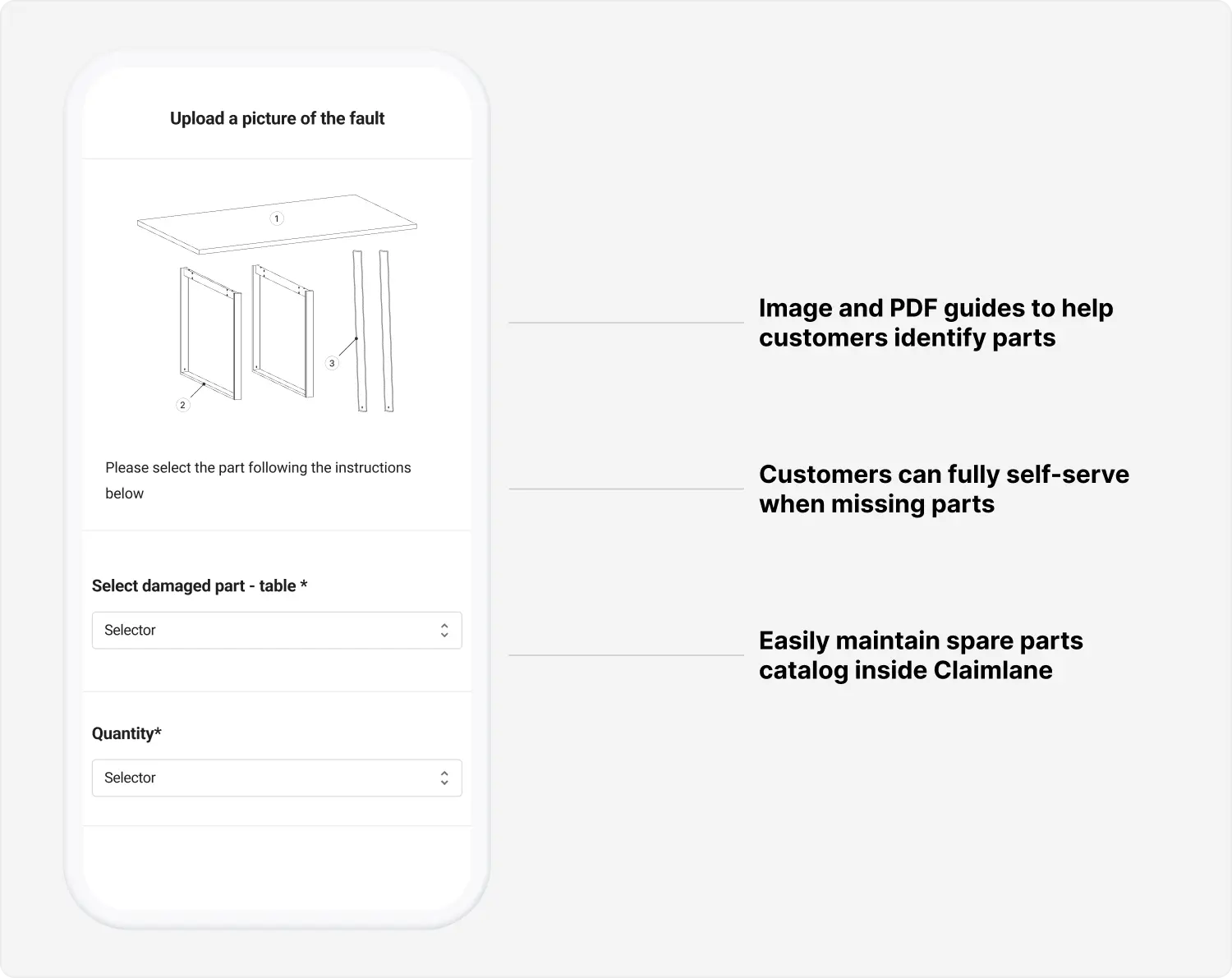
1. Customers identify the exact part with image guides
Customers can view product assembly manuals directly within the self-service portal. Clear diagrams and step-by-step instructions let them point to the exact component they need without translation through email.
This eliminates the most common bottleneck in spare parts handling: the customer not knowing what the part is called.
2. Multiple parts per product, in one request
A single damaged product often needs multiple replacement parts. Claimlane lets the customer select multiple parts in one go, specify quantities, and add reason codes per part. The agent sees the full request in one ticket instead of fragments across several.
One of the biggest challenges when dealing with spare parts is figuring out exactly which one is needed. To make this easier, customers can now view product assembly manuals directly within the self-service portal. This means no more guessing or misunderstandings about which part is required. Customers can view clear diagrams and follow step-by-step instructions to identify the exact component they need.
3. A spare parts database that builds itself
Two options for getting started:
As customers use the portal, Claimlane learns and grows the database based on actual requests. Agents enrich it over time. No upfront migration project.
If you already have a structured list of spare parts, upload it once and the database is ready. Most brands combine both: upload what they have, let the system fill in the rest.
4. Agent view that's actually useful
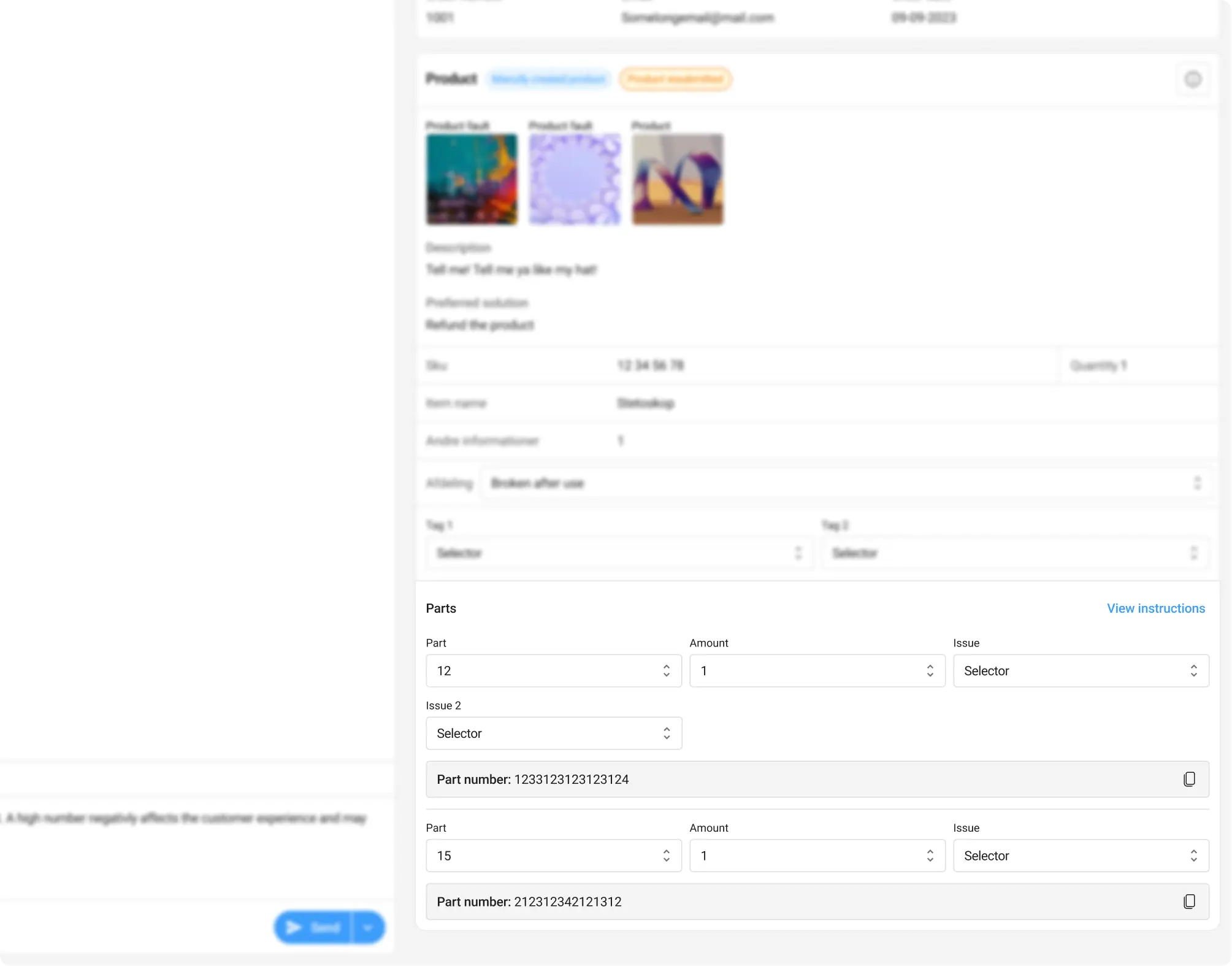
Once the customer submits a request, the agent sees a structured view of selected parts in the ticket: part numbers, quantities, reasons, customer photos. The agent can verify, add new parts to the system, modify selections, and approve resolution. No spreadsheet lookup, no email chain reconstruction.
Brands like Swoon use Claimlane to handle spare parts requests inside the same workflow as their full warranty claims. See how Swoon improved their returns and warranty workflow with Claimlane.
Easily handle spare part request
Once a customer has made their selections, support agents will see a detailed, organized view of the parts requested in the ticket. This makes it easy for support teams to verify the parts selected, add new parts to the system as needed, and keep track of part numbers for future reference. It’s a more efficient way of handling spare parts inquiries, ensuring no detail is overlooked.
How spare parts fit into the broader aftersales operation
Spare parts management is one piece of the aftersales picture. It connects to:
Many spare parts requests originate from a warranty claim. The two should share the same case.
A working spare parts workflow shifts the economics. Cases that would default to replacement now resolve as a part shipment.
Many spare parts are sourced from suppliers. The same platform should handle supplier requests and credit recovery.
Spare parts data feeds into product quality analytics. Which parts fail? Which suppliers? Which production batches?
The bottom line
For brands selling furniture, baby products, electronics, outdoor gear, or any durable goods category, spare parts management is one of the highest-leverage parts of the aftersales workflow.
Done badly (email chains, wrong-version parts, full replacements when a part would do), it costs 3-5x more than necessary and damages the customer experience. Done well (visual self-service, multi-part requests, structured database, integrated warranty workflow), it becomes one of the best customer satisfaction levers available, since most customers prefer a fast spare part to a slow full replacement.
For brands looking at the spare parts side of warranty operations, see the Design Concept webinar on how a design brand handles spare parts and warranty claims, or book a Claimlane demo to see the Spare Part Workflow in action.
Tired of long resolution times on your warranty claims? Hear how Claimlane can help your business.
Tracking spare parts requests alongside warranty claims is essential. Here's a guide to warranty tracking software and what to look for.