.webp)
Every warranty claim ends with a decision: fix the product or send a new one.
Get it wrong and the costs add up fast. Replace too often and margins shrink. Repair too often and customers wait weeks for a product that might break again. The best warranty operations don't leave this to gut instinct. They use a structured decision framework that factors in cost, speed, product value, defect type, and customer impact.
This guide provides that framework.
Why the Repair vs Replace Decision Matters
The resolution type on a warranty claim affects far more than the immediate cost:
- Customer satisfaction: A fast replacement feels generous. A slow repair feels like the brand doesn't stand behind its product.
- Total cost per claim: Repair is often cheaper per unit but slower. Replacement is faster but more expensive upfront.
- Logistics complexity: Repairs require reverse shipping, diagnosis, parts sourcing, labor, and return shipping. Replacements require inventory and one-way shipping.
- Product lifecycle: Repairing a product that's near end-of-life wastes resources. Replacing a product with a minor fixable defect wastes inventory.
- Environmental impact: Repair extends product life and reduces waste. But shipping a product back and forth for repair also generates emissions.
Brands that handle warranty claims at scale need a consistent, data-driven approach to this decision.
The 50% Rule and Its Limitations
The most common rule of thumb: if the repair cost exceeds 50% of the replacement cost, replace the product.
This works as a starting point but misses important nuances:
- A $200 product with a $90 repair cost (45%) might still warrant replacement if the repair takes 3 weeks and the customer is unhappy
- A $50 product with a $30 repair cost (60%) might warrant repair if the product is discontinued and replacement inventory doesn't exist
- The "50% rule" doesn't account for the cost of customer dissatisfaction, repeat claims, or logistics overhead
A better framework considers multiple factors, not just cost.
The Decision Framework: Six Factors
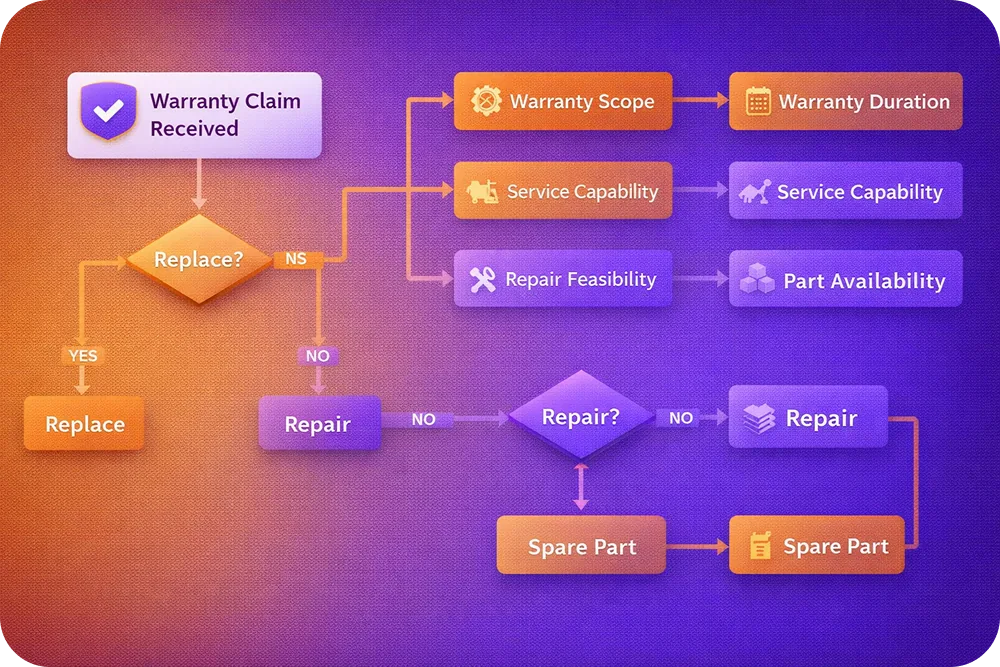
Factor 1: Cost comparison
Start with the numbers:
- Repair cost: Parts + labor + inbound shipping + outbound shipping + diagnosis time
- Replacement cost: Unit cost + shipping + processing + inventory holding cost
Include hidden costs that are easy to miss:
- Return shipping labels for repair (often $5-15 per package)
- Warehouse receiving and inspection time
- Risk of repair failure (and a second claim)
- Customer service time managing the repair timeline
Returns analytics platforms track these costs per product category, making the comparison straightforward over time.
Factor 2: Resolution speed
How long will each option take?
| Resolution Type | Typical Timeline | Customer Wait |
|---|---|---|
| Replacement (in stock) | 1-3 days | Minimal |
| Replacement (backordered) | 1-4 weeks | Moderate-High |
| Repair (spare part) | 3-7 days | Low-Moderate |
| Repair (complex, return) | 2-6 weeks | High |
Speed matters. Research shows that 97% of shoppers say a positive return experience makes them more likely to shop again. Long repair timelines risk losing the customer entirely.
Factor 3: Product value and lifecycle
- High-value products (over $200): Repair is often worth the effort because the cost savings are significant
- Low-value products (under $50): Replacement is almost always faster and cheaper than diagnosing and repairing
- End-of-life products: Replace with a newer model (and use the warranty claim as a retention opportunity)
- Discontinued products: Repair may be the only option if replacement stock doesn't exist
Factor 4: Defect type and severity
Not all defects are equal:
- Cosmetic damage: Often repairable or compensable with a partial refund rather than a full replacement
- Component failure (single part): Ideal candidate for spare parts repair, send the part directly to the customer
- Systemic defect (design or manufacturing flaw): Replace, because the repair is likely to fail again
- Safety-related defect: Always replace immediately, no exceptions
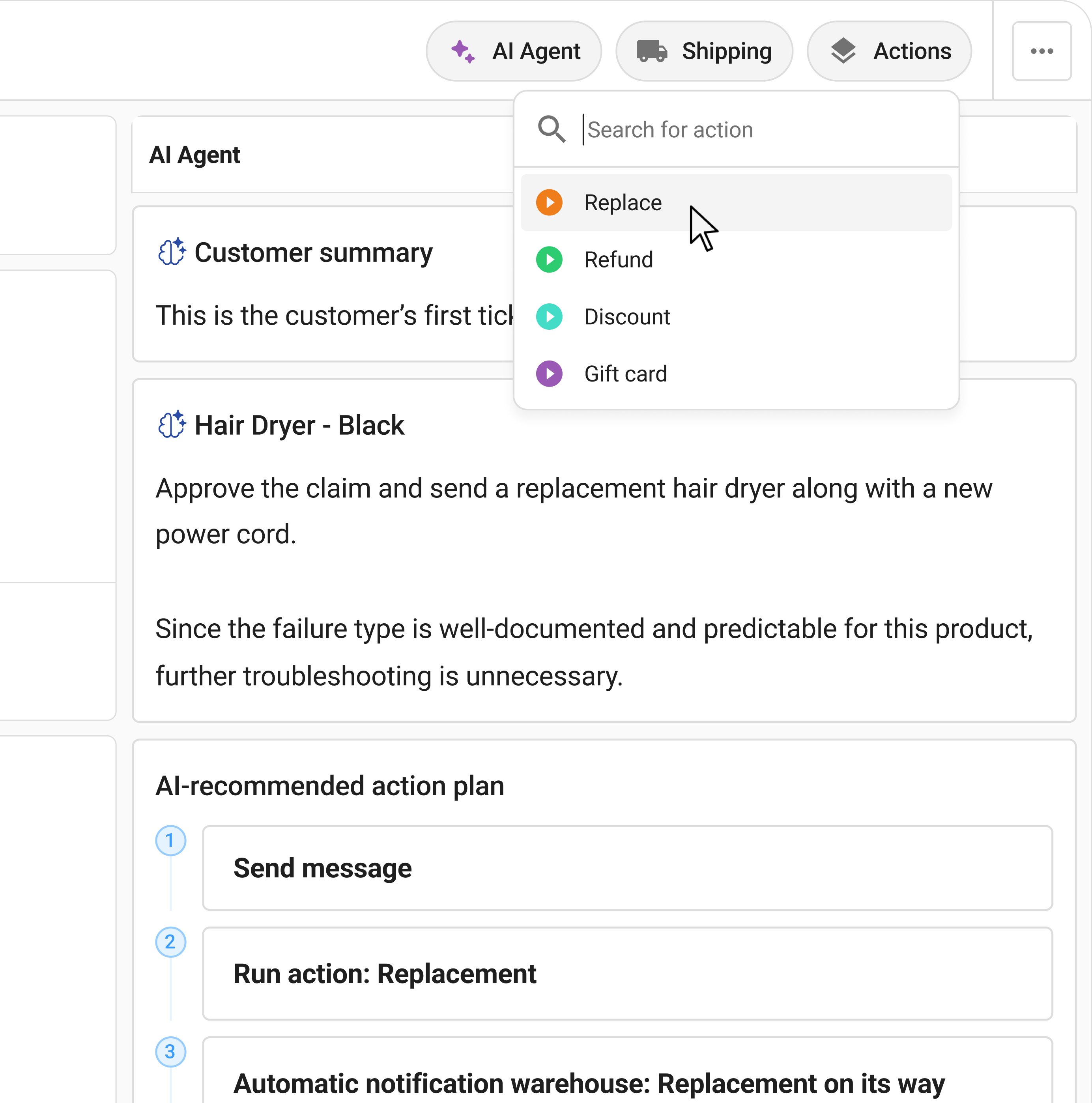
Claimlane's AI Agent, the first AI agent purpose-built for warranty claims and returns, analyzes product photos and defect descriptions to classify defect type and severity automatically. This classification feeds directly into the repair vs replace decision, ensuring consistency across thousands of claims.
Factor 5: Repair success probability
Not all repairs stick. Key questions:
- What percentage of repaired products come back with a second claim within 6 months?
- Is this defect type known to recur after repair?
- Does the repair address the root cause or just the symptom?
If the repeat claim rate after repair exceeds 15-20%, the total cost of "repair + second repair or eventual replacement" often exceeds the cost of replacing upfront.
Warranty analytics that track repeat claim rates per product and defect type provide the data to make this call.
Factor 6: Customer relationship value
The claim might be about a $30 product, but the customer might be worth $3,000 in lifetime value. Consider:
- Is this a first-time buyer or a loyal repeat customer?
- Is the customer already frustrated (multiple contacts, long wait)?
- Is there a social media or review risk?
For high-value customers or situations with elevated frustration, replacing the product, even when repair would be cheaper, is the right business decision. The cost of losing the customer far exceeds the cost difference.
Decision Matrix
| Scenario | Action | Reasoning |
|---|---|---|
| Low-value product, any defect | Replace | Repair cost exceeds product value |
| High-value, single component | Repair (spare part) | Cost-effective and fast |
| High-value, systemic defect | Replace | Repair likely to fail again |
| Safety defect | Replace immediately | Non-negotiable |
| Discontinued product | Repair | No replacement stock |
| High-value customer, frustrated | Replace | Retention exceeds cost |
| Cosmetic damage only | Partial refund/repair | Full replacement disproportionate |
| Product under 30 days old | Replace | Customer expects working product |
How to Automate the Repair vs Replace Decision
Manual decision-making doesn't scale. When a brand handles hundreds of warranty claims per week, every claim requiring a human to weigh six factors creates a bottleneck.
Build decision rules into your workflow
Claimlane's workflow engine allows brands to set rules that automatically route claims to the correct resolution:
- If product value is under $50, auto-approve replacement
- If defect type is "component failure" and spare part is in stock, route to spare parts fulfillment
- If product is within 30 days of purchase, auto-approve replacement
- If defect is safety-related (based on category), flag for immediate replacement and quality team notification
These rules handle 60-80% of claims without human involvement, freeing the team to focus on edge cases.
Use AI for defect classification
Claimlane's AI Agent analyzes customer-submitted photos to classify the defect type and severity. The AI determines whether the issue is cosmetic, a single-component failure, or a systemic product defect. This classification feeds directly into the decision rules.
For example, if a customer submits a photo of a broken chair leg, the AI recognizes it as a single-component failure and routes the claim to spare parts fulfillment. If a customer submits a photo of a cracked frame, the AI classifies it as a structural failure and routes to replacement.
Track outcomes and refine
The framework should improve over time. Track:
- Repeat claim rate per resolution type: Are repaired products coming back more often than expected?
- Cost per claim by resolution type: Is repair actually cheaper once all costs are included?
- Customer satisfaction by resolution type: Do replacement customers rate higher than repair customers?
- Time to resolution by type: How much faster is replacement vs repair in practice?
Use Claimlane's analytics to monitor these metrics and adjust decision rules accordingly.
Spare Parts: The Third Option
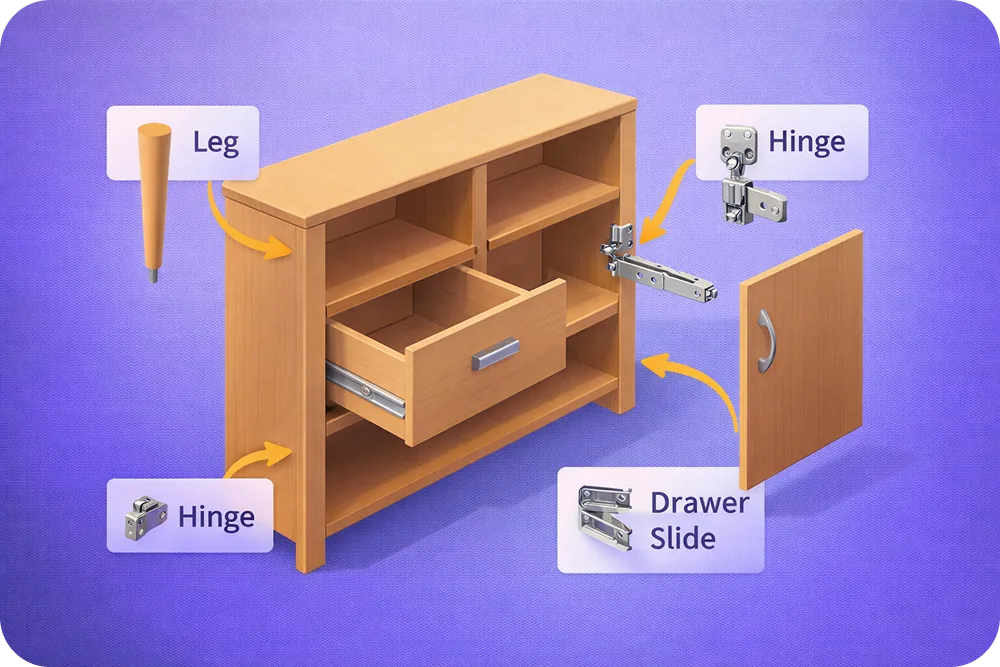
The repair vs replace debate often overlooks a third option: sending a spare part directly to the customer.
Instead of the customer shipping the entire product back (slow, expensive, logistically complex), the brand ships a replacement component. The customer installs it or a local technician does.
Spare parts management within the warranty workflow is particularly effective for:
- Furniture (table legs, drawer slides, hardware)
- Electronics (power adapters, cables, covers)
- Outdoor equipment (poles, clips, fabric patches)
- DIY/hardware (handles, blades, batteries)
Black Diamond automated warranty claim and repair workflows through Claimlane, using spare parts as a primary resolution path for their technical outdoor products. This avoids the cost and environmental impact of full product replacements while getting the customer back to using the product quickly.
Industry-Specific Considerations
Furniture
Furniture returns are notoriously slow (averaging 47 days in some cases). Repair via spare parts is almost always preferable for furniture because:
- Shipping a full piece of furniture back is expensive ($50-200+ for large items)
- The product may be assembled and difficult to repackage
- The defect is often a single component (leg, hinge, drawer mechanism)
Electronics
Electronics often have modular components that make repair straightforward. But consumer expectations are high: a broken phone or laptop that takes 3 weeks to repair creates significant customer frustration. For personal electronics, fast replacement with a refurbished unit is often the best option.
Baby and nursery
Safety is paramount for baby products. Any defect that could pose a safety risk should result in immediate replacement. Sebra uses Claimlane to manage claims on their children's furniture, ensuring safety-related claims get prioritized and resolved correctly.
Supplier Recovery on Repairs
When a product is repaired under warranty, the cost of repair should be recovered from the supplier if the defect was a manufacturing issue.
This requires:
- Documenting the repair (what was done, parts used, labor time)
- Linking the repair to the original warranty claim
- Forwarding the claim to the supplier with repair documentation
Supplier recovery on repairs is often lower than on replacements because the documentation is more complex. A centralized claims system that tracks repairs alongside replacements ensures nothing falls through the cracks.
The Environmental Angle
Repair is generally better for the environment than replacement. It extends product life, reduces manufacturing demand, and avoids the waste of disposing of a product with a single defective component.
But the environmental calculation isn't always straightforward:
- Shipping a product back and forth for repair generates emissions
- A repaired product that fails again doubles the environmental cost
- Recommerce and refurbishment programs can offset some environmental impact of replacements
Brands with sustainability commitments should factor environmental impact into their repair vs replace framework. For many, the spare parts approach is the best compromise: it avoids full product replacement without requiring reverse logistics for the entire product.