.webp)
Why warranty operations keep breaking
Warranty claims sit at the awkward intersection of customer service, logistics, finance, and supplier management. When any one of those four breaks, the claim stalls. Most operations leaders aren't fighting a single problem. They're fighting six at once, and every fix in one place creates a small fire in another.
This article breaks down the seven warranty management challenges that show up most often at brands and retailers running 1,000+ claims per year. Each one comes with a concrete fix, real metrics where they exist, and the part of the workflow it actually moves.
- Data fragmentation, supplier coordination, and manual triage are the top three warranty bottlenecks for mid-market brands.
- Fixes that work share three traits: one source of truth for claim data, automation on routine decisions, and analytics on supplier and product quality.
- Operations teams running modern warranty workflows resolve 50-80% faster and recover more from suppliers.
- Claimlane brings claims, warranty registration, repair workflows, supplier chargebacks, and analytics into one warranty management system.
Challenge 1: Claim data lives in five different places
The most common pattern: warranty data scattered across email, the helpdesk, the ERP, a shared spreadsheet, and the supplier portal. When a claim arrives, the agent has to check four of those to figure out what's happening, who owns the next step, and whether the supplier already responded.
This is the data silo problem in warranty form. Retail returns data silos covers the broader version. For warranty specifically, the cost shows up in resolution time and supplier recovery rates.
The fix
Consolidate to one warranty record per claim, with photos, serial numbers, order history, supplier ID, and resolution actions in the same place. Claimlane's warranty management software does this by pulling order and product data from your ecommerce platform and ERP into a single claim view. Agents stop asking "where's the photo, where's the serial?" because both live next to the claim ID.
Konges Sløjd handled this exact problem. The team consolidated claim data and ERP records in one place, so resolution actions trigger downstream automatically.
"With the integration to Business Central, resolving a claim in Claimlane automatically triggers all the necessary processes in our ERP. The customer service agent's work is complete the moment the claim is resolved."
Challenge 2: Supplier coordination kills the SLA
Most warranty SLAs miss because of the supplier handoff, not the front-end. A customer files the claim, the brand reviews it within a day, then the file sits in a supplier inbox for two weeks waiting on a credit note or replacement approval. That's where the 14-day average resolution actually comes from.
Supplier chargebacks and supplier recovery both cover this. The pattern: weak data on the claim means the supplier rejects it, asks for more info, and the whole loop restarts.
The fix
Forward claims to suppliers with everything they need in one structured request: serial number, purchase date, defect photos, customer evidence, and the resolution being requested. Claimlane's Forward to Supplier module does this and tracks supplier response time so you have leverage in QBRs. Brands that adopt it cut supplier handoff time by half on average.
Challenge 3: Triage takes longer than the actual repair
A support agent reads the email, opens five tabs, decides if it's under warranty, decides if it needs repair or replacement, decides who handles it, and only then starts work. The triage itself takes 15-25 minutes on average. Multiply by 1,000 claims a month and that's 250-400 hours wasted on a decision before any real action.
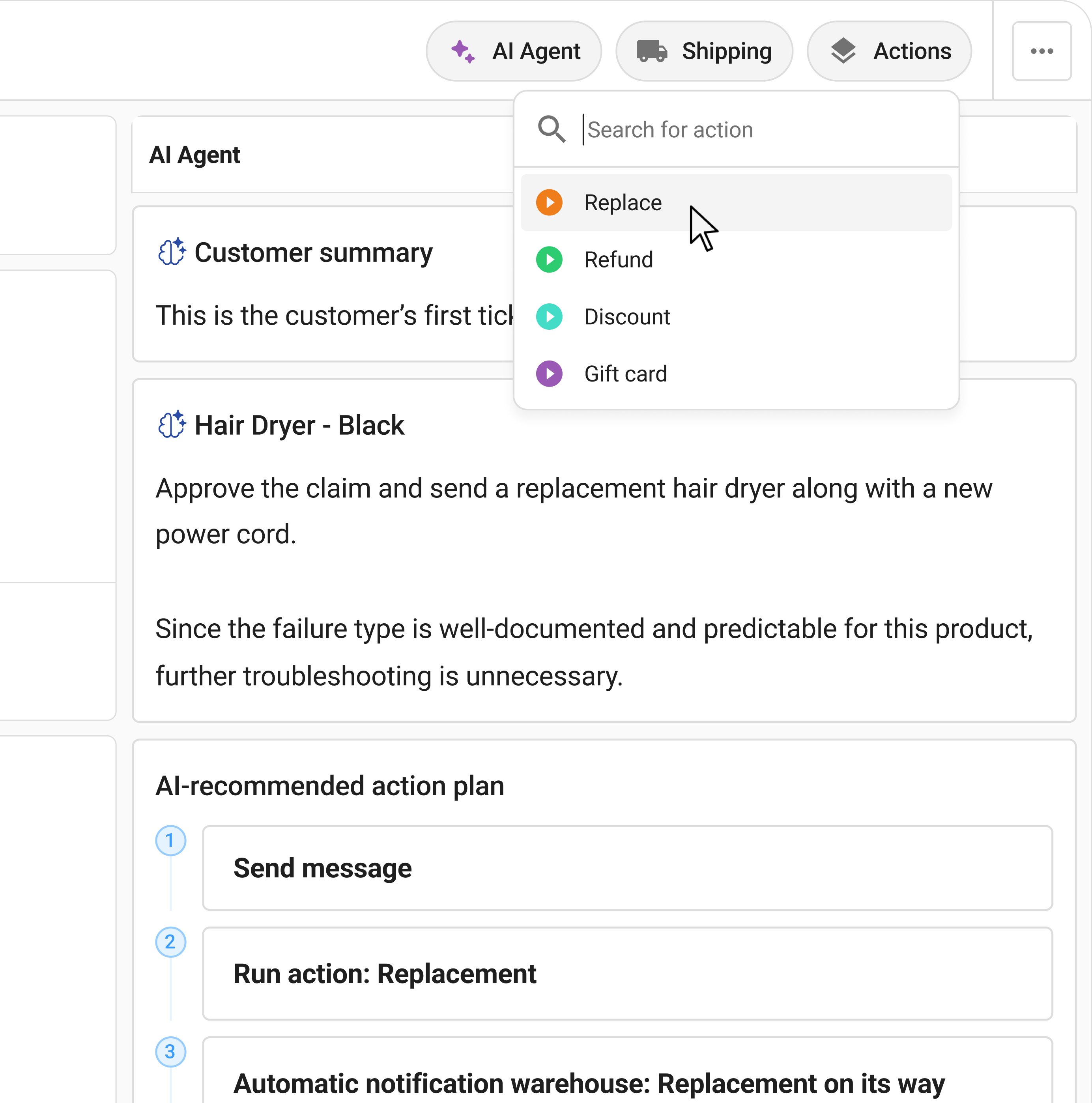
This is where AI changes the math. Claimlane's AI Agent, the first AI agent purpose-built for warranty claims and returns, reads the photos, applies the warranty rules per product and supplier, and recommends or auto-approves the right action. Agents review and confirm, instead of starting from zero.
Where AI works and where it doesn't
AI handles the routine 70-80% well: visible damage, missing parts, clear warranty eligibility. The 20-30% edge cases (disputed claims, complex repairs, gray-area policy) still need a person. The point isn't to replace agents. It's to free them up for the cases that need judgment.
MaxGaming, the largest gaming and e-sports retailer in Scandinavia with 30,000+ SKUs, resolves complex RMA cases 77% faster using Claimlane's AI Agent. The MaxGaming case study covers the full setup.
Challenge 4: Repair vs replace decisions are inconsistent
Five agents, five different judgment calls on the same defect. Some replace too fast (cost goes up). Some push for repair when replacement would be faster (resolution time goes up). Customers compare notes online and your brand looks arbitrary.
Repair vs replace warranty claims covers the framework. The short version: write the rules into the workflow, not the agent's head.
The fix
Define repair-vs-replace logic per product category and per defect type, then enforce it through workflows. When a claim comes in with a specific defect on a specific SKU, the system shows the agent the recommended path with the cost and time impact. Override is allowed but logged.
- Product cost is high relative to repair
- Defect is localized and verifiable
- Customer values the original unit
- Spare parts are in stock
- Repair cost exceeds 50% of unit cost
- Defect indicates a quality pattern
- Customer churn risk is high
- Supplier credit covers replacement
Challenge 5: SLA tracking is reactive, not proactive
Most warranty teams find out a claim breached SLA when the customer escalates. By then the relationship damage is done, and the win-back cost is higher than just resolving on time would have been.
Warranty SLA management for brands and how to reduce claim resolution time cover the operational side.
The fix
Set SLA timers per claim type, surface the ones approaching breach, and route them to a senior agent before they break. Claimlane's analytics module tracks SLA performance by claim type, product category, and supplier. The teams that close this gap fastest treat near-breach as a daily standup item, not a monthly report.
Challenge 6: Repeat customers, repeat issues, no pattern detection
The same customer keeps filing claims on the same product family. Or a defect pattern emerges on a single SKU and no one notices for two months because each agent only sees their own queue. By the time you spot it, you've shipped 8,000 more units.
Warranty analytics for product quality and predictive warranty analytics explain the analytics piece. How to manage repeat returns (SBWAD) covers the customer side.
The fix
Run weekly reports on defect rate by SKU, supplier, and batch. Set an alert threshold (e.g., defect rate on a single SKU rises above 2x the category average) so the merchandising team and the supplier hear about it in week one, not month three. Claimlane's analytics surface this automatically and let you push the data back to the supplier with proof.
Challenge 7: No audit trail when things go wrong
A disputed warranty claim becomes a legal letter. The brand needs to show: when the claim was filed, what evidence was provided, what decision was made and why, who made it, and what was communicated to the customer. If that trail lives across emails and one agent's memory, you're exposed.
EU right to repair, implied warranty, and GPSR for retailers all push toward stricter documentation.
The fix
Every action on every claim gets logged with timestamp, agent, and reasoning. Photos, customer messages, supplier responses, and resolution decisions all stay attached to the claim record. This isn't just compliance. It's also how you train new agents on edge cases without making them shadow for three months.
How the seven challenges connect
Fix one and the others get easier. Consolidate data (Challenge 1) and triage automation (Challenge 3) starts working because the AI Agent has clean inputs. Add supplier forwarding (Challenge 2) and supplier coordination stops killing the SLA (Challenge 5). Add analytics (Challenge 6) and the audit trail (Challenge 7) builds itself.
This is the case for treating warranty management as one connected workflow, not five separate apps. The 4 pillars of warranty claims software lays out the framework. The next-level pieces (best warranty management software, warranty claim software) compare specific tools.
For a parallel piece on the practices that prevent these challenges in the first place, see the upcoming article on warranty management best practices for operations leaders.
Why brands trust Claimlane on warranty
Claimlane is rated 4.8/5 on G2 by brands and retailers running real warranty operations. Read the reviews and see why operations teams pick it over fragmented stacks.
See Claimlane reviews on G2 →Brands using Claimlane for warranty operations include Davidsen (who went from 5 agents handling claims to 1-2), Black Diamond, MaxGaming, and Konges Sløjd. The Davidsen case study, Black Diamond case study, and GrejFreak case study cover the operational change in detail.
Claimlane is rated 4.8/5 on G2 across warranty and returns categories.
What to do this quarter
If you're staring at a warranty queue that keeps growing, pick two challenges and fix them first. Most operations leaders see the biggest gain from consolidating data (Challenge 1) and automating triage (Challenge 3). Everything else compounds from there.
For the bigger reset, see how to reduce warranty claims, how to improve your warranty claim rate, and optimize your warranty claim process.
FAQ
Conclusion
Warranty management challenges aren't separate fires. They share a common cause: scattered data and manual decisions on every claim. The fix is the same in every case. Consolidate the record, automate the routine, and use the data to push suppliers and improve product quality over time.
For a walkthrough of how Claimlane handles all seven in one platform, book a demo.