.webp)
The EU's Right to Repair Directive takes effect on July 31, 2026. For ecommerce brands selling electronics, appliances, and other covered products into the European market, this is not a future problem. It is a compliance deadline three months away.
The directive gives consumers the right to request repairs from manufacturers at a reasonable price and within a reasonable timeframe. It extends warranty periods by 12 months when a customer chooses repair over replacement. And it requires brands to keep spare parts available for years after a product goes on sale.
For brands that already handle warranty claims and repairs, the directive formalizes what good after-sales service should look like. For brands that don't have structured repair workflows yet, the clock is ticking.
- The EU Right to Repair Directive (2024/1799) requires manufacturers to repair covered products at a reasonable price and time, even after the original warranty expires. The transposition deadline is July 31, 2026.
- Covered products include washing machines, refrigerators, vacuum cleaners, electronic displays, mobile phones, tablets, and servers. More categories will be added as new Ecodesign regulations are adopted.
- Consumers who choose repair over replacement get a 12-month warranty extension from the date the repair is completed, changing the math on repair-vs-replace decisions for brands.
- Claimlane helps brands comply with repair workflows, spare parts tracking, AI-powered claim assessment, and warranty extension management from a single platform.
What Is the EU Right to Repair Directive?
The Right to Repair Directive (2024/1799) is an EU regulation that requires manufacturers to repair certain products when consumers request it, even outside the original warranty period.
The directive was published in the Official Journal of the European Union on July 30, 2024. All EU member states must transpose it into national law by July 31, 2026.
Why It Exists
The directive is part of the EU's broader push toward a circular economy. The reasoning is simple: if products get repaired instead of thrown away, waste decreases, consumers save money, and brands build longer customer relationships.
Before this directive, consumers often had no practical option but to replace broken products. Repair services were difficult to find, spare parts were expensive or unavailable, and some manufacturers used software restrictions to block independent repairs.
The directive addresses all three problems.
The Legal Framework
The Right to Repair works alongside several existing EU regulations:
- The Sale of Goods Directive, which governs implied warranty rights across the EU
- The Ecodesign Directive, which sets repairability requirements for specific product categories
- The GPSR (General Product Safety Regulation), which governs product safety and recall processes
Together, these create a comprehensive framework for how products must be designed, sold, supported, and repaired across the European market.
When Does the Right to Repair Take Effect?
July 31, 2026. That is the deadline for all EU member states to have national legislation in place.
Some countries are already ahead of schedule. Germany published its draft implementation law in early 2026, with specific requirements for electronics and appliance manufacturers.
Critical detail: the repair obligation applies to products sold before July 31, 2026, not just products sold after. If a consumer bought a washing machine in 2024, the manufacturer must still honor repair requests starting from the directive's effective date.
Which Products Are Covered?

The directive covers products that already have EU Ecodesign repairability requirements. The initial list includes:
| Product Category | Examples | Spare Parts Duration |
|---|---|---|
| Large household appliances | Washing machines, dishwashers, refrigerators | 7-10 years |
| Small household appliances | Vacuum cleaners | 7 years |
| Electronic displays | TVs, monitors | 7 years |
| Mobile phones and tablets | Smartphones, tablets | 5 years |
| Servers and data storage | Enterprise servers | 7 years |
| Batteries | Portable and industrial batteries | Per regulation |
Will More Products Be Added?
Yes. The European Commission has the authority to expand the list as new Ecodesign regulations come into force. Furniture, textiles, and other product categories are on the roadmap.
For furniture brands, this means the directive may eventually apply directly. Brands like Swoon that already run repair and replacement workflows will have a head start when the scope expands.
For electronics brands, the requirements are already active and non-negotiable.
What Manufacturers Must Do
The directive creates four core obligations for manufacturers of covered products.
Repair at Reasonable Cost and Time
When a consumer requests a repair, the manufacturer must:
- Complete the repair within a reasonable timeframe
- Charge a reasonable price (or provide the repair for free)
- Provide a cost estimate before beginning the repair
The directive does not define exact numbers for "reasonable." National courts in each member state will interpret these terms based on product type, repair complexity, and local market conditions.
Provide Spare Parts at Reasonable Prices
Manufacturers must keep spare parts available for a defined period after the last unit of a product is sold. The specific duration depends on the product category and the applicable Ecodesign regulation.
This is a major shift. Many brands currently stop stocking spare parts within 2-3 years of a product's end of life. The directive pushes that timeline to 5-10 years depending on the category.
For brands that already use spare parts management systems, this is an operational expansion. For brands that don't track parts at all, it's a new logistics challenge.
Share Repair Information Publicly
Manufacturers must publish:
- Clear information about their repair services
- Indicative pricing for common repairs
- Access to repair manuals and diagnostic tools
This information must be easy to find, typically on the manufacturer's website or through the upcoming European Repair Platform.
No Software or Hardware Barriers to Repair
The directive explicitly prohibits manufacturers from using software, hardware, or contractual terms that prevent or obstruct repairs. This includes:
- Software locks that disable a device after a third-party repair
- Firmware updates that block non-original components
- Warranty terms that penalize consumers for using independent repair shops
Independent repair shops must be able to use non-original spare parts, unless there is a legitimate reason (such as safety certification or intellectual property) to require originals.
What Sellers and Retailers Must Do
The directive creates obligations for sellers too, not just manufacturers.
The 12-Month Warranty Extension
This is the biggest change for retailers: when a consumer chooses repair over replacement during the legal guarantee period, the guarantee extends by an additional 12 months from the date the repair is completed.
That means a product with a standard 2-year EU warranty could effectively have a 3-year warranty if the consumer opts for repair in the second year.
For brands handling high volumes of warranty claims, this changes the math on repair vs replacement decisions. Repairs become more attractive to consumers because they gain extra warranty coverage. But brands must track extended warranty periods accurately in their systems.
Informing Customers About Repair Options
Under the updated Sale of Goods Directive, sellers must inform consumers about the availability of repairs before the consumer makes a choice between repair and replacement. Practically, this means:
- Customer service teams need to know which products qualify for repair
- Self-service portals should present repair as an option alongside replacement and refund
- Warranty workflows should route repairable products to repair paths, not default to replacement
How Right to Repair Changes Warranty Claims
The directive shifts warranty claim processing from a replace-first model to a repair-first model.
Repair-First Claim Workflows
Instead of the traditional flow (customer complains, brand sends a replacement, old product gets returned or scrapped), the directive encourages a structured repair path:
- Customer submits a claim with photos and product details
- Brand assesses whether the product is repairable
- If repairable, the brand offers repair with a cost estimate and timeline
- Customer chooses repair (with 12-month warranty extension) or replacement
- Repair is completed and tracked
- Extended warranty period begins
This requires structured claim intake, product assessment capabilities, and repair tracking, all within a single system.

Tracking Repair Timelines and Costs
The directive requires that repairs are completed within a reasonable time. Brands need to track:
- When a repair request was received
- When the repair started and finished
- What parts were used and at what cost
- When the extended warranty period begins and ends
Without a system to track these data points, compliance becomes guesswork.
"Before Claimlane, our entire customer service team of 5 agents was involved in claims handling, with additional seasonal help from other departments. Today, we have 1-2 agents who can solve everything in Claimlane."
Spare Parts Management Under the Directive
Spare parts are the backbone of the Right to Repair. Without available parts, repairs cannot happen and the directive becomes unenforceable.
Availability Requirements
Manufacturers must ensure spare parts remain available for the full duration specified in the applicable Ecodesign regulation. For most covered products, that is 7-10 years after the last unit is sold.
This requires accurate demand forecasting for parts, dedicated warehousing and logistics infrastructure, and a system to track which parts go to which repairs.
Pricing Rules
Spare parts must be priced "reasonably." The directive does not set maximum prices, but the intent is clear: parts should not be priced so high that repair becomes more expensive than replacement.
Brands that inflate spare parts prices to discourage repairs will face regulatory scrutiny.
Independent Repairer Access
Third-party repair shops must have access to the same spare parts that authorized service centers use. This opens the repair ecosystem and gives consumers more choices.
For brands, this means spare parts distribution needs to accommodate external partners, not just internal service teams.
Right to Repair vs GPSR: Key Differences
The Right to Repair Directive and the General Product Safety Regulation (GPSR) are separate regulations with different goals, but they overlap in important ways for ecommerce brands.
| Aspect | ⚙️ Right to Repair | 🛡️ GPSR |
|---|---|---|
| Focus | Product repairability and lifespan | Product safety and recall processes |
| Effective date | July 31, 2026 | Already active |
| Applies to | Manufacturers, sellers | Manufacturers, importers, distributors, retailers |
| Key requirement | Repair obligation + spare parts | Safety documentation + recall capability |
| Warranty impact | 12-month extension for repairs | No warranty changes |
Brands selling into the EU need to comply with both. A product recall under GPSR might overlap with repair obligations under the Right to Repair. Having a unified system for tracking both processes prevents gaps.
Penalties for Non-Compliance
The directive follows a full harmonization approach: member states cannot impose stricter or more lenient rules than what the directive specifies.
However, each member state sets its own penalties for non-compliance. In Germany, the draft implementation law includes fines and potential injunctive relief for manufacturers that refuse reasonable repair requests or fail to provide spare parts.
Beyond fines, the commercial risk matters just as much. Consumers who are denied repairs will file complaints with consumer protection agencies, leave negative reviews, and switch brands. In a market where customer experience drives loyalty, non-compliance is a brand risk alongside a legal one.
How to Prepare: A Compliance Checklist
Here is what ecommerce brands should complete before July 31, 2026:
Identify which products fall under Ecodesign repairability requirements
Confirm parts availability for covered products for the required 5-10 year duration
Build structured processes for receiving, assessing, and tracking repairs end-to-end
System must handle the 12-month warranty extension for repair-opted claims
Add repair services, indicative pricing, and spare parts details to your website
Agents must know which products qualify and how to present repair options
Ensure supplier contracts include spare parts commitments matching the directive
ERP, claims platform, and spare parts system must share data for compliance tracking
Keep records of repair requests, timelines, costs, and outcomes for regulatory audits
The EU's pan-European repair platform launches July 2027. Register early for visibility

How Claimlane Supports Right to Repair Compliance
Claimlane is a warranty and returns management platform built for exactly this kind of regulatory shift. Here is how it maps to the directive's requirements.
Repair Workflows
Claimlane's workflow engine lets brands build repair-first claim flows. When a customer submits a claim, the system can automatically assess whether the product is repairable, present repair as an option, and route the claim to the right service team or external repair partner.
Spare Parts Tracking
Through the spare parts management capabilities, brands can track which parts are used in each repair, monitor spare parts inventory levels, and confirm that parts remain available for the required 5-10 year window.
AI-Powered Claim Assessment
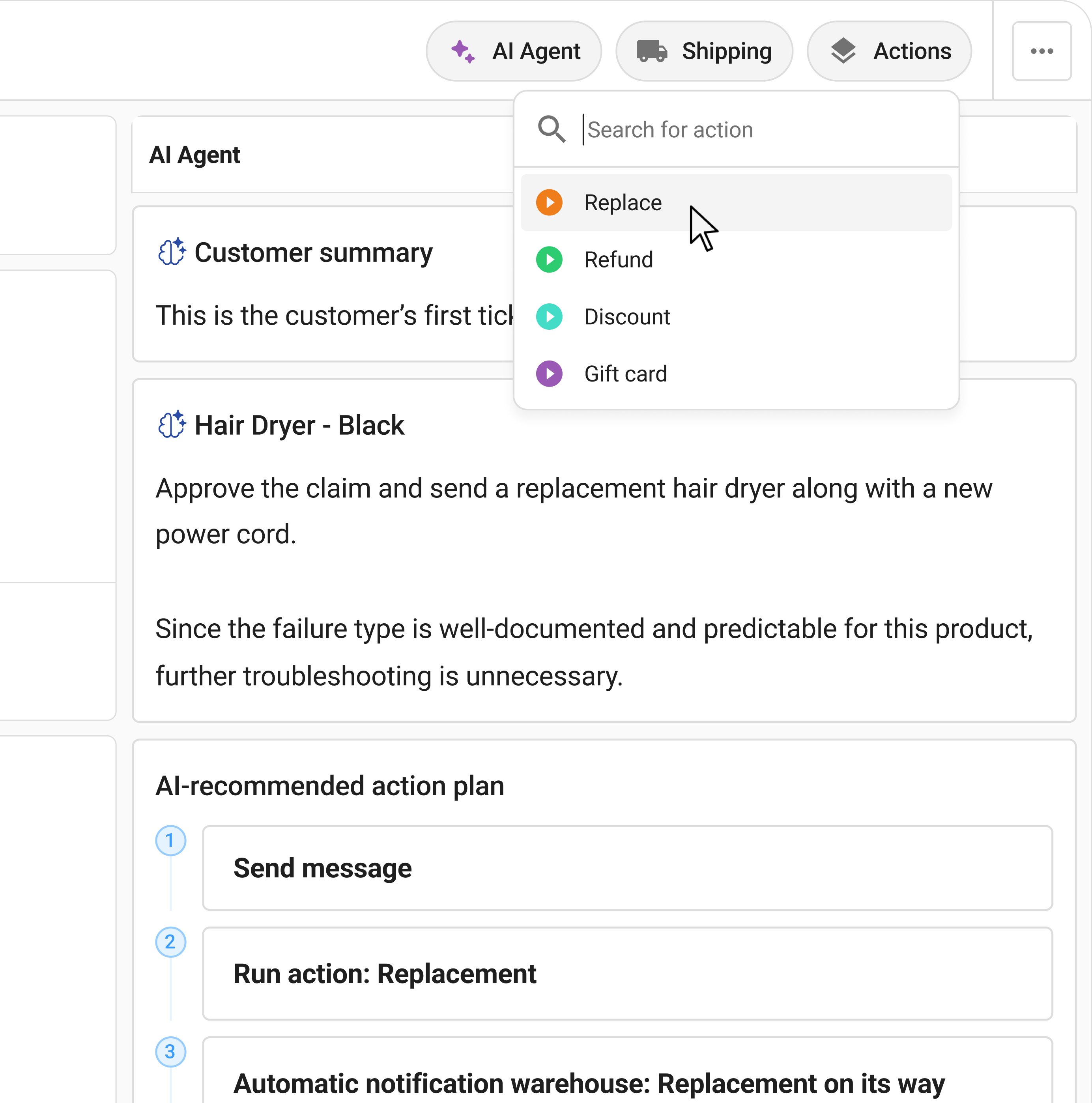
Claimlane's AI Agent, the first AI agent purpose-built for warranty claims and returns, analyzes product images and videos submitted by customers. It applies warranty rules per product and supplier, and recommends whether a product should be repaired, replaced, or refunded. This speeds up the repairability assessment that the directive requires and reduces the manual effort for customer service teams.
Warranty Registration and Extension Tracking
With warranty registration, brands can track warranty periods accurately, including the 12-month extension triggered when customers choose repair. Every claim, repair, and warranty event is logged in a single system.
Analytics and Compliance Reporting
Claimlane's analytics dashboard tracks repair rates, repair costs, spare parts usage, and claim resolution times. These metrics are essential for demonstrating compliance during audits and for optimizing repair operations over time.
Supplier Forwarding for Repairs
When repairs require supplier involvement, Claimlane's forward-to-supplier feature routes claims directly to suppliers with all documentation attached. This is critical for B2B warranty claims where the manufacturer needs supplier input on repair feasibility or parts sourcing.
Claimlane is rated 4.8/5 on G2.
The Environmental Angle
The Right to Repair is not only about legal compliance. It is about sustainability.
The European Commission estimates that better repair practices could reduce waste by 35 million tonnes per year across the EU. For brands, this creates a genuine marketing opportunity: companies that make repair easy can position themselves as environmentally responsible.
Consumer attitudes back this up. Research from the European Council shows that 77% of EU consumers prefer to repair products rather than replace them. Brands that meet this preference build stronger long-term loyalty.
For a detailed look at the sustainability side of warranty claims, see The Environmental Impact of Customer Warranty Claims.
There is also a financial incentive. Repairs that recover a product's functionality at a fraction of the replacement cost turn warranty claims from pure cost centers into revenue-preserving operations. The hidden costs of returns and claims become visible once brands start comparing repair vs replacement economics systematically.
Industry-Specific Implications
Electronics and Appliance Brands
The directive hits electronics brands first. Mobile phones, washing machines, and displays are already in scope. Brands selling these products into the EU must be ready by July 2026.
Furniture and Home Goods
While furniture is not yet covered, it is on the EU's expansion roadmap. Brands like Swoon that already have repair workflows will be ahead of the curve.
DIY and Hardware
DIY and hardware brands should watch closely. Power tools with electronic components may fall under future Ecodesign expansions. The repair mindset is already strong among DIY customers, who expect spare parts availability and clear repair instructions.
Davidsen in the Danish hardware market has already invested in structured warranty claim processes, positioning them well for any future scope expansion.
Baby and Nursery
Safety-critical products like strollers and car seats in the baby and nursery sector could see repair requirements in future iterations of the directive. Brands handling warranty registration and structured claims processes are better positioned.

The European Repair Platform (Launching 2027)
The European Commission will launch a pan-EU online repair platform by July 31, 2027. The platform will help consumers:
- Find local repair services and certified repairers
- Compare repair prices across providers
- Access refurbished product sellers
- Discover community repair initiatives
Registration will be free for businesses. While voluntary, brands that register early will gain visibility with repair-conscious consumers and demonstrate compliance commitment.
FAQ
Yes. The repair obligation applies to all in-scope products regardless of purchase date. If a consumer owns a covered product and requests a repair after July 31, 2026, the manufacturer must comply.
The directive covers products with EU Ecodesign repairability requirements: washing machines, dishwashers, refrigerators, vacuum cleaners, electronic displays, mobile phones, tablets, servers, and batteries.
When a consumer chooses repair instead of replacement during the legal guarantee period, the seller's liability extends by 12 additional months from the repair completion date.
Yes. Any brand selling covered products to EU consumers must comply, whether sales happen in physical stores or through online channels.
Yes, but at a reasonable price. The directive doesn't set maximum prices, but repairs shouldn't be priced so high that consumers are pushed toward buying a replacement instead.
Yes. The European Commission can expand the scope as new Ecodesign regulations are adopted. Textiles and furniture are among the categories under consideration.
They are separate regulations. GPSR covers product safety and recalls. Right to Repair covers product repairability and lifespan. Brands selling into the EU must comply with both.
Claimlane provides repair workflows, spare parts tracking, AI-powered claim assessment, warranty extension management, and compliance analytics, helping brands meet every requirement of the directive from one platform.