
.webp)
Omnichannel customer service means every support channel works through one system with shared customer context. That covers email, chat, phone, social, and self-service. The customer doesn't repeat themselves. The agent sees the full history. The experience feels continuous regardless of which channel the customer uses.
For ecommerce brands, omnichannel customer service is table stakes. Customers reach out through Instagram DMs, email, live chat, and phone, sometimes about the same issue. The brands that handle this well build customer loyalty. The brands that don't create frustration that costs repeat purchases.
This guide compares the leading omnichannel customer service platforms for ecommerce, with particular attention to how each handles post-purchase interactions: returns, warranty claims, and delivery issues.
- • True omnichannel = unified context, not just multiple channels.
- • Most platforms: strong on messaging, weak on returns and warranty.
- • Post-purchase = 60-70% of support volume.
- • Claimlane automates the post-purchase claims that omnichannel platforms can't handle natively.
Best Omnichannel Customer Service Platforms Compared
| Platform | Channels | Best For | Post-Purchase | Price |
|---|---|---|---|---|
| Claimlane | Portal, email, integrations | Returns & warranty | Purpose-built AI | Custom |
| Zendesk | All channels | Enterprise | Ticket-based | $55/agent |
| Gladly | Voice, email, chat, SMS | DTC brands | Conversation only | Custom |
| Gorgias | Email, chat, social | Shopify brands | Macros | $10/mo |
What Is Omnichannel Customer Service?
Omnichannel customer service is not the same as multichannel customer service. The difference:
- Multichannel: Multiple channels exist (email, chat, phone) but they operate independently. A customer who emails about a problem and then calls has to explain the issue again.
- Omnichannel: All channels are connected through a unified system. The agent on the phone sees the email thread. The chatbot knows about the open ticket. Context follows the customer.
For omnichannel ecommerce specifically, this extends to order data. The agent should see order history, delivery status, previous returns, and warranty claims without asking the customer.
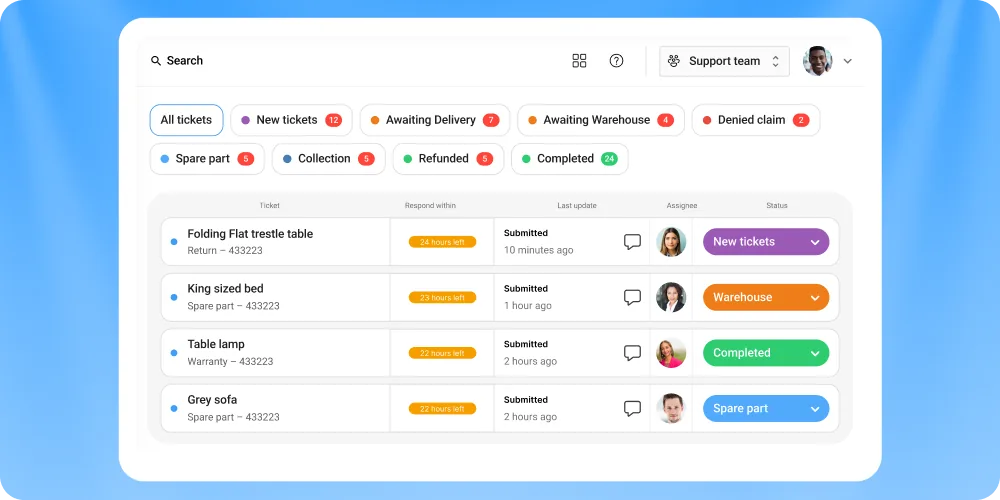
Claimlane: The Post-Purchase Layer for Omnichannel Support
Claimlane is not a traditional omnichannel helpdesk. It's the layer that handles the post-purchase interactions general helpdesks handle poorly. That covers warranty claims, defect assessment, and supplier recovery.
Why it complements omnichannel platforms:
- Zendesk handles the general support ticket. Claimlane handles the warranty claim inside it.
- Gorgias shows the Shopify order data. Claimlane processes the return with AI image analysis.
- Any helpdesk can route a ticket. Only Claimlane can assess a defect photo and auto-approve a warranty claim.
Key features:
- AI defect analysis: Image recognition identifies product defects and assesses severity.
- Self-service portal: Customers submit claims with guided evidence collection.
- Automated workflows: Product-specific warranty rules determine resolution automatically.
- Supplier forwarding: Defect claims are compiled and forwarded to suppliers for cost recovery.
- Analytics: Defect patterns, product quality trends, and operational metrics.
- 75+ integrations: Connects with Shopify, Zendesk, WooCommerce, Business Central, and more.
Coolshop, a major Nordic online retailer, uses Claimlane alongside its existing helpdesk to separate warranty claims from general support. The helpdesk handles pre-purchase questions and order status. Claimlane handles the product quality claims that need evidence review and supplier coordination.
With Claimlane, we've transformed our returns process into a streamlined, automated system. We can now efficiently track the status of all returns and claims, and our teams collaborate more effectively than ever before. In short, the solution helps us streamline communication and share information both internally and externally, which has been key to our success.
Simone Andersen · Customer Care Manager, Coolshop

Zendesk: Best for Enterprise Omnichannel
Zendesk is the most established omnichannel platform. It supports email, live chat, phone, social, and messaging apps in one agent workspace. Zendesk AI adds ticket classification, response suggestions, and bot-powered first replies.
Strengths: Broadest channel coverage, enterprise-grade security, massive marketplace of apps and integrations, extensive reporting and analytics.
Omnichannel capability: True unified inbox with full conversation history across channels. Agent workspace shows customer context from all touchpoints.
Post-purchase limitation: Zendesk handles claims as tickets. No image analysis, no warranty rule engine, no automated claim resolution. Brands using Zendesk with Claimlane route warranty claims to Claimlane for specialized processing.
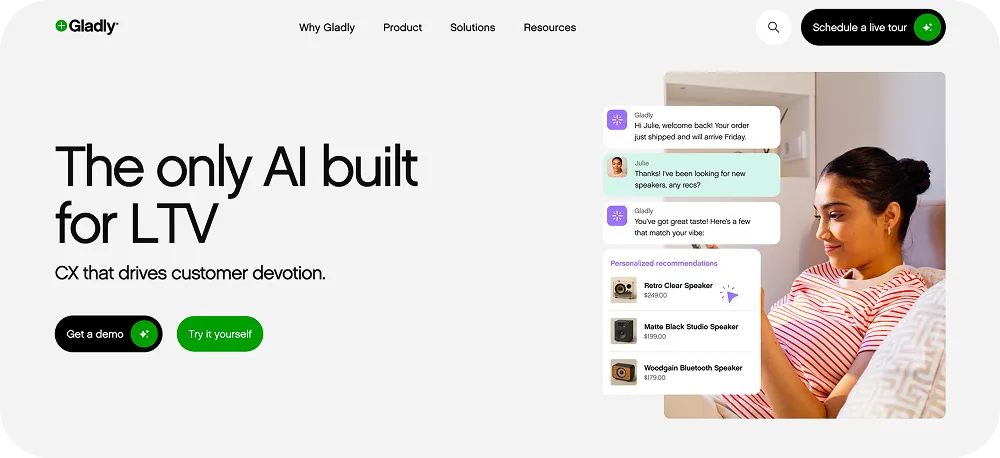
Gladly: Best for Customer-Centric DTC Brands
Gladly organizes everything around the customer rather than the ticket. One continuous conversation per customer, across all channels. Agents see the complete relationship history.
Strengths: Customer-first data model, native voice integration, strong personalization capabilities.
Omnichannel capability: All channels feed into a single customer timeline. No ticket numbers, just conversations.
Post-purchase limitation: Returns require agent intervention. No automated claim assessment or warranty rule logic.
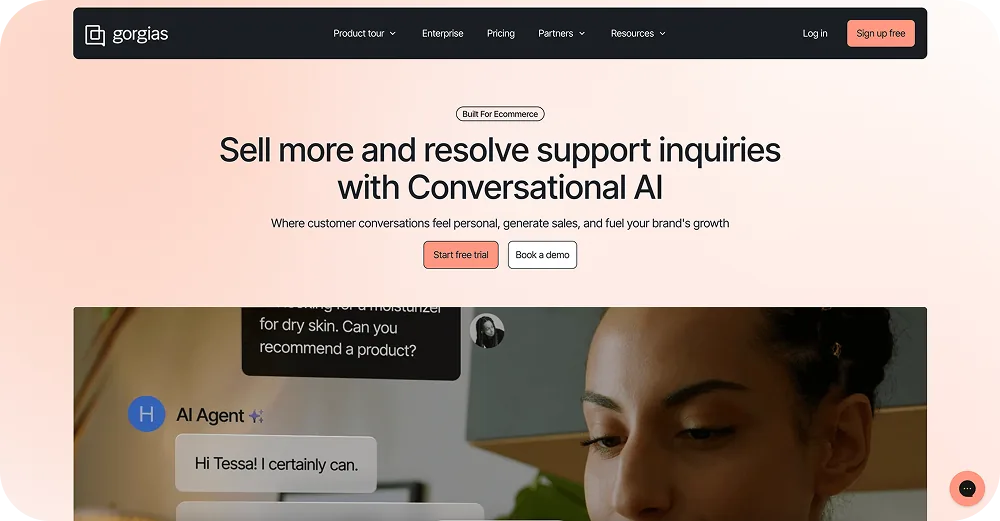
Gorgias: Best for Shopify-Native Support
Gorgias is built for ecommerce with deep Shopify integration. Order data appears directly in the support conversation. Agents can issue refunds, cancel orders, and create return labels without switching tools.
Strengths: Shopify-native, order context in every ticket, macro-based automation, affordable for small teams.
Omnichannel capability: Email, chat, social media, and SMS in one inbox. Shopify order data enhances context.
Post-purchase limitation: Returns are macro-based (template responses). No AI claim assessment, no supplier forwarding.
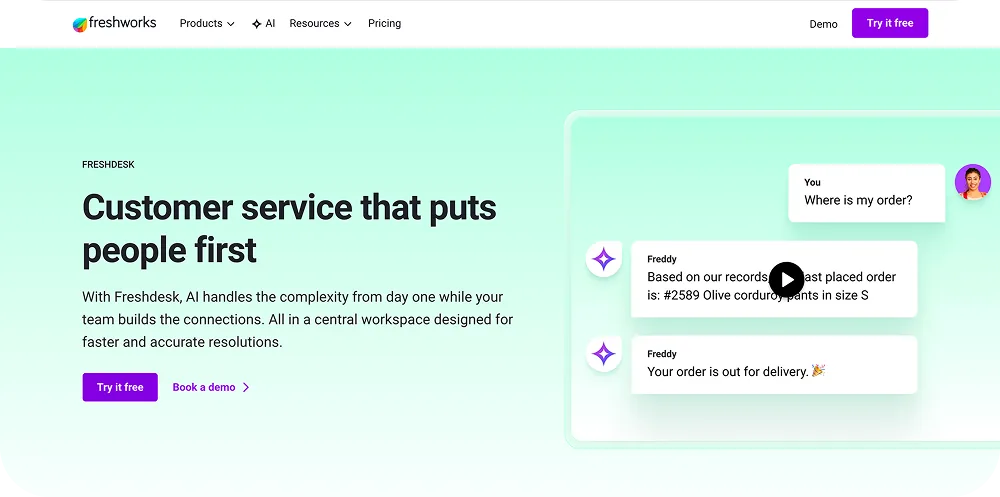
Freshdesk: Best for Mid-Market Teams
Freshdesk offers a full omnichannel suite at competitive pricing. Channels covered: email, phone, chat, social, and WhatsApp. Freddy AI adds ticket classification and response suggestions.
Strengths: Strong value for mid-market teams, good phone/voice support, WhatsApp integration, affordable pricing tiers.
Post-purchase limitation: General ticketing system without ecommerce-specific features or claim automation.
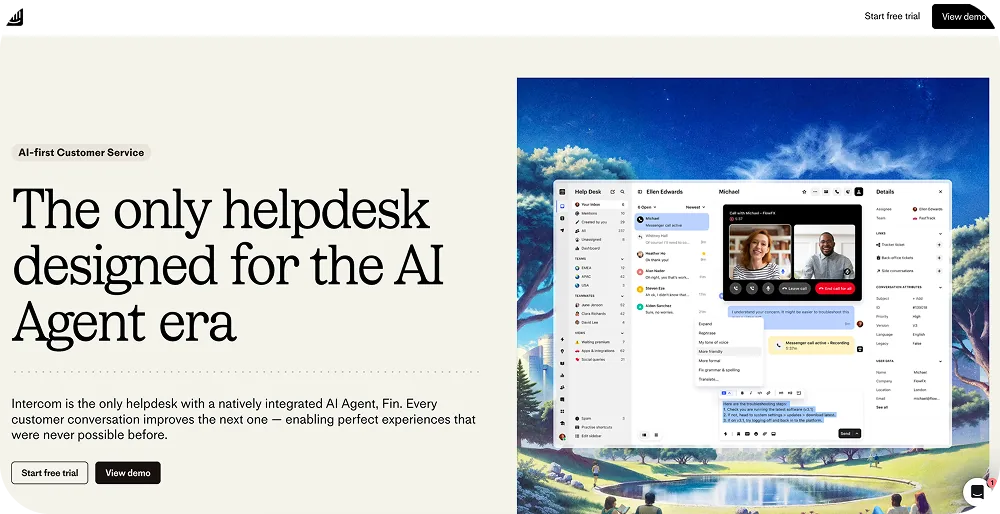
Intercom: Best for Product-Led Companies
ntercom is strong at in-app messaging and conversational support. The Fin AI agent handles routine inquiries automatically. The messenger embeds directly into products and websites.
Strengths: Strongest messenger experience, strong AI agent (Fin), excellent for SaaS and product-led companies.
Post-purchase limitation: Designed for digital products more than physical goods. No warranty claim workflows.
The Omnichannel Post-Purchase Gap
Every omnichannel platform shares the same weakness: post-purchase operations.
The pattern:
- Strong: Messaging, ticketing, routing, agent workspace, AI for response generation
- Weak: Warranty claim assessment, image-based defect analysis, automated resolution, supplier forwarding
This matters because post-purchase support is 60-70% of ecommerce support volume. The biggest category of support interactions is the one omnichannel platforms handle worst.
Omnichannel Customer Service and Customer Loyalty
The connection between omnichannel customer service and customer loyalty is well documented but often misread. Loyalty programs (points, tiers, rewards) drive repeat purchases. Omnichannel customer service drives the willingness to use them.
A customer who has a terrible return experience won't redeem their loyalty points. A customer who has a fast, fair warranty claim resolution will shop again without needing a discount.
The most effective customer loyalty plans combine:
- Loyalty program mechanics (points, tiers, exclusive access) handled by platforms like Voyado or Yotpo
- Omnichannel support (unified messaging and ticketing) handled by Zendesk, Gladly, or Gorgias
- Post-purchase excellence (fast claims, fair resolutions, easy returns) handled by Claimlane
How to Choose an Omnichannel Platform
Channel Requirements
List the channels your customers actually use. If 90% of support is email and chat, you don't need a platform optimized for phone. Match the platform to your channel mix.
Ecommerce Integration Depth
Surface-level integrations show order numbers. Deep integrations show order history, delivery tracking, previous returns, and customer lifetime value. Gorgias and Gladly lead here.
AI Capabilities
Every platform now offers AI. The question is where: response suggestions, ticket classification, automatic resolution, or sentiment analysis? Match AI capabilities to your highest-volume use cases.
Post-Purchase Handling
Ask specifically: how does this platform handle warranty claims? If the answer is "through tickets," you'll need a complementary tool like Claimlane for claims automation.
Scalability and Pricing
Per-agent pricing works for small teams. At scale, it becomes expensive. Check for volume-based pricing, automation discounts, and hidden costs (phone minutes, AI usage fees).