.webp)
Introduction: sentiment is a routing signal, not a chatbot feature
Most AI sentiment vendors pitch sentiment as a dashboard. A mood meter on top of the support inbox. That framing wastes the signal. Sentiment is a routing input. The interesting question is not how angry the customer is on average. It is which claim decision should fire next, given everything the conversation, the photo and the order history say together.
In 2026, the brands getting value from sentiment AI run it as part of a best-of-breed stack. Conversations stay in Zendesk, Gorgias or Intercom. The conversational AI inside the support tool handles tier one. A claims-specialist agent picks up sentiment alongside image and order signals to decide what happens on the warranty or return side: approve, escalate, route to supplier, push to repair, schedule a human callback. The pattern mirrors the broader read in ecommerce AI agents and the deeper logic in AI agents post-purchase support.
What AI sentiment analysis actually does in customer service
AI sentiment analysis in customer service uses natural language processing, voice tone analysis and behavioural signals to score the emotional valence of an interaction in real time, so the system can route, prioritise or trigger an action based on the score rather than wait for a human to read the ticket.
The useful definition is not "detects positive or negative." That is a 2018 framing. Modern sentiment analysis reads multiple signals together: lexical content of the message, escalation patterns across a thread, time-to-reply gaps, capitalisation and punctuation density, voice prosody when calls feed in, and contextual order data (high-value purchase, second claim, late delivery). The output is a structured score plus a recommended next action.
The scoring side is solved technology. The action side is where most deployments fall short. The supporting view on automation maturity is in AI customer service automation and contact center automation technologies.
Why sentiment matters specifically on claims and warranty
Sentiment data has the highest leverage on the interactions that already cost the most. Warranty disputes, damaged-in-transit claims, repair-or-replace decisions and B2B claims all have multiple stakeholders, multiple touchpoints and a real risk of regulatory or churn cost. Tier-one shipping questions do not.
Three dynamics make claims a sentiment sweet spot.
The customer is already frustrated. Returns and warranty interactions start at a lower baseline than general support. Sentiment that drops further is a leading indicator of escalation, churn, or a public complaint.
The decision is high stakes. Approving the wrong claim costs money. Denying the right claim costs a customer. Sentiment plus image evidence plus order history is a stronger basis for that decision than rules alone. The architecture pattern shows up in thinking in workflows warranty resolution.
The resolution path is multi-system. A claim touches the customer-facing portal, the support tool, the OMS, the supplier portal and the repair partner. Sentiment is the signal that decides which path the claim takes through that chain. Deeper read in how to reduce claim resolution time in customer service.
The best-of-breed split: conversation layer vs claims execution layer
The stack architecture that works in 2026 keeps two layers separate.
Zendesk · Gorgias · Intercom · Salesforce Service
- Owns the customer thread
- Runs first-line conversational AI
- Detects baseline sentiment
- Surfaces escalation patterns
Claimlane AI Agent
- Owns the claim decision
- Reads sentiment, image, order, serial
- Routes to supplier, repair, refund, escalate
- Applies brand- and supplier-specific rules
Sentiment crosses the boundary. The conversation layer detects it in the thread. The claims layer uses it as one input among several to drive the decision. Brands that try to do everything in one tool collapse the layers and end up with a worse customer experience and a worse claim outcome. The architecture argument is consistent with omnichannel customer service platforms and best ecommerce customer service software.
Real-time vs post-hoc sentiment
Two modes show up in vendor pitches. Only one is operationally useful.
Real-time sentiment scores each message as it arrives. The score drives routing, prioritisation and decision triggers. This is the mode that matters on claims.
Post-hoc sentiment aggregates scores across thousands of tickets to produce dashboards. Useful for trend analysis. Not useful for changing the outcome of the ticket the customer is in right now.
The gap matters when the brand evaluates vendors. Vendors that ship only post-hoc sentiment cannot drive a routing change mid-conversation. The decision-loop view is in voice AI customer service and post-sales ticketing system.
The signals a useful sentiment agent reads
A single sentiment number per message is a thin signal. A useful agent reads more.
Lexical signal. Word choice, intensity, threat patterns (legal language, social-media references), and resolution language.
Escalation pattern. Sentiment trajectory across the thread. A slowly rising negative slope is a stronger predictor than a one-off angry message.
Voice prosody. Tone, speech rate and silence patterns when calls or voice notes feed in. Pattern explored in voice AI customer service.
Image and video sentiment. Damage photos with annotations, video walk-throughs of a defect. The visual evidence carries emotional information that supports or contradicts the text. The mechanics are in AI image recognition warranty claims.
Behavioural metadata. Time on page, repeated form submissions, abandoned attempts, prior claim history. These are reliable predictors of escalation.
Combined signal beats any single channel. A claims-specialist agent reading all five gets a sharper read than a chatbot reading lexical content alone.
Use cases that move the needle on claims and returns
Five use cases concentrate the value.
Warranty disputes
The sentiment signal flags warranty cases where the customer expects coverage and the policy is ambiguous. The agent escalates to a senior reviewer or routes to a human callback before the case turns into a public complaint. The framework view is in warranty SLA management and warranty management best practices.
Damaged-in-transit claims
Photos plus message tone reveal whether the damage is minor cosmetic or major functional. Sentiment routes the case to the right resolution path (returnless on minor, replacement with carrier claim on major). Operational pattern in how to handle damaged in transit claims.
Complex B2B claims
B2B threads run longer and involve more stakeholders. Sentiment drift across the thread predicts whether the account is at risk and which contact needs an outreach. Tactical read in B2B warranty claims and how to simplify B2B returns.
Refund disputes
Sentiment around fairness ("why am I not getting a full refund") is a strong early signal of a chargeback risk. Routing to a human resolver before the dispute formalises saves the chargeback fee and the relationship. The chargeback view is in payment reversals and chargebacks.
Repair vs replace tension
Customers often push for replacement when repair is the operationally and environmentally correct path. Sentiment reading on "do not want this fixed" language flags cases that need a human explanation, not a workflow automation. The repair-vs-replace logic is in repair vs replace warranty claims.
How a claims-specialist AI agent uses sentiment
Claimlane's AI Agent, the first AI agent purpose-built for warranty claims and returns, combines sentiment with three other signals when it makes a claim decision: image evidence, serial-number lookup against serial number tracking software data, and policy match against brand and supplier rules. The agent decides one of five things on every claim:
- Auto-approve and refund
- Route to repair
- Route to supplier for chargeback
- Escalate to human reviewer
- Schedule a callback for a sensitive customer
Sentiment shifts the call between auto-approve and human review. A high-confidence approval path stays automated. A high-sentiment-risk approval path goes to a human. The result is fewer escalated complaints and faster cycle time on the majority of claims. The operational mechanics are in AI RMA automation and AI warranty claims automation.
Our agents stopped reading every long ticket twice. Sentiment routes the angry ones to humans, and the AI agent handles the straightforward claim decisions across thirty thousand SKUs.
MaxGaming runs Claimlane's AI Agent across 30,000+ SKUs and 200+ brands. Complex RMA cases close 77% faster with the agent on the call, with sentiment routing tipping the balance on the cases that need a human. Full case study at MaxGaming.
Sentiment plus image grading: the hybrid signal
The most interesting deployments combine text sentiment with image-based defect grading. The photo of a torn package plus a customer saying "this is unacceptable" gives a different routing decision than the same words with a photo showing a perfectly intact box and a minor cosmetic mark.
The hybrid signal cuts false escalation. Customers using strong language about cosmetic issues do not always need human intervention. Customers using calm language about a structural failure often do. The image plus sentiment pair sorts these cases out at intake. The broader image-driven view is in AI returns management and AI warranty fraud detection.
Common mistakes implementing sentiment AI
Four patterns slow ROI.
Starting with the dashboard. Teams that pilot sentiment for reporting first rarely move to real-time routing. Start with one routing use case, prove it works, then expand.
Ignoring the photo channel. Sentiment models trained on text only miss the strongest signal on warranty and damage claims, which is the photo evidence.
Deploying inside the chatbot only. The chatbot reads sentiment from the customer's first message and then loses signal as the case routes to a human or a workflow. The sentiment has to follow the claim through the full lifecycle.
No feedback loop on the decision. Sentiment models drift without ground truth. The claim outcome (approved, escalated, refunded, denied) is the label that lets the model improve. Without it, accuracy plateaus.
Claimlane scores 4.8/5 on G2 across returns and warranty categories.
Vendors and the build versus buy question
The build-vs-buy decision splits cleanly. Most teams buy the conversation-layer sentiment from their support vendor (Zendesk AI, Intercom Fin, Gorgias AI, Salesforce Einstein). That is the right call for tier-one ticket triage.
Building a custom sentiment stack for the claims-decision layer is harder. The signals are multi-modal (text, image, voice, order data, serial data), the action surface is operational (supplier routes, repair routes, refund logic) and the model needs domain training on claim outcomes specifically. Most brands buy a claims-specialist agent for that layer rather than build it. Comparison view in customer service automation software platforms.
Intercom, Zendesk and Gorgias all extend toward the claims layer with mixed depth. The deeper integration view sits in Zendesk RMA, Zendesk alternatives, Zendesk vs Claimlane difference and Gorgias alternatives.
Where Claimlane's AI Agent fits in your CX plus claims stack
Claimlane's AI Agent sits as a peer to the conversational AI in the support tool, not as a replacement. The architecture works as follows:
Customer message arrives in the support tool. The conversational AI handles tier-one (order status, policy questions). For claim-related messages, the support tool hands off to Claimlane via API, attaching the thread context and the sentiment score so far.
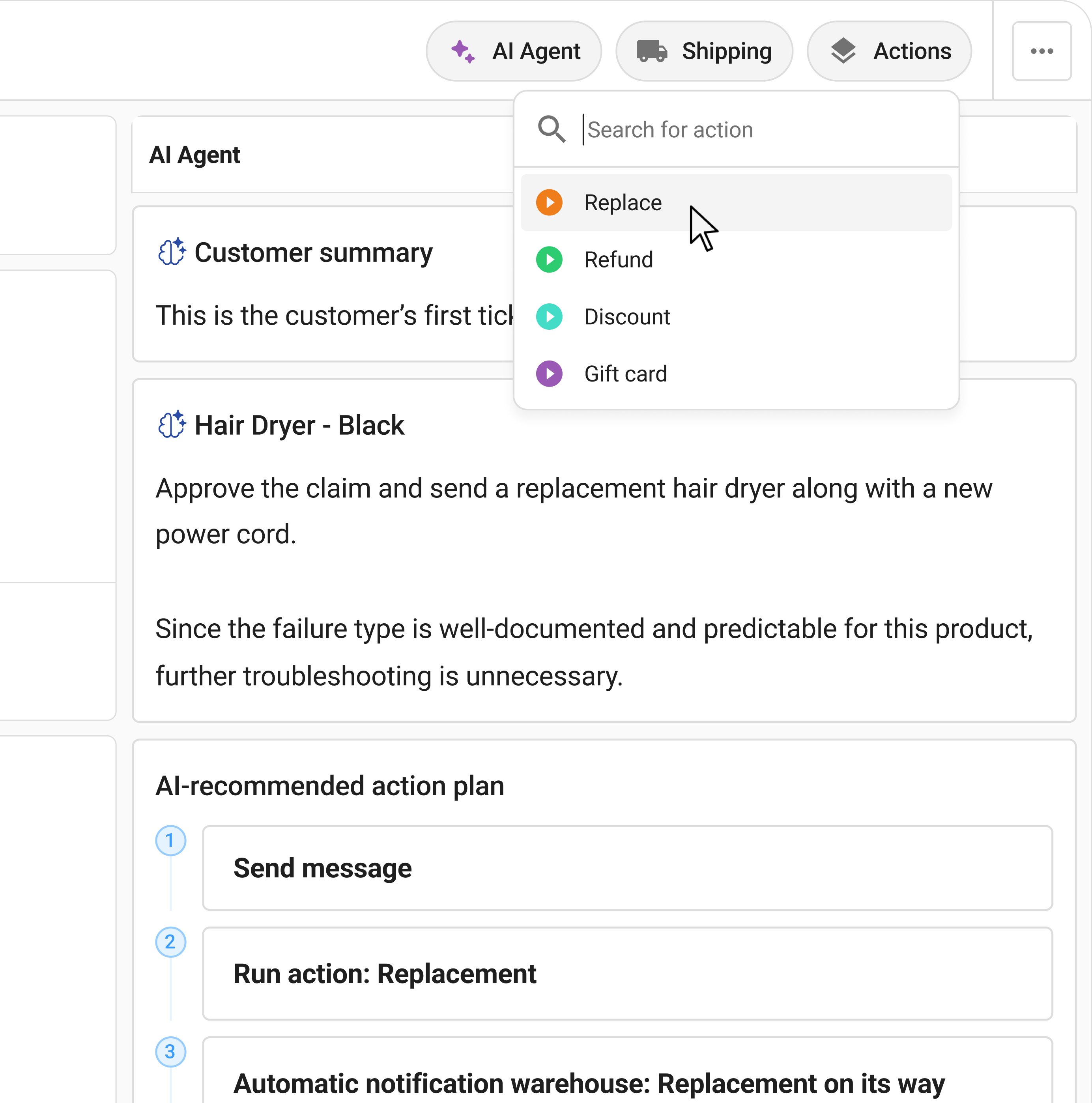
Claimlane's AI Agent reads the sentiment plus the image (if attached), runs the policy and supplier rules through Workflows, looks up serial and order data, and returns a decision. The decision either auto-resolves the claim through the self-service portal, routes via Forward to supplier, or escalates to a human with the full context attached.
Analytics on Claimlane Analytics feed the sentiment-routing model with claim outcomes (approved, repaired, escalated, churned) so the model improves over time.
The agent is built specifically for warranty claims and returns. Details and architecture at Claimlane AI Agent. Retailers running this pattern include MaxGaming at scale across thirty thousand SKUs and Skechers on global warranty claims.
See Claimlane's AI Agent sit between your CX tool and your claims P&L. Book a 30-minute walkthrough.
FAQ
Conclusion: sentiment earns its keep on the claim, not the chart
Sentiment AI is a routing input, not a metric. The brands getting value run it inside a best-of-breed stack: conversation in Zendesk, Gorgias or Intercom, claim decision in a specialist agent. Sentiment crosses the boundary via API and changes which decision fires next on the warranty, return or repair side.
The practical move in 2026 is to deploy text sentiment in the support tool, add image-based grading at claim intake, route claim-related threads to a claims-specialist agent, and feed the claim outcome back to retrain the model. The upside lands on cycle time, escalation rate and chargeback risk simultaneously.
See Claimlane's AI Agent route claims with sentiment plus image plus order data. Book a 30-minute walkthrough.