The pitch for conversational AI in warranty claims is that it talks to customers so agents do not have to. True, but incomplete, and the incomplete part is where deployments fail.
The hard skill is not conversation. It is knowing when to stop the conversation and hand the case to a person. A model that will happily approve a 900 euro repair because a customer asked nicely is worse than no automation at all. A model that collects a clean photo, a serial number, and an order reference, then routes anything unusual to a human, is worth a great deal.
So this piece draws the boundary directly. What conversational AI can be trusted to do in a warranty claim, and what it should hand off. The line is the whole product.
Conversational AI for warranty claims is a natural-language interface that guides a customer through filing a claim: collecting evidence, answering status questions, and checking coverage in plain language. Its role is guided intake and triage. It is not a decision engine for complex or high-value cases, which stay with a reviewer.
What conversational AI can do well
The strong use cases share one trait: they are bounded. The task has a clear finish line and low downside if it goes slightly wrong.
Guided intake is the strongest. A customer describes a broken product, and the interface asks for the photo, the serial number, and the order details in the right order, so nothing is missing when a reviewer picks it up. That alone removes the back-and-forth that stretches a claim over days. Claimlane's self-service warranty intake is built around this collection step.
Status answers are the second. "Where is my claim" is the most common message a warranty team gets, and it is pure deflection when a model can read the case and answer it. That is ticket deflection applied to after-sales rather than generic support.
Coverage checks are the third, within limits. A model can tell a customer whether a product is inside its warranty window and what evidence a claim will need, which cuts customer effort on claims and returns and raises first-contact resolution.
| Conversational AI can handle | It should hand off |
|---|---|
| Guided intake and evidence collection | High-value repairs and replacements |
| Claim status and next-step questions | Disputed wear-versus-defect calls |
| Warranty window and coverage checks | Supplier-liability and B2B dealer cases |
| Routine approvals within set thresholds | Anything flagged as possible fraud |
What it should not decide alone
The right column of that table is where trust is won or lost. Four case types should always reach a person, and a well-built system routes them there without a fight.
High-value cases first. The cost of a wrong approval scales with the price of the repair, so the threshold for human review should be a currency figure the brand sets. This is the core of sound AI agent guardrails on claims.
Disputed calls second. When the question is whether a fault is a defect or ordinary use, that is judgment, and a conversational layer should collect the evidence and pass it up rather than rule on it. Claimlane's deeper claims triage with image review handles that recommendation behind the chat, with a human on the decision.
Supplier and dealer cases third. Omnichannel retailers with dealer networks run hybrid B2C and B2B claim flows, where liability and credit terms sit between parties. A customer-facing chat is the wrong place to settle that.
Suspected fraud last. A flagged pattern should quietly route to review, never get argued with in the open conversation.
Conversational AI is not a chatbot
The distinction matters because most buyers have been burned by a scripted bot that looped them in circles. A rules-based chatbot follows a decision tree. A conversational AI agent reads the actual claim record and responds to the specific case. The difference is covered in AI agents versus chatbots, and it is why the older conversational AI for customer service generation felt so thin.
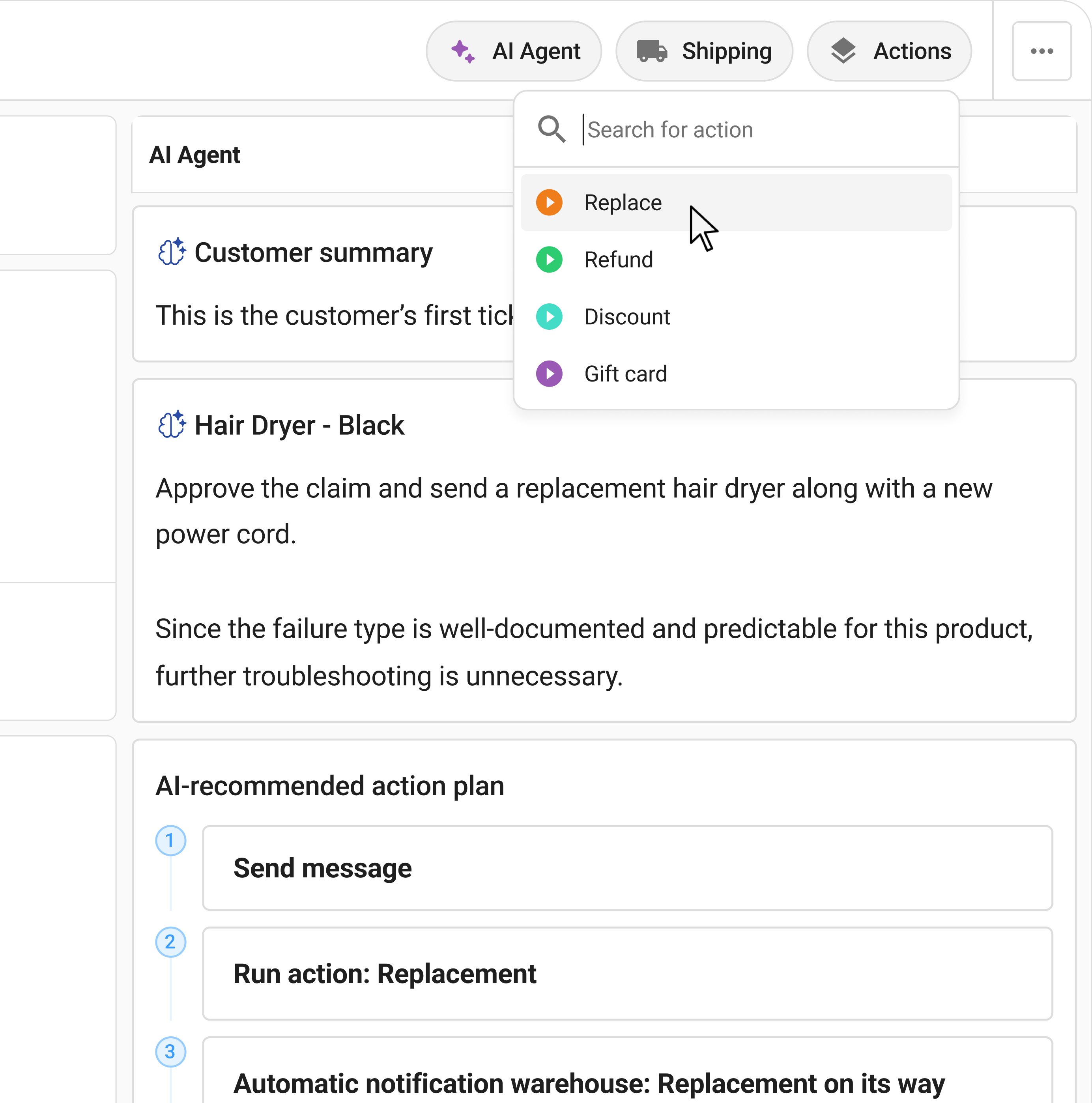
Claimlane's AI Agent, the first AI agent purpose-built for warranty claims and returns, sits on the warranty record itself, applies the brand's rules per product and supplier, and knows where the human threshold is. The mechanics are on the product AI page.
That 77% is the boundary working as intended. The agent cleared the routine volume and the routable recommendations, and the team spent its time on the cases that genuinely needed it.
The intake portal is where it lives
Conversational AI in warranty is not a floating widget. It is the front of the claim portal, feeding a structured case behind it. Brands building that flow should read how to build a claims portal, because the conversation is only as good as the record it writes to. When the intake is clean, the RMA process that follows is faster for everyone, including post-sales ticketing. Swoon runs its claims intake through Claimlane on this model, shown in the Swoon case study.
Claimlane's 4.8/5 rating on G2 comes in large part from teams that set the human threshold correctly and let the agent own everything below it.
The finance case for drawing the line well
A conversational layer that over-automates costs money on wrong approvals. One that under-automates costs money on agent time. The line between them is a dial, not a switch, and it should be set per claim type against a currency threshold. For omnichannel retailers running both consumer and dealer claims, getting that dial right is the difference between reducing customer effort and leaking margin, and it connects directly to the brand's wider integrations so the agent reads live order data.
Frequently asked questions
What can conversational AI do in a warranty claim?
Guided intake and evidence collection, claim status answers, coverage and warranty-window checks, and routine approvals within thresholds the brand sets. These are bounded tasks with a clear finish line.
What should conversational AI not decide on its own?
High-value repairs and replacements, disputed wear-versus-defect calls, supplier-liability and B2B dealer cases, and anything flagged as possible fraud. Those route to a human reviewer.
Is conversational AI the same as a chatbot?
No. A chatbot follows a scripted decision tree. A conversational AI agent reads the actual claim record and responds to the specific case, applying the brand's warranty rules rather than a fixed script.
How much faster can it make warranty claims?
Results vary by claim mix. MaxGaming resolved complex RMA cases 77% faster using Claimlane's AI Agent, by clearing routine volume and recommending actions on the rest.
Draw the line, then automate under it
The brands that get conversational AI right in warranty do not ask how human the bot sounds. They ask where the human threshold sits, set it per claim type, and let the agent own everything below it.
Seeing where that line should fall is easier with a brand's own claim types on the screen. Read how Claimlane's AI Agent handles warranty and repair cases to see the boundary drawn on real examples.