.webp)
Customer effort is the strongest predictor of loyalty in after-sales interactions. It beats satisfaction scores. It beats NPS. When a customer needs to return a product or file a warranty claim, the single biggest factor in whether they'll buy again is how hard the process was.
The Customer Effort Score (CES) measures exactly this: "How easy was it to get your issue resolved?" For returns and claims, the answer is often: not easy enough.
This guide covers practical ways to reduce customer effort at every step of the claims and returns process.
Why Customer Effort Matters More Than Satisfaction
The Research
Harvard Business Review's widely cited research on customer effort found that 96% of customers who had a high-effort experience became less loyal, compared to only 9% of those with a low-effort experience. The conclusion: reducing effort is more important than exceeding expectations.
For returns and claims, this is especially relevant. Nobody contacts support because they're happy. They contact support because something went wrong. In that moment, the brand's job isn't to delight them. It's to make the resolution as painless as possible.
The Cost of High Effort
High-effort returns experiences cost brands in multiple ways:
- Repeat contacts. When customers can't resolve the issue in one interaction, they call back, email again, or open chat. Each additional contact costs $5-12 on average.
- Negative reviews. Frustrated customers are far more likely to leave negative reviews. And they mention the return experience specifically.
- Churn. Even if the refund is processed correctly, the effort it took to get there determines whether the customer comes back.
- Social media complaints. High-effort experiences get shared. Low-effort ones don't.
Where Customer Effort Creeps In

Finding How to Start
The first friction point: figuring out how to initiate a return or claim. Many brands bury the return process behind FAQ pages, contact forms, or worse, require customers to email support and wait for instructions.
Every extra click between "I need to return this" and actually initiating the return is effort that drives dissatisfaction.
Gathering Documentation
Warranty claims often require photos, serial numbers, proof of purchase, and written descriptions of the defect. If the customer has to gather all of this, compose an email, attach files, and hope they included everything, the effort is high. And if the agent responds asking for more info, the effort doubles.
Waiting for Responses
Email-based returns processes create dead zones. The customer submits a request, waits 24-48 hours for a response, provides additional information, waits again, receives a return label, and then ships the item. A process that could take 10 minutes stretches across a week.
Repeating Information
When customers contact support about a return, they often have to re-explain the issue at each touchpoint. They tell the chatbot, then tell the agent, then tell the specialist. Each repetition is effort.
Unclear Next Steps
After initiating a return, many customers don't know what happens next. Will they get a label? When? Do they need to pack the item a specific way? When will the refund appear? Uncertainty creates anxiety, which leads to follow-up contacts.
How to Reduce Effort at Every Stage

Stage 1: Making It Easy to Start
Put the return/claims entry point where customers look first.
- Prominent link in the order confirmation email
- "Start a return" button in the customer account
- Dedicated URL (e.g., returns.yourbrand.com)
- Link in the website header or footer
A self-service portal that lets customers start a return or warranty claim in under 2 minutes is the gold standard. The portal looks up the order, presents eligible items, and guides the customer through a structured process.
Brands like Matas use Claimlane's portal to let customers initiate claims independently, reducing the need for support agent involvement.
Stage 2: Structured Data Collection
Instead of asking customers to compose a free-form email describing the problem, the claims portal collects structured data:
- Product selection from the order (no need to type product names)
- Return reason from a dropdown (categorized data, not free text)
- Photo/video upload directly in the form
- Serial number if applicable
- Description as an optional field for context
This does two things: it reduces customer effort (guided form vs. blank email) and gives the operations team structured data that can be processed automatically.
Stage 3: Instant Resolution Where Possible
Not every return needs human review. Many can be approved instantly:
- Change-of-mind returns within the return window? Auto-approve and generate a label.
- Low-value items where return shipping costs more than the product? Auto-refund without requiring the item back.
- Warranty claims that match known defect patterns? Auto-approve the resolution.
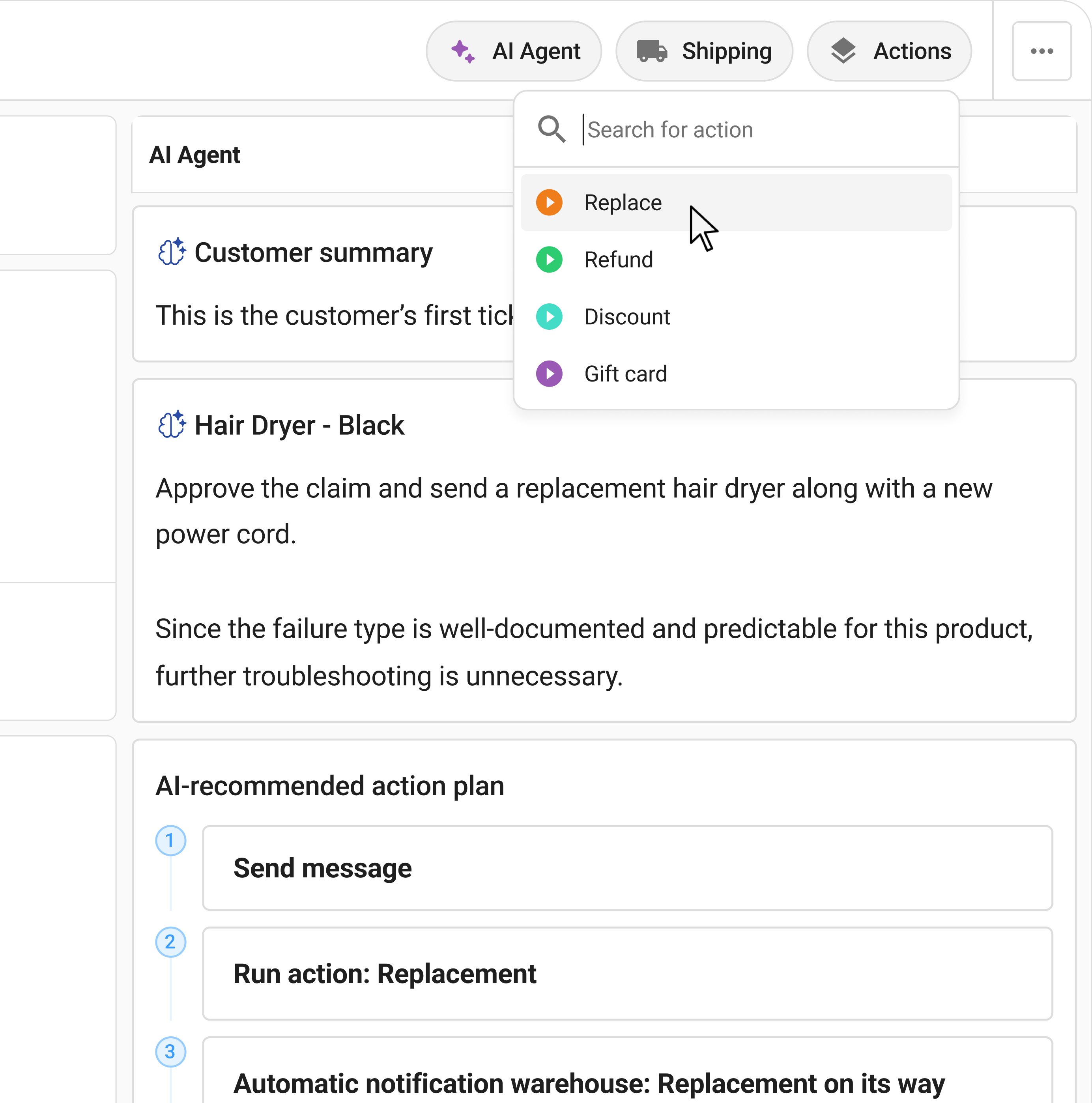
Claimlane's AI Agent, the first AI agent purpose-built for warranty claims and returns, makes instant resolution possible for warranty claims. It analyzes product images and videos, applies warranty rules per product and supplier, and recommends or auto-approves resolutions. MaxGaming resolved complex RMA cases 77% faster using this approach.
Automated workflows route each claim based on type, value, product category, and customer history, ensuring the right resolution happens without manual triage.
Stage 4: Proactive Communication
Customers shouldn't have to ask "what's happening with my return?" Automated status notifications should proactively update at each step:
- Return request confirmed
- Label generated / instructions sent
- Item received at warehouse
- Inspection complete
- Refund/replacement processed
Each proactive notification prevents a reactive support ticket. Brands that notify customers throughout the process see significant drops in "where is my refund?" inquiries.
Stage 5: Fast Resolution
Speed matters. Every day between return initiation and refund completion is a day the customer is thinking about the effort they've invested.
Benchmarks to target:
- Return label generation: Instant (within the portal session)
- Warranty claim assessment: Under 24 hours (or instant with AI)
- Refund processing: Within 3-5 business days of receiving the item
- Exchange shipment: Within 1-2 business days of receiving the return
Davidsen went from 5 agents handling claims to 1-2 agents by automating their workflow. Fewer handoffs mean faster resolution.
Measuring Customer Effort
Customer Effort Score (CES)
The standard measurement. After a return or claim is resolved, ask:
"On a scale of 1-7, how easy was it to resolve your issue?"
(1 = very difficult, 7 = very easy)
Track CES over time and by return type. Warranty claims typically score lower than standard returns because they involve more steps.
Operational Effort Metrics
CES captures the customer's perception. Operational metrics capture the actual effort:
- Number of contacts per claim. Ideal: 0-1 (self-service plus proactive notifications). If customers average 3+ contacts per claim, effort is too high.
- Time to resolution. From first contact to final resolution. Break this into waiting time vs. processing time.
- Self-service completion rate. What percentage of returns/claims are completed entirely through the portal without agent intervention?
- First-contact resolution rate. When customers do contact support, how often is the issue resolved in that first interaction?
Channel-Specific Effort
Different channels create different effort levels:
- Self-service portal: Lowest effort (customer controls the process)
- Live chat: Low effort (real-time resolution)
- Phone: Medium effort (wait times, but real-time)
- Email: Highest effort (asynchronous, multiple exchanges)
The goal is to shift as many claims as possible to the lowest-effort channels.
Reducing Effort for Warranty Claims Specifically
Warranty claims are inherently higher-effort than standard returns. The customer has a defective product, needs to document the defect, and often waits longer for a resolution. Here's how to minimize the friction.
Clear Warranty Information at Purchase
Warranty registration at the point of purchase captures the data needed for future claims upfront. When a claim is filed later, the system already has the product details, purchase date, and customer information. No hunting for receipts.
Brands that offer warranty registration see higher claim completion rates and faster resolution because the documentation exists from day one.
Image-First Claims
Instead of lengthy written descriptions, let the photo tell the story. A structured claims portal that puts photo/video upload front and center reduces the effort of explaining a defect in words. Claimlane's AI Agent then analyzes these images to assess the claim, often resolving it without human review.
Single-Touch Supplier Claims
When a warranty claim needs to go to the supplier, the customer shouldn't feel that handoff. From the customer's perspective, the process should be: submit claim, get resolution. The supplier forwarding happens behind the scenes.
Konges Sløjd uses Claimlane to improve data quality on retailer claims, ensuring supplier claims are complete on the first submission.