.webp)
Why return fraud is no longer a back-office problem
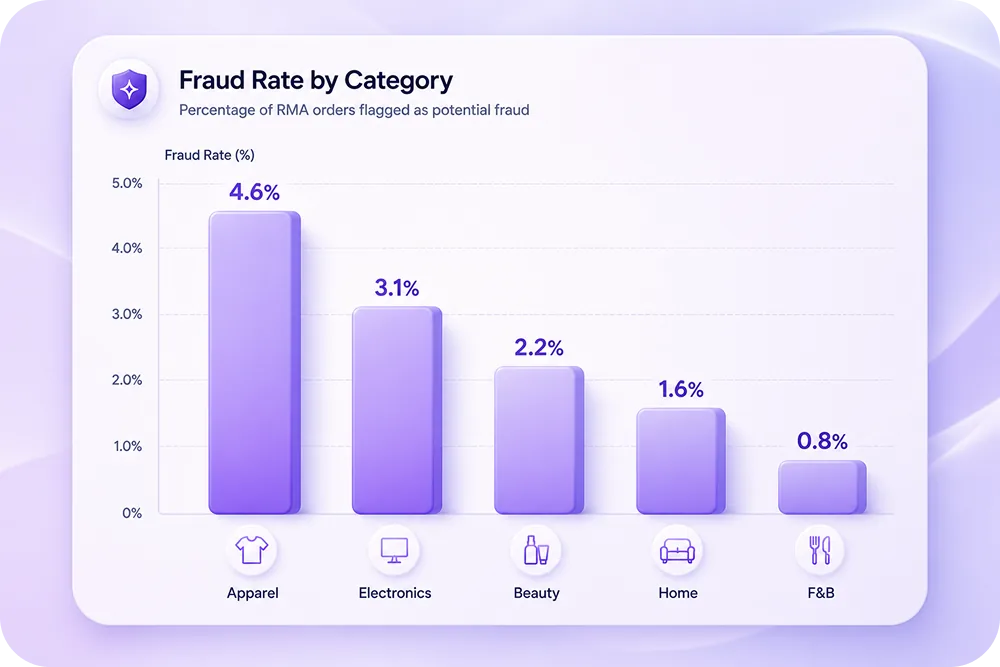
Return fraud used to be a rounding error inside ecommerce. In 2026 it sits at 2 to 5% of revenue depending on the category, and the worst-hit verticals (apparel, electronics, beauty) are seeing 8 to 12%. The pattern that pushed it there is well understood: cheaper logistics, generous policies, social-media coaching on how to game them, and a generation of customers who treat the return policy as a try-before-you-buy mechanism.
Stopping it without alienating real customers is the hard part. Block too aggressively and the conversion rate drops. Block too softly and the warehouse fills with empty boxes. This piece runs through 12 tactics that brands are actually using in 2026, with the data and the trade-offs that come with each. Existing context worth scanning: return fraud in ecommerce.
- Return fraud sits at 2 to 5% of ecommerce revenue and is climbing fastest in apparel, electronics, and beauty.
- The strongest tactics are policy-level (clear rules, account-tier limits), not technology-level (chasing every refund anomaly).
- AI-assisted intake and refund decisioning catch the patterns humans miss; the policy still has to give them something to enforce.
- Brands using Claimlane apply a layered approach: policy at the front, structured intake in the middle, and refund decisioning at the back, all running on one case file.
What return fraud actually looks like
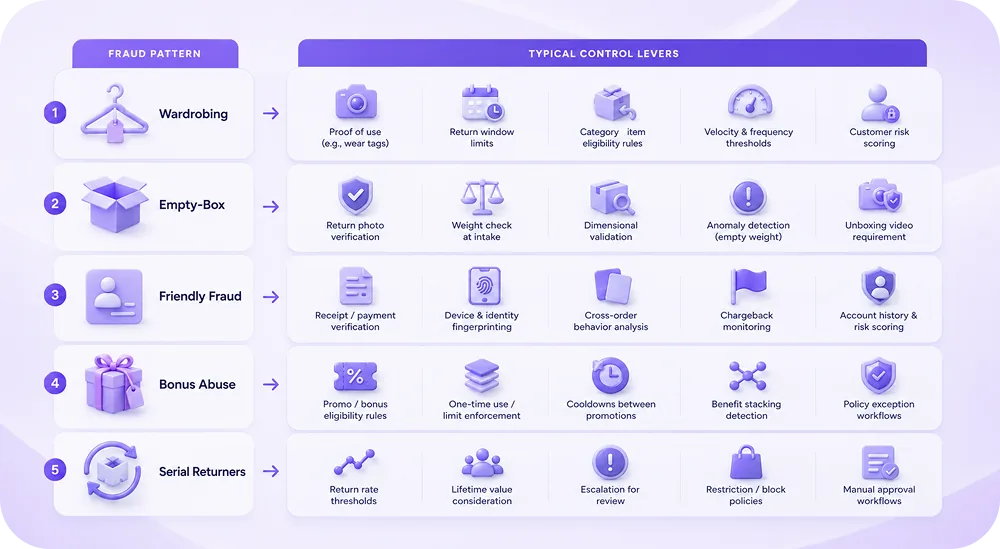
The category is broader than most teams realise. Return fraud is any attempt to obtain a refund, replacement, or credit the customer is not entitled to. Five patterns cover most of the volume.
Wardrobing
Buying an item, wearing or using it once, returning it as new. High in apparel, party-occasion goods, and electronics with brief use cases (cameras, drones).
Empty-box and substitution
The customer returns an empty box or substitutes the original product with a cheaper or broken item. Receiving has to catch it before the refund issues.
Friendly fraud and item-not-received scams
The customer claims the order never arrived (or arrived damaged) and demands a refund. Carrier proof is the only defence.
Bonus-card and store-credit abuse
The customer abuses promotion stacking, returns at full price, or rotates between accounts to cash out store credit. Account-level scoring catches it.
Serial returners
The customer returns over 50% of what they buy across many orders. Not always fraud, but the unit economics break before the policy does. See the framing in average ecommerce return rates.
The 12 tactics, ranked by impact
1. Write the policy in plain language
Most return policies are a legal mess. Clear, plain-English policies reduce fraud by removing the loopholes the legal team did not notice. See the existing post on ecommerce return policy strategies and template options in return policy templates for ecommerce.
2. Tier the policy by customer behaviour
One return window for everyone is the highest-fraud option. Tiered policies (looser for loyalty members, tighter for first-time customers from high-fraud regions) cut abuse without hurting the customer base that matters. The same principle shows up in customer lifetime value after returns.
3. Capture structured reasons at submission
Free-text reasons are useless for fraud detection. A short, structured list (wrong size, defective, changed mind, not as described) gives the system something to score. Combine with the broader returns data silos approach.
4. Require photos at submission for damage claims
A photo upload on the customer's phone is enough to remove 60 to 80% of low-effort fraud. The submission overhead is small for legitimate customers and high for opportunists. Vision models read the photos; see AI image recognition for warranty claims.
5. Use refund decisioning, not blanket approval
Refunds should be a decision, not a default. The decision can be: refund to card, refund to store credit, exchange, repair, or refuse with reason. Score each case and pick the lowest-cost path the customer will accept. The existing piece on refund automation tools covers the operational side.
6. Run account-level scoring
A first-time customer returning a $40 t-shirt is a different risk from a customer with 18 prior orders and a 4% return rate. Score the account, not the order. This is where AI does its best work because the pattern is statistical, not visual.
7. Hold refunds until inspection on flagged cases
Standard cases: refund on label scan. Flagged cases: refund on inspection. The split moves average refund time only slightly while removing the empty-box problem. The Claimlane workflow engine handles the conditional logic.
8. Catch carrier-side patterns
INR (item-not-received) claims correlate with specific carriers, addresses, and time windows. The carrier API gives the data, the policy decides what to do with it. Pair this with automatic status emails so legitimate customers always have proof in their inbox.
9. Limit promotional stacking on returns
When a customer returns a promo-discounted item, the refund should match what they paid, not the sticker price. Most cart platforms get this wrong out of the box and the policy team has to enforce it manually. Automating it is a 10-minute rule change with a measurable impact.
10. Use the self-service portal as a friction layer
A well-designed self-service portal raises the floor on what a fraudster has to do to file a claim. Photo upload, structured reason, account login. Legitimate customers see a slightly more thorough form. Opportunists go elsewhere.
11. Train support on fraud cues without making them prosecutors
The support team should know the top five fraud patterns and have a clear escalation path. They should not be the ones deciding to refuse a refund. See the broader frame in customer service workflows for returns.
12. Measure and tune monthly
Fraud is adversarial. The pattern that works in January will be gamed by March. Measure the fraud rate by category, channel, and reason every month and update the rules. The analytics product layer is where this lives.
| Tactic | Lift | Effort |
|---|---|---|
| 1. Plain-language policy | Medium | Low |
| 2. Tiered policy | High | Medium |
| 3. Structured reasons | Medium | Low |
| 4. Photos at submission | High | Low |
| 5. Refund decisioning | High | Medium |
| 6. Account-level scoring | High | High |
| 7. Refund on inspection | High | Medium |
| 8. Carrier-side patterns | Medium | Medium |
| 9. Promo stacking rule | Medium | Low |
| 10. Self-service portal friction | High | Medium |
| 11. Support training | Low | Low |
| 12. Monthly tuning | Compounds | Medium |
Where AI sits in the prevention stack
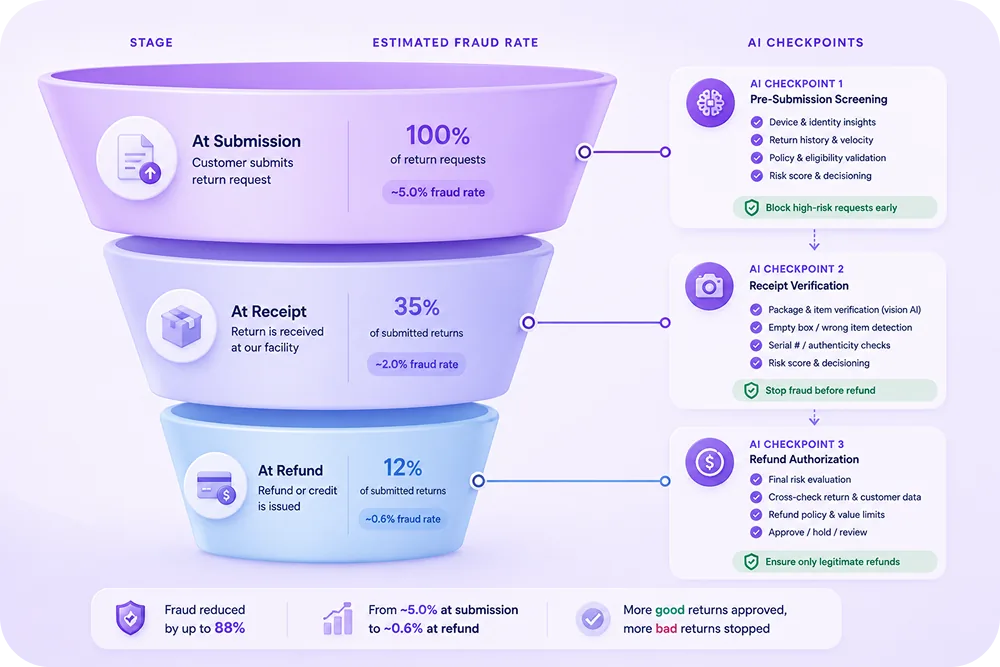
Three places in the flow get the most out of AI. Each one is a complement to the policy work, not a substitute for it. The existing piece on AI warranty fraud detection in ecommerce goes deeper on the warranty side.
At submission
Language models parse the customer's stated reason. Vision models read the photo. The system flags inconsistencies between the two (the customer says "wrong size" but the photo shows damage).
At receipt
Vision checks whether the returned box contains the expected item and whether the condition matches what the customer reported. The pattern is the same as the intake step in Article 3 on AI for RMA automation.
At refund
Anomaly detection runs on the account, not the order. Customers with statistically odd return patterns get flagged for human review before the refund issues.
"Once we layered structured intake and refund decisioning into the Claimlane flow, the empty-box problem stopped being a weekly meeting. The cases that need attention show up flagged, and the rest pass through."— Onyx Cookware, premium cookware brand (read the case study)
The cost-of-prevention curve
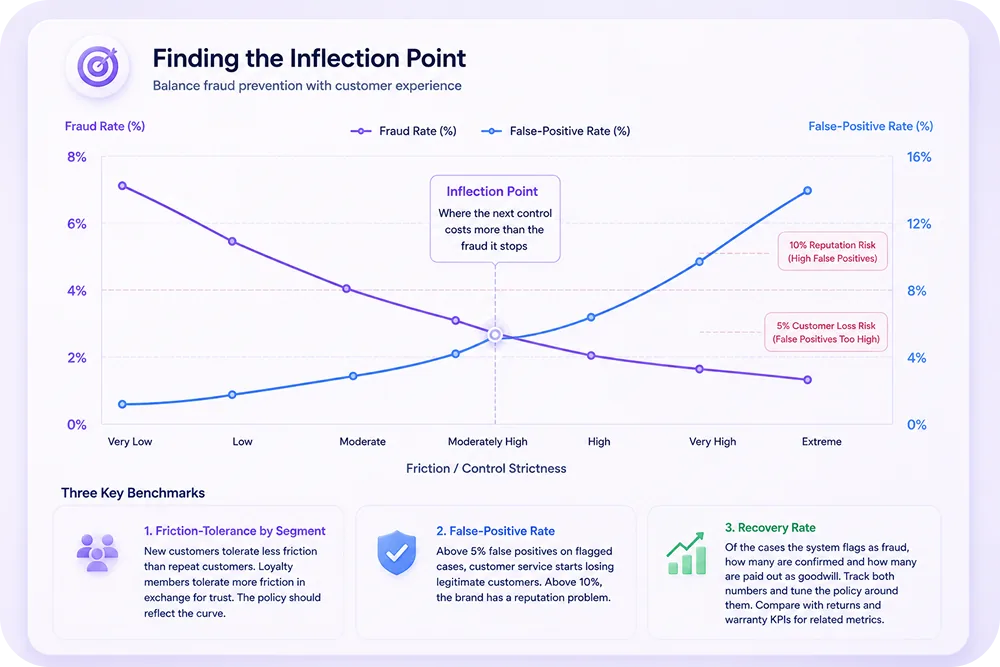
Every fraud control adds friction. The trick is to find the inflection point where the next control costs more than the fraud it stops. Three benchmarks help.
Friction-tolerance by segment
New customers tolerate less friction than repeat customers. Loyalty members tolerate more friction in exchange for trust. The policy should reflect the curve.
False-positive rate
Above 5% false positives on flagged cases, customer service starts losing legitimate customers. Above 10%, the brand has a reputation problem.
Recovery rate
Of the cases the system flags as fraud, how many are confirmed and how many are paid out as goodwill. Track both numbers and tune the policy around them. Compare with returns and warranty KPIs for related metrics.
How prevention links to retention
Fraud prevention and customer retention sound like opposites. They are not. The customers brands want to retain are not the ones gaming the policy; they are the ones who file a legitimate claim and want a clear answer fast. Targeted prevention frees up agent time for the cases that build loyalty.
Sister reads on the retention side: customer retention after returns and post-purchase experience and customer loyalty.
Legal limits in 2026
Three jurisdictions matter for most ecommerce brands. The rules differ.
European Union
The 14-day right of withdrawal still stands. Brands can require photos and structured reasons for damage claims, but cannot deny a refund within the window on a non-damaged item. The fraud-relevant rules sit in supplementary national legislation. See GPSR for retailers under EU law.
United Kingdom
Consumer Rights Act 2015 governs the floor. Brands can layer stricter return controls above the legal minimum. The high-fraud categories (electronics, beauty) tend to use shorter windows and stricter condition rules.
United States
State-by-state, with federal protections under FTC mail-order rules. Most brands run a single policy and tune by category rather than by state.
For the broader compliance and operational pattern, see warranty management best practices and the 4 pillars of warranty claims software.
A 30-day starting plan
For brands new to systematic fraud prevention, the first month should hit the highest-lift, lowest-effort tactics.
Week 1
Audit the existing policy. Plain-language rewrite where needed. Pull a fraud baseline from the last 90 days of cases. The existing post on auditing your returns process is the starting point.
Week 2
Switch the submission form to structured reasons and add the photo requirement on damage claims.
Week 3
Implement promo-stacking rule on refund amounts. Set up account-level flagging in the system. The Claimlane integrations layer connects the ecom platform and the case system.
Week 4
Train the support team on the top five fraud patterns. Set the monthly tuning cadence with the analytics owner.
"The day we required photos at submission and switched to structured reasons, the wardrobing cases dropped off the charts. The team got their afternoons back."— CULT, lifestyle and design brand (read the case study)
What not to do
Three patterns waste budget and goodwill.
Banning customers based on raw return rate
Return rate alone is a bad fraud signal. Some categories run 40% returns naturally. Use account-level scoring that factors in category, channel, and order value.
Hiding the policy
A vague policy increases fraud because the loopholes are wider. Be specific.
Treating support as the front line of fraud detection
Support agents should escalate, not adjudicate. The system flags, a fraud-trained reviewer decides.
Reading list
For brands going deeper, three companion reads.
- How to reduce returns covers the upstream lever.
- Returnless refunds in ecommerce covers the case where refund-without-return is the right answer.
- Store credit vs refund covers the channel decision.
Frequently asked questions
Conclusion
Return fraud is a multi-layer problem. The policy is the floor, structured intake is the second layer, and refund decisioning is the third. AI sits inside the second and third layers as a detection-and-scoring tool, not a judge. Brands that get the order right see the fraud rate move and the customer experience hold.
To see how Claimlane runs structured intake, refund decisioning, and case-level fraud screening on one platform, book a demo. Walkthrough available on the interactive demo page.