.webp)
Most ecommerce brands know their return rate. Few know where time, money, and customer goodwill leak out of their returns process. A returns audit closes that gap by mapping every step from return initiation to final disposition and measuring what each step actually costs.
The goal isn't just to find problems. It's to quantify them. "Our returns process is slow" becomes "returns take an average of 14 days to process, costing us $22 per return in labor alone, and 30% of customers don't repurchase after a return."
This article walks through a complete returns process audit: what to measure, where to look for waste, how to benchmark against industry standards, and which fixes deliver the fastest ROI.
- A returns audit maps every step and measures time, cost, and customer impact.
- Biggest leaks: processing delays, manual data entry, unstructured return reasons, poor supplier recovery.
- Typical result: 20-40% reduction in per-return costs.
- Claimlane provides structured data and analytics for benchmarking.
Step 1: Map the Current Returns Flow
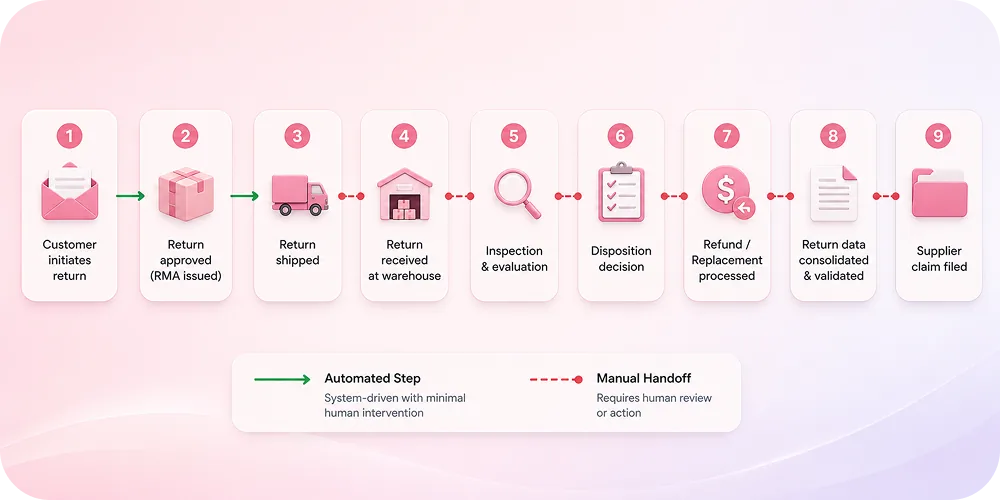
Before measuring anything, document every step a return goes through from customer initiation to final disposition.
Common Return Flow Steps
- Customer initiates return (email, phone, portal, or chat)
- Support team reviews request (checks eligibility, asks for information)
- Return authorized (RMA issued, label generated)
- Customer ships product back
- Warehouse receives return
- Inspection and grading (resellable, refurbish, defective, recycle)
- Refund or exchange processed
- Product restocked or disposed
- Supplier claim filed (if defective)
Map each step with the actual tools used, people involved, and average time. Most brands discover their process has more manual handoffs than they realized.
Brands using Claimlane's self-service portal can skip Steps 1-3 entirely for most returns. The portal handles initiation, eligibility checking, and evidence collection automatically.
Step 2: Measure Key Metrics
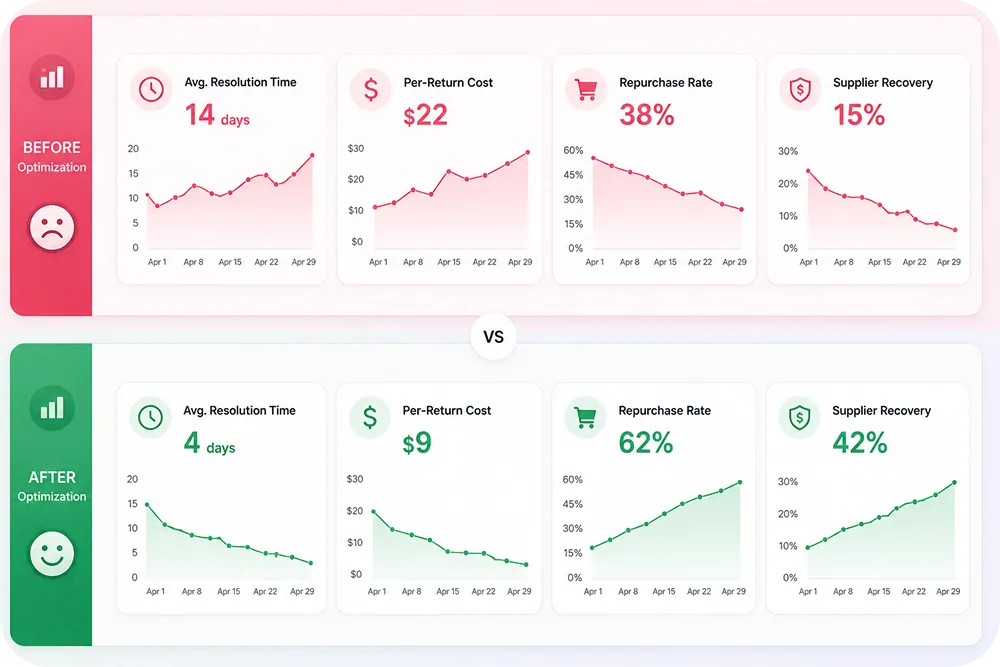
For each step in the process, measure:
Time Metrics
- Return initiation to authorization: How long from customer request to RMA approval?
- Authorization to receipt: How long until the product arrives at the warehouse?
- Receipt to refund: How long from warehouse receipt to customer refund?
- Total resolution time: End-to-end from customer request to completed return.
Cost Metrics
- Per-return processing cost: Labor + shipping + system costs per return
- Return shipping cost: Who pays, and how much per package?
- Restocking cost: Labor to inspect, repackage, and relist returned items
- Inventory write-down: Value of returned products that can't be resold at full price
Customer Metrics
- Customer satisfaction after return: Survey scores or NPS for customers who returned a product
- Repurchase rate after return: Do returning customers buy again?
- Customer lifetime value impact: How do returns affect long-term revenue per customer?
Volume Metrics
- Return rate by product/category: Which products drive the most returns?
- Return reason breakdown: Why do customers return?
- Serial returner rate: What percentage of returns come from repeat returners?
Claimlane's analytics provides most of these metrics automatically, broken down by product, return reason, and time period. Brands without structured returns data often struggle to get accurate numbers at this stage.
Step 3: Identify the Biggest Cost Leaks
Most returns process audits reveal the same set of problems:
Manual Return Initiation
If customers initiate returns via email or phone, every return requires a support agent to read the message, ask follow-up questions, verify the order, and issue an RMA. This costs $5-10 per return in labor alone. A self-service portal eliminates this cost.
Missing Return Reason Data
Without structured return reasons, brands can't identify which products need better descriptions, which suppliers have quality issues, or which categories have the highest return rates. They're flying blind.
Claimlane's AI Agent, the first AI agent purpose-built for warranty claims and returns, classifies return reasons from customer submissions with consistent categories. This turns return data from noise into actionable intelligence.
No Supplier Recovery
When a customer returns a defective product, the brand absorbs the cost unless it files a claim with the supplier. Many brands skip this step because it requires gathering evidence, writing emails, and tracking follow-ups. Supplier forwarding through Claimlane automates this, recovering costs that would otherwise be written off. See the guide on supplier chargebacks for the full process.
Slow Refund Processing
Every day between return receipt and refund issuance is a day the customer is frustrated. Brands with manual refund processes average 5-7 days from receipt to refund. Automated refund tools can cut this to same-day.
Poor Product Disposition
Returned products that sit in a "returns pile" for weeks lose value. Fast grading and disposition (resell, refurbish, recycle, or send to recommerce) recovers more value.
Step 4: Benchmark Against Standards
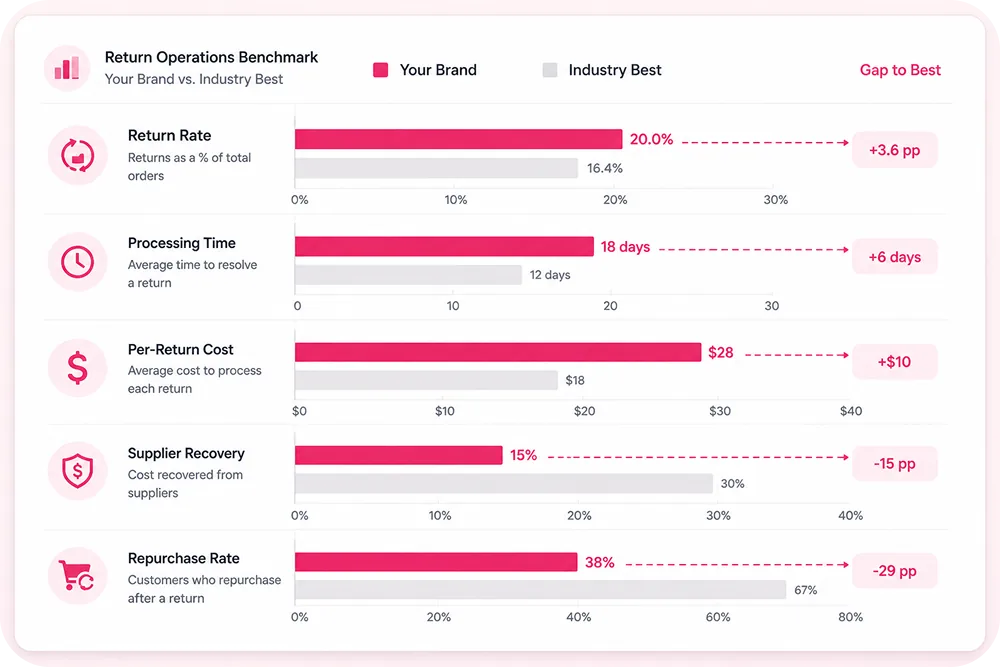
Compare audit results against industry benchmarks:
- Return rate: 15-30% depending on category (higher for apparel, lower for electronics)
- Processing time: Best-in-class brands process returns in 2-3 days. Average is 7-14 days.
- Per-return cost: $10-15 for automated processes, $20-30 for manual processes
- Supplier recovery rate: Best brands recover 60-80% of defect-related costs from suppliers. Average brands recover under 20%.
- Customer repurchase rate after return: 60-70% for well-handled returns, under 40% for poor experiences
Claimlane's returns and warranty KPIs guide covers the full list of metrics to track.
Step 5: Prioritize Fixes by ROI

Rank improvement opportunities by impact and effort:
Quick Wins (implement in 1-2 weeks)
- Deploy a self-service return portal to eliminate manual initiation
- Add structured return reason collection
- Set up automated customer notifications for return status
Medium-Term (1-3 months)
- Implement AI-powered return classification for consistent data
- Set up supplier forwarding for defective product claims
- Connect returns to analytics for product quality feedback
Strategic (3-6 months)
- Build predictive returns analytics for proactive management
- Implement returns-adjusted profitability tracking
- Optimize return policies based on data
Claimlane is rated 4.8/5 on G2 and covers quick wins through strategic improvements in one platform.
Step 6: Re-Audit Quarterly
A returns audit isn't a one-time exercise. Product mix changes, customer behavior shifts, and new issues emerge. Run a lighter version of the audit quarterly, focusing on:
- Changes in return rate by category
- Processing time trends
- New patterns in return reasons
- Supplier recovery rates
- Customer retention metrics after returns
FAQ: Returns Process Audit
Conclusion
A returns process audit turns gut feelings into data. It reveals exactly where time and money leak out and which fixes will deliver the biggest ROI.
The foundation: structured return data. Claimlane captures every return reason, classifies defects with AI, tracks processing times, and provides analytics that make auditing straightforward.
Book a demo to see how Claimlane gives brands the data they need for a returns process audit.