.webp)
Why the RMA process is the right place for AI
Return Merchandise Authorization is the document and decision layer that sits between a customer return request and a warehouse action. Most brands still run it manually, with one person reading an email and another typing a tracking number into a spreadsheet. That is the pattern AI is built to replace.
The work is repetitive, image and text heavy, and rule-bound. Vision models handle the unboxing photo. Language models read the customer's complaint. A rules engine routes the case to the right path. The whole loop closes in seconds instead of days. For a broader look at where this sits inside the operation, see Claimlane's piece on the after-sales automation stack.
- RMA is the documentation and decision layer between a return request and the warehouse action, and it is the highest-impact place to put AI inside reverse logistics.
- The fastest payoff comes from automating intake (vision + language), validation (rules), and supplier routing (rules + probability) before touching the harder steps.
- Most teams overshoot by trying to automate the customer conversation first. The volume sits in the back-office RMA steps, not the chat window.
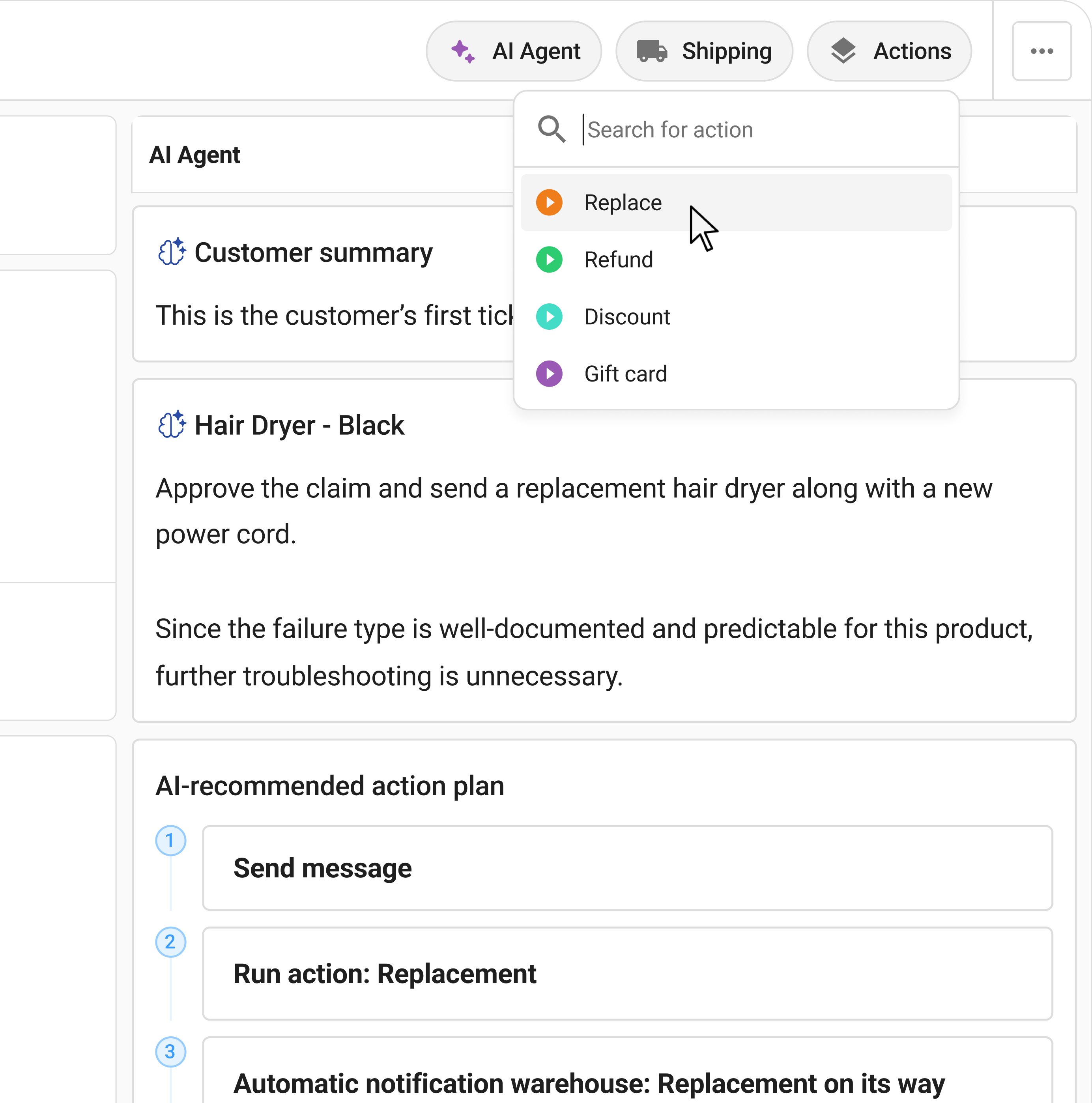
- Brands using Claimlane's AI Agent, the first AI agent purpose-built for warranty claims and returns, automate the RMA flow end to end and keep humans on the cases that need judgment.
What an RMA actually is
RMA stands for Return Merchandise Authorization. It is the formal approval that lets a customer send something back, paired with a reference number that follows the unit through receiving, inspection, and disposition. For the definitional piece, see the existing RMA explainer on Claimlane.
Three things have to be true for an RMA to be useful:
- The unit can be tied back to an order and a customer.
- The reason for return is structured, not free text.
- The next step is decided before the unit leaves the customer's hands.
When any of those break, the warehouse ends up with anonymous boxes and the support team ends up with angry emails. AI in the RMA flow fixes the first two and informs the third.
The six steps where AI sits inside RMA
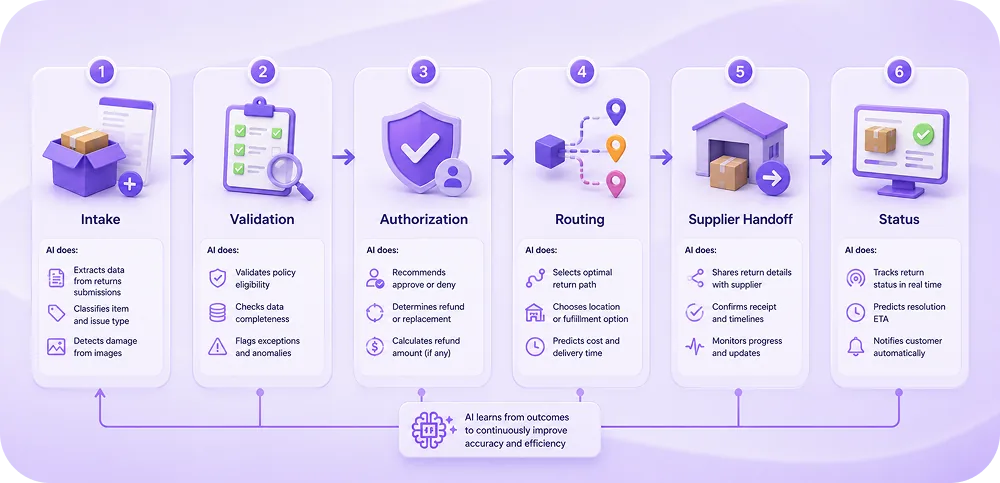
The RMA flow runs in roughly the same shape across categories. Hard goods, soft goods, electronics, food and beverage; the steps are similar. The model below is how Claimlane structures it in production.
1. Intake
The customer submits the return through a portal, an email, or a chat. AI normalises whatever comes in into a structured case with product, order, reason, and condition fields. Vision models handle photos. Language models handle text. Compare this with the broader pattern in AI image recognition for warranty claims.
2. Validation
Is the product covered? Is the order inside the return window? Is the customer in good standing? The validation layer is rules-first, AI-second. The rules say what is allowed. The AI flags edge cases for human review and learns from the override pattern.
3. Authorization
Once validated, the RMA number is generated and sent to the customer with the next action: ship to a hub, drop off at a return bar, hold for pickup, or refuse. Brands using the Claimlane self-service portal issue the RMA without a support agent ever touching the case.
4. Routing
Which path does the unit take? Refurbish, restock, recycle, repair, return to supplier, or dispose. The routing decision is the most operationally consequential, and AI helps by scoring the probable disposition based on condition and historical data. This is the same pattern explored in Article 2 on AI in reverse logistics.
5. Supplier handoff
For warranty-driven RMAs, the supplier package has to be complete. Photos, serial number, defect description, repair logs. AI assembles the package from the case data and triggers the forward-to-supplier flow without a support agent retyping anything.
6. Status updates
The customer should hear about the case before they ask. AI triggers the status update at each stage, pulling from the same structured fields. See automatic status emails for the customer-side pattern.
| Step | What AI does | Human check |
|---|---|---|
| Intake | Reads photos and text, fills structured fields | Low confidence cases |
| Validation | Checks rules, flags edge cases | Policy exceptions |
| Authorization | Issues RMA number, sends instructions | None for standard cases |
| Routing | Scores disposition, recommends path | High-value or unclear cases |
| Supplier handoff | Builds claim package, sends to supplier | Disputed claims |
| Status updates | Triggers messages at each stage | Tone-sensitive cases |
Where AI in RMA pays back first
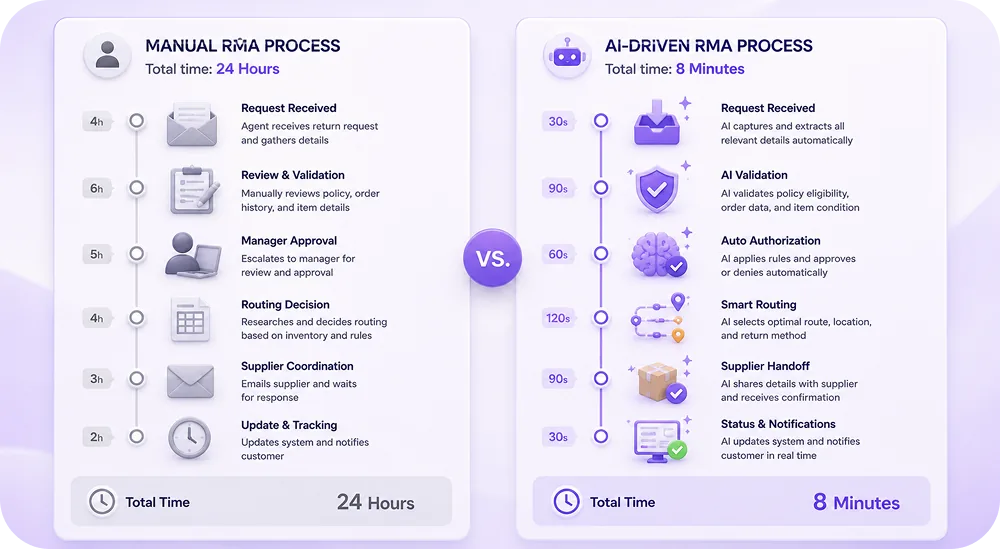
Brands that roll AI into the RMA flow tend to see three benefits before anything else: time-to-RMA drops, agent hours shift to high-judgement work, and supplier recovery speeds up. The hard part is choosing the order. See the broader benchmarks in returns and warranty KPIs.
Time-to-RMA
The wall-clock time from customer request to RMA number issued. Manual flow: 12 to 48 hours. AI-driven flow: minutes. The compression here is where most of the customer-experience lift comes from.
Agent hours per case
Manual RMA review takes about 8 to 12 minutes per case. Once the structured fields are reliable, that drops to 1 to 3 minutes of human time, and only on the exceptions. Compounded over thousands of cases per month, it is the difference between a five-person team and a one-to-two person team. The Davidsen case study walks through that exact reduction; see the Davidsen warranty claims story.
Supplier recovery time
Suppliers reject incomplete packages. AI assembly catches the missing fields before the case leaves the building. Brands report supplier credit notes coming back in days instead of weeks. The mechanics are covered in the supplier recovery guide.
"The complex cases used to be the bottleneck. With Claimlane's AI Agent in the loop, RMAs that took a day now close inside an hour, and the team can spend their time on the cases that actually need a human."— MaxGaming, largest gaming and e-sports e-commerce in Scandinavia (read the case study)
Why brands still trip up
AI in the RMA flow fails for three reasons. Most projects hit at least two of them on the way to production.
Free-text intake never goes away
There is always a customer who emails support directly. The system has to handle that case cleanly, otherwise the agent ends up doing manual work for the long tail. The fix is a language model that parses the email into the same structured fields the portal uses.
Rules are stale, not wrong
Most rules engines were set up two years ago and have not been touched since. AI cannot fix a stale rule. Brands need a quarterly rules review with the analytics team. See how to set that up in warranty management best practices.
Supplier data quality
If the supplier rejects the case for missing fields, AI cannot save it. Fix the data dictionary first, then bring AI in. The retail returns data silos post covers what to clean up first.
A 90-day rollout that actually works
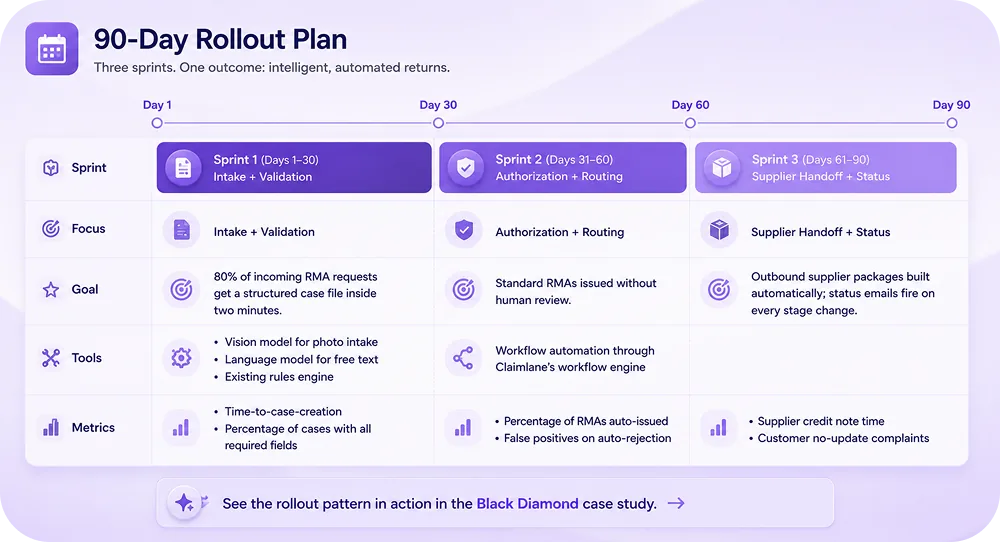
The trap is to start with a six-month platform replacement. The pattern that works is to layer AI into the existing case flow in three sprints.
Sprint 1: Intake plus validation
Goal: 80% of incoming RMA requests get a structured case file inside two minutes. Tools: vision model for photo intake, language model for free text, plus the existing rules engine. Metrics: time-to-case-creation, percentage of cases with all required fields.
Sprint 2: Authorization plus routing
Goal: standard RMAs issued without human review. Tools: workflow automation through Claimlane's workflow engine. Metrics: percentage of RMAs auto-issued, false positives on auto-rejection.
Sprint 3: Supplier handoff plus status
Goal: outbound supplier packages built automatically; status emails fire on every stage change. Metrics: supplier credit note time, customer no-update complaints. See the rollout pattern in action in the Black Diamond case study.
- Map the existing RMA flow end to end before touching anything
- Define what counts as a "good" case file (the data dictionary)
- Pick one product category for the pilot, not the entire catalogue
- Set a baseline on time-to-RMA, agent minutes per case, supplier credit note time
- Layer AI into intake first, validation second, routing third
- Keep human review on every flagged case for the first 30 days
- Quarterly rules review with the analytics owner
What the customer experience actually looks like
Customers do not care what model is running behind the scenes. They care about three things: a quick RMA number, a clear next step, and an honest update when something changes. AI delivers those three because it removes the queue. There is no inbox for the case to sit in.
The same principle shows up in post-purchase experience and customer loyalty. The customer's view of the brand is set in the post-purchase window, not the marketing campaign.
The integrations that make AI RMA work
AI in RMA only pays off when the data reaches the systems on either side. The shop, the helpdesk, the warehouse, the ERP, the email tool. See the full integration set on Claimlane integrations and the broader frame in best ecommerce integrations.
For Shopify brands, the integration pattern is well-documented in Shopify returns and the integrations layer cross-references the Mailchimp integrations roundup from Article 1 of this batch.
How AI in RMA differs from AI in claims
Some teams use the words interchangeably. They are not the same.
RMA is about the unit and the flow
The output of an RMA is a number, a next step, and a case file. The unit is going somewhere, and the system has to know where.
Claims are about the outcome
The output of a claim is a decision: refund, replace, repair, refuse, or escalate. Claims live downstream of RMA. AI helps in both places, but the data needed is different. See the existing AI warranty claims automation for the claims side.
Measuring AI RMA the right way
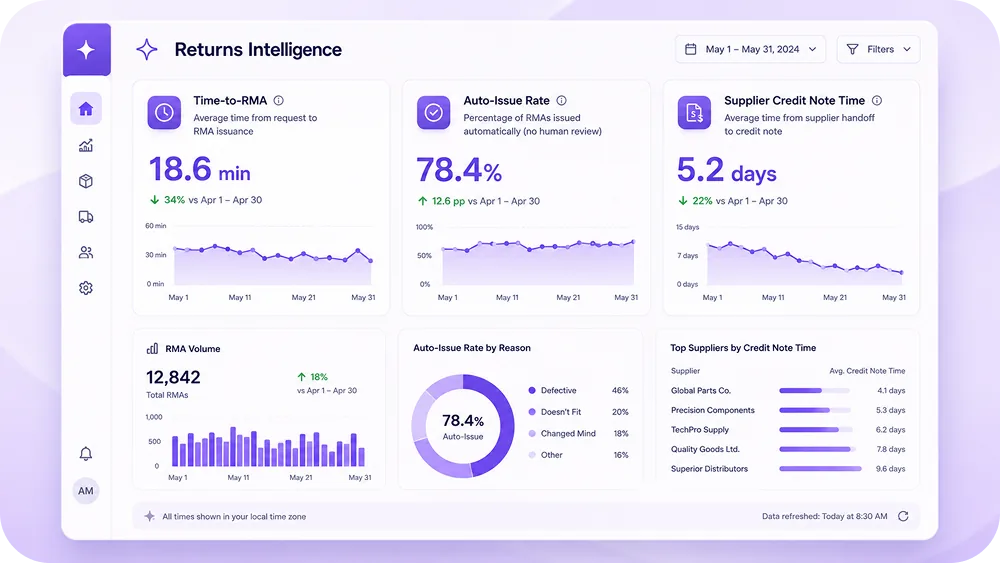
Two-minute dashboards beat one-hour reports. Pick three core metrics, put them on a wall, and check them every morning.
Time-to-RMA
Median minutes from customer request to RMA number issued. Target under 5 minutes.
Auto-issue rate
Percentage of RMAs that closed without human review. Target 70 to 85% once the flow stabilises. See the broader analytics product and the existing post on predictive returns analytics for ecommerce.
Supplier credit note time
Median days from RMA issued to supplier credit landing. Target under 14 days for standard categories. The forward-to-supplier feature handles the handoff.
Where AI in RMA still falls short
Three weaknesses persist in 2026. Worth saying out loud before the budget conversation.
Multi-product cases
A single return that includes two SKUs from two suppliers with two warranty terms still trips most models. Human review stays.
Languages and locales
Vision and language models perform worse on smaller European languages. Brands operating across the EU need to test in every market. The same issue shows up in managing cross-channel returns.
Edge cases the model never saw
Any case the training set did not include comes back to a human. The fix is feedback loops. Every override should retrain something.
"Once we moved the RMA flow into Claimlane, the warehouse stopped asking why a unit had landed. The case file came with it."— Skechers, performance footwear brand
Reading list before you commit
For brands evaluating AI in the RMA flow, three companion reads are worth the hour.
- How to optimize your warranty claim process
- Predictive warranty analytics
- Reducing customer effort in claims and returns
Sister piece on the fraud side: return fraud prevention playbook (Article 5 of this batch).
Frequently asked questions
Conclusion
AI in RMA is not a science project. It is the practical layer that sits on top of an already-defined process and removes the queue. Brands that get the data right first and layer AI in second see the time-to-RMA, agent hours, and supplier recovery numbers move inside the first quarter.
To see how Claimlane runs the AI-assisted RMA flow end to end, book a demo. Or watch the walkthrough on the interactive demo page.