.webp)
Most customer success teams in ecommerce do not look like classic SaaS CS teams. There is no quarterly business review. There is no named CSM. What there is, is millions of micro-decisions: a refund request, a warranty claim, a follow-up after a damaged parcel, a churn risk hiding inside a 1-star review. AI fits the ecommerce shape of customer success because it can handle volume that no human team can.
This playbook is for brands shipping physical goods, not for B2B SaaS. It covers the use cases that move retention numbers, the platforms shaping the space in 2026, the KPIs worth tracking, and the limits worth respecting.
- Ecommerce customer success is mostly a post-purchase problem: returns, warranty, repair, and the moments around them.
- AI moves the needle on three things: faster resolutions, better churn signals, and targeted post-resolution outreach.
- The wrong place to start is a generic chatbot. The right place is the workflow that costs the team the most hours today.
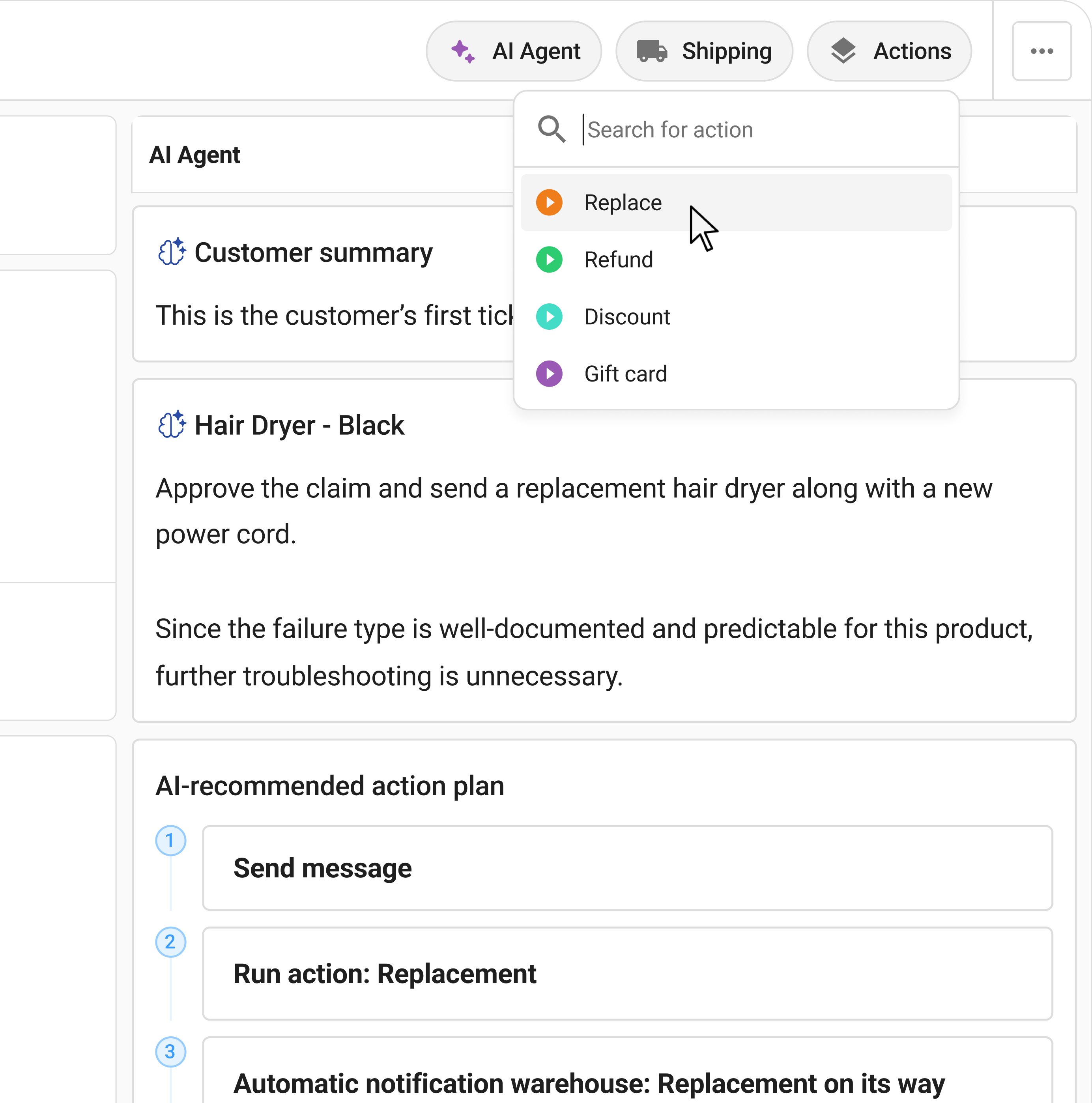
- Claimlane's AI Agent, the first AI agent purpose-built for warranty claims and returns, helps brands like MaxGaming resolve complex RMA cases 77% faster.
What AI Customer Success Actually Means in Ecommerce
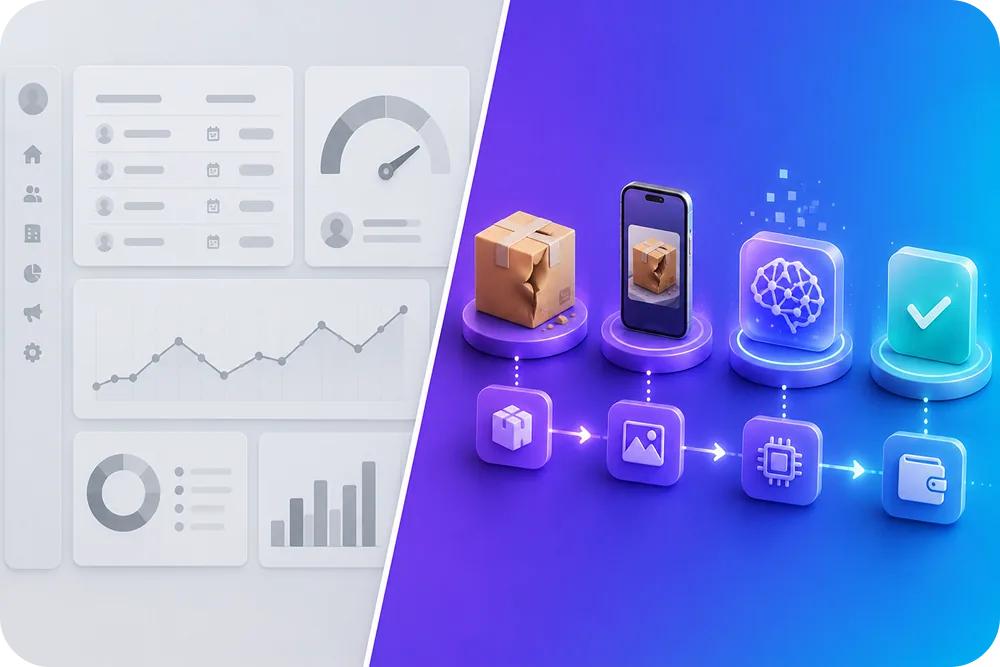
The phrase "AI customer success" is borrowed from B2B SaaS, where it usually points at health scoring, churn prediction, and CSM workflow tools. In ecommerce, the same words point at something different. The customer is not a logged-in user the brand sees every week. The customer is the buyer of a $480 jacket who comes back when the zipper fails 14 months later. Success means resolving that moment without losing them.
That reframing matters because most "AI for CS" platforms were not built for it. They predict churn for software seats. They do not review a photo of a torn jacket lining against a warranty rule. For ecommerce, the AI use cases that earn their place sit inside the post-purchase experience, not in a separate CSM stack.
7 AI Use Cases Worth Funding First
1. Claim adjudication
AI reads photos and videos, applies warranty rules, recommends a resolution. The agent only sees flagged edge cases.
2. Return reason classification
AI maps free-text reasons ("colour is off") to clean categories so analytics actually work.
3. Churn signals after returns
AI scores at-risk customers based on return frequency, sentiment, and resolution time.
4. Post-resolution outreach
Personalised win-back or thank-you flows fired after a positive claim outcome.
5. Sentiment routing
High-frustration tickets jump the queue. Cool tickets stay in self-service.
6. Predictive defect detection
AI spots SKUs trending toward higher claim rates before the support queue notices.
7. Fraud screening
AI flags duplicate images, mismatched serial numbers, and behaviour patterns linked to claim fraud.
The first one drives the biggest impact for brands with serious warranty volume. Claim adjudication used to be the part nobody could automate. Claimlane's AI Agent, the first AI agent purpose-built for warranty claims and returns, changed that pattern by combining image review with rule application. There is a longer breakdown in the AI image recognition for warranty claims piece, and a wider view in the AI warranty claims automation guide.
How AI Customer Success Differs from AI Customer Support
The two terms get mixed up. Support is reactive. Success is the work that keeps the customer past the resolution. AI changes the relationship between the two by removing the bottleneck.
When a typical claim takes 14 days, support owns the whole window and success never gets a chance to act. When AI cuts that to 2 days, success can run win-back outreach the same week. AI agents for post-purchase support covers the support side. The retention side is covered well in customer retention after returns.
For a comparison of broader AI tooling, the ecommerce AI agents overview and the AI chatbots for ecommerce roundup cover platforms beyond claim adjudication.
Platforms Shaping AI Customer Success in 2026
The market split into three groups.
Generic AI CS suites. Gainsight AI, Totango Spark, ChurnZero. These are still B2B SaaS-first. They handle subscription health well. They do not handle warranty claims.
Customer service AI. Intercom Fin, Zendesk AI, Gorgias Auto. Fast at first-touch reply. Limited at claim resolution because they do not own the underlying workflow data.
Post-purchase AI. Claimlane (for returns and warranty), Narvar (for tracking and concierge), Aftership (for parcel tracking). This is the group with the most leverage on ecommerce retention, because it owns the moment the customer is most likely to churn. For a wider look, the new Aftership alternatives guide compares 7 of these tools side by side, and the customer service automation platforms overview maps the support tier.
Why MaxGaming Picked Claim Adjudication First
MaxGaming is the largest gaming and e-sports ecommerce brand in Scandinavia, with 30,000+ SKUs across 200+ brands. Complex RMA cases used to take agents months of product training to handle. The pattern was familiar: an agent who left took years of tacit knowledge with them.
The AI Agent reviews submitted images, checks them against business rules per product and supplier, and recommends actions. The agent only intervenes where the AI is not confident. Read the MaxGaming case study.
"Our agents do not need months of product knowledge anymore. The AI handles the routine work, the team handles the cases that need judgment."
KPIs That Tell You AI Customer Success Is Working
Generic "AI lift" metrics are noise. The ones below are not.
1. Time to resolution
Days from claim filed to claim closed. For most brands, the baseline is 7-14 days. AI-assisted brands drop to 1-3 days for routine cases. The returns and warranty KPIs guide has full benchmarks.
2. Auto-resolved claim share
Percent of claims closed without a human touch. 30-60% is realistic depending on category. Apparel runs higher, electronics lower.
3. Repeat purchase rate after a claim
The one that proves AI customer success works. Brands that resolve fast hold a higher 90-day repeat purchase rate. The customer lifetime value after returns piece covers the math.
4. Cost per claim
Fully loaded support and logistics cost per claim.
5. Supplier credit recovery rate
For brands handling supplier claims, the share of claims that result in a successful credit note. Supplier recovery details here.
6. CSAT after claim resolution
The survey that matters. The customer expectations pyramid piece explains why this score moves retention more than any other.
A Rollout Path That Does Not Stall
Most AI projects in ecommerce fail at the data step, not the model step. The order below works because it builds the data foundation first.
Step 1: Pick one workflow with clean inputs
Claims with photos. Returns with clear reason codes. Tickets with order context attached. Not free-text emails into a shared inbox.
Step 2: Move that workflow into a tool with structured data
If claims live in Zendesk macros and Excel sheets, no AI will help. Move to a workflow engine that owns the data.
Step 3: Set rules, then add AI on top
AI without rules is a guess. Rules without AI is a maze. The combo is what produces auto-resolutions that the team can defend.
Step 4: Measure two metrics for 30 days
Time to resolution. Auto-resolved share. If both move, expand. If neither moves, the workflow is wrong, not the model.
Step 5: Add analytics
Only once the operational metrics are stable. Returns and warranty analytics on faulty SKUs and supplier performance pay off in months 4-6, not week one.
Risks and Limits Worth Respecting
AI customer success has real failure modes. The most common ones in ecommerce:
Hallucinated decisions on edge cases. AI confidently approves a claim it should have escalated. The fix is a confidence threshold that defaults to human review, not auto-approve.
Bias from training data. If past claims were resolved unfairly, AI will copy that pattern. The fix is regular sampling of AI decisions against a fresh policy review.
Customer trust drop when the AI gets caught. If a customer realises they are talking to AI and it gave them the wrong answer, the brand pays for it twice. The fix is honest disclosure plus a fast human path.
Over-automation in B2B. B2B claims have politics and context that AI rarely catches. The B2B warranty claims piece covers the nuances.
Where This Goes in 2026 and Beyond
Three directions are already visible.
Multi-modal AI for repair workflows. Photo, video, and short customer audio combined to decide repair-vs-replace faster. The repair vs replace warranty claims explainer covers the current state.
Predictive defect detection earlier in the supply chain. AI flags rising claim trends per supplier before the QA team notices. The predictive warranty analytics and AI supplier quality scoring pieces have more.
Voice AI for the front door. Status checks, eligibility questions, parcel updates. The resolution still happens in the workflow tool. Voice handles the question, the AI Agent handles the case.
The Cost of Doing Nothing: A Worked Example
The strongest argument for AI in ecommerce customer success is not "it is the future". It is the math on a stack of unresolved claims.
Consider a mid-market brand handling 1,200 warranty claims per month. Average claim value: €180. Manual resolution time: 12 days. CSAT drops measurably for any case open beyond 5 days. Industry data puts the 90-day repeat purchase rate at 58% for claimants with fast resolution and 31% for claimants with slow resolution.
The cost of slow resolution on a single month's cohort:
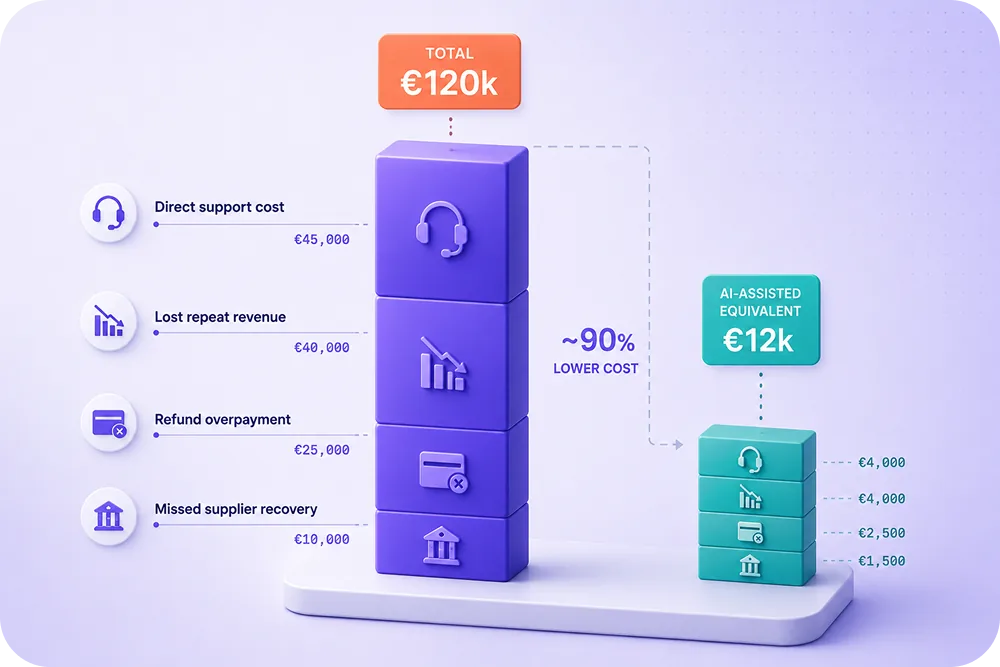
- Direct support cost: 1,200 claims × 22 minutes of agent time × €0.85 per minute = €22,440
- Lost repeat revenue: 27 percentage points × 1,200 claimants × €180 average order = €58,320 in the 90-day window
- Refund overpayment when eligibility is not enforced before refund: roughly 6 to 9% of claims, around €15,000
- Supplier credit not recovered when handoff is unstructured: roughly 40% of supplier-eligible cases worth €25,000
That is €120k of monthly cost that does not appear on any single line of any single report. AI alone does not fix this. AI on top of structured intake and rule logic does.
The brands that win in 2026 are not the ones with the best models. They are the ones who turned this invisible cost into a board metric. Once it is on the slide, the funding moves itself. The hidden costs of returns and claims piece covers the wider category of invisible cost.
What Most Retention Programs Miss
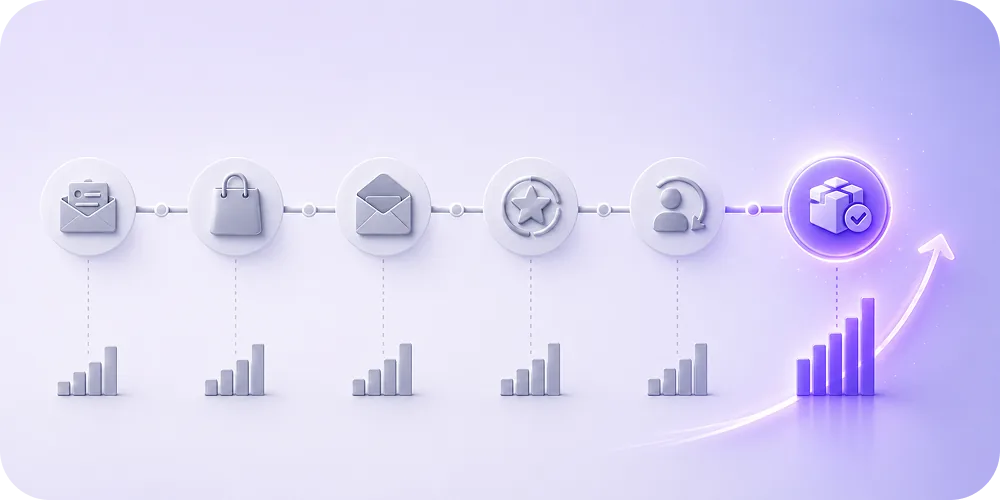
Most retention programs in ecommerce optimise the wrong moment. The discount email after a purchase. The win-back campaign for lapsed buyers. The loyalty tier upgrade. None of those moments matter more than the claim resolution, because no other touchpoint catches the customer at peak emotional volume.
A customer who files a warranty claim is signalling churn. The resolution either confirms the suspicion (slow, defensive, transactional) or reverses it (fast, generous, human-on-AI). The lift from getting that single moment right is larger than the lift from any other retention lever a brand pulls in a quarter. The post-purchase experience and customer loyalty piece and the why warranty claim process builds customer loyalty piece both back this up with operator data.
For ecommerce CS leaders, the operating shift is treating claim resolution as a retention investment, not a support cost. That reframing changes which metrics show up in the weekly review and which workflows get headcount.
G2 Recognition
Claimlane holds a 4.8/5 rating on G2, with the AI Agent rollout cited in multiple recent reviews as the standout feature.
Industry Notes
Brands in electronics hit warranty volume first and benefit fastest from AI claim adjudication. Brands in furniture deal with damaged-in-transit volume and image-heavy claims, which AI handles well. B2B brands need the human in the loop to stay senior on big-ticket cases. The Swoon case study and the OnyxCookware case study show two very different shapes of the same playbook.
FAQ
What is the difference between AI customer success and AI customer support? +
What is the best AI customer success tool for ecommerce? +
Can AI predict customer churn after a return? +
How long does it take to roll out AI customer success? +
Is AI safe for B2B warranty claims? +
Conclusion
AI customer success in ecommerce is not a CSM bot. It is the workflow tool that owns the post-purchase moment, runs faster than the support team can, and feeds analytics that retention teams can act on.
The brands moving the most retention numbers in 2026 are the ones picking one workflow, owning the data, layering AI on rules, and measuring two metrics for 30 days. Book a walkthrough at /book-demo to see how the AI Agent handles a sample claim end-to-end.