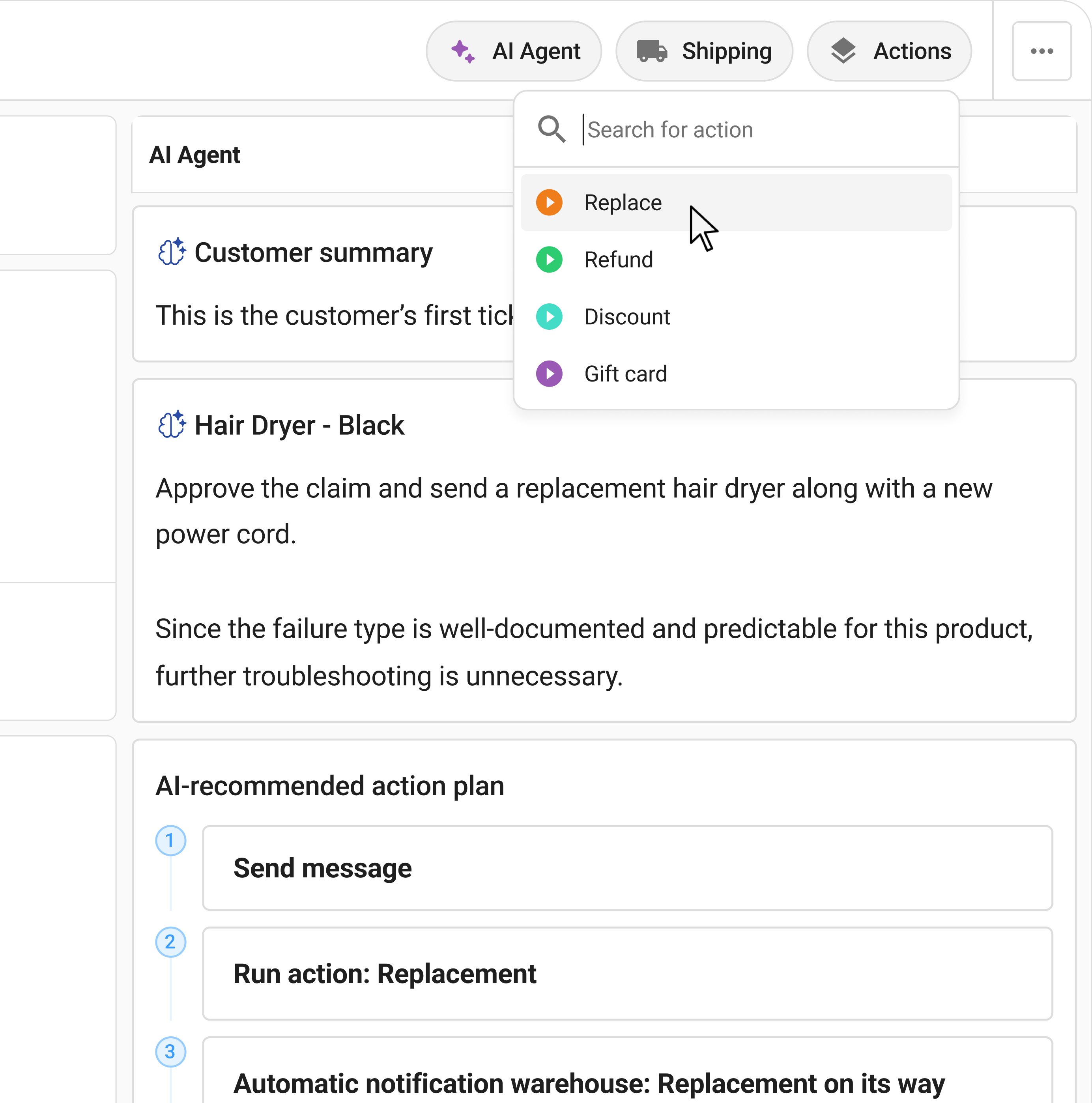
.webp)
Warranty claims are one of the most time-consuming parts of running an ecommerce business. Each claim needs product knowledge, policy lookup, photo review, and a judgment call. Multiply that by hundreds of claims per week, and you have a team buried in repetitive work instead of solving the hard problems.
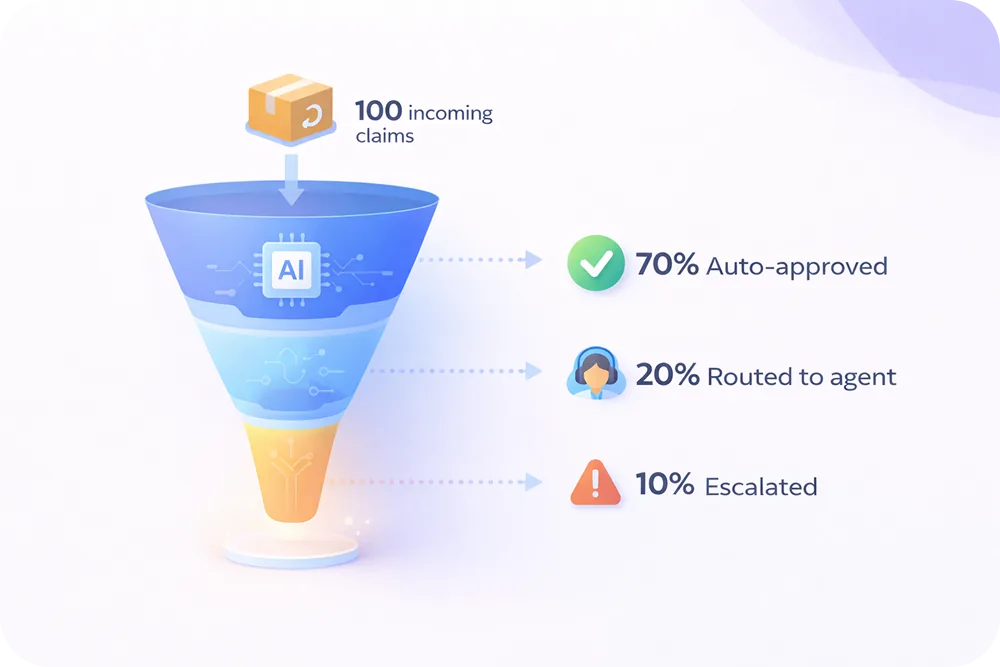
AI warranty claims automation changes that equation. Brands using AI to process warranty claims are auto-approving 40 to 70% of routine cases without a human touching them, cutting average resolution time from days to hours.
This guide covers how AI warranty claims automation actually works, what it can and cannot do today, and how to implement it without ripping out your current systems.
Why Warranty Claims Are Harder to Automate Than Returns
Standard return processing follows relatively simple rules. The customer bought an item, wants to send it back, and the brand checks the return window and condition requirements.
Warranty claims are different. They involve:
- Product-specific warranty terms that vary by SKU, category, and supplier
- Defect assessment that requires interpreting photos and customer descriptions
- Multi-party coordination between the brand, customer, and supplier
- Varied resolution paths including repair, replacement, refund, spare parts, or credit notes
- Longer timelines with multiple touchpoints over days or weeks
- Supplier liability that determines who pays for the resolution
A support agent handling warranty claims needs deep product knowledge. Training new agents takes months. And even experienced agents make inconsistent decisions when policies are complex.
This is exactly why AI fits the problem so well. The complexity that makes warranty claims expensive for humans is the kind of structured decision-making that AI excels at.
How AI Warranty Claims Processing Works
AI warranty claims automation follows a structured pipeline that mirrors what your best agent does, at scale and without fatigue.
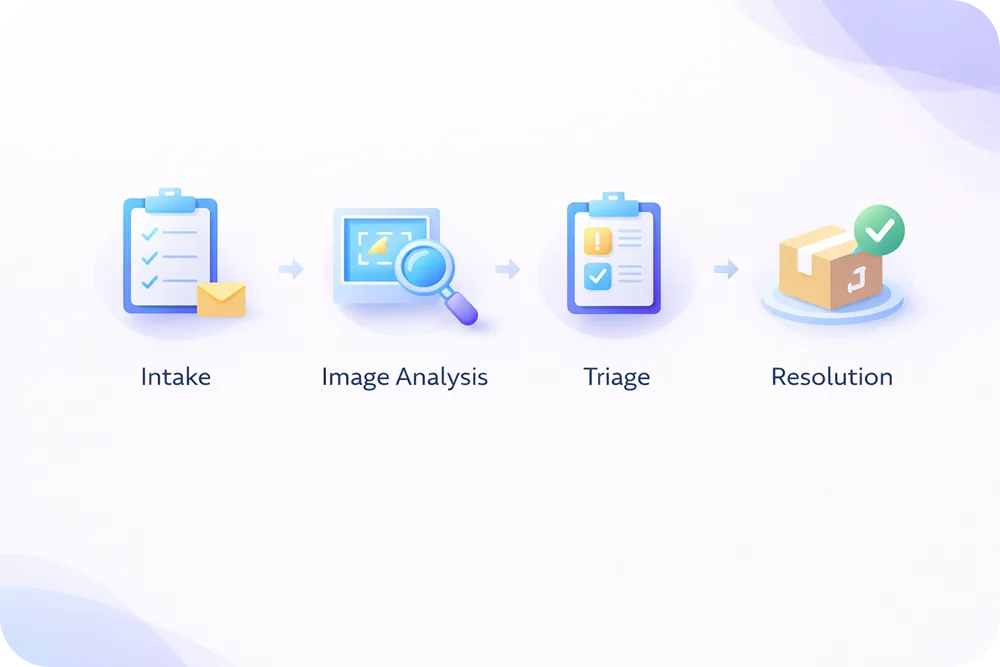
Claim intake and classification
When a customer submits a warranty claim through a self-service portal, the AI system immediately:
- Extracts the order number, product details, and purchase date
- Checks if the product is still within the warranty period
- Reads the customer's description and classifies the issue type (defect, damage, missing part, malfunction)
- Identifies the specific product, category, and associated supplier
This happens in seconds. No agent needs to open the ticket, look up the order, or check warranty dates manually.
AI image and video analysis
The customer uploads photos or videos of the defective product. Computer vision models analyze these to:
- Verify the product identity matches what was ordered
- Assess damage type and severity (cosmetic scratch vs. structural failure vs. manufacturing defect)
- Detect signs of misuse that might void the warranty
- Compare against known defect patterns for that specific product
- Flag suspicious submissions like stock photos, AI-generated images, or photos that do not match the described issue
This is where AI warranty claims processing delivers the most value. Photo review is the single most time-consuming step in manual warranty handling, and AI does it in under a second.
AI claims triage and routing
Based on the classification and image analysis, the AI triages each claim into one of several paths:
| Claim Category | AI Action | Human Involvement |
|---|---|---|
| Simple defect, clear photo, standard warranty | Auto-approve replacement or refund | None |
| Known recurring defect for this SKU | Auto-approve + flag for supplier review | None (supplier notified) |
| Unclear photos or borderline damage | Request additional photos from customer | None (automated follow-up) |
| High-value item or complex repair | Route to specialist with AI summary | Agent reviews AI recommendation |
| Suspected fraud or warranty void | Flag and escalate with evidence | Agent makes final decision |
The AI does not make all decisions alone. It makes the easy decisions automatically and gives agents better tools for the hard ones.
Claims Auto-Approval Rules: Setting the Boundaries
AI warranty claims automation is only as good as the rules it follows. The best platforms let brands configure auto-approval rules at multiple levels:
Product-level rules
Different products have different warranty terms and claim patterns:
- Electronics might require photo evidence and serial number verification
- Apparel might allow returnless refunds under a certain value threshold
- Furniture might require a repair assessment before any replacement
Supplier-level rules
When brands resell products from multiple suppliers, each supplier may have different warranty agreements:
- Supplier A covers defects for 2 years and accepts photo-only claims
- Supplier B requires the defective product to be returned before issuing credit
- Supplier C handles all warranty claims directly and needs claims forwarded
Platforms like Claimlane let brands configure these rules per product, per supplier, and per claim type, so the AI applies the right policy every time without an agent needing to remember which supplier requires what.
Value-based thresholds
Smart auto-approval rules also consider the economics:
- Claims under $30: Auto-approve returnless refund (shipping costs more than the product)
- Claims $30-$150: Auto-approve replacement if photo confirms defect
- Claims over $150: Route to agent with AI recommendation
Customer history rules
AI factors in the customer's history to adjust approval confidence:
- First-time claim from a repeat customer with good history: Higher auto-approval confidence
- Third claim in 60 days from the same customer: Flag for review regardless of value
- Customer with previous fraud flags: Always escalate to agent
Automated Warranty Approval in Practice
What does automated warranty approval actually look like from the customer and agent perspective?
The customer experience
- Customer visits the brand's warranty claim portal
- Enters order number or scans a QR code
- Selects the defective product and describes the issue
- Uploads photos showing the defect
- Receives an instant or near-instant decision
- Gets a replacement shipped, a refund processed, or clear next steps
The entire process takes 3-5 minutes. No email chains. No waiting 3-5 business days for a response.
The agent experience
Agents no longer spend their day on routine claims. Instead, they:
- See a filtered queue of only the claims that need human judgment
- Get an AI-generated summary for each escalated claim, including recommended action
- Spend their time on complex cases, supplier negotiations, and quality investigations
- Review analytics dashboards showing claim patterns and product issues
MaxGaming, the largest gaming and esports ecommerce company in Scandinavia with over 30,000 SKUs across 200+ brands, cut RMA case resolution time by 77% after implementing AI-powered claims automation.
Smart Returns Automation: Beyond Simple If-Then Rules
The term "smart returns automation" distinguishes AI-powered systems from basic rule-based automation.
Basic automation works with simple if-then rules:
- IF return reason = "wrong size" AND within 30 days THEN approve
- IF product category = "electronics" THEN require photos
Smart returns automation adds intelligence:
- Analyzes photos to assess damage without human review
- Understands free-text descriptions and maps them to issue categories
- Learns from past decisions to improve accuracy over time
- Adjusts confidence thresholds based on claim patterns
- Detects anomalies that rules alone would miss
The difference matters because warranty claims are too varied for simple rules. A rule that says "approve all claims with a photo" will approve fraudulent claims. A rule that says "escalate all electronics claims" will overwhelm agents with routine issues. Smart automation handles the nuance.
Intelligent Returns Routing: Getting Claims to the Right Place
Intelligent returns routing uses AI to direct each claim to the optimal resolution path. For warranty claims, this is critical because claims often involve multiple parties.
Routing to the right team
Not all agents handle all claim types:
- Tier 1 agents handle standard approvals and customer communication
- Product specialists handle technical defect assessments
- Supplier managers handle forwarding and credit note negotiations
AI routes each claim based on complexity, product type, and required expertise.
Routing to the supplier
For brands that resell products, many warranty claims need to be forwarded to the original supplier. AI automates this by:
- Identifying the supplier for the claimed product
- Compiling the required documentation (photos, description, proof of purchase)
- Sending the supplier claim in the format each supplier expects
- Tracking supplier response times and following up on SLA breaches
Black Diamond Equipment streamlined their entire warranty and repair workflow using this kind of intelligent routing, handling claims across multiple product categories with different resolution paths.
Routing to repair vs. replace
For products that can be repaired, AI determines the most cost-effective path:
- If repair cost < 40% of product value: Route to repair workflow
- If spare parts are available: Send replacement part instead of full replacement
- If repair is not economical: Approve full replacement and route defective unit to quality analysis
No-Code Returns Automation: Making AI Accessible
One of the biggest shifts in AI warranty claims automation is the move toward no-code platforms. Previously, implementing AI in claims processing required custom development, data science teams, and months of integration work.
Modern no-code returns automation platforms let operations teams:
- Configure auto-approval rules through visual interfaces, not code
- Set up claim workflows by dragging and dropping steps
- Define escalation triggers based on value, product type, or risk score
- Connect to ecommerce platforms (Shopify, WooCommerce, Magento) with native integrations
- Adjust AI behavior by reviewing and correcting past decisions
This means the people who understand the business rules (operations managers, customer service leads) can configure the AI directly, without waiting for engineering resources.
Davidsen, one of Scandinavia's largest DIY retail chains, went from needing 5 agents to handle warranty claims down to 1-2 agents after implementing no-code claims automation.
Returns Workflow Automation AI: The Full Picture
AI warranty claims automation does not exist in isolation. It works best as part of a broader returns workflow automation strategy.
End-to-end workflow automation
A fully automated warranty claims workflow looks like this:
- Customer submission via self-service portal (structured data + photos)
- AI classification identifies issue type, product, and warranty status
- AI image analysis assesses defect type and severity
- Auto-approval or routing based on configured rules and AI confidence
- Automated customer notification with resolution and next steps via status emails
- Supplier claim forwarding if the supplier is liable
- Resolution execution (refund, replacement, repair order, spare part shipment)
- Data logging for analytics, supplier performance tracking, and ML model improvement
Integration points
For the workflow to run smoothly, the AI claims platform needs to connect with:
- Ecommerce platform (Shopify, WooCommerce) for order and product data
- ERP/inventory system for stock availability and spare parts
- Shipping provider for return labels and replacement shipments
- Accounting system for refund processing and credit notes
- Supplier portal for claim forwarding and SLA tracking
Measuring the Impact of AI Warranty Claims Automation
Brands implementing AI warranty claims automation should track these metrics:
Efficiency metrics
- Auto-approval rate: Percentage of claims resolved without human intervention (target: 40-70%)
- Average handling time: Time from submission to resolution (target: under 24 hours for auto-approved claims)
- Agent time per claim: Minutes spent on claims that do require human review (should drop by 50%+)
- First-response time: How quickly the customer gets an initial response (should be instant for auto-triaged claims)
Quality metrics
- Auto-approval accuracy: Percentage of auto-approved claims that turn out to be correct decisions
- Escalation rate: Percentage of claims that need human review (lower is better, but too low may mean the AI is too aggressive)
- Customer satisfaction: Post-resolution survey scores for AI-handled vs. agent-handled claims
- Fraud catch rate: Percentage of fraudulent claims detected before approval
Financial metrics
- Cost per claim: Total processing cost divided by claim volume
- Supplier recovery rate: Percentage of claim costs recovered from suppliers
- Return on automation investment: Net savings vs. platform cost
Common Concerns About AI Warranty Claims Automation
"What if the AI approves a claim it should not?"
Every AI system makes mistakes. The key is setting appropriate confidence thresholds. Start conservative: only auto-approve claims where AI confidence is above 95%. As you review decisions and tune rules over time, you can gradually widen the auto-approval criteria.
Most platforms also let you set maximum auto-approval values. A $15 item might get auto-approved, while a $500 item always gets human review regardless of AI confidence.
"What about edge cases and unusual products?"
AI handles the 70% of claims that follow predictable patterns. The other 30% still goes to agents, but those agents now have AI-generated summaries, image analysis results, and recommended actions. Even the claims that are not auto-approved are faster to resolve.
"We have hundreds of suppliers with different rules"
This is actually an argument for AI, not against it. No human agent can remember the warranty terms for hundreds of suppliers. AI looks up the right rules every time, applies them consistently, and never forgets that Supplier B requires the defective product to be returned while Supplier A only needs photos.
"Our claims are too complex for automation"
Start with the simple ones. Even automating just 30% of claims frees up significant agent time. As the AI learns from your data, the percentage of automatable claims grows.
How to Get Started With AI Warranty Claims Automation
Implementing AI warranty claims automation follows a practical progression:
Phase 1: Structure your data (Week 1-2)
Before AI can automate anything, you need structured claim data:
- Set up a self-service claims portal that collects product info, issue type, and photos in a consistent format
- Define your warranty terms per product and supplier in a central system
- Start collecting claim data in a structured database instead of scattered emails
Phase 2: Rule-based automation (Week 2-4)
Build your first auto-approval rules based on your most common, clearest claim types:
- Returnless refunds for items under a value threshold
- Instant replacement for products with known, recalled defects
- Automatic supplier forwarding for brands that handle their own warranty
Phase 3: AI-powered processing (Month 2-3)
Layer in AI capabilities:
- Image analysis for defect verification
- NLP for automatic issue classification
- Confidence-based routing that improves with each processed claim
Phase 4: Continuous optimization (Ongoing)
Use analytics and reporting to:
- Identify products with high claim rates and investigate root causes
- Track supplier quality and warranty cost by vendor
- Refine auto-approval thresholds based on accuracy data
- Expand automation to new product categories as confidence grows
FAQ
AI warranty claims automation uses artificial intelligence to process warranty claims automatically. It analyzes product photos, applies warranty rules, and auto-approves routine claims without human intervention, while routing complex cases to agents with AI-generated recommendations.
Most brands see 50-80% reduction in processing time. Auto-approved claims resolve in under 24 hours compared to 3-7 days with manual processing. Even escalated claims are faster because agents get AI-generated summaries and recommendations.
Yes. AI platforms let brands configure different warranty rules per supplier, product category, and claim type. The AI applies the correct rules automatically and can forward claims to suppliers with all required documentation.
Start with conservative confidence thresholds so the AI only auto-approves clear-cut cases. Set maximum value limits for auto-approval. Review AI decisions regularly and adjust rules. The system learns from corrections over time.
Modern platforms offer no-code configuration through visual interfaces. Operations managers and customer service leads can set up rules, workflows, and escalation triggers without engineering support.
Basic rule-based automation can be live within 2-4 weeks. Full AI-powered processing with image analysis and auto-approval typically takes 2-3 months to configure and optimize for your specific products and policies.