.webp)
Most returns processes treat every customer and every product the same. A first-time buyer returning a $20 item gets the same experience as a loyal customer returning a $500 product with a legitimate defect. That uniformity costs brands money and loyalty.
AI changes this. By analyzing customer history, product data, and claim patterns, AI can personalize every aspect of the return experience: which policy applies, what resolution to offer, how quickly to process, and whether to require the product back at all.
The result is not just operational efficiency. It is a fundamentally better customer experience that turns a cost center into a retention driver.
- AI personalizes returns by analyzing customer value, purchase history, product type, and claim patterns.
- High-value customers can get instant approvals and returnless refunds. Serial returners get stricter policies.
- Personalized returns increase repeat purchase rates by 15-25% compared to one-size-fits-all policies.
- Claimlane's AI Agent personalizes claim resolution based on product, customer, and defect data automatically.
What Is Returns Personalization?
Returns personalization means tailoring the return or warranty claim experience based on data about the customer, the product, and the situation. Instead of a single policy applied to everyone, the system adapts in real time.
Examples of personalized returns
- A loyal customer with zero previous claims gets an instant replacement approved by AI, no photos required
- A first-time buyer gets the standard flow: submit photos, wait for review, receive resolution
- A customer flagged for frequent returns gets a longer review process with additional verification
- A high-value product gets routed to a specialist team; a low-value item gets a returnless refund automatically
This is not about punishing customers. It is about matching the experience to the context so that legitimate claims get resolved faster and abuse gets caught earlier.
How AI Enables Returns Personalization
Customer segmentation
AI analyzes purchase frequency, order value, return history, and claim outcomes to segment customers automatically. These segments drive policy decisions without manual rules for each scenario.
Product-aware routing
AI-powered claim analysis understands that a defective appliance and a wrong-size shirt need completely different resolution paths. Product category, price point, warranty status, and defect type all influence routing.
Predictive resolution
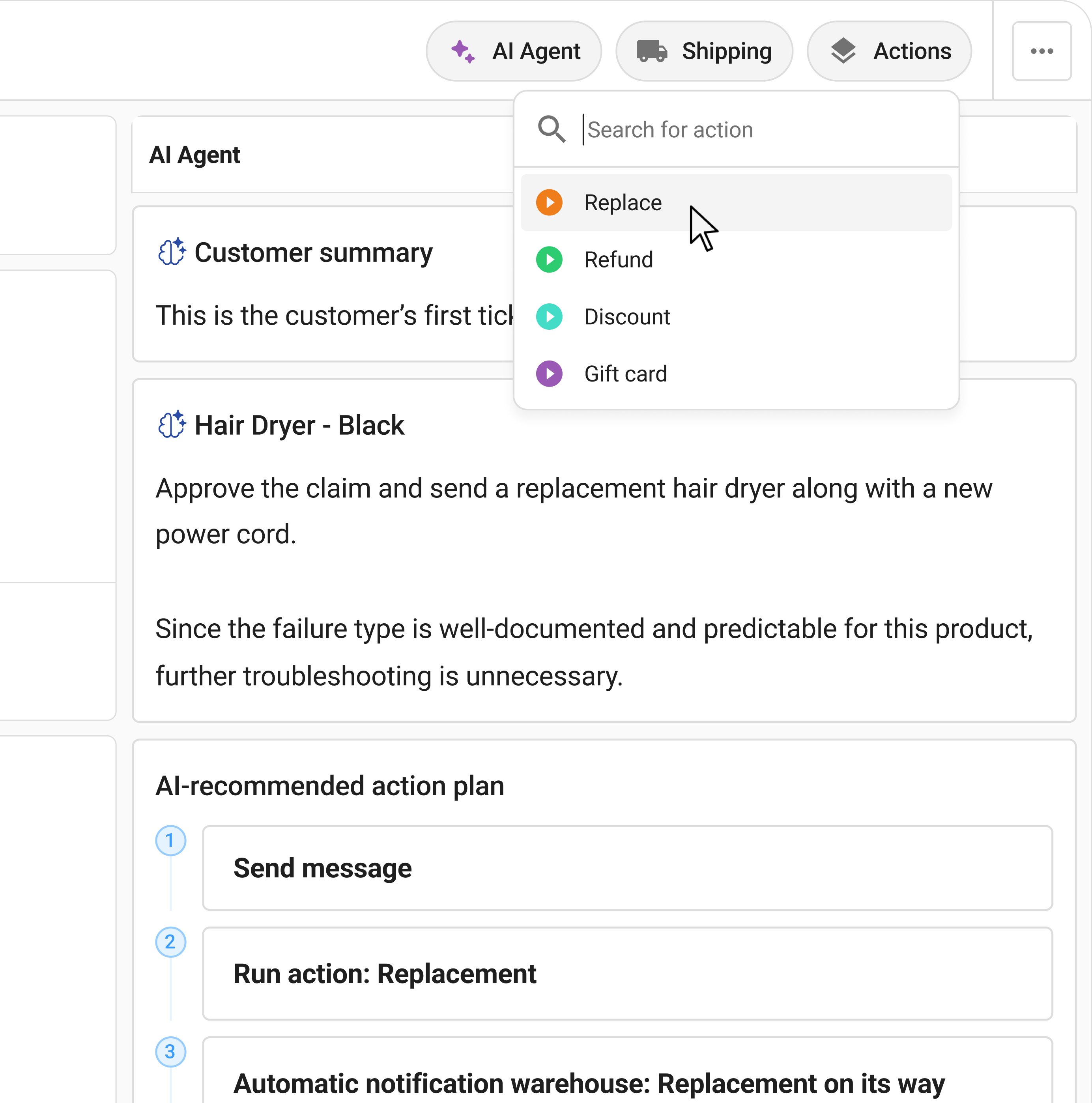
Based on similar past claims, AI predicts the most likely resolution and recommends it to the agent or auto-approves it. Claimlane's AI Agent does this by analyzing the claim photos, product data, and historical patterns to recommend repair, replacement, or refund.
Dynamic policy application
Custom workflows in Claimlane can apply different policies based on customer segment, product category, region, or claim type. The customer sees a seamless experience; behind the scenes, different rules govern different scenarios.
- Same policy for everyone
- Manual review of every claim
- Fixed resolution options
- No customer history context
- Average 3-5 day resolution
- Policies adapt per customer + product
- AI auto-approves eligible claims
- Dynamic resolution per context
- Full purchase + claim history
- Instant to same-day for qualified claims
Five Ways AI Personalizes the Returns Experience
1. Intelligent claim triage
When a customer submits a claim through the self-service portal, AI immediately assesses the claim based on the customer profile, product warranty status, and submitted evidence. High-confidence claims from trusted customers get fast-tracked. Ambiguous claims from unknown buyers get routed for manual review.
Claimlane's AI Agent does this automatically, analyzing defect photos against known product issues and recommending resolutions to the support team.
2. Returnless refunds for the right scenarios
Not every return needs the product back. Returnless refunds save shipping costs and speed up resolution. But applying them universally invites abuse.
AI identifies the right scenarios: low-value items where return shipping exceeds product cost, trusted customers with clean histories, and products that cannot be resold regardless.
3. Personalized resolution offers
Instead of defaulting to refund, AI can offer the resolution most likely to retain the customer. A loyal customer might get offered a replacement with expedited shipping. A price-sensitive buyer might prefer store credit with a bonus. A customer with a defective product might prefer a repair.
4. Supplier-specific routing
For warranty claims involving suppliers, supplier forwarding routes the claim to the correct supplier based on product, defect type, and supplier performance data. AI learns which suppliers respond fastest for which types of claims.
5. Proactive intervention
AI can identify products with emerging defect patterns from analytics data and proactively reach out to affected customers before they file claims. This turns a negative experience into a positive one.
The Business Case for Personalized Returns
Higher customer lifetime value
Customers who have a positive returns experience are 2-3x more likely to purchase again. Personalizing that experience for high-value customers amplifies the effect.
Lower processing costs
Auto-approving straightforward claims reduces agent workload. Automation of routine decisions lets teams focus on complex cases that genuinely need human judgment.
Reduced return abuse
Personalized policies make it harder to exploit blanket return rules. Customers with suspicious patterns get appropriate scrutiny without penalizing legitimate buyers.
Better supplier accountability
When claims are routed to suppliers with full data, supplier recovery improves. AI tracks supplier response times and resolution rates, creating accountability.
How Claimlane Enables Returns Personalization
Claimlane is the platform that makes returns personalization operational, not theoretical.
AI Agent for intelligent triage
Claimlane's AI Agent, the first AI agent purpose-built for warranty claims and returns, analyzes every claim submission. It assesses photos, matches against known defect patterns, checks warranty eligibility, and recommends the optimal resolution. All before a human touches the claim.
Configurable workflows per segment
Custom workflows let brands define different paths based on customer segment, product category, claim value, and region. A VIP customer claiming a defective high-value item follows a different workflow than a new customer returning a low-cost accessory.
Self-service portal with adaptive forms
The self-service portal adapts based on the product type and claim reason. A warranty claim for electronics asks for serial numbers and defect photos. A sizing issue for apparel asks for measurements and fit preferences.
Analytics for continuous optimization
Returns analytics track resolution outcomes by customer segment, product category, and claim type. This data feeds back into workflow optimization, creating a continuous improvement loop.
Rated 4.8/5 on G2. Book a demo or try the interactive demo.
Personalization vs. Privacy: Getting the Balance Right
Personalizing returns requires customer data. Brands need to balance personalization with GDPR compliance and customer trust.
Best practices
- Use aggregated patterns, not individual surveillance. "Customers who bought X and filed Y type claims typically need Z" is better than detailed individual profiling.
- Be transparent about return policies. Customers should understand why policies differ.
- Do not penalize customers for exercising legal rights. EU consumer protection and Right to Repair legislation sets minimum standards.
- Use AI to speed up legitimate claims, not to deny valid ones.
Getting Started with AI Returns Personalization
Step 1: Audit your current returns data
Before personalizing, understand your baseline. What are the most common return reasons? Which products have the highest defect rates? Which customer segments return most frequently?
Step 2: Define customer segments
Start with simple segments: new vs. returning, high-value vs. low-value, clean history vs. frequent returner. Refine with data over time.
Step 3: Map resolution paths per segment
For each segment-product combination, define the ideal resolution path. VIP + defective product = instant replacement. New customer + sizing issue = standard exchange flow.
Step 4: Implement with configurable workflows
Use a platform like Claimlane that supports segment-based workflow configuration. Start with 2-3 segments and expand based on data.
Step 5: Measure and optimize
Track resolution times, customer satisfaction, repeat purchase rates, and processing costs per segment. Adjust workflows based on outcomes.
FAQ
Conclusion
One-size-fits-all returns policies leave money on the table and frustrate loyal customers. AI-powered personalization matches the returns experience to the customer and the situation, resolving legitimate claims faster while catching abuse earlier.
Book a demo to see how Claimlane's AI Agent personalizes returns at scale.