.webp)
A customer who returns a product is at a crossroads. The product did not meet expectations. The brand now has one chance to keep the relationship alive. How the return is handled determines whether the customer comes back or walks away.
Most brands optimize their returns process for cost efficiency: faster refunds, lower shipping costs, better restocking rates. These matter. But they miss the bigger opportunity. The return is a moment of high engagement where the brand can demonstrate care, speed, and reliability, all of which drive retention.
This guide covers the strategies that turn post-return customers into repeat buyers, with data on what works, what does not, and how to measure the impact.
- The post-return window is the highest-leverage moment for retention. Customers are paying attention and forming lasting opinions.
- Speed, transparency, and ease of submission are the three factors that most influence whether a customer buys again after a return.
- Exchange-first and store-credit-first flows retain 2-3x more revenue than refund-only policies.
- Claimlane's self-service portal, AI assessment, and automated status updates address all three retention factors in one platform.
Why Post-Return Retention Matters More Than Acquisition
Acquiring a new customer costs 5-7x more than retaining an existing one. A customer who has already purchased once has demonstrated interest in the brand, provided their data, and overcome the trust barrier.
When that customer returns a product, the brand's investment in acquisition is at risk. If the return goes poorly, the acquisition cost is wasted. If the return goes well, the customer's lifetime value often exceeds that of customers who never returned anything.
The math is straightforward: improving post-return retention by even 5% has a larger impact on revenue than a 5% improvement in acquisition. Yet most brands spend 10x more on acquisition than on the returns experience.
The Seven Strategies That Drive Post-Return Retention
1. Make Submission Effortless
Every friction point in the return submission process increases the chance of abandonment or frustration. The goal is a self-service portal where customers can submit a return or warranty claim in under 3 minutes, on any device, without emailing or calling.
The portal should auto-populate order data, guide photo uploads, and confirm submission instantly. Claimlane's portal does all of this and supports multiple languages for international brands.
2. Resolve Fast
Resolution time is the number one driver of post-return satisfaction. The target is under 48 hours for standard returns and same-day for straightforward warranty claims.
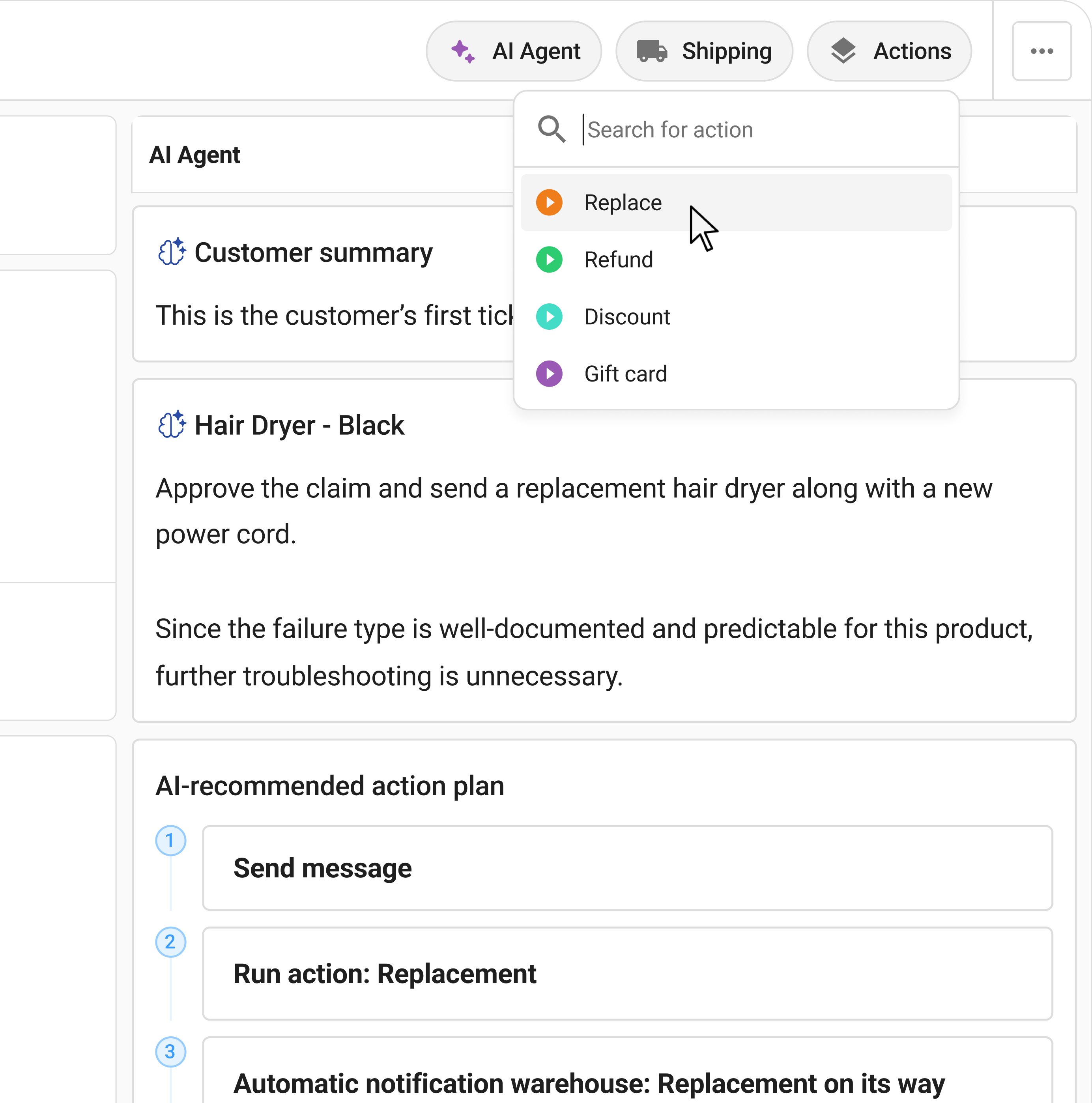
Claimlane's AI Agent, the first AI agent purpose-built for warranty claims and returns, assesses claims from photos and applies business rules automatically. Claims that meet auto-approval criteria are resolved without agent involvement, often within minutes of submission.
3. Communicate Proactively
Customers should never need to ask "where is my refund?" Automated status emails at submission, assessment, approval, and resolution keep the customer informed and reduce customer effort.
The absence of proactive communication is the single biggest driver of post-return dissatisfaction. Silence feels like neglect.
4. Offer Exchanges and Store Credit First
When the customer's reason for return allows it (wrong size, changed mind, minor defect), offering an exchange or store credit instead of an automatic refund retains revenue and keeps the customer in the brand's ecosystem.
Claimlane's workflow engine can be configured to suggest exchange or store credit as the default resolution, with refund available if the customer prefers.
5. Personalize the Recovery
A generic "your return has been processed" email misses the opportunity. The best brands personalize the post-return communication:
- Suggest alternative products based on the return reason
- Offer a small discount or free shipping on the next order
- Ask for feedback on the return experience (short, 2-question survey)
This turns the return from an ending into a bridge to the next purchase.
6. Fix the Root Cause
If a product generates returns because of sizing issues, product description gaps, or recurring defects, the most effective retention strategy is fixing the product, not just the process.
Claimlane's analytics dashboard identifies the specific reasons customers return each product. When the data shows a pattern (e.g., 40% of returns for a specific SKU are size-related), the fix is in the product page, not the returns workflow. For defect-driven patterns, supplier quality reporting closes the loop.
7. Measure and Iterate
Retention is not a one-time fix. Track repurchase rates by return reason, resolution type, and speed. Test different post-return communications. Compare retention rates for customers who used the self-service portal versus those who emailed support.
The brands that improve fastest are the ones that treat the returns experience like a product: measured, iterated, and optimized.
"We noticed that customers who used our Claimlane self-service portal came back and ordered again far more often than those who went through our old email-based process. The portal experience itself became a retention tool."
— Henry Currer, Head of Customer Success, Swoon
Retention by Return Type
Different return types require different retention approaches:
| Return Type | Customer Mindset | Retention Strategy | Best Resolution |
|---|---|---|---|
| Wrong size/color | "I like the brand" | Easy exchange, suggestions | Exchange / store credit |
| Changed mind | "Not sure about brand" | Frictionless refund + offer | Refund + discount |
| Product defect | "Product failed me" | Fast resolution, apology | Replacement or repair |
| Warranty claim | "Brand owes me" | Speed + transparency | Repair, replace, refund |
| Shipping damage | "Not my fault" | Immediate, no hassle | Replacement (no return) |
Measuring Retention After Returns
Track these metrics to understand whether your returns process is helping or hurting retention:
- 90-day repurchase rate for customers who returned (benchmark: 25-40%)
- Time to repurchase after return resolution (shorter = better experience)
- Post-return AOV compared to pre-return AOV (should be equal or higher)
- NPS/CSAT immediately after claim resolution
- Resolution time distribution (target: 80% under 48 hours)
Claimlane's analytics provides the claims-side data. Connecting it to the ecommerce platform through integrations gives the full retention picture.
What Not to Do After a Return
Do Not Go Silent
The worst post-return experience is silence. No confirmation, no status update, no follow-up. The customer assumes the brand does not care.
Do Not Make It Adversarial
Requiring customers to "prove" their claim, jumping through hoops to get a refund, or questioning their honesty destroys trust. Treat the claim as legitimate unless data suggests otherwise. For actual fraud, AI-powered fraud detection catches patterns without penalizing honest customers.
Do Not Forget the Follow-Up
A return without follow-up is a missed opportunity. Even a simple email two weeks later ("We hope you found something you love") keeps the brand in the customer's mind.
Do Not Ignore the Data
Every return tells the brand something about its products, descriptions, suppliers, or shipping. Ignoring this data means the same problems keep causing the same returns, losing the same customers. Use returns analytics to close the loop.
The Claimlane Retention Stack
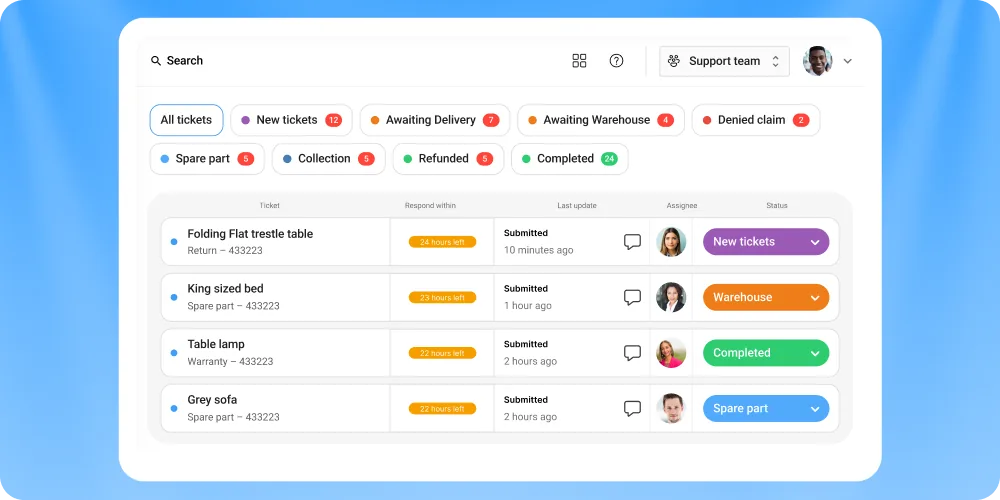
Claimlane addresses every retention-critical touchpoint in the returns process:
- Instant intake via branded self-service portal
- Same-day resolution through AI assessment and auto-approval
- Proactive updates via automated emails at every stage
- Flexible resolution options (exchange, store credit, repair, refund)
- Root cause analytics to fix products and suppliers, not just claims
- 75+ integrations with ecommerce platforms, ERPs, and helpdesks
Claimlane is rated 4.8/5 on G2.