.webp)
A customer submits a warranty claim with three blurry photos of a scratched laptop. A support agent squints at the images, checks the warranty terms, compares it to known defect patterns, and makes a judgment call. That process takes 10 to 15 minutes per claim. Multiply it by hundreds of claims per week, and the bottleneck becomes obvious.
AI image recognition changes this equation entirely. Computer vision models now analyze product photos in seconds, identifying damage types, assessing severity, and cross-referencing against warranty rules automatically. The result: faster resolutions, fewer fraudulent claims slipping through, and support teams freed up for the cases that actually need human judgment.
This guide breaks down how AI image recognition works for warranty claims, what it can and cannot detect, and how brands are using it to cut processing time and costs.
What Is AI Image Recognition for Warranty Claims?
AI image recognition for warranty claims uses computer vision, a branch of artificial intelligence, to analyze photos and videos submitted by customers as part of a warranty or return claim.
Instead of relying on a human agent to visually inspect every image, the AI model handles the same warranty claims processing workflow in seconds:
- Identifies the product in the photo and matches it to the order
- Detects and classifies damage types (cracks, scratches, discoloration, broken components, missing parts)
- Assesses damage severity (cosmetic vs. structural vs. non-functional)
- Flags signs of misuse vs. manufacturing defects
- Checks whether the submitted image is authentic (not a stock photo, AI-generated image, or reused from a previous claim)
The technology has matured significantly. Early computer vision struggled with varied lighting, angles, and backgrounds. Modern models trained on millions of product images handle these variations reliably.
Why Manual Photo Review Fails at Scale
Manual photo review worked when warranty volumes were low. It breaks down as ecommerce grows.
The consistency problem
Two different agents reviewing the same set of damage photos may reach different conclusions. One might approve a replacement for a scratched surface. Another might classify the same scratch as cosmetic and deny the claim. This inconsistency frustrates customers and creates liability issues. When damaged product claims involve subjective judgment, inconsistency becomes the norm rather than the exception.
The speed problem
A trained agent spends 5 to 15 minutes per claim reviewing photos, checking warranty terms, and making a decision. During peak periods (post-holiday returns, product recalls, seasonal spikes), the queue backs up fast.
The knowledge problem
Warranty claims span hundreds or thousands of SKUs, each with different warranty terms, known defect patterns, and supplier-specific rules. No human agent can hold all of this in their head. They rely on documentation lookups, which slows processing further. Without a structured warranty claims processing system, agents waste time hunting for the right rules instead of resolving claims.
The fraud problem
With generative AI tools now capable of producing photorealistic images of product damage, manual detection of fake claim photos is becoming nearly impossible. A Truepic study found that AI-generated damage images can fool human reviewers, highlighting the need for automated authenticity verification.
| Challenge | Manual Review | AI Image Recognition |
|---|---|---|
| Time per claim | 5–15 minutes | Under 30 seconds |
| Consistency | Varies by agent | Uniform rules applied every time |
| Fraud detection | Relies on agent instinct | Metadata analysis + image forensics |
| Scalability | Linear (more claims = more agents) | Handles volume spikes automatically |
| Product knowledge | Limited by training and memory | Trained on full product catalog |
How Computer Vision Analyzes Warranty Claim Photos
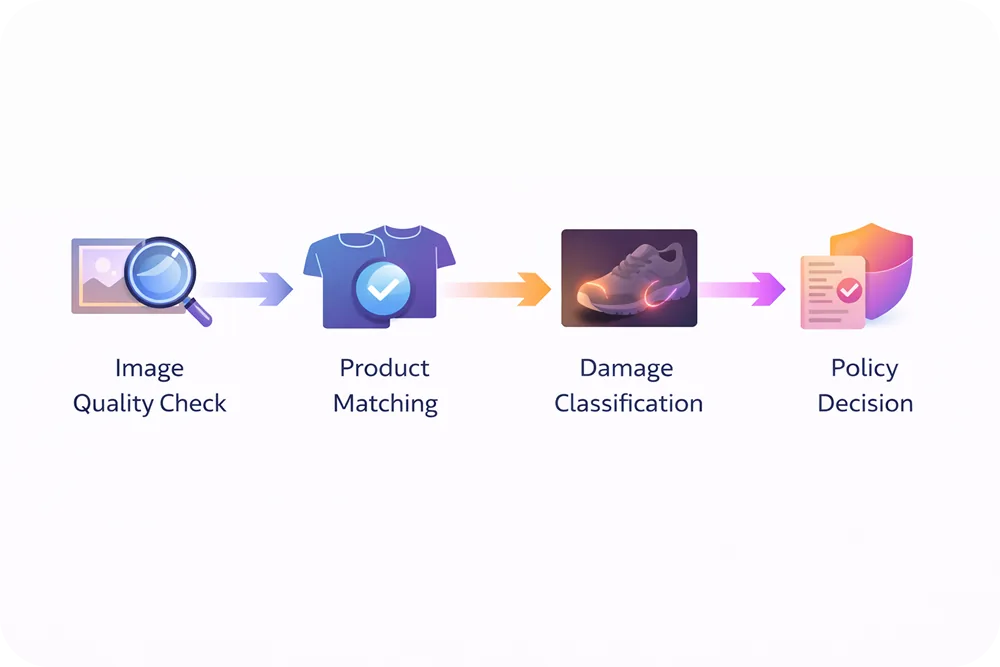
Modern computer vision for warranty claims works in multiple stages. Each stage adds a layer of intelligence to the analysis.
Stage 1: Image quality assessment
Before analyzing damage, the system checks whether the submitted photos are usable:
- Is the image in focus?
- Is lighting sufficient to see the product clearly?
- Does the image show the actual product (not packaging, paperwork, or unrelated items)?
- Are multiple angles provided when required?
If the images do not meet quality thresholds, the system automatically requests better photos from the customer through the self-service portal and sends automatic status emails keeping the customer informed, saving agents from back-and-forth email exchanges.
Stage 2: Product identification and matching
The AI identifies what product is in the photo and matches it against the customer's order data:
- Recognizes the product model, variant, and color
- Confirms the product matches the order associated with the claim
- Flags discrepancies (wrong product in photo, product from a different brand or model year)
This step catches a surprising number of invalid claims early, including cases where customers accidentally submit photos of the wrong item.
Stage 3: Damage detection and classification
This is the core of AI image recognition for warranty claims. The model:
- Locates areas of damage within the image
- Classifies the damage type: crack, scratch, dent, discoloration, corrosion, peeling, broken component, missing part, water damage, burn mark
- Assesses severity on a scale (cosmetic, functional, structural, total loss)
- Determines probable cause: manufacturing defect, shipping damage, normal wear, misuse, or accidental damage
Training data matters enormously here. The best systems are trained on product-specific datasets, not generic image recognition models. A scratch on a laptop screen means something different from a scratch on a cast iron pan.
Stage 4: Policy matching and decision support
Once the AI has classified the damage, it cross-references against warranty rules:
- Does the warranty cover this type of damage for this product?
- Is the product within its warranty period?
- Does the supplier require photo evidence for this damage category?
- What resolution does the policy prescribe (repair, replace, refund, supplier claim)?
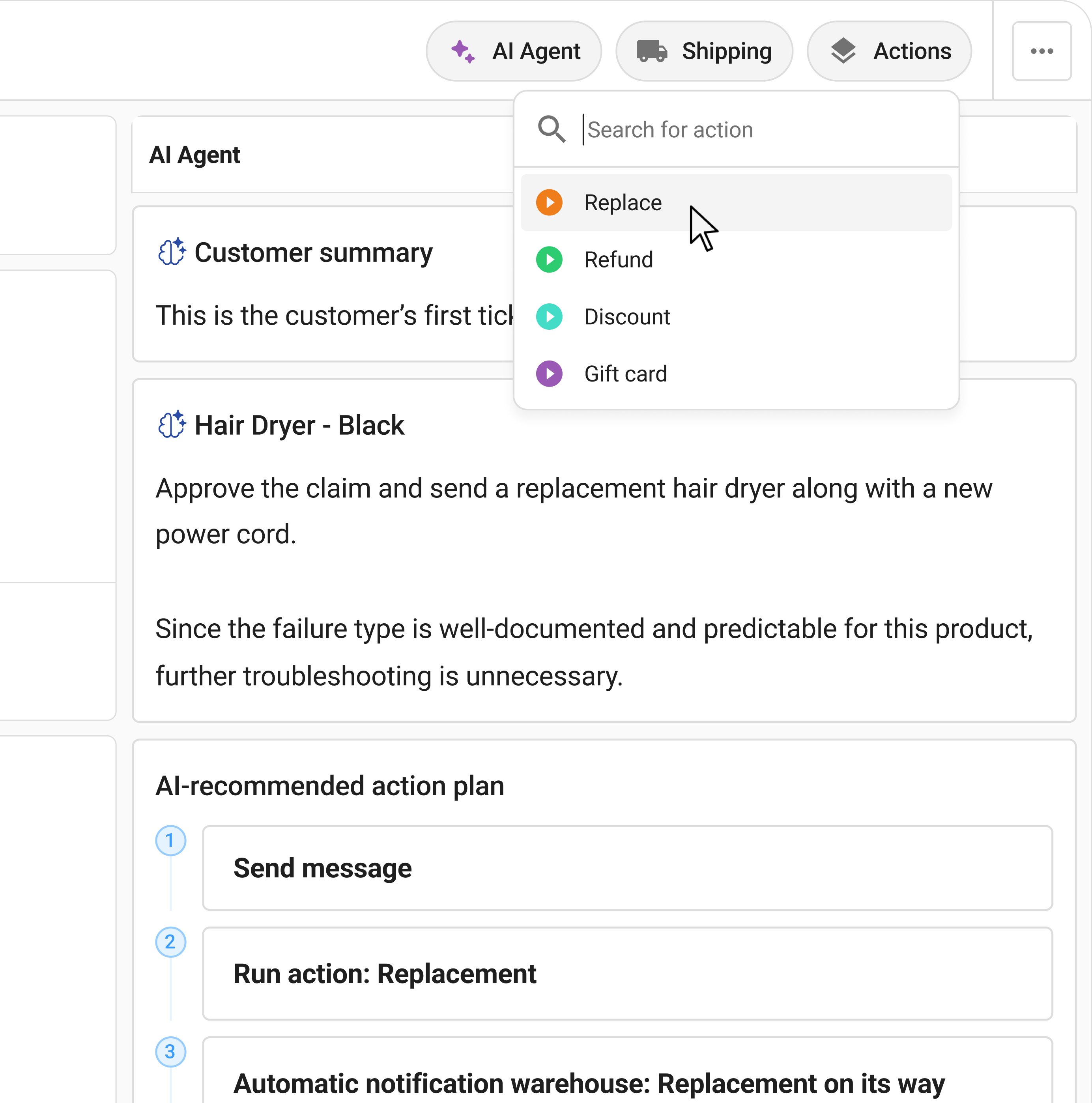
Platforms like Claimlane combine image analysis with product-specific warranty rules and supplier policies, so the AI can recommend or auto-execute the correct resolution without an agent needing to look anything up. For low-value items, this might mean triggering a returnless refund automatically. For supplier defects, it routes the claim for supplier forwarding with all evidence attached.
What AI Image Recognition Can Detect
Computer vision for warranty claims has become remarkably capable. Here are the main damage categories modern systems handle reliably.
Physical damage
- Cracks and fractures: From hairline cracks in screens to full structural breaks in plastic housings
- Scratches and scuffs: Surface-level marks vs. deep gouges that affect functionality
- Dents and deformation: Impact damage to metal or hard plastic surfaces
- Chips and chipping: Edge damage on ceramics, glass, or coated surfaces
Material deterioration
- Discoloration and staining: Color changes that indicate material degradation or chemical exposure
- Corrosion and rust: Metal oxidation patterns that signal manufacturing or coating defects
- Peeling and flaking: Paint, coating, or laminate separation from the base material
- Fabric wear: Pilling, thinning, seam separation, or thread pulls in textile products
Component failures
- Missing parts: Buttons, knobs, fasteners, or accessories that have detached
- Broken mechanisms: Hinges, zippers, clasps, or moving parts that are visibly damaged
- Electrical indicators: Burn marks, melted plastic, or discolored circuit board areas visible through vents or openings
Manufacturing defects
- Assembly errors: Misaligned components, visible glue residue, uneven stitching
- Finish defects: Paint runs, uneven coating, visible mold marks
- Material flaws: Bubbles, inclusions, or inconsistencies in materials
AI Fraud Detection in Warranty Claims
Warranty fraud costs manufacturers and retailers billions annually. AI image recognition adds multiple layers of fraud detection that human reviewers simply cannot match at scale.

Detecting AI-generated fake damage photos
As generative AI tools improve, fraudulent claimants can generate realistic photos of product damage that never actually occurred. Computer vision systems trained on real vs. synthetic images can detect:
- Artifacts and inconsistencies typical of AI-generated images
- Metadata anomalies (creation software, timestamps, geolocation data)
- Lighting and shadow inconsistencies within the image
- Texture patterns that differ from real-world damage
Detecting reused or stock images
Some fraudulent claims submit photos pulled from the internet or reused from previous claims. AI detects this through:
- Reverse image matching against web sources and previously submitted claims
- EXIF data analysis (does the photo timestamp match the claim timeline?)
- Device fingerprinting (was the photo taken on a device consistent with the claimant's profile?)
Pattern analysis across claims
AI does not just look at individual photos. It analyzes patterns across a customer's claim history:
- Same damage type claimed repeatedly across different products
- Photos with suspiciously similar composition or backgrounds across multiple claims
- Claim frequency that exceeds statistical norms
Brands using AI for return fraud detection report catching 30 to 40% more fraudulent claims compared to manual review processes. Combined with broader AI returns management strategies, image-based fraud detection becomes part of a layered defense system.
How Claimlane Uses AI Image Recognition
Claimlane's AI agent uses image recognition as a core part of its claims processing workflow. Here is how it works in practice.
The workflow
- Customer submits a warranty claim through the self-service portal, uploading photos and videos of the product issue
- The AI agent analyzes the submitted media: identifying the product, detecting damage, and classifying the defect type
- The system cross-references findings against product-specific warranty rules and supplier policies
- For routine cases, the AI auto-resolves: approving a replacement, initiating a refund, or generating a return label
- For complex cases, the AI provides the support agent with a summary, damage classification, and recommended resolution
- If the claim involves a supplier warranty, the AI compiles evidence and documentation for supplier forwarding
What makes this different from generic AI
Generic image recognition models (like those used in insurance) are trained on broad categories of damage. Claimlane's AI is trained specifically for warranty and returns use cases in ecommerce and retail:
- It understands product-specific defect patterns (a cracked stroller joint vs. a peeling furniture finish)
- It applies different rules per product, per supplier, per customer segment
- It learns from every processed claim, improving accuracy over time
- It works inside the same portal the support team already uses, so there is no separate tool to manage
MaxGaming, the largest gaming and esports ecommerce in Scandinavia with 30,000+ SKUs across 200+ brands, uses this AI-powered approach and resolved RMA cases 77% faster than with manual processing. The AI reviews images, checks business rules, and recommends actions so support agents no longer need months of product training.
Customer submits claim
Photos and videos uploaded through self-service portal with order details and issue description.
AI analyzes media
Computer vision identifies product, detects damage type and severity, checks image authenticity.
Policy matching
Findings cross-referenced against product warranty rules, supplier terms, and customer history.
Auto-resolve or escalate
Routine claims approved automatically. Complex cases routed to agents with AI summary and recommendation.
Supplier forwarding
If supplier warranty applies, AI compiles evidence package and forwards claim with documentation.
Industries Where AI Image Recognition Matters Most
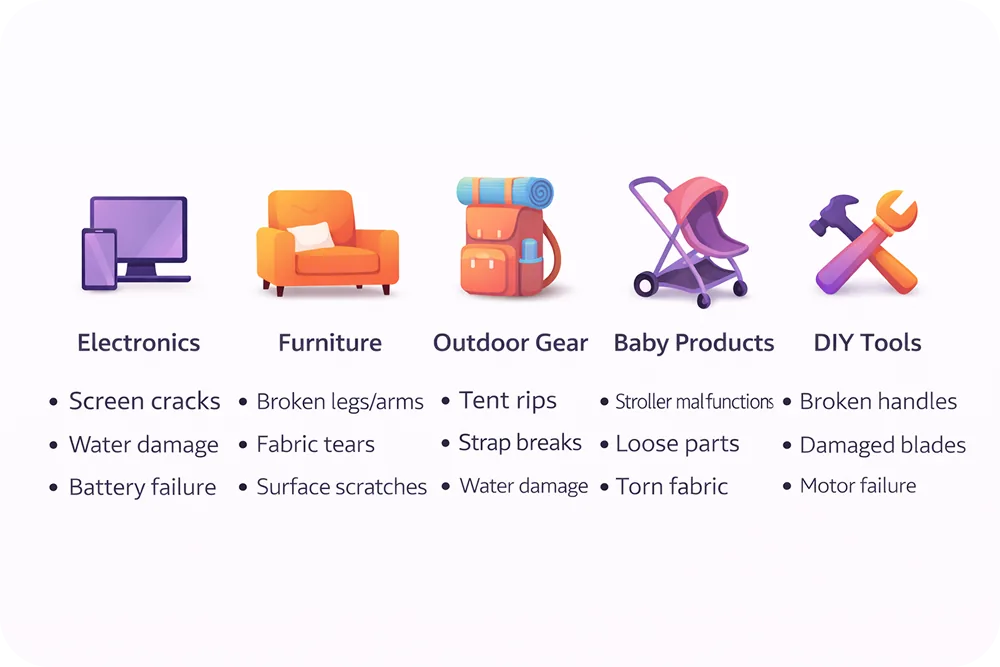
AI image recognition for warranty claims adds the most value in industries with complex products, high claim volumes, and difficult-to-verify damage.
Electronics and gaming
Screen damage, port failures, and internal component issues are hard to assess from photos without product expertise. AI models trained on electronics defect patterns outperform generalist agents who may not know the difference between a pressure mark and a dead pixel cluster.
Furniture and home goods
Furniture warranty claims often involve large, hard-to-photograph items where damage assessment requires multiple angles. AI can stitch together information from multiple photos to build a comprehensive damage picture. Furniture returns already take an average of 47 days to resolve, and image recognition helps cut that timeline significantly. Ecommerce logistics challenges compound the problem, making automation even more critical for bulky goods.
Outdoor and sporting goods
Products like climbing gear, camping equipment, and sporting goods face legitimate wear-and-tear claims alongside genuine manufacturing defects. AI image recognition is particularly good at distinguishing normal use patterns from warranty-covered defects. Black Diamond, a premium outdoor gear brand, uses automated warranty and repair workflows to handle these complex cases.
Baby and nursery products
Safety-critical products like strollers, car seats, and cribs require fast and accurate warranty processing. AI image recognition helps brands identify structural defects quickly and prioritize safety-related claims for immediate resolution.
DIY and hardware
Tools, building materials, and hardware products generate warranty claims involving corrosion, material fatigue, and component failures that require product-specific knowledge to evaluate. Davidsen, one of Scandinavia's largest DIY retailers, reduced claims staffing from 5 agents to 1-2 after automating warranty workflows.
Building an AI Image Recognition Workflow for Claims
Implementing AI image recognition for warranty claims is not an all-or-nothing switch. Most brands follow a phased approach.
Phase 1: Structured data collection (Weeks 1-2)
Before AI can analyze images effectively, you need consistent image data. This means:
- Setting up a self-service claims portal that prompts customers for specific photo angles (similar to the structured intake approach used in how to automate returns)
- Requiring minimum image quality standards (resolution, focus, lighting)
- Collecting structured metadata alongside images (product ID, purchase date, damage description)
- Defining your damage taxonomy (the categories the AI will learn to classify)
Phase 2: AI-assisted review (Weeks 3-6)
Start with AI providing recommendations while human agents make final decisions:
- AI analyzes submitted photos and suggests a damage classification
- Agent reviews the AI suggestion and approves, modifies, or overrides
- Every agent decision feeds back into the model, improving accuracy
- Track agreement rate between AI and agents to measure readiness for automation
Phase 3: Auto-resolution for routine claims (Month 2-3)
Once the AI reaches high agreement rates (typically 85%+), begin auto-resolving:
- Low-value claims with clear damage matching covered defect types
- Claims where image analysis confidence exceeds a defined threshold
- Product categories with well-established defect patterns
- Keep human review for high-value items, edge cases, and flagged fraud
- Apply restocking fees or returnless refund policies based on AI damage assessment and item value
Phase 4: Full integration with supplier workflows (Month 3+)
Extend AI image recognition into supplier claim management:
- AI compiles evidence packages for supplier warranty claims automatically
- Damage classification data feeds into supplier performance tracking
- Defect pattern analysis identifies supplier quality issues before they escalate
- Warranty cost attribution by supplier becomes data-driven, not estimate-based
- Brands using 3PL returns management can integrate AI image verification at the warehouse receiving stage
Measuring ROI of AI Image Recognition
The business case for AI image recognition in warranty claims is straightforward to measure.
Direct cost savings
- Processing time reduction: Claims that took 10-15 minutes drop to under 1 minute for auto-resolved cases
- Headcount efficiency: Teams handle 3-5x more claims with the same staffing
- Fraud prevention: Computer vision systems detect 30-40% more fraudulent claims compared to manual review, according to Bastelia's research on warranty automation
Indirect benefits
- Faster resolution times: Customers get answers in hours instead of days, improving satisfaction and repeat purchase rates. Understanding consumer buying behavior and returns shows that speed is a primary driver of post-claim loyalty
- Consistent decisions: Every claim is evaluated against the same rules, reducing complaints about unfair treatment
- Product quality insights: Aggregated damage data from image analysis reveals product defect patterns that inform product development and supplier negotiations
- Supplier accountability: Photo evidence and AI classifications create an audit trail for supplier warranty cost recovery through product analytics
(MaxGaming case study)
vs. manual review
per agent
Limitations and Honest Trade-Offs
AI image recognition is not a silver bullet. Understanding its limitations helps set realistic expectations.
What it struggles with
- Internal defects: If the damage is inside the product (a motor that stopped working, a battery that does not hold charge), photos alone cannot diagnose it. AI image recognition works best for visible, external damage.
- Subjective assessments: "It does not look like the photo on the website" or "the color seems slightly off" are claims where human judgment still outperforms AI.
- Rare products: Models need training data. Products with very few historical claims may not have enough data for accurate classification.
- Video analysis complexity: While improving rapidly, real-time video analysis (e.g., a customer showing a product that intermittently malfunctions) is still less reliable than static image analysis.
How to handle the gaps
- Use AI for the 60-80% of claims with clear, visible damage
- Route subjective or internal-defect claims to human agents with AI-provided context
- Continuously feed new claim data back into the model to expand coverage
- Combine image analysis with other data points (customer history, product batch data, return reason text) for a more complete picture
The Future: Video Analysis and Real-Time Inspection
AI image recognition for warranty claims is evolving fast. Here is what is coming next.
Real-time video walkthroughs
Instead of uploading static photos, customers will submit short videos showing the product issue. AI will analyze video frames, detect intermittent problems (a hinge that sticks, a speaker that crackles), and flag the exact moments that show the defect.
Augmented reality guided claims
AR overlays will guide customers to photograph the right areas of the product at the right angles, dramatically improving image quality and reducing back-and-forth requests for better photos.
Cross-brand defect databases
Anonymized defect pattern data shared across brands will help AI models detect emerging product issues faster. If multiple brands see the same hinge failure pattern in products from the same supplier, the system flags it before it becomes a widespread recall.
Predictive warranty claims
Combined with IoT sensor data and purchase pattern analysis, AI will predict which products are likely to generate warranty claims and trigger proactive outreach before the customer even notices the issue.
FAQ
AI image recognition uses computer vision models to analyze photos and videos submitted with warranty claims. The system identifies the product, detects and classifies damage types, assesses severity, checks for fraud indicators, and cross-references findings against warranty policies to recommend or auto-execute resolutions.
Modern computer vision models can distinguish many types of damage causes based on visual patterns. Manufacturing defects typically show consistent, predictable patterns (e.g., uniform cracking at a stress point), while misuse damage tends to be more irregular and localized. Accuracy improves with product-specific training data.
With well-trained models and clear warranty policies, AI can auto-resolve 40 to 70% of warranty claims that involve visible damage. The exact percentage depends on product complexity, claim variety, and how well-defined the warranty rules are.
Yes. AI systems analyze image metadata, check for AI-generated artifacts, perform reverse image searches against previously submitted claims and web sources, and detect lighting and shadow inconsistencies. These checks catch fraudulent photos that human reviewers typically miss.
Products with externally visible defects work best: electronics (screen damage, casing cracks), furniture (scratches, structural damage), sporting goods (fabric tears, component failures), and consumer goods (packaging damage, material defects). Products with internal or performance-based issues are harder to assess from images alone.