.webp)
The average ecommerce return rate in 2026 sits around 20.8%. That means roughly one in five online purchases gets sent back. For apparel, it's worse: return rates can reach 24-30% depending on the category.
These numbers aren't random. They're the direct result of how consumers make buying decisions online. The gap between what a customer expects when they click "buy" and what they experience when the package arrives is where returns are born.
Understanding consumer buying behavior isn't just an academic exercise for ecommerce brands. It's the most practical framework for reducing returns, improving customer satisfaction, and protecting margins.
Average ecommerce return rate in 2026
Return rates for apparel categories
Brick-and-mortar return rate
Higher return rate online vs in-store
Why Ecommerce Return Rates Are 2.5x Higher Than In-Store
Brick-and-mortar return rates hover around 8.7%. Online return rates are roughly 2.5 times higher. The difference comes down to one thing: the online shopping experience fundamentally changes how consumers evaluate products.
In a physical store, customers can touch the fabric, try on the shirt, test the weight of a backpack. Online, they're making purchase decisions based on photos, descriptions, and reviews. That information gap creates uncertainty, and uncertainty creates returns.
According to a 2025-2026 consumer report by Shorr Packaging, the top reasons for returning online purchases break down like this:
- 44% of returns are due to wrong fit or size
- 31% are because the product arrived damaged
- 11% cite the item not matching its description
- 9% are simple change of mind
- 5% fall into other categories
These categories map directly to specific consumer behaviors and brand-side gaps. Understanding each one opens up practical ways to reduce returns.
Why Shoppers Return Online Purchases
The Psychology Behind Online Buying Behavior
Consumer buying behavior in ecommerce is shaped by cognitive biases, emotional triggers, and environmental factors that don't exist in physical retail. Understanding these psychological drivers is the first step toward reducing returns at the source.
The Confidence Gap
Online shoppers can't physically interact with products. This creates a confidence gap: the difference between how certain a customer feels about a purchase in-store versus online. Customers compensate for this gap in two primary ways:
- Over-ordering (bracketing): Buying multiple sizes or colors with the intent to return what doesn't work. This is especially common in apparel and footwear.
- Relying on return policies: A generous return policy reduces the perceived risk of buying. Customers essentially use the return window as a try-on period.
Both behaviors lead to higher return rates, but they're rational responses to the lack of tactile information. Brands that close the information gap reduce the need for these compensating behaviors.
Impulse Buying and Post-Purchase Regret
Online shopping environments are designed to reduce friction. One-click purchasing, saved payment methods, and countdown timers all encourage fast buying decisions. But fast decisions often lead to regret.
Research from Salsify's 2026 consumer behavior report found that 55% of consumers switch products based on better prices or promotions. Many of these switches happen impulsively, and impulse purchases have significantly higher return rates than considered ones.
Social Proof and Herd Behavior
Consumers are heavily influenced by reviews, ratings, and "bestseller" labels. This social proof can drive purchases of products that aren't actually the right fit for the individual buyer. A product with 10,000 five-star reviews might be genuinely excellent, but if a customer buys it based on hype rather than personal need, the return probability climbs.
The "Free Returns" Effect
Free return shipping has become a competitive expectation. But it fundamentally changes buying behavior. When returns are free, the perceived cost of a wrong purchase drops to zero. Customers order more freely, knowing they can send anything back without penalty.
A 2026 study published in the Journal of Retailing and Consumer Services examined how return fees are perceived through the lens of loss aversion and mental accounting. The findings showed that how return fees are designed and communicated matters as much as whether they exist at all. Customers process return fees differently depending on whether they're framed as a deduction from the refund or as a separate charge.
Generational Differences in Buying and Return Behavior
Not all consumers behave the same way. Age plays a significant role in both purchasing patterns and return rates.
Gen Z (Ages 18-30)
Gen Z shoppers return more than any other generation. According to the NRF, shoppers aged 18-30 made 7.7 returns of online purchases in the past 12 months, more than any other age group.
This generation grew up with free returns as the norm. They're also the most likely to bracket purchases, ordering multiple options with the intent to keep one and return the rest.
Millennials (Ages 31-43)
Millennials balance convenience with value consciousness. They're more likely to research products thoroughly before buying, but also more likely to be influenced by social media recommendations that don't always lead to the right product match.
Gen X and Boomers (Ages 44+)
Older consumers generally have lower return rates. They tend to be more deliberate in their purchasing decisions and less likely to engage in bracketing behavior. However, they may have less tolerance for complicated return processes, making ease of returns important for retention with this group.
How Returns Shape Where Customers Shop
The return experience isn't just a cost center. It's a competitive differentiator that directly affects customer acquisition and retention.
2026 data from Route shows that 97% of shoppers say a positive return experience makes them more likely to shop with that brand again. And 82% say easy returns influence their decision to try new brands in the first place.
This creates a paradox for brands: making returns easy encourages more returns, but making returns difficult drives customers to competitors.
The solution isn't to make returns harder. It's to reduce the reasons customers need to return in the first place, while keeping the process smooth for legitimate returns.
Of shoppers say a positive return experience makes them more likely to repeat purchase
Say easy returns influence whether they try new brands
Of consumers admit feeling guilty about returning items
The Return Guilt Factor
Interestingly, return culture is not entirely guilt-free. The Shorr Packaging report found that 40% of consumers say they've felt guilty about returning an item. This suggests that many returns aren't casual decisions. Customers don't enjoy the hassle of repacking, labeling, and dropping off returns.
Brands can leverage this insight by making the pre-purchase experience good enough that customers feel confident in their purchase. When customers feel well-informed, they buy with more conviction and return less.
Reducing Returns by Addressing Buying Behavior
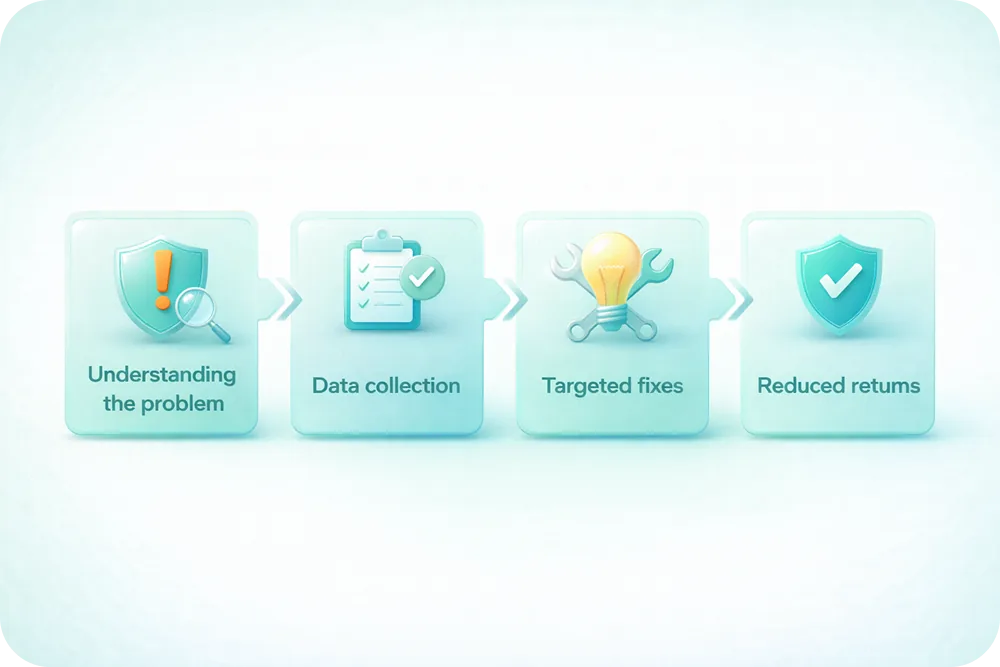
The most effective return reduction strategies address the root causes of returns, not the returns process itself. Here's how to tackle each major driver.
Close the Information Gap
The biggest driver of returns (fit and sizing issues at 44%) is fundamentally an information problem. Brands can address it with:
- Detailed size guides with actual garment measurements, not just S/M/L labels
- Customer review photos showing the product on real people of different body types
- AR and virtual try-on tools that let customers visualize products before buying
- Comparison tools that show how the sizing compares to other popular brands the customer may already own
Fix Product Content
The 11% of returns caused by products not matching their description is entirely preventable. This means:
- Photography that accurately represents color, texture, and scale
- Descriptions that are honest about materials, dimensions, and use cases
- Video content that shows the product in real-world contexts
- Clear disclosure of any limitations or differences from images
Reduce Shipping Damage
At 31% of all returns, damaged products represent a massive opportunity. Solutions include:
- Right-sizing packaging to prevent movement during transit
- Using protective inserts for fragile items
- Working with carriers to identify routes or facilities with high damage rates
- Collecting photo evidence from customers who receive damaged items to build a data picture of where damage occurs
Platforms like Claimlane streamline the damaged product claim process by letting customers submit photo evidence directly, which helps brands identify patterns in shipping damage and hold carriers accountable.
Address Impulse Buying
While friction-free checkout drives conversions, some strategic friction can reduce regret-driven returns:
- Wishlists and save-for-later: Encourage customers to revisit items rather than buying immediately
- Purchase confirmation nudges: A brief "Are you sure?" step for high-value or final-sale items
- Post-purchase engagement: Follow-up emails with usage tips, styling advice, or setup guides that reinforce the purchase decision
Make Exchanges Easier Than Refunds
When a customer wants to return a product, offering a seamless exchange experience converts what would be lost revenue into retained revenue. The key is making the exchange process even easier than the refund process:
- Instant exchange options that ship the new item before the return arrives
- Store credit with a small bonus (e.g., 10% extra) to incentivize exchanges over refunds
- Returnless refunds for low-cost items where the shipping cost exceeds the product value
How to Use Return Data to Improve Buying Decisions
Return data is one of the most underutilized data sources in ecommerce. Every return contains information about why the purchase didn't work out. Brands that systematically analyze this data can improve product pages, reduce future returns, and make better merchandising decisions.
Return Reason Analysis
Categorize returns by reason at the SKU level. If a specific product has a 40% return rate due to sizing, the product page needs better size information. If a product is frequently returned as "not as described," the photography or copy needs updating.
Customer Feedback Loops
Collect detailed feedback at the point of return initiation. Go beyond generic reason codes. Ask specific questions: "What didn't meet your expectations?" and "What would have helped you make a better decision?"
Product Development Input
Return patterns can inform product improvements. If a specific feature or dimension consistently causes returns, that's a design issue. If color representation is a recurring problem, invest in better photography equipment or processes.
The Economics of Return Prevention vs. Return Processing
Every return costs a brand between $15 and $30 to process (shipping, inspection, restocking, customer service). For a brand processing 10,000 returns per month, that's $150,000 to $300,000 in monthly processing costs alone, before accounting for lost revenue from refunds.
Investing in return prevention (better product content, size guides, quality control) typically costs a fraction of what returns cost to process. Even reducing the return rate by 2-3 percentage points can save hundreds of thousands of dollars annually.
Case Study: How Understanding Buyer Psychology Reduces Returns
Consider MaxGaming, a gaming peripherals retailer. Gaming products have specific fit and compatibility requirements that customers often get wrong when buying online. By implementing structured claims and returns workflows with Claimlane, MaxGaming was able to collect detailed return reason data, identify which products had the highest return rates and why, and make targeted improvements to product descriptions and compatibility information.
The lesson: return data, when properly collected and analyzed, becomes a roadmap for reducing future returns.
FAQ: Consumer Buying Behavior and Returns
What's the average ecommerce return rate?
Around 20.8% in 2026, or about 2.5x the in-store rate. Apparel categories run even higher at 24-30%.
Why do people return online orders?
Wrong fit (44%), damage (31%), not as described (11%), and change of mind (9%).
What is bracketing?
Ordering multiple sizes/colors of the same product with the intent to return most. Especially common in apparel among Gen Z.
Do free returns increase return rates?
Yes, but removing them hurts conversions. Better to close the information gap so customers buy right the first time.
Which generation returns the most?
Gen Z averages 7.7 returns per year, the highest of any age group. They grew up with free returns as standard.
How can brands reduce returns without hurting sales?
Better size guides, accurate photos, AR try-on, and customer review images. Reduce uncertainty, not convenience.