.webp)
Return processing time is the gap between when a customer initiates a return and when the resolution is complete (refund issued, replacement shipped, or repair finished). It is one of the most visible metrics in ecommerce customer experience.
Customers expect fast returns. A 2026 consumer survey found that 67% of shoppers check the return policy before purchasing, and 72% say slow refunds make them less likely to buy again from a brand.
But for brands, return processing involves multiple steps: claim submission, review, approval, shipping, receiving, inspection, and financial processing. Each step adds time. Without automation, the process typically takes 7-14 business days. With the right tools, it can take under 24 hours.
- Average return processing takes 7-14 business days without automation.
- The biggest bottlenecks: manual claim review, waiting for physical returns, and manual refund processing.
- AI-powered triage, self-service portals, and ERP integration can reduce processing to under 24 hours.
- Claimlane reduces claim-to-resolution time by 40-60% through AI triage and automated workflows.
Average Return Processing Times by Industry
Processing times vary significantly by industry, product type, and whether the return involves a warranty claim.
These numbers represent end-to-end processing from claim submission to refund/replacement. Brands using automated platforms report 40-60% faster processing.
The Return Processing Timeline: Where Time Gets Lost
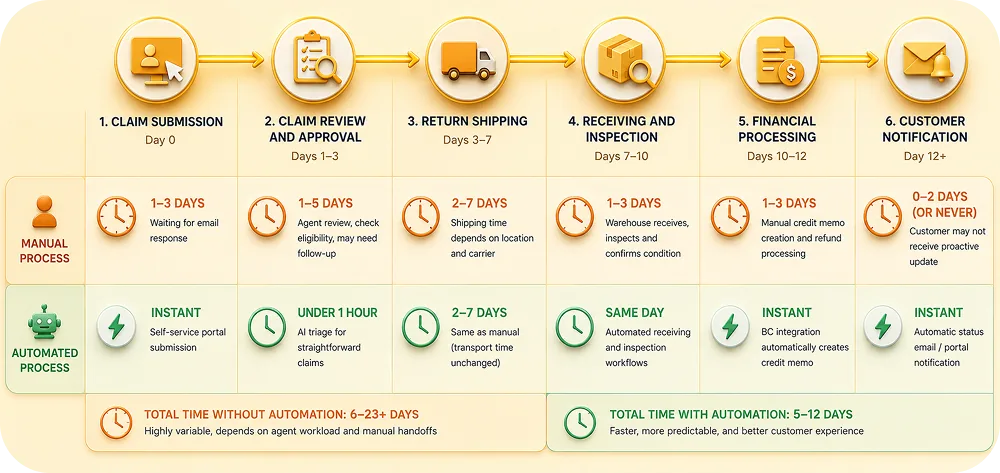
A typical return process has 6 stages. Each adds time.
Stage 1: Claim submission (Day 0)
The customer initiates the return. Without a self-service portal, this means emailing support and waiting for a response. With a portal, submission is instant.
Time added without automation: 1-3 days (waiting for email response)
Time with self-service portal: Instant
Stage 2: Claim review and approval (Days 1-3)
An agent reviews the claim, checks eligibility, examines photos (if provided), and decides on the resolution. Without structured data, the agent may need to ask follow-up questions.
Time added without automation: 1-5 days
Time with AI triage: Under 1 hour for straightforward claims
Stage 3: Return shipping (Days 3-7)
The customer ships the product back. This step is skipped for returnless refunds.
Time added: 2-7 days (depends on location and carrier)
Stage 4: Receiving and inspection (Days 7-10)
The warehouse receives the returned item, checks it against the claim, and confirms condition.
Time added without automation: 1-3 days
Time with automation: Same day
Stage 5: Financial processing (Days 10-12)
The refund is created in the ERP or payment system. Without ERP integration, this requires manual credit memo creation.
Time added without automation: 1-3 days
Time with BC integration: Instant (automatic credit memo)
Stage 6: Customer notification (Day 12+)
The customer is informed that the refund has been processed. Without automatic status emails, the customer may never receive a proactive update.
Time added without automation: 0-2 days (or never)
Time with automation: Instant
How to Reduce Return Processing Time
1. Implement a self-service portal
A self-service portal eliminates the email back-and-forth. Customers submit claims with photos, order details, and defect descriptions in a structured format. The claim enters the system immediately.
2. Use AI for claim triage
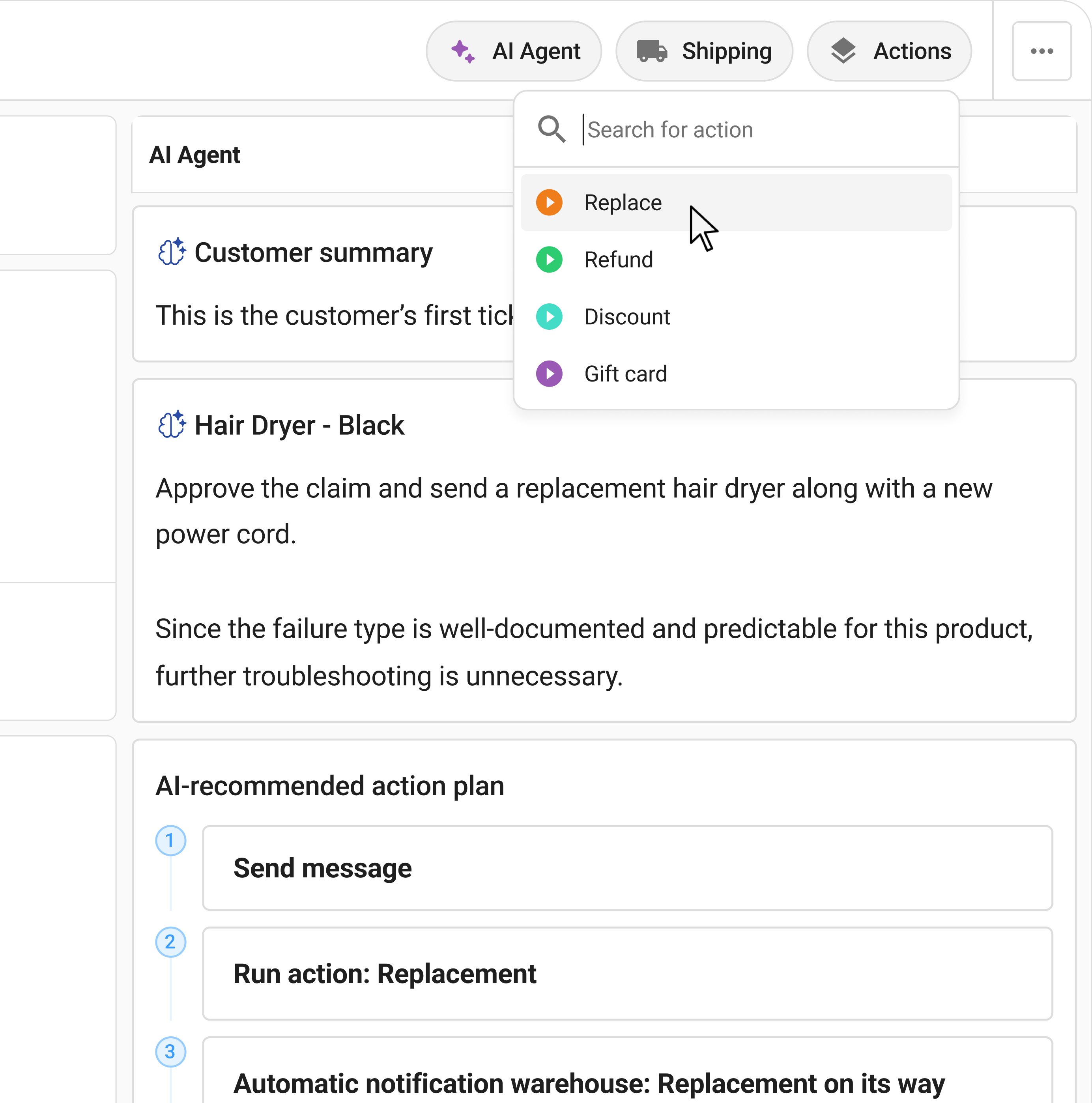
Claimlane's AI Agent, the first AI agent purpose-built for warranty claims and returns, analyzes claim submissions instantly. It assesses photos, checks warranty eligibility, and recommends resolutions. Straightforward claims can be auto-approved, cutting review time from days to minutes.
3. Offer returnless refunds for qualifying items
Returnless refunds eliminate the shipping and inspection stages entirely. For low-value items where return shipping costs exceed product value, refunding without requiring the product back saves time and money for both sides.
4. Automate financial processing
Connect the returns platform to the ERP. Claimlane's Business Central integration automatically creates credit memos when claims are resolved, eliminating the manual financial processing step.
5. Send automatic status updates
Customers should not have to ask "where is my refund?" Automatic status emails at each stage (claim received, approved, refund processed) reduce support inquiries and improve the experience.
6. Set up configurable workflows
Custom workflows route different types of returns through different processes. A simple sizing return gets a fast track. A complex warranty claim gets routed to a specialist. A high-value item gets additional verification.
- Email-based submission
- Manual review per claim
- Manual credit memo in ERP
- No proactive updates
- Self-service portal submission
- AI triage in minutes
- Auto credit memo via ERP sync
- Instant status notifications
The Business Impact of Faster Returns
Customer retention
Customers who receive fast refunds are 2-3x more likely to purchase again. A return experience that takes 2 weeks feels like a punishment. One that takes 24 hours feels like good service.
Reduced support volume
Every day a return takes to process generates "where is my refund?" inquiries. Cutting processing time from 14 days to 24 hours eliminates most of those follow-up contacts.
Better cash flow visibility
Faster processing means faster financial reconciliation. Analytics on processing times help finance teams forecast refund liabilities more accurately.
Competitive advantage
Brands with fast, transparent returns processes convert more first-time buyers. "Fast, free returns" is now a baseline expectation, not a differentiator. The new differentiator is instant, AI-powered resolution.
Measuring Return Processing Time
Key metrics to track
- Submission to first response: How quickly the customer gets acknowledged. Target: under 1 hour.
- Submission to resolution: Total time from claim to approved resolution. Target: under 24 hours for simple claims.
- Resolution to refund: Time between approval and financial processing. Target: same day with ERP integration.
- End-to-end processing: Total time from claim to refund received. Target: 1-3 business days for standard returns, same day for returnless.
Claimlane's analytics dashboard tracks all of these metrics with breakdowns by product category, claim type, team member, and time period.
FAQ
Conclusion
Return processing time directly affects customer loyalty, support costs, and brand reputation. The biggest wins come from eliminating manual steps: self-service portals for instant submission, AI for instant triage, and ERP integration for instant financial processing.
Book a demo to see how Claimlane reduces return processing times.