.webp)
Why reverse logistics needs AI now
Forward logistics has had a decade of optimisation. Reverse logistics has not. Returns still get unboxed, photographed, and routed by humans reading notes from other humans. Every step adds time and time costs money. AI sits well in reverse logistics because the work is repetitive, image-heavy, and rule-based, which is exactly what current models are good at.
This piece covers six AI use cases that brands are running in production today, not theoretical demos. Each section explains the workflow, the model behind it, and the metric it moves.
- AI in reverse logistics works when the task is repetitive, image or text heavy, and rule-based.
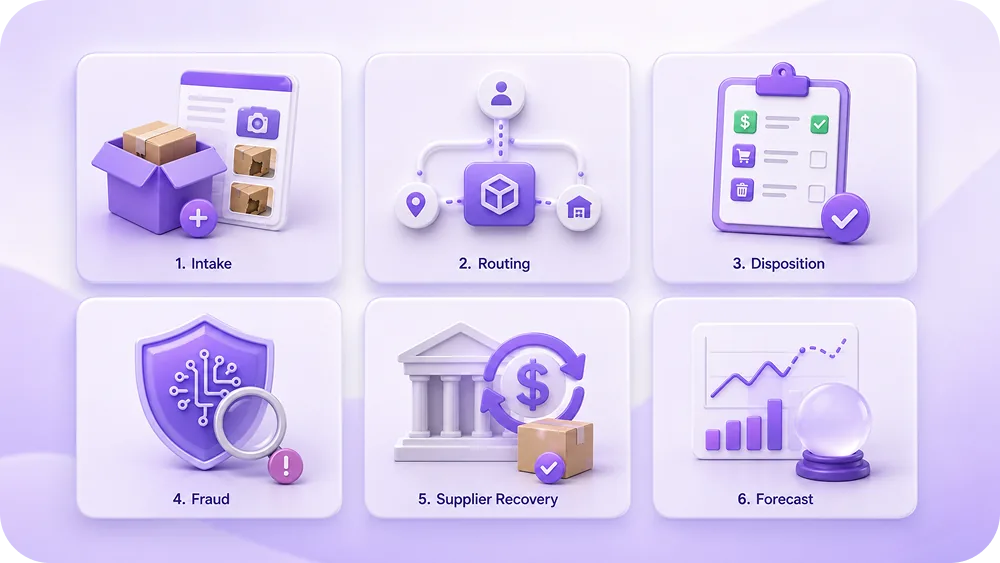
- The six highest-leverage use cases are intake triage, repair-vs-replace routing, disposition, fraud screening, supplier recovery, and forecast.
- The biggest gains come from combining a vision model with a rules engine, not from chatbots alone.
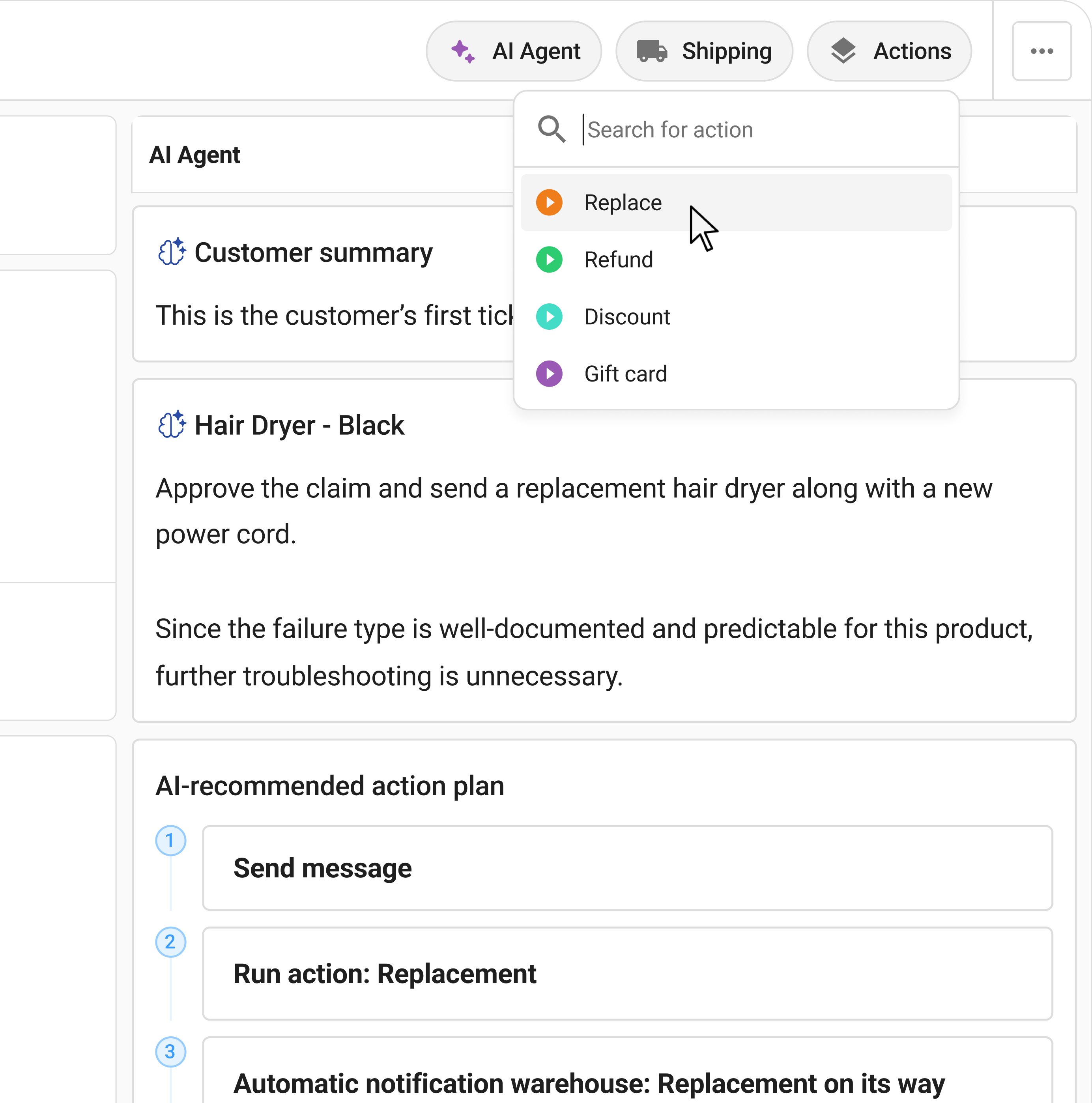
- Brands using Claimlane's AI Agent, the first AI agent purpose-built for warranty claims and returns, automate the triage and routing layers end to end.
What counts as reverse logistics in 2026
Reverse logistics covers everything that happens when a product moves backwards. Returns, warranty claims, repairs, replacements, refurbishment, recycling, and supplier recovery. The category sits inside aftersales operations and overlaps heavily with customer service.
The operational pattern is consistent across categories. A customer reports an issue. A person assesses it. A decision is made on what to do with the product. The decision triggers a physical move. AI can sit at three points in that loop: the assess step, the decision step, and the move step. See the 5 Rs of reverse logistics for the underlying framework.
Use case 1: Intake triage with computer vision
The first step in any return is figuring out what came back and what condition it is in. Most brands still do this with a person and a clipboard. AI vision models replace that step.
The customer or warehouse worker uploads photos. The model identifies the product, reads the serial number where visible, and flags damage type. The output feeds the case as structured data instead of free-text notes. For warranty cases, this is the same pattern covered in AI image recognition for warranty claims.
What it moves
Intake time per case drops from minutes to seconds. Data quality goes up because the structured output feeds analytics cleanly. The downstream support agent gets a case that is already categorised.
"Our AI Agent reviews images, checks our business rules, and recommends an action. New support hires are productive in days, not months."— MaxGaming, largest gaming and e-sports e-commerce in Scandinavia
Use case 2: Repair-vs-replace routing
The decision to repair, replace, or refund is a rules problem with a probability layer. Brands have rules: under warranty, specific product, supplier responsible. AI adds the probability layer: how often does this defect lead to a successful repair, and how long does it take.
Claimlane's workflow engine runs the rules. The AI Agent runs the probability layer. The combined output tells the agent what to do next. Brands using both reduce time spent on the repair-vs-replace decision by 60% or more.
Where it goes wrong
The model is only as good as the historical data. Brands with under 12 months of structured case data should start with rules-only and layer AI as the data accumulates. Predictive warranty analytics covers the data quality bar.
Use case 3: Disposition decisions
Once a product is back in the warehouse, someone has to decide what happens to it: restock, refurbish, recycle, dispose, or send to a third party. The decision used to be a person looking at the product and a price list. AI runs the same decision in milliseconds based on condition, market demand, and refurbishment cost.
The payoff is twofold. Resale value goes up because products move faster. Disposal costs go down because more units stay in the recommerce loop. Brands selling refurbished products report margin uplift in the 5 to 15% range.
Use case 4: Fraud screening at the case level
Return fraud is a fast-growing problem in 2026. Friendly fraud, wardrobing, and serial returners cost ecommerce brands between 2 and 5% of revenue depending on category. AI helps in three places: at submission, at receipt, and at refund.
At submission, the model checks the customer's history, the order value, and the claim pattern. At receipt, vision checks whether the box is empty or contains a substituted item. At refund, anomaly detection flags accounts with statistically odd return rates. Combined with AI warranty fraud detection, the result is fewer false positives on legitimate customers.
Where to draw the line
Fraud models flag, they do not decide. The hard rule is human review on every blocked refund. Otherwise the brand alienates real customers. See return fraud strategies for the policy side.
Use case 5: Supplier recovery automation
For brands that recover costs from suppliers when a product fails, the bottleneck is documentation. Photos, serials, claim numbers, dates, repair logs. AI assembles the supplier package automatically from the case data, so the brand sends a complete file instead of three emails over two weeks.
This matters because most suppliers reject incomplete claims. The cleaner the package, the faster the credit note. Compare manual vs automated speed in the supplier recovery guide. The forward-to-supplier feature handles the handoff end to end.
Use case 6: Return rate forecasting
Returns are seasonal, sized to launches, and correlated with category and channel. AI handles that better than spreadsheets. The brand feeds the model order data, return data, and product attributes. The output is a forecast by SKU, channel, and week.
The forecast moves three downstream decisions: warehouse staffing, refurbishment capacity, and inventory buffer. Brands using predictive returns analytics cut overtime in returns warehouses by 15 to 25%. Pair this with AI demand forecasting in reverse logistics for the forward side.
How these use cases fit together
%201.png)
The trap is to buy six tools and end up with six silos. The pattern that works is one platform that handles cases, with AI layered into the steps that benefit from it.
Step 1: Get the data clean
AI fails on messy data. The first job is to consolidate case data into one platform with structured fields. See retail returns data silos for the failure pattern most brands start from.
Step 2: Add vision and rules
Vision for intake. Rules for routing. These two together do 60% of the lift.
Step 3: Add probability
Once there are 12 months of structured data, layer the probability models for repair-vs-replace, fraud, and forecasting.
Step 4: Measure and tune
Put returns and warranty KPIs on a dashboard and tune the rules monthly. AI models drift, rules need refresh, and the dashboard is what tells the team where to look.
Where AI in reverse logistics still falls short
AI is not a silver bullet. Three weaknesses persist in 2026.
Complex multi-product claims
When a case includes multiple products with different warranties and suppliers, the model still struggles. Human review is needed.
Country and language coverage
Vision and language models trained on US English perform worse on smaller languages. EU brands need to test in every market they serve. The same pattern shows up in cross-channel returns management.
Edge cases the model never saw
Any case the training set did not include comes back to a human. The fix is feedback loops: every human override teaches the model.
"We dropped from five people on claims down to one or two, with faster resolutions on top."— Davidsen, building materials retailer (read the case study)
Building blocks: what to look for in an AI reverse logistics platform
- Vision model for product and damage identification
- Rules engine that can be edited without developer help
- Probability layer trained on the brand's own historical cases
- Self-service claim portal for the customer-facing step
- API and webhooks for downstream tools (CRM, email, ERP)
- Real-time analytics with KPI dashboards
- Supplier portal for forward-claim handoff
- Audit trail for every AI decision
For the broader integrations layer, see Claimlane's integrations product and the more general AI agents in post-purchase support overview.
Frequently asked questions
Conclusion
AI in reverse logistics works when it sits inside the operation, not next to it. Vision plus rules plus probability, layered into the existing case flow, is the pattern brands are getting paid for in 2026. The brands that wait for a perfect platform will keep paying for the people, the time, and the unhappy customers.
To see how Claimlane's AI Agent handles intake, routing, and supplier recovery for warranty and returns, book a demo. Or watch the 30-minute walkthrough on the interactive demo page.