.webp)
The pre-purchase tech stack gets all the attention. Marketing automation, CRM, product information management, personalization engines. Brands spend months evaluating and integrating tools that drive conversions.
The after-sales tech stack gets whatever is left over. Usually an ERP module and a shared inbox. Maybe a helpdesk. The result is that returns, warranty claims, and supplier recoveries run on manual processes while the rest of the business runs on automation.
This guide lays out what a modern after-sales automation stack looks like, which layers matter most, and how the pieces connect.
- A modern after-sales stack has five layers: intake, processing, resolution, supplier management, and analytics.
- The claims management platform is the central hub that connects self-service portals, AI assessment, ERP transactions, and supplier workflows.
- AI reduces agent handling time by 50-80% by automating claim assessment, warranty validation, and resolution recommendations.
- Claimlane connects all five layers and integrates with 75+ platforms to eliminate manual handoffs between systems.
Why After-Sales Needs Its Own Stack
After-sales operations touch more systems than most teams realize. A single warranty claim can involve:
- The ecommerce platform (order lookup)
- The customer service tool (initial contact)
- The ERP (credit memo, inventory adjustment)
- The warehouse (receiving returned items)
- The supplier (cost recovery for defects)
- The shipping provider (return labels, tracking)
Without a central system connecting these touchpoints, agents bounce between tabs, copy-paste data, and manually trigger actions that should be automatic. The stack is meant to eliminate these handoffs.
The Five Layers of After-Sales Automation

Layer 1: Intake
How claims enter the system. The goal is structured, self-service intake that requires no agent involvement for the initial submission.
Components:
- Customer self-service portal (branded, multilingual)
- B2B retailer claims portal
- Email parsing for legacy submissions
- Ecommerce platform integration (order data, product data)
Claimlane's self-service portal handles all four intake channels. Customers and retailers submit claims with photos, defect categories, and order references. The data arrives pre-structured, eliminating the back-and-forth emails that slow down every ERP-based process.
Layer 2: Processing
How claims are evaluated and routed. This is where AI makes the biggest difference.
Components:
- Warranty validation engine (product-specific rules)
- AI claim assessment (photo/video analysis)
- Workflow routing (by product, defect type, value, customer tier)
- Approval logic (auto-approve, agent review, manager escalation)
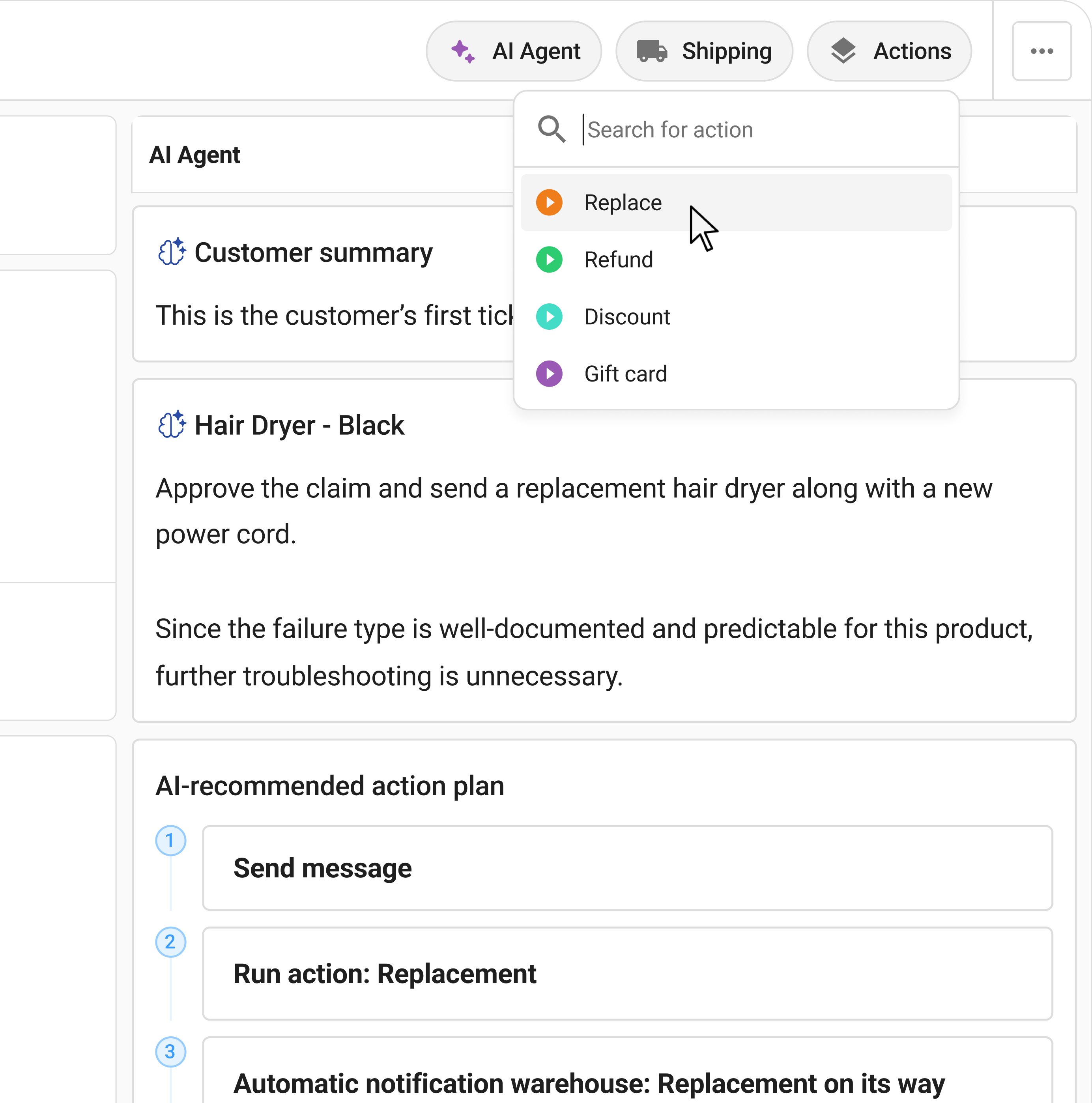
Claimlane's AI Agent, the first AI agent purpose-built for warranty claims and returns, handles assessment automatically. It analyzes product images, applies warranty rules per product and supplier, and recommends or auto-approves resolutions. The workflow engine routes claims that need human review to the right person based on configurable rules.
Layer 3: Resolution
How claims are resolved and what happens next. Multiple resolution paths need to work in parallel.
Components:
- Refund processing (credit memo in ERP)
- Replacement fulfillment (new order creation)
- Repair workflow (intake, diagnosis, repair, QA, return)
- Spare parts fulfillment
- Store credit issuance
- Automated status emails to customers
Claimlane triggers the financial transaction (credit memo, replacement order) in the ERP automatically on resolution. No agent needs to switch systems.
Layer 4: Supplier Management
How defect-related claims are forwarded to suppliers for cost recovery.
Components:
- Supplier claim forwarding with evidence
- Supplier response tracking
- Supplier chargebacks and credit note management
- Supplier quality scoring
Claimlane's forward-to-supplier feature sends claims with all evidence to the responsible supplier. The supplier resolves the claim in the same platform. Recovery rates and response times are tracked automatically.
Layer 5: Analytics
How the data from all four layers feeds back into product and operational decisions.
Components:
- Claim rate dashboards (by SKU, category, supplier)
- Defect type distribution
- Resolution time and cost metrics
- Supplier performance reports
- Product quality trend analysis
Claimlane's analytics module aggregates data across all claims and presents it in views designed for customer service, product, and procurement teams. This is where after-sales data turns into product quality improvements.
How AI Transforms the After-Sales Stack
AI is not an optional upgrade for the after-sales stack. It is the layer that makes the difference between incremental improvement and step-change efficiency.
What AI Does in After-Sales Today
- Image and video analysis. The AI examines product photos submitted with claims and identifies defect types, severity, and whether the damage is consistent with a warranty claim or misuse.
- Warranty rule application. Different products, brands, and suppliers have different warranty terms. The AI checks eligibility automatically.
- Resolution recommendation. Based on the defect type, product value, customer history, and business rules, the AI recommends the optimal resolution.
- Auto-approval. Claims that meet predefined criteria (low value, clear defect, valid warranty) are approved without agent intervention.
- Pattern detection. The AI flags unusual spikes in claims for specific products or suppliers, enabling proactive quality interventions.
The Impact
Brands using Claimlane's AI Agent report:
- 50-80% reduction in agent handling time per claim
- 77% faster resolution (MaxGaming case)
- Consistent assessment quality regardless of agent experience
- Better defect data because AI categories are standardized
For more on how AI is reshaping post-purchase operations, see the guide on AI agents for post-purchase support.
"After implementing Claimlane, what used to take 5 agents now takes 1-2. And the data we get back on product issues has completely changed how we talk to our suppliers."
— Tanja Munch, Customer Service Manager, Luksusbaby
Integrations That Matter

The after-sales stack is only as good as its integrations. Here are the connections that eliminate manual work:
Ecommerce Platforms
Shopify, WooCommerce, Magento, BigCommerce. The integration pulls order data and product catalogs so customers can select the right order when submitting a claim. For platform-specific guides, see the articles on best Shopify tools and BigCommerce integrations.
ERPs
Business Central, NetSuite, SAP. The integration pushes credit memos, replacement orders, and inventory adjustments into the ERP when claims are resolved. For a detailed walkthrough, see how to optimize your warranty claim process with Business Central.
Helpdesks
Zendesk, Gorgias, Freshdesk. The integration lets agents trigger claims from support tickets and view claim status without leaving the helpdesk.
Shipping Providers
Automatic return label generation and tracking. The customer receives a label without the agent needing to log into a separate system.
Claimlane connects to 75+ platforms across all four categories.
Building the Stack: Where to Start
Brands do not need to implement all five layers at once. The highest-impact starting point depends on the biggest pain:
If Customer Experience Is the Priority
Start with Layer 1 (Intake). A self-service portal eliminates the email bottleneck and gives customers an immediate, branded experience. This alone can cut resolution time by 50%.
If Agent Efficiency Is the Priority
Start with Layer 2 (Processing). AI assessment and workflow routing reduce the time agents spend per claim from 20-45 minutes to under 5 minutes.
If Cost Recovery Is the Priority
Start with Layer 4 (Supplier Management). Forwarding claims to suppliers with structured evidence data recovers costs that are currently absorbed as losses. Supplier chargebacks can deliver immediate ROI.
If Product Quality Is the Priority
Start with Layer 5 (Analytics). But analytics requires structured data, which means Layers 1 and 2 need to be in place first. The fastest path to quality data is implementing the full intake-to-analytics pipeline.
Common Stack Mistakes
Treating the Helpdesk as the Claims Platform
Helpdesks (Zendesk, Gorgias, Freshdesk) are excellent for general support tickets. They are not designed for claims workflows that require photo evidence, warranty validation, supplier forwarding, and ERP integration. Using a helpdesk for claims creates the same data gaps as using the ERP alone. For a comparison, see the guide on best ecommerce customer service software.
Building Custom Integrations Instead of Using Native Ones
Custom middleware between the ERP and a homegrown claims process is expensive to build and maintain. Platforms like Claimlane provide native integrations that are maintained by the vendor, reducing IT burden.
Ignoring the Supplier Layer
Many brands automate customer-facing claims but never build the supplier recovery workflow. This leaves money on the table. Every defect claim that is not forwarded to the supplier is a cost the brand absorbs unnecessarily.
Skipping Analytics
Automation without analytics is efficiency without intelligence. The data from claims should feed back into product development, procurement decisions, and supplier negotiations. Without analytics, brands solve the same problems repeatedly.
The Claimlane Stack
Claimlane covers all five layers of the after-sales automation stack in a single platform:
- Intake: Branded self-service portal, B2B portal, email integration
- Processing: AI Agent, warranty rules engine, workflow automation
- Resolution: Auto-triggered credit memos, replacement orders, repair tracking
- Supplier: Forward-to-supplier, chargeback tracking, supplier scoring
- Analytics: Dashboards for claims, defects, suppliers, and costs
It integrates with 75+ platforms so every layer connects to the systems brands already use.
Claimlane is rated 4.8/5 on G2.