.webp)
A return policy is one of those pages every ecommerce store needs but few get right. It sits quietly on the footer until a customer needs to send something back. Then it becomes the difference between a repeat buyer and a lost one.
Return policy generators promise to make the process painless. Plug in a few details about the store, pick some options, and get a ready-to-publish policy. But not all generators are equal, and the best return policy is only useful if the returns process behind it actually works.
TL;DR
- Return policy generators create basic refund and return policies using templates and guided questionnaires, saving hours of legal drafting.
- Free tools like Termly, TermsFeed, and Shopify cover the essentials, but most produce generic policies that still need manual customization.
- A great return policy means nothing without the operational backbone to process returns, track claims, and issue refunds quickly.
- Platforms like Claimlane (rated 4.8/5 on G2 G24.8★★★★★) turn the policy into a living process with self-service portals, automated workflows, and AI-powered claim resolution.
What Is a Return Policy Generator?
A return policy generator is an online tool that creates a return and refund policy for an ecommerce store based on a short questionnaire. The store owner answers questions about return windows, refund methods, product conditions, and shipping responsibilities. The tool then produces a formatted document ready to paste into a website.
Most generators are free or freemium. They use pre-written legal language and fill in the blanks with the store's specific details. The output typically covers:
- Return eligibility and time limits
- Acceptable product conditions for returns
- Refund methods (original payment, store credit, exchange)
- Who pays for return shipping
- Non-returnable items and exceptions
- Processing timelines
These tools solve a real problem. Writing a return policy from scratch takes time, and getting the legal language wrong can create liability. A generator handles the boilerplate so the merchant can focus on running the business.
But here is the catch. A return policy document is just words on a page. The real challenge is building the returns process behind that policy. That is where most ecommerce brands hit friction.
Why Every Ecommerce Store Needs a Return Policy
Building Customer Trust
A clear return policy removes buying hesitation. According to the National Retail Federation, retail returns totaled $890 billion in 2024. Customers expect a straightforward process when things go wrong.
Stores without a visible return policy lose conversions. Shoppers check the policy before completing a purchase, especially for higher-priced items. If the policy is hard to find or unclear, they leave.
Legal Requirements
Several jurisdictions require merchants to display return and refund terms. The EU gives consumers a 14-day withdrawal period for online purchases. Australia requires refunds for faulty goods under consumer law. Even in the US, where no federal law mandates a return policy, individual states like California require conspicuous disclosure if a store does not accept returns.
A refund policy generator helps cover the basics, but brands selling internationally should review the output against local regulations.
Reducing Support Volume
When the policy is clear, customers can answer their own questions. Fewer "what is your return policy?" tickets. Fewer disputes. Fewer chargebacks. This is where a self-service approach to returns management pays off in practice.
Best Free Return Policy Generators (2026)
The SERP for "return policy generator" is packed with free tools. Here are the ones worth considering.
Termly
Termly is one of the most popular options. It walks users through a step-by-step questionnaire covering return windows, refund types, shipping costs, and exceptions. The free tier generates a basic policy. Paid plans add customization, hosting, and a live editor.
Best for: Stores that want a comprehensive questionnaire with guided prompts.
TermsFeed
TermsFeed offers a similar generator with a clean interface. It produces policies for ecommerce stores, SaaS products, and mobile apps. Free plans include a hosted page. Premium plans unlock downloads and advanced editing.
Best for: Merchants who want a hosted policy page without building one from scratch.
Shopify Refund Policy Generator
Shopify's free generator is straightforward. Enter company details, answer a few questions, and receive a policy by email. It is basic but functional, and it integrates naturally into Shopify stores.
Best for: Shopify merchants who want a quick, no-frills starting point.
FreePrivacyPolicy.com
FreePrivacyPolicy.com provides a free generator with hosting included. The tool covers standard return scenarios and produces a policy that can be linked from any website, Wix store, or WooCommerce site.
Best for: Small stores looking for a completely free option with hosting.
GetTerms.io
GetTerms.io generates return policies that can be downloaded as PDFs and translated into 7+ languages. It also includes a cookie consent platform as a bonus.
Best for: International stores needing multilingual policy support.
What to Include in a Return Policy
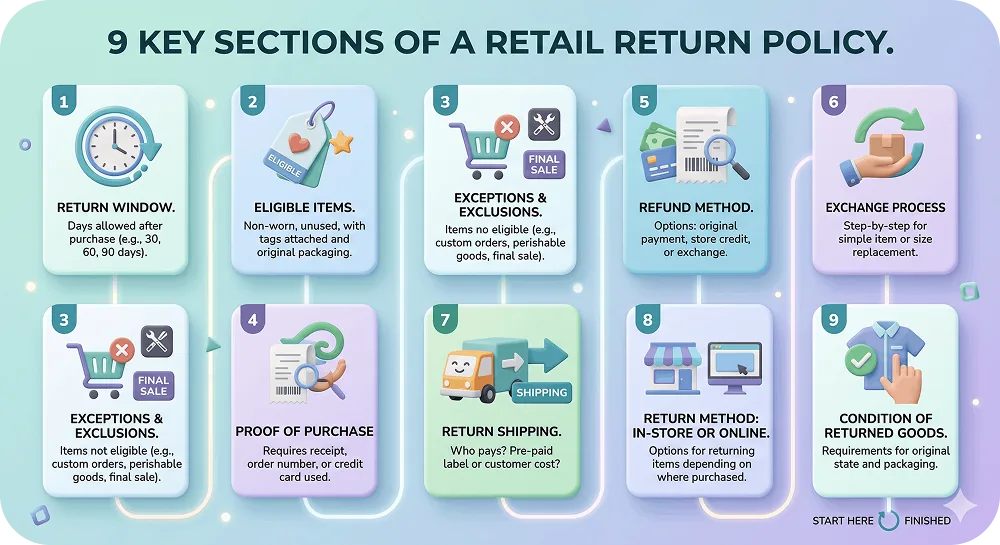
A return policy generator handles the structure, but knowing what to include helps evaluate whether the output is complete.
%201.png)
Return Window
Most ecommerce stores offer 14 to 30 days. Some extend to 60 or 90 days for electronics or seasonal items. The return window should be clearly stated with the start date (from delivery, not purchase).
Accepted Product Conditions
Specify whether items must be unused, in original packaging, or with tags attached. Different product categories may need different rules. Furniture returns, for example, often have stricter condition requirements than apparel returns.
Refund Methods
Will customers receive a refund to the original payment method, store credit, or an exchange? Many brands are shifting toward store credit to retain revenue after returns. The policy should spell this out.
Return Shipping
Who pays for the return label? Free return shipping increases return rates but also increases conversion rates. Some brands cover shipping for defective items but charge for buyer's remorse returns. This is a key cost consideration every merchant needs to weigh.
Non-Returnable Items
List categories excluded from returns: perishable goods, personalized items, intimate apparel, hazardous materials, digital downloads. Being explicit here reduces disputes.
Processing Timeline
Customers want to know how long the refund takes. Best practice: state the inspection window (1 to 5 business days after receiving the item) plus the refund processing time (5 to 10 business days depending on the payment provider).
Warranty and Defect Claims
Return policies often blend with warranty claim processes. If a product arrives defective or breaks within warranty, the process may differ from a standard return. The policy should explain the distinction and link to a separate warranty or claims page if applicable.
The Gap Between Policy and Process
Here is where most return policy generators fall short. They produce a document. They do not build the operational system that fulfills the promises in that document.
A policy that says "returns processed within 5 business days" means nothing if the support team is manually tracking returns in spreadsheets. A policy that offers exchanges needs a system that can facilitate product swaps without requiring customers to place a new order and wait for a separate refund.
This is the fundamental difference between a return policy generator and a returns management system. The generator writes the rules. The system enforces them.
Customer Quote
"Before Claimlane, our entire customer service team of 5 agents was involved in claims handling, with additional seasonal help from other departments. Today, we have 1-2 agents who can solve everything in Claimlane."
Andreas Bang Nielsen, Marketing & Ecommerce Director, Davidsen
How to Use a Return Policy Generator (Step by Step)
Using a return policy generator takes about 10 to 15 minutes. Here is the typical process.
Step 1: Gather Store Details
Before starting, collect the business name, physical address (if applicable), contact email, and website URL. Some generators also ask for the business type (physical goods, digital products, SaaS).
Step 2: Define Return Rules
Answer questions about the return window, accepted conditions, refund methods, and exclusions. Think about edge cases: what happens with opened electronics? What about items bought on sale?
Step 3: Set Shipping Terms
Decide who covers return shipping. Some generators let merchants specify different rules for different return reasons (defective vs. changed mind).
Step 4: Review and Customize
Read the generated policy carefully. Generic language might not fit every business. Adjust wording to match the brand voice and add product-specific clauses that the generator missed.
Step 5: Publish and Link
Post the policy on a dedicated page. Link to it from the footer, checkout page, product pages, and order confirmation emails. The policy should be easy to find from anywhere on the site.
Step 6: Build the Process Behind It
This is the step most generators skip. Set up the actual returns workflow: how customers initiate returns, how the team reviews requests, how refunds get processed. A self-service portal that lets customers submit return requests with photos and order details saves significant support time.
How It Works: Policy to Process
Return Policy Generator vs Return Policy Template
Generators and templates serve the same purpose but work differently.
%201.png)
Templates
A return policy template is a static document with placeholder text. The merchant reads through it, replaces the brackets with their own details, and deletes sections that do not apply. Templates give more control over wording but require more effort and legal awareness.
Generators
Generators ask questions and build the document dynamically. They are faster and require less legal knowledge. But the output can feel generic, and some generators push users toward paid plans for basic features like downloading the policy.
Which One to Choose?
For a first-time store owner who needs something fast, a generator works. For brands with complex return scenarios, multiple product categories, or international customers, starting with a template and customizing it provides better results. Either way, the policy needs a strong returns workflow behind it to actually work.
Return Policy Best Practices for Ecommerce
Keep It Simple
Avoid legal jargon. Write the policy at an eighth-grade reading level. Use short sentences. Break complex rules into bullet points.
Make It Visible
Do not bury the policy in a sub-menu. Link to it from the site footer, the checkout page, product pages, and order confirmation emails. BigCommerce research shows that a visible return policy directly influences purchase decisions.
Be Specific About Timelines
Vague language like "returns accepted within a reasonable timeframe" creates confusion. Specify exact numbers: 30 days from delivery. Refund processed within 5 to 7 business days after inspection.
Offer Multiple Return Options
Give customers choices: full refund, store credit, or exchange. Brands that offer store credit alongside refunds retain more revenue and keep customers in the buying cycle.
Differentiate by Return Reason
Not every return deserves the same treatment. A defective product should get free return shipping and a full refund. A "changed my mind" return might require the customer to cover shipping. Platforms that support automated return workflows can route different return types to different processes automatically.
Update Regularly
Return policies are not set-and-forget documents. Product lines change. Regulations evolve. Shipping costs fluctuate. Review the policy at least quarterly and update it whenever something material changes.
How AI Is Changing Return Policy Enforcement
The newest shift in returns management is AI-powered claim handling. Instead of a human reviewing every return request, AI agents can analyze photos of damaged products, check warranty status, apply business rules, and recommend or auto-approve resolutions.
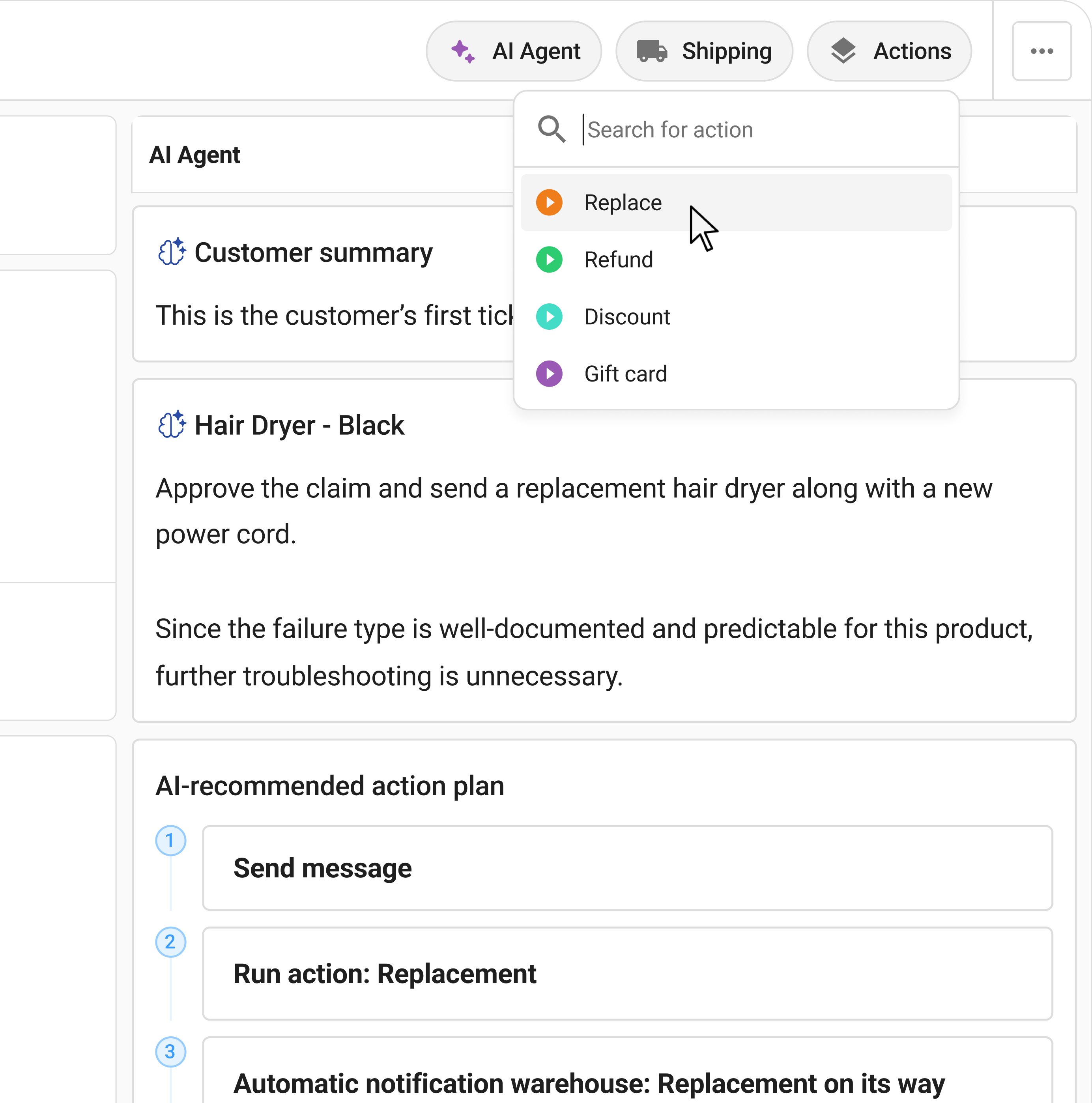
Claimlane's AI Agent, the first AI agent purpose-built for warranty claims and returns, does exactly this. It reviews submitted images and product information, matches them against configured business rules for each product and supplier, and suggests the right resolution. This means the policy's rules are not just written down but actively enforced at scale.
For brands processing hundreds or thousands of returns monthly, AI removes the bottleneck of manual review. Support agents stop spending time on routine decisions and focus on complex cases that actually need human judgment.
Customer Quote
"Before Claimlane, every case required manually digging around to find the best solution. Now we move faster and with real confidence. You can feel the impact within our support team and in every customer interaction."
Nick Magnusson, Head of Customer Service, MaxGaming
Common Mistakes in Ecommerce Return Policies
Copying a Competitor's Policy
Every business has different products, margins, and customer expectations. A policy written for a fashion brand does not work for an electronics retailer. Generic templates need serious customization.
Hiding the Policy
Burying the policy behind three clicks kills trust. Shoppers who cannot find the return information assume the worst. Link it everywhere: footer, product pages, cart, checkout, confirmation emails.
Being Too Restrictive
A "no returns" policy might save on logistics costs, but it tanks conversion rates. Research consistently shows that generous return policies increase purchase confidence and repeat buying.
Ignoring International Rules
Selling to EU customers? The Consumer Rights Directive gives buyers 14 days to return items without reason. Selling to Australia? Faulty goods must be refunded regardless of the return window. A return policy generator may not cover all jurisdictions, so brands should review the GPSR and EU compliance requirements separately.
Not Differentiating Returns and Warranty Claims
Returns and warranty claims are different processes. A return might be a size issue or buyer's remorse. A warranty claim involves a defective product within the warranty period. The policy should explain both paths clearly.
No Self-Service Option
Forcing customers to email support to start a return creates friction and slows down the process. A self-service claims portal where customers can upload photos, select the reason, and track status removes this bottleneck entirely.
Return Policy by Industry
Different industries need different approaches to return policies.
Fashion and Apparel
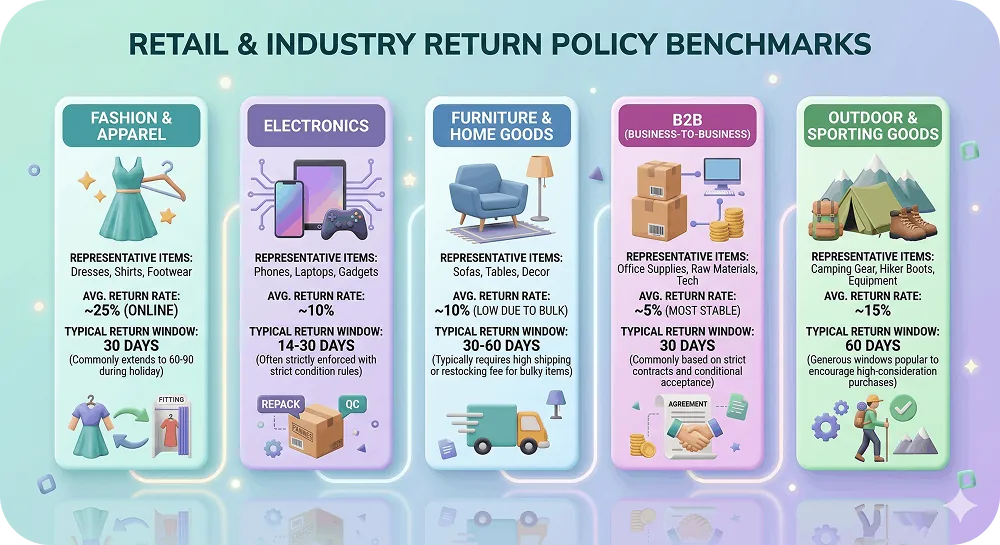
High return rates (20 to 30%) due to sizing issues and bracketing. Policies often allow 30 to 60 days. Many brands encourage exchanges over refunds to retain revenue.
Electronics
Shorter return windows (14 to 30 days) with strict condition requirements. Restocking fees are common. Warranty claims for defective units often extend beyond the return window.
Furniture
Complex returns due to size and shipping costs. Furniture returns can take up to 47 days to process. Policies need to address assembly, white-glove pickup, and damage during transit.
B2B and Wholesale
Return policies for B2B transactions differ significantly from B2C. Bulk orders, contractual terms, and supplier recovery programs add complexity. The policy often needs to reference specific contract terms rather than a one-size-fits-all approach.
Outdoor and Sporting Goods
Products may show normal wear from testing. Brands like Black Diamond need to distinguish between manufacturing defects and damage from use. The policy should clearly define what qualifies as a warranty claim versus normal wear.
Going Beyond the Generator: Returns Management Platforms
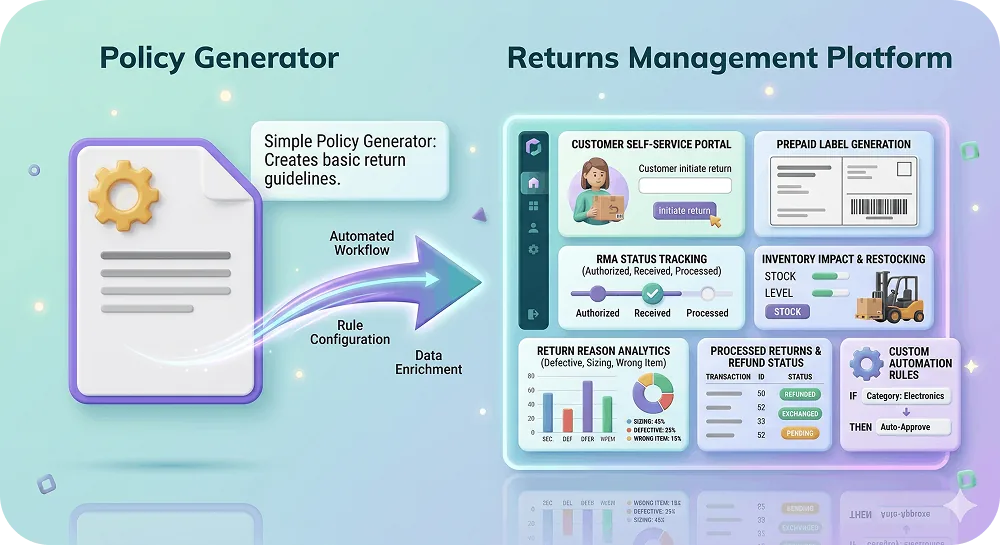
A return policy generator gets the words right. A returns management platform gets the process right. Here is what a platform adds beyond the policy document.
%201.png)
Self-Service Portal
Customers submit returns through a branded portal instead of emailing support. They upload photos, select the return reason, and get an instant response based on configured rules. Claimlane's self-service portal handles this for both returns and warranty claims.
Automated Workflows
Return requests route automatically based on reason, product category, order value, and customer history. Defective items go to the warranty team. Size exchanges process instantly. High-value returns flag for manual review. Workflow automation eliminates manual routing.
Analytics and Reporting
Return policy generators produce a document. Returns management platforms produce data. Analytics on return reasons, defect patterns, supplier performance, and processing times help brands make better product and policy decisions.
Integration with ERP and Ecommerce
Returns data needs to flow into the broader business: inventory updates, financial reconciliation, customer records. Claimlane connects with Shopify, WooCommerce, ERP systems, and 75+ other platforms through its integrations hub.
Supplier Recovery
When a product is defective, the cost should not always fall on the retailer. A returns management platform can forward claims to suppliers with documentation, photos, and claim details, automating the recovery process.
Return Policy Template: Key Sections
Whether using a generator or writing from scratch, every return policy should include these sections.
Return Policy and Customer Retention
Return policies are not just about managing losses. A well-executed return process directly influences whether customers come back.
Studies show that 92% of consumers will buy again from a retailer if the return process is easy. Conversely, a bad return experience is one of the top reasons customers switch to competitors.
The connection between customer lifetime value and returns is well documented. Customers who return items and have a positive experience often spend more over time than customers who never return anything. Returns are a touchpoint, not just a cost center.
Brands that use return data to improve products close the loop. If 15% of returns for a specific product cite "not as described," the product listing needs updating. If a particular size runs small, the size guide needs adjusting. This feedback loop only works when returns are tracked systematically, not through ad hoc email threads.