.webp)
ERP systems are built to run a business. They manage orders, inventory, finance, and procurement. They are not built to handle warranty claims.
This distinction matters because most brands try to force their ERP to do both. They process warranty claims through the same return order workflow they use for standard returns, skip the evidence collection, manually check warranty dates, and hope the customer does not get frustrated waiting.
The result is slow resolution times, unhappy customers, and zero usable data on why products are failing. Here is exactly what ERPs get wrong about warranty claims and what to use instead.
- ERPs like Business Central, SAP, and NetSuite process financial transactions but lack warranty-specific workflows like evidence collection, warranty validation, and AI assessment.
- Manual warranty processing in ERPs takes 2-3 weeks per claim and generates no usable quality data.
- Dedicated claims platforms reduce resolution time by 50-77% while capturing structured defect data.
- Claimlane integrates with major ERPs so brands keep their financial backbone and add purpose-built warranty automation on top.
What ERPs Actually Do Well
Before explaining what is missing, it is worth acknowledging what ERPs handle competently:
- Order management: Sales orders, purchase orders, invoices, and credit memos
- Inventory tracking: Stock levels, warehouse locations, item journals
- Financial processing: General ledger, accounts receivable, accounts payable
- Supplier management: Vendor records, purchase history, payment terms
These are critical functions. No one is suggesting brands replace their ERP. The problem is that warranty claims require capabilities that sit outside this scope, and ERPs were never designed to deliver them.
The Five Things ERPs Cannot Do for Warranty Claims
%201.png)
1. Collect Photo and Video Evidence
When a customer reports a defective product, the first thing any warranty team needs is visual evidence. What does the damage look like? Is it a material failure, cosmetic issue, or misuse?
ERPs have no built-in mechanism for customers to upload photos or videos. Most brands work around this by asking customers to email images, which agents then store in shared drives or attach to notes fields. This workaround breaks at scale and makes it impossible to run analytics on image data later.
A dedicated self-service claims portal collects structured evidence at the point of submission. Customers upload photos, select defect categories, and provide product details in a guided flow. All of this data is attached to the claim record automatically.
2. Validate Warranty Eligibility Automatically
ERPs store purchase dates and can technically calculate whether a product is still under warranty. But they do not have a rules engine that automatically checks warranty eligibility when a claim is submitted.
In practice, agents must manually look up the purchase date, calculate the warranty period, check for product-specific exceptions (different warranties for different product lines), and determine if the claim qualifies. For brands with complex warranty structures, this manual check takes 5-15 minutes per claim and is prone to error.
Claimlane's workflow engine automates this entirely. Warranty rules are configured per product category, and every incoming claim is validated against them before an agent ever sees it.
3. Assess Claims with AI
AI-powered claim assessment is the single biggest gap between ERPs and purpose-built claims platforms.
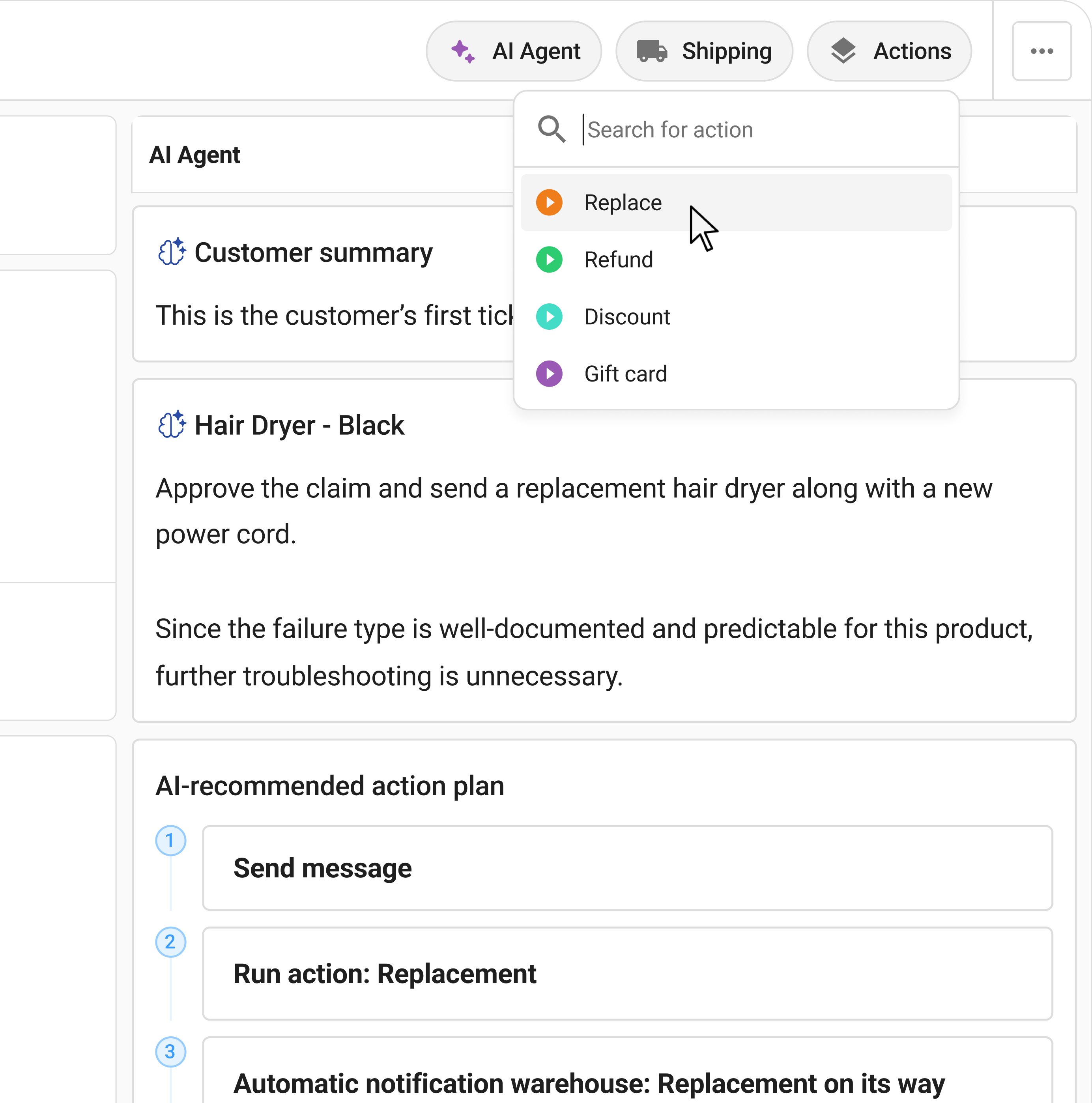
Claimlane's AI Agent, the first AI agent purpose-built for warranty claims and returns, analyzes product images and videos, applies warranty rules per product and supplier, and recommends or auto-approves resolutions. An ERP cannot do any of this. It processes transactions. It does not evaluate whether a cracked handle warrants a replacement or a repair.
MaxGaming, the largest gaming and e-sports e-commerce retailer in Scandinavia with 30,000+ SKUs across 200+ brands, resolved complex RMA cases 77% faster using Claimlane's AI agents. The AI reviews images, checks business rules, and recommends actions so support agents no longer need months of product training.
"Before Claimlane, every case required manually digging around to find the best solution. Now we move faster and with real confidence. You can feel the impact within our support team and in every customer interaction."
— Nick Magnusson, Head of Customer Service, MaxGaming
4. Manage Supplier Claims and Cost Recovery
When a warranty claim is caused by a supplier's defective component, the brand needs to forward the claim to the supplier for cost recovery. ERPs track supplier purchase orders, but they do not have a workflow for:
- Sharing claim evidence (photos, descriptions, serial numbers) with the supplier
- Letting the supplier respond to the claim within the same system
- Tracking the status of supplier claims separately from customer claims
- Generating supplier-specific defect reports for negotiation
Claimlane's forward-to-supplier feature handles all of this. The supplier sees the claim with full evidence and resolves it in the same platform, which means the brand can track supplier response times, defect acknowledgment rates, and total recovered costs. For a complete framework, see the guide on supplier management for ecommerce.
5. Provide Warranty Analytics
ERPs generate financial reports. They can show total credit memos by period, return values by customer, and inventory write-offs. What they cannot show is:
- Claim rate per product SKU
- Defect type distribution across product lines
- Mean time to failure by product category
- Supplier-level defect rates
- Resolution cost per claim type
These operational metrics require structured claims data that ERPs simply do not collect. Claimlane's analytics dashboard captures this data through the claims process and presents it in views designed for product, procurement, and customer service teams. For details on which metrics to track, see the guide on returns analytics events.
ERP Warranty Gaps by Platform
| Gap | Business Central | SAP | NetSuite | Claimlane |
|---|---|---|---|---|
| Customer self-service portal | No | No | No | ✓ Yes |
| Photo/video evidence | No | No | No | ✓ Yes |
| Automated warranty validation | No | Limited | No | ✓ Yes |
| AI claim assessment | No | No | No | ✓ Yes |
| Supplier claim forwarding | No | No | No | ✓ Yes |
| Defect analytics | No | Basic | No | ✓ Yes |
| Automated status emails | No | No | Limited | ✓ Yes |
| Repair tracking | No | Limited | No | ✓ Yes |
The Real Cost of Processing Warranty Claims in an ERP
When warranty claims run through an ERP, the costs are hidden but real:
Agent Time
Manual warranty processing takes 20-45 minutes per claim when agents must verify warranty dates, request photos by email, create return orders, and follow up with customers. At 100 claims per month, that is 33-75 hours of agent time spent on tasks that could be automated.
Customer Frustration
Without a self-service portal, customers wait for an agent to respond before anything happens. Average resolution times for ERP-processed warranty claims run 2-3 weeks. Customers expect days, not weeks.
Lost Quality Data
Every warranty claim that runs through an ERP without structured defect data is a missed opportunity. Brands cannot identify which products fail most, which suppliers produce the most defects, or whether design changes are working. This data disappears into free-text notes fields that nobody analyzes.
Unrecovered Supplier Costs
Without a supplier claims workflow, brands absorb the cost of defective products instead of recovering it from the responsible supplier. For a brand handling 500 warranty claims per month, this can represent tens of thousands in unrecovered costs annually. See the guide on supplier chargebacks and warranty cost recovery for strategies.
The Integration Approach: ERP + Claims Platform
The solution is not replacing the ERP. It is adding a purpose-built claims layer that sits on top and integrates with it.

How It Works
- Customer submits a claim through Claimlane's self-service portal (not through the ERP)
- Claimlane validates the claim against warranty rules, product data, and order history (pulled from the ERP)
- AI assesses the claim by analyzing photos, checking business rules, and recommending a resolution
- Agent reviews and resolves (or the AI auto-approves if rules are met)
- Claimlane pushes the financial transaction (credit memo, replacement order) back to the ERP
The ERP continues to be the system of record for finance and inventory. Claimlane is the system of record for claims.
Claimlane integrates with Business Central, NetSuite, and SAP, along with 75+ other platforms including Shopify, WooCommerce, Zendesk, and shipping providers.
What Brands See After Adding a Claims Platform
Brands that add Claimlane alongside their ERP typically see:
- 50-77% reduction in claim resolution time
- 80%+ reduction in agent time per claim (self-service handles intake)
- Structured defect data that feeds product quality improvements
- Higher cost recovery from suppliers through data-backed claims
- Better customer satisfaction from faster, more transparent resolution
"Before Claimlane, our entire customer service team of 5 agents was involved in claims handling, with additional seasonal help from other departments. Today, we have 1-2 agents who can solve everything in Claimlane."
— Andreas Bang Nielsen, Marketing & Ecommerce Director, Davidsen
Claimlane is rated 4.8/5 on G2.
Signs Your ERP Is Holding Back Your Warranty Process
Consider adding a dedicated claims platform if:
- Agents spend more time on data entry than problem-solving
- Customers complain about slow warranty resolution
- Product teams never see warranty claims data
- Supplier cost recovery is manual and inconsistent
- Return reason codes in the ERP do not capture defect details
- Warranty rules vary by product and agents make errors checking them
- The business handles warranty claims, repairs, replacements, and spare parts through the same generic return workflow
For the full warranty software landscape, see the best warranty management software guide.
How to Make the Case Internally
Convincing finance or IT to add another platform alongside the ERP requires a clear ROI story:
- Calculate agent time savings. Multiply claims per month by minutes per claim, then multiply by hourly agent cost. Self-service intake and AI assessment typically reduce this by 70-80%.
- Estimate supplier cost recovery. Total warranty claims caused by supplier defects, multiplied by average claim cost. A claims platform with supplier forwarding can recover 60-80% of this.
- Quantify customer experience impact. Faster resolution reduces churn. Even a 5% improvement in retention for customers who file warranty claims can be worth significant revenue.
- Show the data gap. Ask product and procurement teams what they know about warranty defect patterns. If the answer is "not much," the analytics case makes itself.
GrejFreak achieved ROI almost immediately after implementing Claimlane alongside their existing systems. Read the case study.