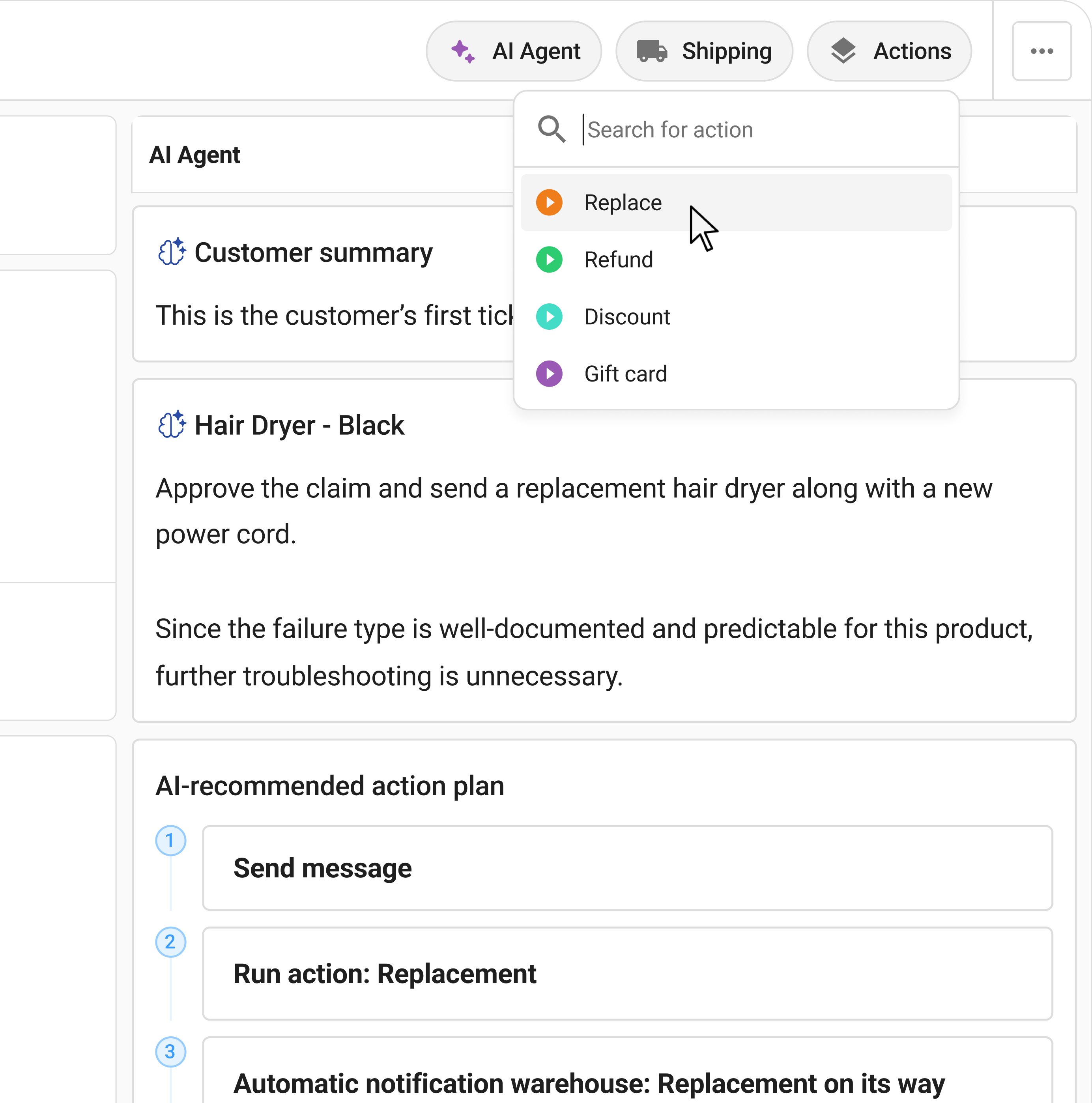

Most leaders looking at AI for warranty and returns want the same two things at once. Automate the routine claims that clog the queue, and keep a human close to the expensive ones that carry risk. The trouble starts when someone asks where the line between those two sits, and the room goes quiet.
That line is the whole subject of guardrails. Without them, the choice looks binary: hand the claims to the agent or keep doing it by hand. With them, the choice becomes a set of dials. The fear is not that the agent is wrong. It is that no one can say why it was right, and cannot step in when it matters.
This is written for omnichannel brands and high-volume retailers running hybrid B2C and dealer claim flows, where automation pays off fastest and an unexplained decision costs the most, the setting described in hybrid B2C and B2B claims management. For those brands, guardrails are the difference between a pilot and a rollout.
AI agent guardrails, defined
AI agent guardrails are the rules, limits, and review points that decide what an AI agent can settle on its own and what it must hand to a person. In warranty and returns, they set which claim types auto-resolve, which get a recommendation for a human to approve, and which are held back entirely.
A guardrail is a decision made in advance so it does not have to be made in a panic. The point is not to slow the agent down on every claim. It is to let it move fast on the claims where the answer is clear and to route the rest to a human before, not after, the money leaves. That difference is what separates a real agent from a chatbot, the distinction in AI agents versus chatbots.
Human in the loop, and where the loop belongs
Human in the loop is the phrase everyone reaches for, and it gets misused. Keeping a human on every claim defeats the purpose of automation. Keeping a human on no claim defeats the purpose of oversight. The skill is putting the loop in the right place.
The right place is defined by value and by ambiguity. A low-value claim with clear evidence does not need a person. A high-value claim, an unusual pattern, or a case where the evidence is thin does. The agent handles the first, recommends on the second, and holds the third, the model behind AI claim auto-approval and the wider capability set in AI agents in post-purchase support. The framework for both is set out by the NIST AI Risk Management Framework, which treats human oversight as a design choice, not an afterthought.
Rules first, AI second, and why it is not a black box
The strongest guardrail is architectural. An AI agent that starts from the brand's own warranty rules is not guessing, it is applying policy and using judgment only at the edges. That is a different thing from a model that decides everything from scratch.
In practice this means the coverage terms, the exclusions, and the supplier conditions live as configurable rules, and the AI reads evidence and recommends within them. The rules are visible and editable by the brand, so the logic is not a mystery, the approach in AI warranty claims automation and the document-reading step in AI claim document extraction. This is where Claimlane's AI Agent, the first AI agent purpose-built for warranty claims and returns, sits: it reviews claim images and video, applies the brand's warranty rules per product and supplier, and recommends or auto-approves within rules the brand controls, rather than behaving as a closed model.
Audit trails and override controls
Trust survives contact with a hard case only if two things exist: a record of why a decision was made and a way to reverse it. An audit trail turns an AI decision from a verdict into a reviewable event. Every recommendation, the evidence behind it, and the rule it applied stay on the record.
Override controls matter as much as the log. A guardrail that cannot be crossed by a person on a legitimate exception is not oversight, it is a wall. The regulatory direction is the same: the EU AI Act pushes toward human oversight, transparency, and traceability for automated decisions, which is exactly what an audit trail and an override switch provide. Keeping decisions consistent against the brand's service commitments is the job described in warranty SLA management.
Automation thresholds by claim type
Trust is not a setting. It is a threshold, and it should differ by claim type rather than apply as one global switch. A workable starting map looks like this.
| Claim type | Default guardrail | Human role |
|---|---|---|
| Low-value, clear evidence | Auto-resolve | Spot-check sample |
| Mid-value or partial evidence | Recommend, human approves | Approve or adjust |
| High-value or unusual pattern | Hold for review | Decide with agent input |
| Suspected fraud signal | Flag and escalate | Investigate |
The fraud row is its own discipline, because an AI agent that screens evidence is also a fraud control, the pattern in AI warranty fraud detection. Setting these thresholds is not a one-time act, it is a routine tuned against outcomes, which is why the logic belongs in a visible workflow rather than in a script no one can read.
What guardrails are worth as volume climbs
The finance case for guardrails is that they let automation scale without adding headcount to match. A brand taking 3,000 claims a month that safely auto-resolves 40 percent of them removes 1,200 manual touches every month, while the guardrails keep the 60 percent that carry risk in front of a person.
That is not a cost saving on paper, it is capacity that does not have to be hired as the brand grows, the economics behind AI ticket deflection and the broader shift in ecommerce AI agents. Framed for a CFO, the guardrails are what make the automation rate defensible, because every auto-resolved claim can be shown to have followed a rule and left a record. The reporting that proves it lives in returns and warranty KPIs.
Claimlane holds a 4.8 out of 5 rating on G2.
Guardrails are what let automation widen
The counterintuitive part is that stronger guardrails lead to more automation, not less. A brand that can prove every decision and reverse any of them is comfortable letting the agent take more. A brand with no oversight keeps everything manual out of fear, and never gets the benefit.
So the sequence runs backward from how most teams expect. Put the audit trail, the override, and the thresholds in first, then widen the automation as the record earns trust. The way to think about that build is process before tool, the argument in thinking in workflows for warranty resolution, sitting on top of a clean claims process, the ground in warranty claims processing. Image review remains the part a human trusts an agent with soonest, because it is checkable, the case in AI image recognition for warranty claims. Where the agent also handles customer-facing replies, the same guardrails apply, the ground in generative AI in customer service.
On platform fit, generic returns tools like Loop or AfterShip automate simple size-and-fit flows where the stakes are low. Applying an AI agent to warranty, repair, and supplier claims, where the decisions carry real cost and need real oversight, is the complex post-purchase work Claimlane is built for, running alongside the commerce and helpdesk stack rather than under it. Brands weighing that step often start from the B2B industry view, where hybrid claim flows make guardrails non-negotiable, and pull the intake through a self-service portal that collects the evidence the agent needs.
What to measure
Track automation rate by claim type, not as one number, because a healthy rate on low-value claims and a low rate on high-value ones is the point of the guardrails. Track override rate, the share of AI recommendations a human reverses, since a rising override rate says the rules need tuning before the automation widens. Track time to resolution against accuracy, because guardrails are working only when both improve together, not one at the cost of the other.
Frequently asked questions
What are AI agent guardrails?
What does human in the loop mean for claims automation?
How do audit trails make an AI agent trustworthy?
Should automation thresholds be the same for every claim?
The guardrails are easier to judge in motion than on a page. Seeing how the AI Agent applies a brand's rules, logs each decision, and hands the risky ones to a person is the fastest way to know where the line should sit.
See how the AI Agent keeps a human in the loop