.webp)
What's the Difference Between AI Agents and Chatbots?
Chatbots and AI agents both show up in customer support stacks. Both handle automated interactions. Both get pitched as the next step in CX automation. The actual difference in what they can do is substantial, and picking the wrong one for the wrong job costs brands in resolution quality, agent workload, and supplier money.
This guide separates the three tiers of automated support: scripted chatbots, generalist AI agents, and specialist AI agents. It covers what each does well, where each breaks down, and how they fit together in a post-purchase stack that actually works.
TL;DR
- Chatbots follow decision trees. They handle predictable, high-volume queries like WISMO and FAQ, but fail when context or judgment is required.
- Generalist AI agents (Intercom Fin, Zendesk AI, Ada, Sierra) understand intent and resolve a wide range of support topics without scripts, but lack domain-specific decision logic.
- Specialist AI agents apply domain-specific business rules (checking warranty eligibility, reviewing product photos, attributing supplier costs) to reach operational decisions at scale.
- Claimlane's AI Agent is the first AI agent purpose-built for warranty claims and returns, sitting alongside your helpdesk as the claims execution layer rather than replacing it.
What Is a Chatbot?
A chatbot responds to customer messages using decision trees or keyword triggers. It matches input to a pre-set response and follows a fixed conversational flow from question to answer.
Modern chatbots handle FAQ deflection, order status lookups, account resets, and return policy queries well. They're fast to deploy and inexpensive to run. For high-volume, predictable questions, they perform at scale.
The limit is predictability. Chatbots don't reason. When a customer's situation falls outside the scripted tree, the bot loops, fails, or escalates. That escalation rate is the real cost of over-relying on chatbots for complex post-purchase queries.
What Is an AI Agent?
An AI agent uses a large language model (LLM) to understand intent, work through multi-step problems, and take actions beyond replying to a message.
Unlike a chatbot, an AI agent processes unstructured input (varied phrasing, images, documents, conversational context), applies logic, and reaches a decision or conclusion. It adapts to what the customer actually says rather than matching a keyword to a template.
The core distinction: chatbots reply. AI agents decide and act.
For a broader overview of how AI agents function in an ecommerce context, the ecommerce AI agents guide covers the full category.
The Three Tiers of Automated Customer Support
Most customer support automation maps to one of three categories:
1. Scripted chatbots handle FAQ queries and follow decision trees. Low cost, limited coverage, effective for predictable, low-variability questions.
2. Generalist AI agents use LLMs to understand any customer message and route, reply, or resolve it. Strong first-line coverage across general support topics. No domain-specific training needed, but no domain-specific logic built in.
3. Specialist AI agents apply industry-specific or task-specific business logic on top of LLM reasoning. They don't just understand the message; they check eligibility, review submitted evidence, apply supplier rules, and reach an operational decision.
| Feature | Scripted Chatbot | Generalist AI Agent | Specialist AI Agent |
|---|---|---|---|
| How it works | Decision tree / keyword match | LLM understands intent | LLM + domain business rules |
| Handles unstructured input | No | Yes | Yes |
| Reviews photos / evidence | No | Limited | Yes, core function |
| Applies product/supplier rules | No | No | Yes |
| Reaches financial resolution | No | Rarely | Yes, refund/repair/supplier credit |
| Examples | Tidio bots, basic Zendesk flows | Intercom Fin, Zendesk AI, Ada, Sierra | Claimlane AI Agent (warranty & returns) |
How Scripted Chatbots Still Earn Their Place
Chatbots handle high-volume, low-variability queries at a cost that's hard to beat. WISMO requests, return policy lookups, shipping timelines, and account resets are all good fits. These queries are predictable, the correct answer doesn't change based on context, and the volume is high enough that deflecting them via chatbot saves real agent time.
The risk is overextension. When a brand tries to push warranty claims, defect reports, or complex B2B claims through a chatbot flow, the failure rate climbs fast. Customers get stuck, loop back through the same dead ends, and escalate anyway, with higher frustration than if they'd reached a human from the start.
For more on the WISMO deflection case specifically, the reduce where is my order queries guide covers the right tooling for that slice.
What Generalist AI Agents Do Well, and Where They Stop
Generalist AI agents are a meaningful step up from scripted chatbots. They understand varied phrasing, handle ambiguous requests, and resolve a much broader range of queries without agent involvement.
Tools like Intercom Fin, Zendesk AI, Ada, and Sierra are built for the conversation layer. They read support tickets, suggest replies, route queries, and close lower-complexity issues autonomously. They reduce ticket volume without requiring scripted flows for every possible customer question.
What they're not designed for is domain-specific operational decisions. A generalist AI agent reading a Gorgias ticket can't consistently determine whether a product photo shows a manufacturing defect or customer misuse. It doesn't know that Supplier A covers shipping costs on defects but Supplier B doesn't. It can't check whether the serial number is within warranty. That's not a technology limitation; it's a scope that was never the goal. These tools were designed for conversation coverage, not claims operations.
For a comparison of chatbot-specific tooling, the AI chatbots for ecommerce guide covers the generalist layer in detail.
Why Claims Decisions Are a Different Problem from Support Conversations
The support conversation is a communication problem. The customer needs information, reassurance, or a resolution to their query. CX platforms like Zendesk, Gorgias, Salesforce, and Intercom handle this well.
The claims decision is an operational and financial problem. It requires checking SKU warranty eligibility, matching against supplier agreements, assessing defect severity, and applying configured business rules. The resolution generates financial output: a refund, a replacement, a repair order, or a supplier chargeback.
A generalist AI agent reading a support ticket can't reliably make this call at scale. Not because the technology isn't capable of reasoning, but because the decision logic is specific to each brand's products, policies, and supplier contracts. Without that domain knowledge built into the system, every claims decision depends on agent expertise that doesn't scale.
The AI RMA automation article shows what the decision logic looks like in a practical returns context.
Where Claimlane's AI Agent Fits
Claimlane AI Agent: What It Does
- Reviews customer-submitted photos and videos for visible defects or damage
- Checks SKU eligibility against configured warranty terms and purchase date
- Applies supplier-specific rules to determine cost attribution and recovery
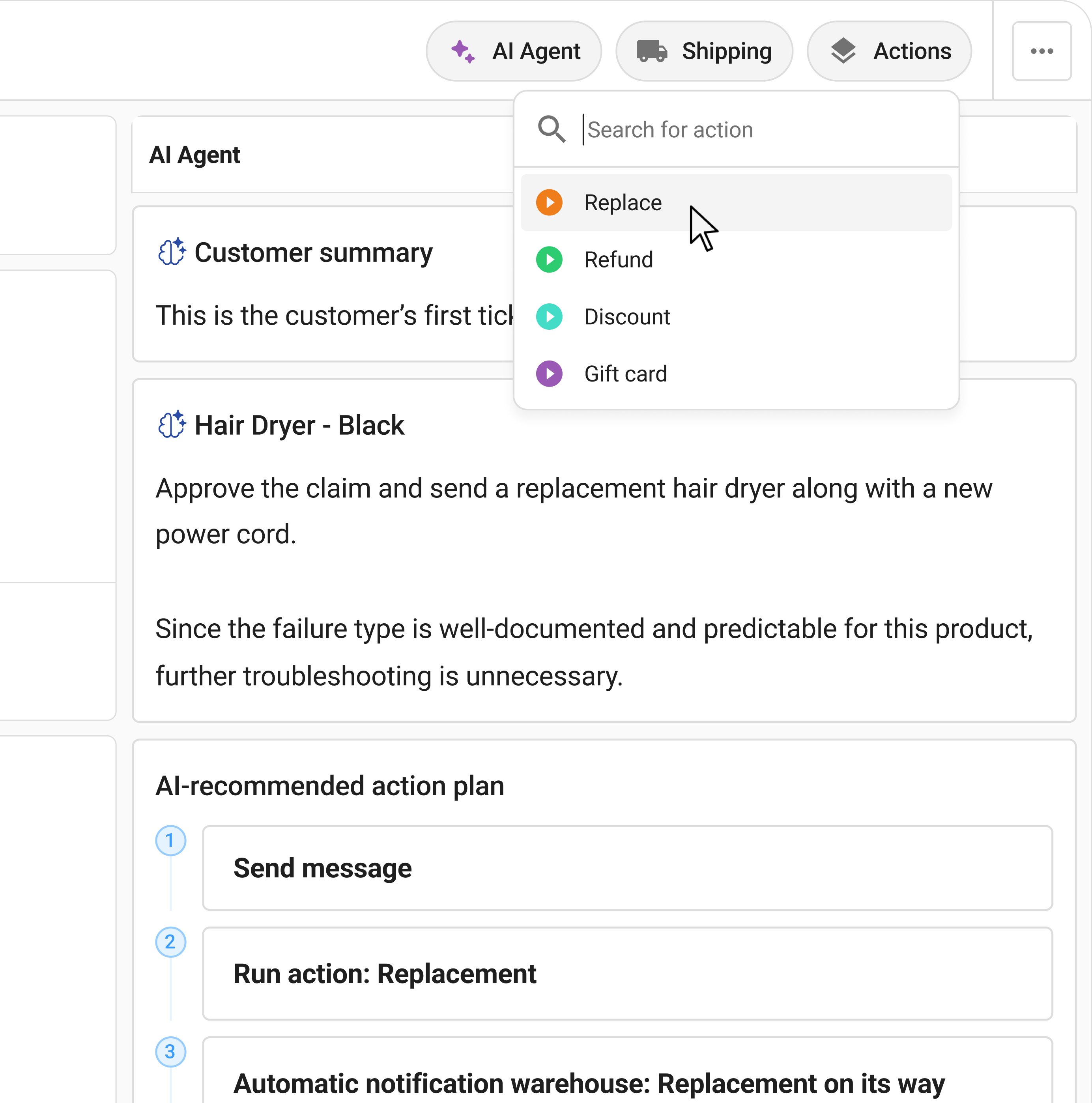
- Recommends resolution (approve, reject, repair, replace, escalate) with a confidence score
- Auto-approves within configured thresholds, reducing agent review to exceptions
- Flags suspected fraud patterns for human review before approval
Claimlane's AI Agent is the first AI agent purpose-built for warranty claims and returns. It reviews submitted evidence, applies brand-specific warranty policies and supplier contracts, and recommends or auto-approves resolutions based on configured thresholds. Support agents see the recommendation alongside the customer evidence and either confirm or override, without needing deep product knowledge.
At MaxGaming, the largest gaming and e-sports e-commerce retailer in Scandinavia with 30,000+ SKUs across 200+ brands, Claimlane's AI Agent cut RMA resolution time by 77% across all cases. Support agents stopped needing months of product training to handle complex warranty cases. The AI reviews the image, checks the business rules, and recommends the action.
For brands managing similar complexity, the claimlane AI agent returns warranty assistant overview covers the full capability set.
The Best-of-Breed Stack: Helpdesk Plus Specialist Agent
The most effective model for post-purchase support doesn't replace the helpdesk. It puts a specialist execution layer alongside it.
A practical architecture for brands with meaningful warranty and returns volume:
- Customer contacts support via Intercom, Gorgias, or Zendesk
- If the query is a warranty claim or return, the agent (or a workflow trigger) opens a claim in Claimlane
- Claimlane's AI Agent reviews the submission, applies business rules, and surfaces a resolution recommendation
- The agent reviews, approves or overrides, and closes the ticket in the helpdesk
The helpdesk handles the conversation. Claimlane handles the claim decision. Both are visible to the support agent in a connected workflow. Claimlane's integrations include native connections to Zendesk, Gorgias, Shopify, Salesforce, and major ERP systems to support this architecture.
For a look at the broader customer service tool category, the best ecommerce customer service software guide covers helpdesk comparisons in detail.
When a Specialist Agent Becomes the Right Call
The threshold is complexity. A specialist AI agent adds clear value when:
- SKU count is high enough that training support agents on product specs isn't viable
- Returns and warranty claims have resolution rules that vary by product, supplier, or region
- Supplier recovery is part of the operation (credits, chargebacks, defect-rate tracking)
- Submitted photos or videos need assessment, not just logging
- Fraud prevention on warranty or return claims is a real business concern
At low complexity (simple return policy, few SKUs, no supplier dimension), a generalist agent with well-configured workflows covers most cases. As complexity grows, the specialist layer pays back in resolution speed, reduced agent training dependency, and supplier credits recovered.
The hidden costs of returns and claims breakdown shows where the financial exposure sits at scale. The AI warranty fraud detection ecommerce article covers the fraud-prevention dimension specifically.
Key Metrics for Comparing AI Support Tools
When evaluating tools at each layer of the support stack, these metrics matter most:
- Ticket resolution rate without human handoff
- Average handling time per case type
- Escalation rate to human agents
- Agent training dependency, how much product knowledge does the agent need vs. the AI?
- Supplier recovery rate, relevant for brands with a warranty or claims operation
Generalist AI agents are strongest on the first two. Specialist agents add leverage on agent training dependency and supplier recovery, both of which are post-purchase KPIs that don't surface in standard helpdesk reporting.
The returns and warranty KPIs guide covers the full measurement framework for post-purchase operations.
Claimlane's G2 Rating
Claimlane holds a G2 rating of 4.8 out of 5. Customer reviews consistently point to the AI Agent's claim assessment accuracy, structured intake process, and supplier recovery workflow as the factors that separate Claimlane from broader returns tools. You can read the reviews directly on Skechers' experience with Claimlane and Onyx Cookware's 1-click claim process.
What to Consider Before Choosing a Tool Category
Before selecting between a chatbot, a generalist AI agent, and a specialist agent, these questions clarify the right fit:
Does the query require reviewing submitted evidence? Product photos, videos, receipts, and serial numbers are standard inputs for warranty and returns cases. A chatbot can't assess them. A generalist agent can acknowledge them. A specialist agent is built to evaluate them.
Does the resolution depend on rules that vary by SKU, supplier, or geography? If yes, the decision logic needs to live in the system. Generalist agents don't carry this; specialist agents do.
Is there financial output attached to the resolution? Credit notes, supplier chargebacks, repair orders. If the decision generates a financial transaction, the accuracy and speed of that decision directly affects margin. This is where specialist agents change the P&L picture.
Are agents spending meaningful time on product research? If your support team needs months of training to handle claims correctly, the agent training cost is a real number. Specialist AI shifts that cost.
If three or more of these are true, a specialist AI agent is the right category. If none are, a well-configured chatbot with escalation paths handles most volume without overengineering the stack.
Voices From the Field
“We are incredibly satisfied with Claimlane, not only as a platform for handling claims, but also as a reliable and proactive software partner.”
Kasper Andersen, IT Director, Konges Sløjd
AI Customer Service Automation: The Bigger Picture
Chatbots, generalist AI agents, and specialist AI agents are three different tools for three different problems. The right architecture for post-purchase support uses all three in sequence, each covering what it was designed for.
For brands investing in AI customer service automation more broadly, the specialist layer is where claims P&L decisions live. Getting the right recommendation at the right speed is the difference between recovering supplier costs and absorbing them.
The AI returns management ecommerce overview covers how the specialist layer fits into the wider returns automation stack. For analytics on what the data produced by these decisions looks like in practice, the Claimlane analytics product page explains how SKU and defect intelligence gets generated at scale.
FAQ
Conclusion
See the difference a claims-specialist AI agent makes
See how Claimlane's AI Agent runs as the claims execution layer inside your existing support stack.
Book a 30-min walkthroughChatbots, generalist AI agents, and specialist AI agents are three different tools for three different problems. The smart stack doesn't choose between them. It uses them in sequence. Scripted bots handle high-volume deflection. Generalist agents resolve first-line queries. Specialist agents handle the claims decisions that determine whether a brand recovers supplier costs or absorbs them.
For brands managing warranty claims, repairs, returns, and supplier recovery at any meaningful scale, the specialist layer is where the claims P&L lives. The 77% resolution-time drop at MaxGaming didn't come from a better chatbot. It came from putting the right AI at the right layer of the stack.