Most writing about generative AI in after-sales stops at the chatbot. A friendly assistant answers questions, and that is the whole story. That is the least valuable place to put it.
The money in after-sales is not in the conversation. It is in the decision. Whether a claim is valid, what resolution it should get, which supplier owes for the fault, and whether the evidence supports any of it. Those are the moments where generative AI changes the economics, and they sit well behind the chat window.
This piece is a ledger of concrete use cases, ordered by how fast each one pays back for a warranty-heavy brand with repairs and spare parts. Each one is a real task an after-sales team does today, by hand, at cost.
Generative AI in after-sales is the use of large language and vision models to read claim evidence, draft decisions, and produce customer communication across warranty, returns, and repair cases. It differs from a support chatbot because it acts on the claim record, applying warranty rules and drafting the resolution, rather than only answering questions.
Use case 1: reading the claim evidence
The first job is comprehension. A claim arrives with a photo, a serial number, an order reference, and a paragraph of customer text. Someone has to read all of it and figure out what actually happened.
Generative AI does the first pass. Document extraction on claims pulls the order and serial data. Image recognition on warranty claims reads the photo for where the failure sits. The output is a structured summary a reviewer can act on in seconds instead of minutes. Claimlane's self-service intake captures that evidence in a form the model can read cleanly.
Use case 2: drafting the claim decision
Comprehension without a recommendation still leaves the slow part. The second use case is the draft decision itself.
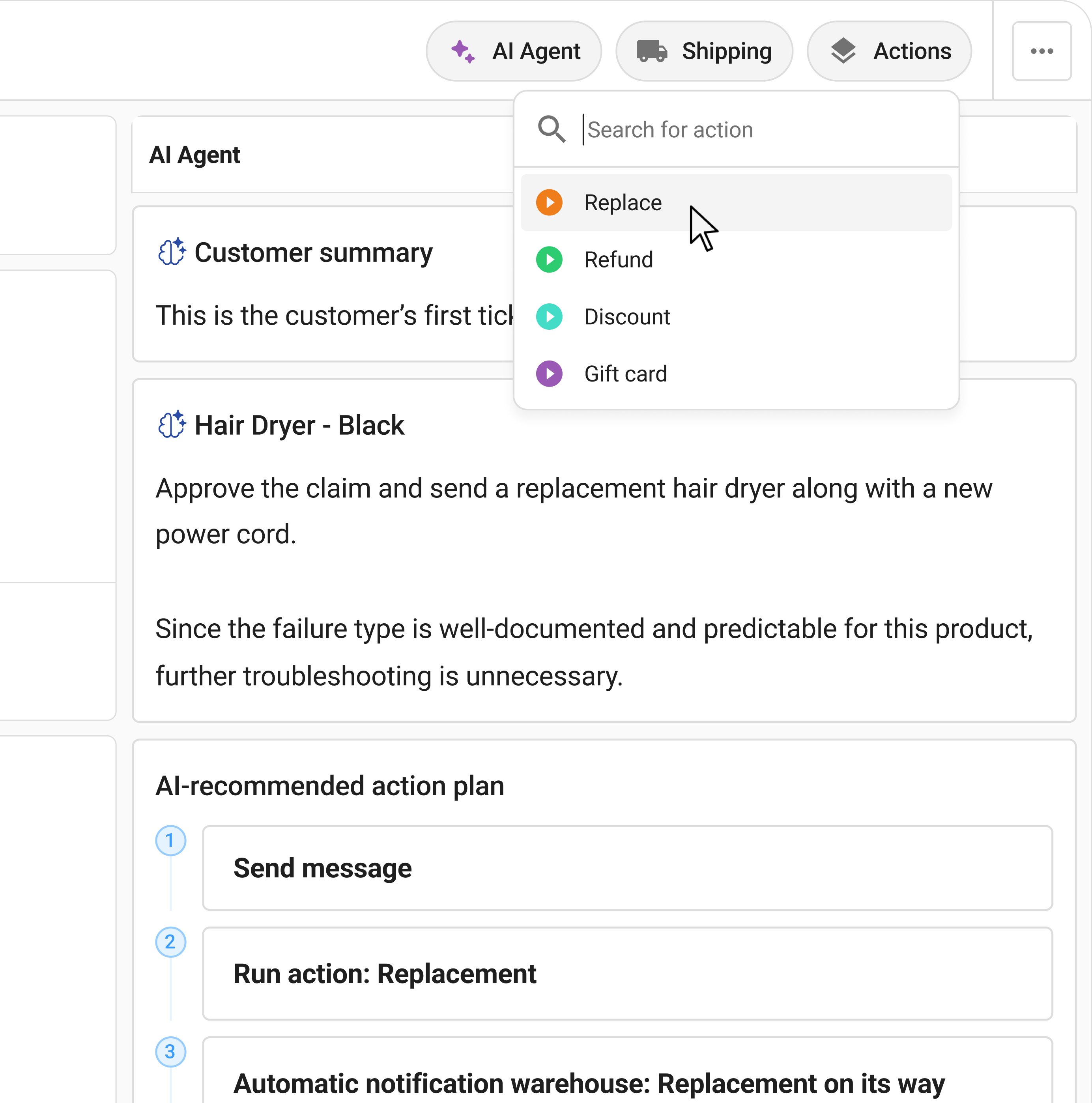
Here the model applies the brand's warranty rules per product and supplier and proposes a resolution: approve, deny, repair, or replace. This is claims triage that ends in a recommendation, not just a queue sort. Claimlane's AI Agent, the first AI agent purpose-built for warranty claims and returns, does exactly this, and the logic is described on the product AI page. On clean, low-value cases it can move to auto-approval within thresholds the brand sets.
Use case 3: routing the repair or the supplier charge
A decision is only useful if the case then goes to the right place. The third use case is routing.
A repairable fault should open a repair path. A supplier-caused defect should open a supplier recovery. Generative AI reads the fault type and routes accordingly, which is where warranty and repair automation meets supplier recovery. Claimlane's forward-to-supplier flow sends the evidence straight to the supplier so the credit note is not left on the table.
Use case 4: writing the customer reply
After-sales generates enormous volumes of near-identical messages. Status updates, evidence requests, approval notes, denial explanations. The fourth use case is drafting those, in the customer's language.
Multilingual returns support means a Danish brand can answer a German customer without a translator in the loop. The draft is written against the actual claim record, so it says what the decision was and why, not a generic template. This is the part of AI customer service automation that removes the most repetitive minutes of the day.
Use case 5: spotting the fraud pattern
The last high-value use case is the one humans are worst at, because it needs memory across thousands of cases. Fraud and abuse patterns.
Generative AI compares a new claim against historical ones and flags the serial number that has been claimed three times, or the photo that has appeared before. Warranty fraud detection and return fraud detection turn a gut feeling into a flag with evidence attached.
That shift, from five agents to one or two, is the finance-readable version of this whole list. It is not softer handle time. It is headcount that moved to higher-value work.
The guardrails that make it usable
None of the above is worth much if leaders do not trust it. The honest concern is over-reliance, and it deserves a direct answer rather than a reassurance.
Four controls make generative AI safe to run in after-sales. Human-in-the-loop review on high-value cases, so the expensive decisions still get a person. Configurable rules with AI suggestions rather than pure automation, so the brand's policy, not the model's guess, sets the boundary. An audit trail on every decision, so any approval or denial can be traced. And override controls with review thresholds, so a team can dial automation up on simple cases and keep it off complex ones. Claimlane's approach to AI agent guardrails on claims is built around these four.
The point of the guardrails is not caution for its own sake. It is that a brand can start automating the safe 60% of cases immediately and expand the threshold as trust builds.
Claimlane's 4.8/5 rating on G2 reflects teams that adopted this in stages rather than all at once.
Where generative AI sits in the stack
Generative AI in after-sales is not a replacement for the commerce platform or the helpdesk. It is the decision layer that runs alongside them. It reads from the order system, applies rules, and writes the resolution back, connecting through the brand's existing integrations. For brands that want the broader picture of where automated agents fit, AI agents in post-purchase support covers the map, and predictive warranty analytics shows what the accumulated decision data is worth later. Matas runs its claims on Claimlane as one of these layers alongside its wider systems, shown in the Matas case study.
Frequently asked questions
What is the difference between a support chatbot and generative AI in after-sales?
A chatbot answers questions. Generative AI in after-sales acts on the claim record: it reads evidence, applies warranty rules, drafts the decision, and routes the case. The value is in the decision, not the conversation.
Which after-sales use case pays back fastest?
Reading evidence and drafting the decision. Those are the highest-volume manual tasks, so automating them within set thresholds removes the most cost first.
How do brands stop over-reliance on AI decisions?
Human-in-the-loop on high-value cases, configurable rules rather than pure automation, an audit trail on every decision, and override controls with review thresholds set by claim type.
Does generative AI replace the helpdesk or commerce platform?
No. It runs as a decision layer alongside them, reading order data through integrations and writing the resolution back, rather than replacing the systems of record.
Start with one use case, not the whole ledger
The brands that get value from generative AI in after-sales do not automate everything on day one. They pick the highest-volume decision, set a conservative threshold, and expand from there.
A short demo of Claimlane's AI Agent against a brand's own claim types shows which use case on this ledger pays back first. Book a demo to see it run on real warranty and returns cases.