
In most brands, a warranty claim gets triaged by a person opening a ticket and deciding, more or less by feel, whether it is legitimate, who should handle it, and how urgent it is. That decision happens hundreds of times a week, and it is the same decision almost every time.
That is the part AI is good at. Not the hard cases, the sorting in front of them.
AI claims triage reviews each incoming claim, reads the evidence, checks it against the brand's rules, and routes it before a human is involved. The team stops opening every ticket and starts opening only the ones that need a person. This is a look behind the curtain at how that sorting actually works.
What claims triage means for physical goods
Most content about claims triage is written for insurance, where the claim is a policy document and the reviewer is an adjuster. Physical-goods triage is a different job.
Here the claim is a photo of a cracked frame or a dead battery, an order number, and a warranty term that depends on the product and the supplier. The triage question is not "does this policy cover it" but "does this evidence match a covered fault, and what is the right resolution." Claimlane's work on AI warranty claims automation sits on this physical-goods version of the problem.
Why manual triage is the bottleneck
The queue is the product. When triage is manual, the queue is only as fast as the people reading it, and it grows linearly with volume.
Manual triage also drags because the first look is rarely the deciding look. An agent opens a claim, finds a missing serial number or a blurry photo, and sends it back. Days pass before the claim is even ready to decide. Claimlane's note on reducing claim resolution time and its breakdown of warranty claims processing show where those days go.
A large catalog makes it worse. With thousands of SKUs across hundreds of suppliers, no agent holds every warranty rule in their head, so triage slows to the speed of looking things up.
What the AI actually looks at
The model reads three things: the visual evidence, the claim details, and the applicable rules.
It reviews the photos and video for the claimed fault, a photo it can read faster than a person can open the ticket. It checks the order, serial number, purchase date, and warranty window. Then it applies the brand's rules per product and supplier to decide whether the evidence supports a covered claim. Claimlane's AI image recognition for warranty claims covers the visual side, and AI RMA automation covers the returns side.
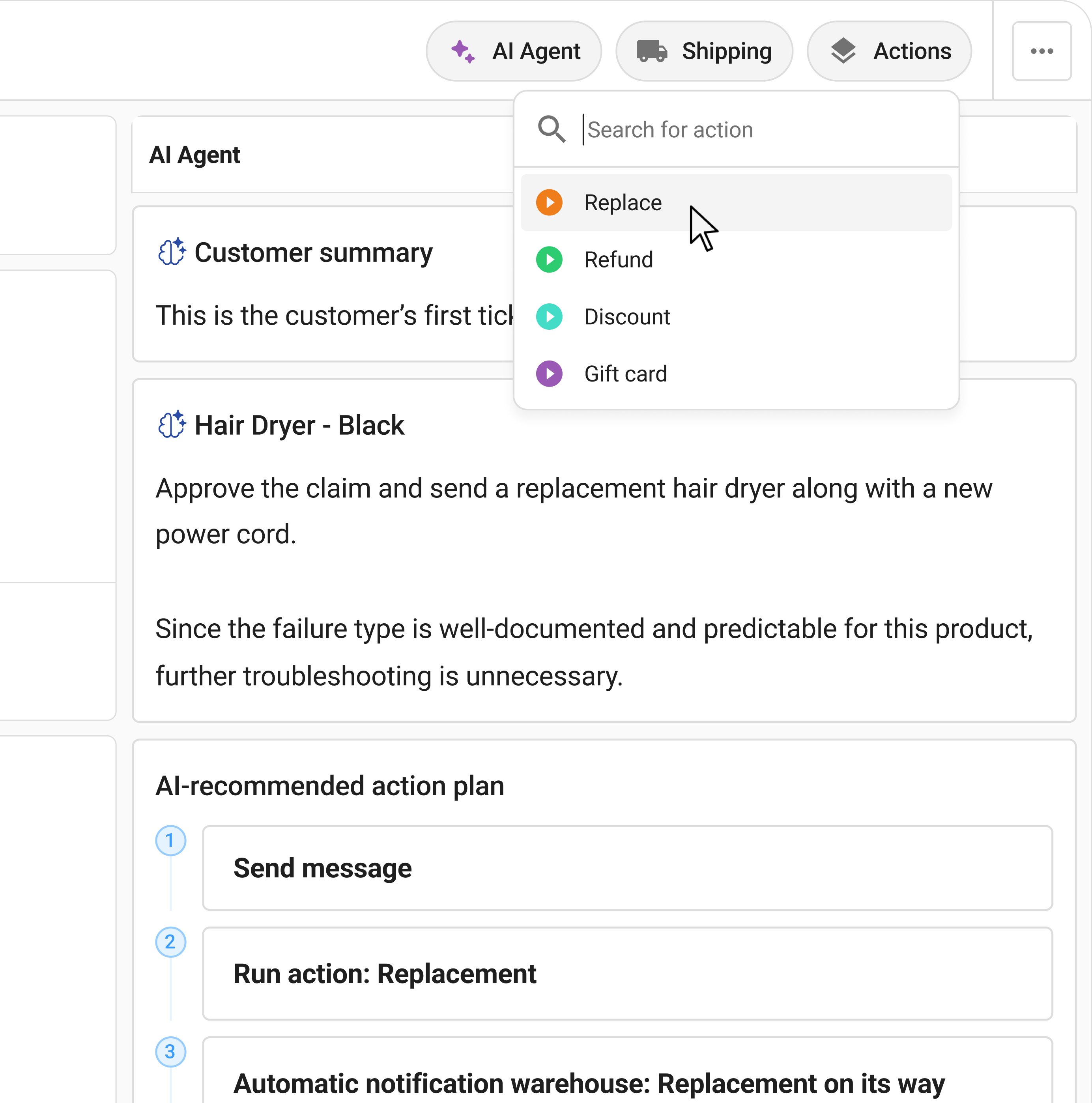
This is where Claimlane's AI Agent, the first AI agent purpose-built for warranty claims and returns, does the work. It analyzes the images and video, applies the warranty rules for that product and supplier, and recommends or auto-approves the resolution.
The three triage outcomes
Every triaged claim lands in one of three lanes.
Clear-cut, low-value, evidence matches the rule. Resolves without a person.
High-value, ambiguous, or evidence-light. Routed to an agent with the case pre-assembled.
Evidence contradicts the claim or is missing. Sent back for more, or declined with a reason.
The auto-approve lane is where the time is saved. Claimlane's AI claim auto-approval explains how the clean cases clear on their own, which is what leaves the team free for the review lane.
How routing rules get set
Routing is not the model guessing. It is the brand's policy, written down and applied consistently.
Rules scale friction with risk. A low-value, first-time, photo-backed claim can auto-resolve. A high-value claim, a repeat claimant, or a claim with weak evidence routes to a human. The decision tree lives in the claims workflow, not in an agent's memory, which is what makes the same claim get the same outcome every time. Claimlane's piece on thinking in workflows for warranty resolution walks through how brands lay these rules out.
The guardrails that keep triage safe
The fear buyers raise is over-reliance: what if the model approves something it should not. That fear is the feature request, and the answer is built into the design.
- Human-in-the-loop on high-value and edge cases, set by the brand's thresholds.
- Configurable rules plus AI suggestions, not pure automation. The brand owns the policy.
- Audit trail on every decision, so any approval can be traced and explained.
- Override controls so an agent can reverse a recommendation, and the system learns the boundary.
Recommended automation thresholds vary by claim type. Low-value consumables can auto-approve at a high rate. High-value electronics or furniture keep a human in the loop until the brand is confident in the pattern.
Where triage plugs into the stack
Triage is not an island. It sits between the intake portal and the systems that hold the order and the money.
The claim enters through a self-service portal that captures structured evidence at submission. Triage then reads from and writes to the rest of the stack: order and customer data from Shopify or an ERP like NetSuite or Business Central, ticket context from Zendesk or Gorgias, and the resolution back to finance. Claimlane runs as the post-purchase execution layer alongside these systems, not underneath them, which is the difference that keeps triage decisions consistent with the record of truth.
Triage vs a generic returns app
This is where the category split matters. A size-and-fit return on a Shopify DTC store barely needs triage, and a returns app like Loop handles it well. Brands comparing that lane can read Loop Returns alternatives.
Complex warranty, repairs, and supplier claims are a different problem. When the claim needs an image reviewed against a supplier warranty term, the triage has to understand faults, not just reasons for return. That is the Claimlane lane, and the comparison sits in best post-purchase software for ecommerce.
What triage does to cost and speed
Triage moves the two numbers that matter: handling minutes and resolution time.
MaxGaming resolves complex RMA cases 77% faster with Claimlane's AI Agent, which reviews claim images and checks business rules so agents do not need months of product training. With 30,000+ SKUs across 200+ brands, manual triage on every claim was not possible.
MaxGaming — read the case study
The mechanism is simple. Auto-approved claims never consume an agent minute, and reviewed claims arrive pre-sorted with the evidence attached, so the agent decides instead of assembling. Claimlane's AI returns management covers the returns-side version of the same gain.
A readiness check
AI triage earns its place when volume and complexity are high enough that manual sorting is the bottleneck.
- 50+ claims per month, growing faster than headcount
- Photo-required claims (electronics, furniture, sporting goods, DIY)
- A large catalog or many suppliers, so no agent knows every rule
- A mix of clear-cut and genuinely complex cases
- Pressure on resolution time and support cost
What to measure
Three numbers show whether triage is working.
Track auto-approval rate by claim type, the share of claims that clear without a person, because that is the labor saved. Track false-approval rate caught on review, which tells the brand whether thresholds are set right. Track time-to-first-decision, since the point of triage is that the deciding look happens sooner. Claimlane's warranty and returns KPIs guide covers the wider set.
Claimlane holds a 4.8 out of 5 rating on G2.
Manual triage is not a judgment problem, it is a sorting problem, and sorting is exactly what a machine should do before a person opens the ticket. To see the routing on a live claim, book a demo.
Frequently asked questions
What is AI claims triage?
It is the automated sorting of incoming warranty and returns claims by validity, resolution path, and priority. The AI reviews the claim's images and details, checks them against the brand's rules, and routes each claim to auto-approve, human review, or rejection before a person is involved.
Does AI triage replace support agents?
No. It filters in front of them. Clean, low-value claims auto-resolve, and everything ambiguous or high-value routes to an agent with the case pre-assembled. Agents spend their time on decisions, not sorting.
How does AI triage stay accurate and safe?
Through guardrails: human-in-the-loop on high-value cases, configurable rules the brand owns, an audit trail on every decision, override controls, and automation thresholds set by claim type. It suggests and auto-approves within limits the brand defines.
How is claims triage different for returns versus insurance?
Insurance triage reads policy documents. Returns and warranty triage reads a photo of a physical product against a supplier warranty term. The evidence, the rules, and the resolutions are different, which is why insurance triage tools do not fit the job.