.webp)
Returns cost U.S. retailers close to $850 billion in 2025. That number keeps climbing. And for most ecommerce brands, processing those returns still relies on manual reviews, email threads, and spreadsheets that slow everything down.
AI returns management is changing that picture fast. Brands that adopt AI-powered returns workflows are cutting processing times by 50% or more, catching fraud earlier, and turning returns data into insights that prevent future issues.
This guide breaks down exactly how AI is reshaping ecommerce returns in 2026, what the technology actually does, and how to decide if it makes sense for your business.
What Is AI Returns Management?
AI returns management refers to using artificial intelligence, including machine learning, computer vision, and natural language processing, to automate and improve how ecommerce brands handle product returns, warranty claims, and exchanges.
Instead of a support agent manually reviewing every return request, reading customer messages, checking product photos, and deciding what to do, AI systems handle the repetitive parts automatically. The agent only steps in for complex or high-value cases.
The core technologies behind AI returns management include:
- Machine learning models that learn from historical return data to predict outcomes and flag anomalies
- Computer vision that analyzes product images and videos to assess damage, verify product condition, and detect fraud
- Natural language processing (NLP) that reads customer messages, extracts return reasons, and routes tickets to the right workflow
- Predictive analytics that identifies return patterns before they become expensive problems
Why Traditional Returns Processing Is Breaking Down
Manual returns handling worked when ecommerce was smaller. It does not scale.
Here is what a typical manual return process looks like:
- Customer submits a return request via email or a portal
- A support agent reads the request and checks the order
- The agent reviews any attached photos
- The agent looks up the return policy for that product category
- The agent decides whether to approve, deny, or escalate
- The agent sends an email with next steps
- The agent updates the internal system manually
That process takes 10 to 30 minutes per return. Multiply it by hundreds or thousands of returns per week, and the cost adds up quickly.
The math behind manual returns
A mid-size ecommerce brand processing 500 returns per week at an average handling time of 15 minutes per return spends roughly 125 hours per week just on returns. That is more than three full-time employees dedicated to returns alone.
| Metric | Manual Process | AI-Powered Process |
|---|---|---|
| Avg. handling time per return | 10–30 minutes | 1–3 minutes |
| Returns auto-approved without agent | 0% | 40–70% |
| Fraud detection accuracy | Low (pattern-dependent) | High (image + behavioral analysis) |
| Time to resolution | 3–7 business days | Same day to 24 hours |
| Cost per return | $15–30 | $3–8 |
How AI Claims Processing Works in Ecommerce
AI claims processing follows a pattern that mirrors what a skilled support agent does, but at machine speed and scale.
Step 1: Intake and data extraction
When a customer submits a return or warranty claim, the AI system automatically extracts key information: order number, product details, purchase date, warranty status, return reason, and any attached photos or videos.
NLP models parse free-text messages to identify the actual issue. A customer who writes "the zipper broke after two weeks" gets tagged as a product defect claim, not a sizing return.
Step 2: Image and video analysis
Computer vision models analyze product photos to:
- Confirm the product matches the order
- Assess the type and severity of damage
- Check if the product shows signs of misuse vs. manufacturing defect
- Verify that the product is real and not a stock photo or AI-generated image
This is especially valuable for warranty claims where brands need to see proof of a defect before approving a replacement.
Step 3: Policy matching and rule application
The AI cross-references the claim against the brand's specific return and warranty policies. Different products, categories, suppliers, and customer segments can all have different rules.
For example:
- Product A has a 2-year warranty and requires photo evidence
- Product B allows returnless refunds under $25
- Supplier X requires all claims to be forwarded with documentation
- VIP customers get instant approvals for low-value items
The system applies the right rules automatically.
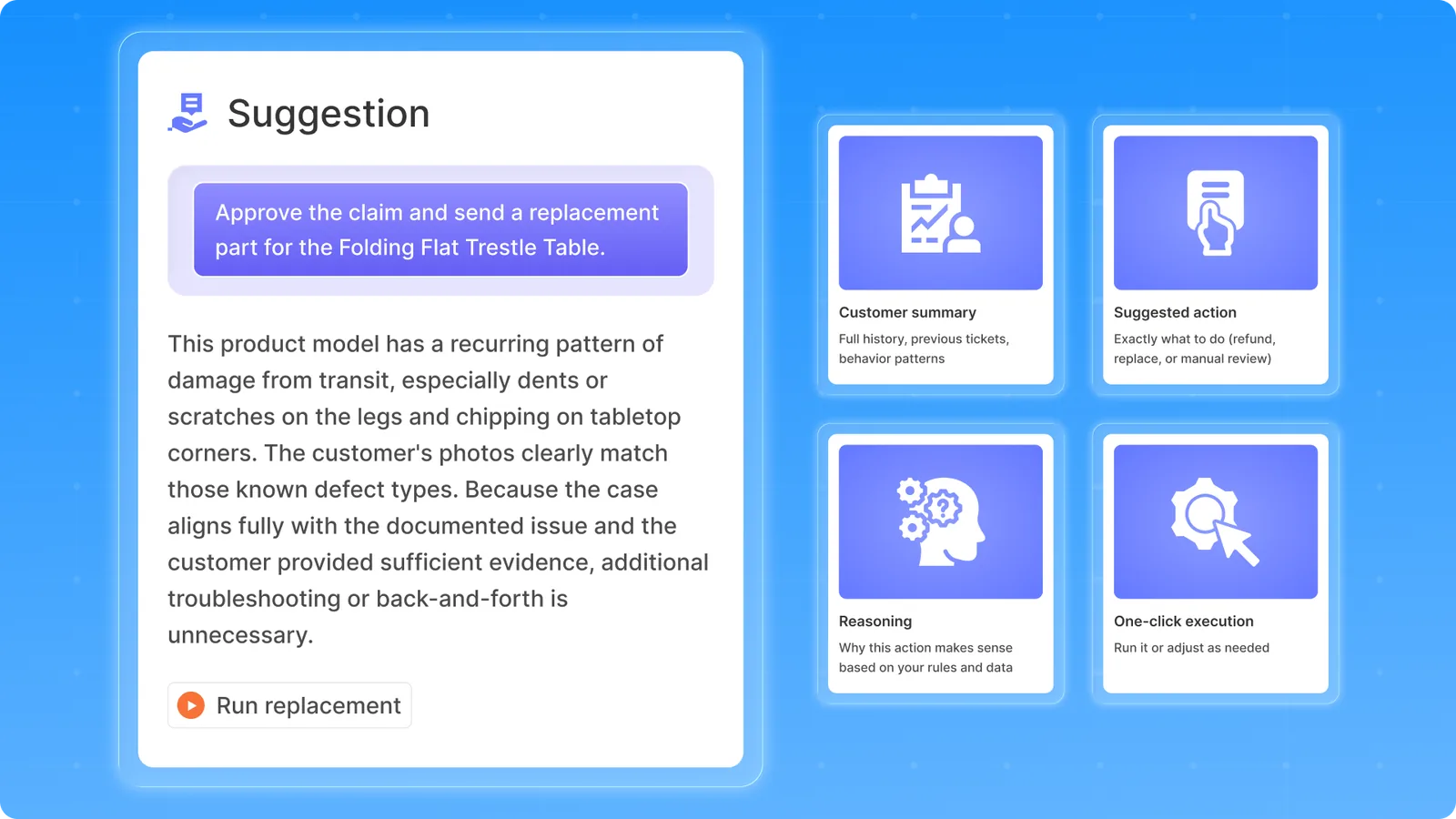
Step 4: Decision and routing
Based on the analysis, the AI either:
- Auto-approves the claim and triggers the next action (refund, replacement, shipping label)
- Auto-denies with a policy-compliant explanation
- Escalates to a human agent with a summary and recommended action
According to McKinsey research on reverse logistics and AI, 40 to 70% of routine claims can be fully automated this way.
.png)
AI Warranty Claims: A Specific Use Case That Matters
Warranty claims are harder than standard returns. They involve product-specific rules, supplier coordination, repair workflows, and longer timelines. This makes them a perfect fit for AI.
Traditional warranty processing requires agents to:
- Know the warranty terms for every product
- Interpret damage from photos
- Decide between repair, replace, or refund
- Coordinate with suppliers on liability and credit notes
- Track the claim through multiple stages
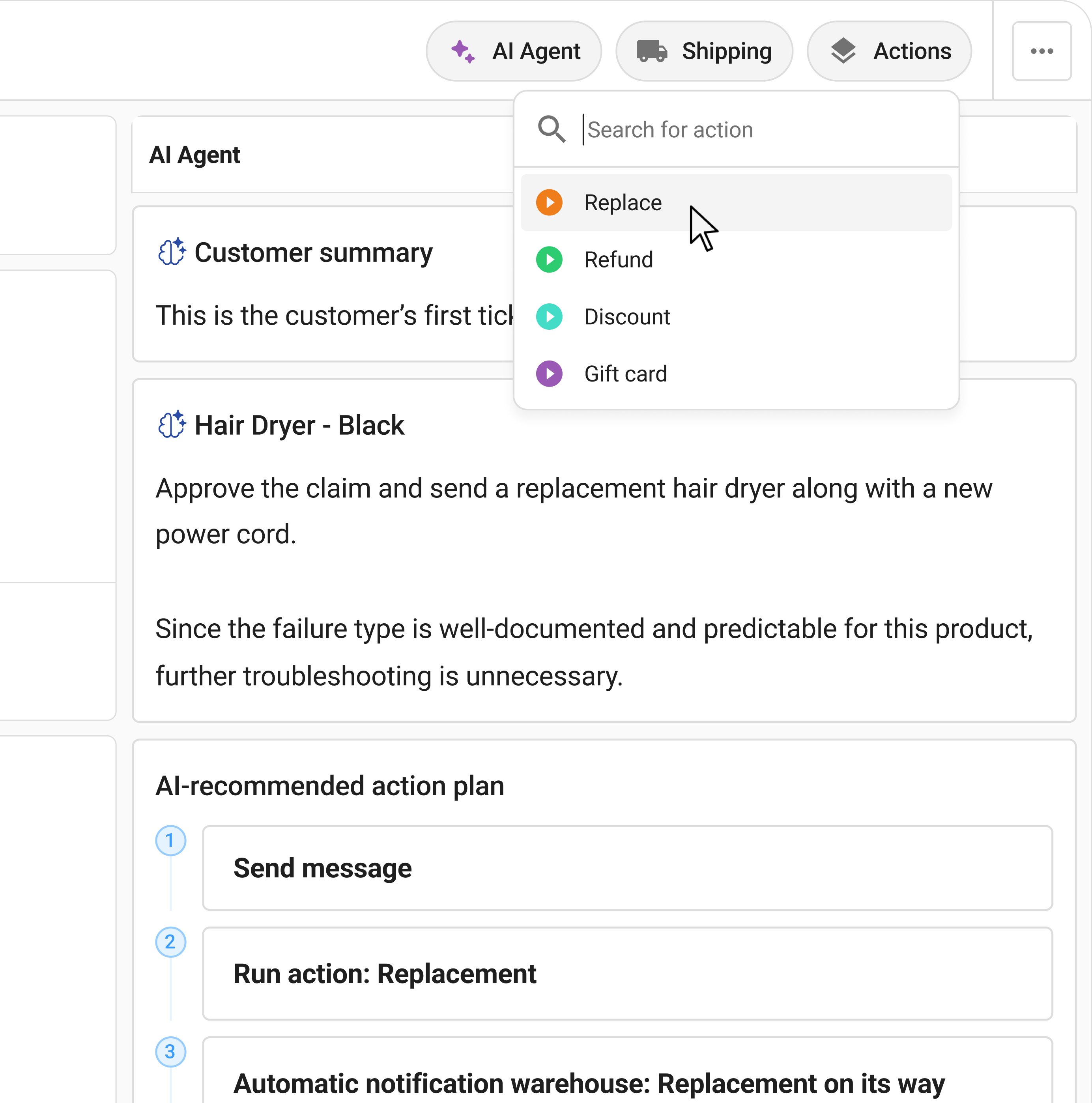
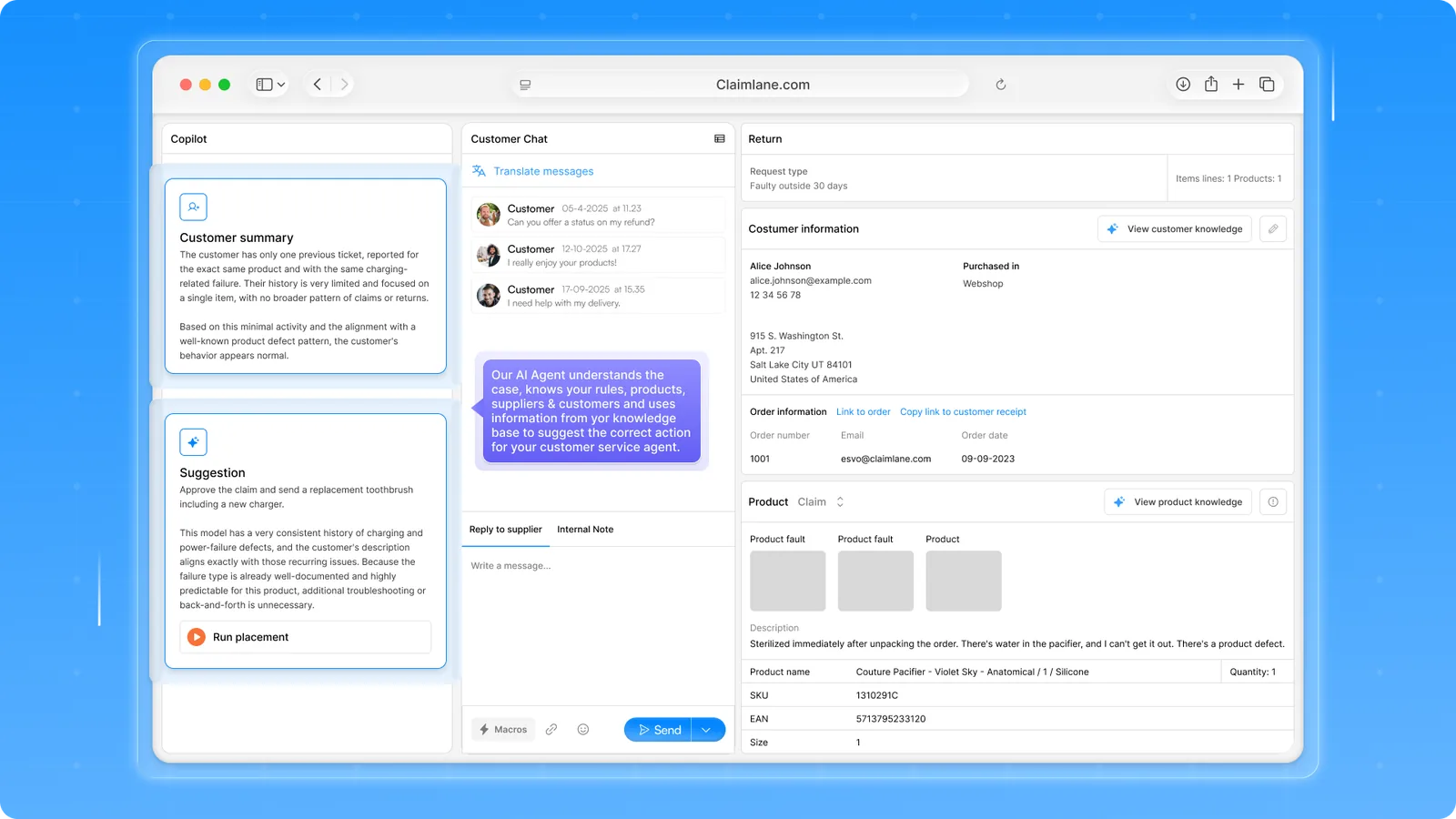
AI warranty claims processing automates the first three steps entirely for straightforward cases. Platforms like Claimlane use AI agents that review submitted images and videos, apply product-specific warranty rules, and recommend resolutions, so support agents no longer need months of product training to handle claims correctly.
MaxGaming, the largest gaming and e-sports ecommerce company in Scandinavia with 30,000+ SKUs across 200+ brands, resolved complex RMA cases 77% faster after implementing AI-powered claims processing.
AI Customer Service Returns: Beyond Just Processing
AI does not just speed up the return itself. It improves the entire customer service experience around returns.
Instant status updates
AI-powered systems provide real-time return status updates via automated notifications, reducing "where is my refund?" support tickets by 30-50%.
Intelligent routing
Not all returns need the same level of attention. AI routes simple returns through fast-track automation while flagging complex cases, high-value items, or potential fraud for human review.
Multilingual support
NLP models handle returns in multiple languages without needing specialized agents for each market, which is critical for brands selling across Europe, North America, and Asia.
Proactive outreach
Some AI systems detect when a customer is likely to return a product based on browsing behavior, cart patterns, or post-purchase signals, and proactively offer support, size guidance, or product information to prevent the return entirely.
Machine Learning Returns: How Models Get Smarter Over Time
The "machine learning" part of AI returns management means the system improves with every return it processes.
Pattern recognition across products
ML models identify which products have abnormally high return rates, which defects are most common, and which suppliers are responsible for quality issues. This turns return data into product quality analytics that feed back into purchasing and supplier management.
Seasonal and trend adjustments
Return patterns shift with seasons, promotions, and product launches. ML models adjust their thresholds and routing rules automatically based on recent data.
Fraud scoring
Every return gets a fraud risk score based on hundreds of signals: customer history, return frequency, product category, claim type, photo analysis, and timing patterns. High-risk returns get flagged for manual review, while low-risk ones flow through automatically.
Retailers using AI for return fraud detection are catching fraudulent claims that manual processes miss entirely.
Predictive Returns Analytics: Preventing Returns Before They Happen
Predictive returns analytics might be the most valuable application of AI in the returns space. Instead of just processing returns faster, it helps brands prevent them.
What predictive returns analytics can forecast
- Product-level return rates before a new product launches (based on similar product data)
- Seasonal return spikes so staffing and logistics can be adjusted in advance
- Customer segments most likely to return, enabling targeted interventions
- Defect patterns that signal a manufacturing issue before it scales
Real impact
Brands using predictive analytics on their return data report:
- 10-15% reduction in overall return rates
- 20-30% improvement in inventory planning accuracy
- Faster identification of supplier quality issues
- More targeted product descriptions and sizing guides
AI Agent Returns Management: The Rise of Autonomous Agents
The newest development in AI returns management is the shift from AI-assisted processing to fully autonomous AI agents that handle entire claim lifecycles without human input.
These AI agents can:
- Read and understand incoming claims
- Analyze product images and documentation
- Apply business rules per product, supplier, and warranty policy
- Approve, deny, or escalate claims independently
- Trigger downstream actions (refunds, replacement orders, shipping labels)
- Update internal systems and notify all parties
Claimlane's AI agent is an example of this approach. It works inside the same portal the support team uses, reviews submissions the same way a human would, but handles repetitive cases automatically so the team can focus on complex claims that actually need human judgment.
AI Aftersales Automation: Returns Are Just the Beginning
Returns are the most visible use case, but AI aftersales automation extends across the entire post-purchase lifecycle:
- Repair workflows: AI determines whether a product should be repaired or replaced based on cost analysis and part availability
- Spare parts management: AI matches defect types to the correct replacement part and triggers orders automatically
- Supplier claims: AI forwards claims to the right supplier with all required documentation, tracks responses, and follows up on SLAs
- Warranty registration: AI validates warranty registrations and links them to product records for future claims
Brands like Black Diamond use this kind of end-to-end automation to handle warranty and repair workflows that would otherwise require large specialized teams.
How to Evaluate AI Returns Management Software
Not all AI returns tools are created equal. Here is what to look for when evaluating platforms:
Must-have features
- Computer vision for image/video analysis (not just text-based automation)
- Configurable rules per product, category, and supplier (one-size-fits-all does not work for warranty)
- Self-service portal where customers submit claims with structured data
- Integration with your ecommerce platform (Shopify, WooCommerce, etc.) and ERP systems
- Analytics dashboard with return reason tracking, product insights, and supplier performance
Nice-to-have features
- Multilingual support
- Supplier claim forwarding and SLA tracking
- Repair and spare parts workflow support
- Returnless refund automation based on item value
Red flags
- Platforms that only do simple rule-based routing and call it "AI"
- No image analysis capability
- Cannot handle warranty claims, only simple returns
- No per-product or per-supplier rule configuration
Implementation: Getting Started with AI Returns
Adopting AI returns management does not require replacing your entire tech stack. Most brands follow this progression:
- Start with a self-service portal that collects structured return data, photos, and order information. This creates the clean data AI needs to work.
- Add rule-based automation for your simplest, highest-volume return scenarios. This alone can automate 20-30% of returns.
- Layer in AI analysis for image review, fraud scoring, and claim classification. This pushes auto-approval rates to 40-70%.
- Expand to predictive analytics once you have 3-6 months of structured data. This helps prevent returns and optimize policy.
Davidsen, one of Scandinavia's largest DIY retailers, went from 5 agents handling claims to 1-2 agents after implementing automated claims workflows.
The Cost of Waiting
According to Forbes, return fraud alone is expected to reach 9% of total retail returns. Return volumes keep growing. Customer expectations for fast resolution keep rising.
Brands that delay AI adoption in returns and claims management will face:
- Higher per-return costs as labor expenses increase
- Slower resolution times as volumes grow
- More fraud slipping through manual review
- Less insight into product quality and supplier issues
- Worse customer experiences compared to competitors who have automated
FAQ
AI returns management uses artificial intelligence, including machine learning, computer vision, and natural language processing, to automate how ecommerce brands process returns, warranty claims, and exchanges. It handles tasks like image analysis, policy matching, and claim approvals automatically.
Most brands see a 50–80% reduction in per-return processing costs after implementing AI automation. The exact savings depend on return volume, claim complexity, and the level of automation adopted.
Yes. AI warranty claims processing uses image analysis and product-specific rules to evaluate defects, apply warranty terms, and decide between repair, replacement, or refund. Platforms like Claimlane specialize in this exact use case.
Research shows that 40–70% of routine claims can be automatically approved by AI without human intervention. The rate depends on how well the system is configured with product-specific rules and policies.
Most AI returns platforms integrate natively with Shopify, WooCommerce, and other major ecommerce platforms. They sync order data, product details, and customer information to power automated workflows.
No. Brands processing as few as 50–100 returns per week can benefit from AI automation. The ROI scales with volume, but even smaller brands save significant time by automating routine claims and improving data collection.