.webp)
What AI ticket deflection means
AI ticket deflection is the practice of answering a customer's question before it ever becomes a support ticket. The customer gets a real answer, the question closes, and no agent touches it.
The older meaning of deflection was uglier. It meant making support so hard to reach that customers gave up. That is not deflection in any useful sense. It just hides the demand and damages trust. Modern AI ticket deflection does the opposite: it resolves the query on the spot, fast, so the customer never needs an agent and never feels pushed away. This guide covers what deflection means, how it is measured, the 2026 benchmarks, the trap that breaks most programs, and where AI agents deflect best. For the wider context, the AI customer service automation guide and the post-sales ticketing system overview sit next to this one.
- AI ticket deflection resolves a customer question through automation before it becomes a support ticket.
- Deflection only counts when the customer's problem is actually solved, not when they give up trying to reach a human.
- 2026 analyses put median tier-1 deflection near 40%, with returns, warranty, and order-status queries the easiest to deflect.
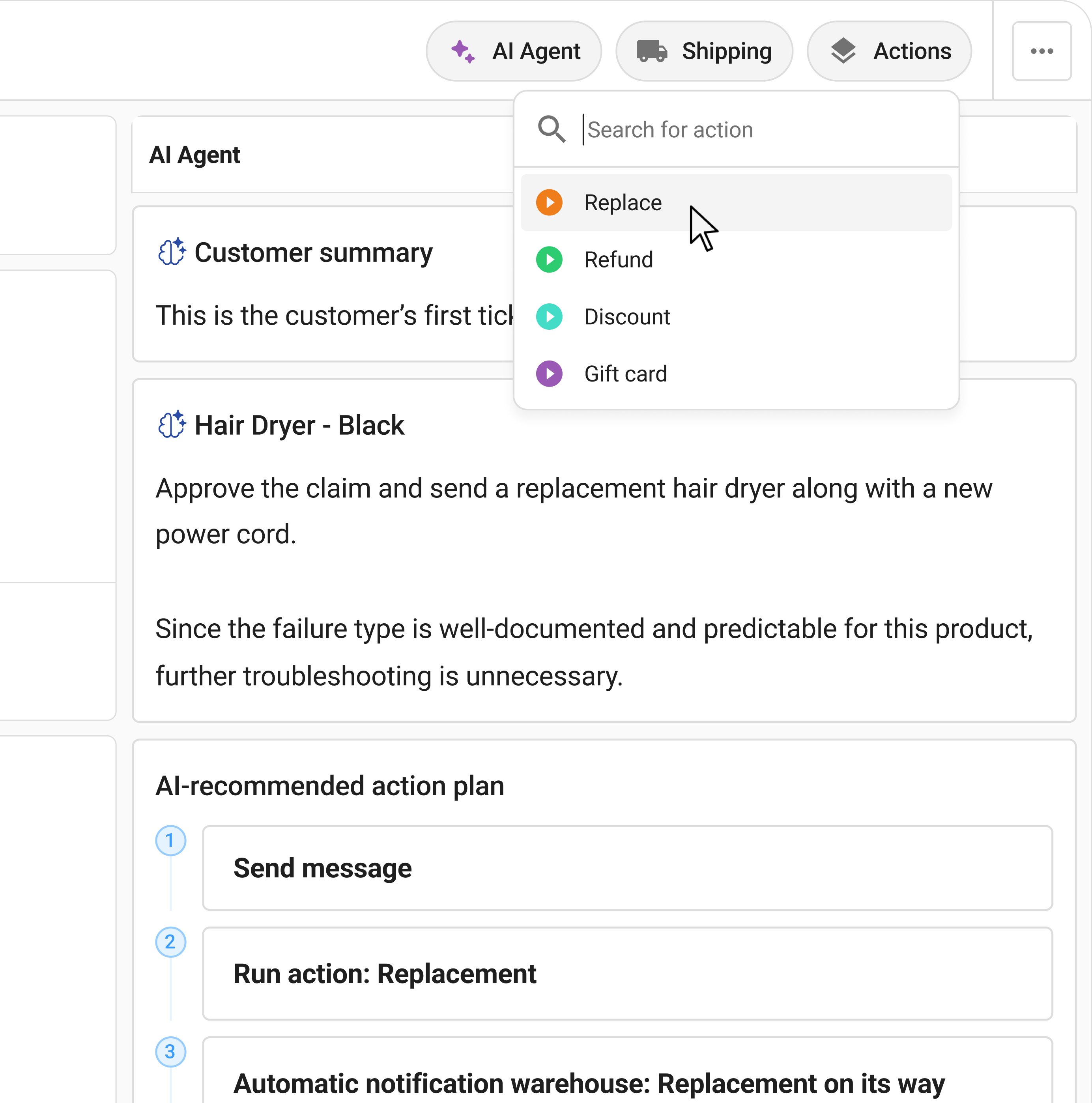
- Claimlane's AI Agent deflects returns and warranty tickets by reading evidence, applying the rules, and resolving the case in the self-service portal.
Deflection rate: how it is measured
The basic formula is simple. Deflection rate is the number of questions resolved by self-service or AI, divided by the total number of questions that came in across self-service and tickets.
The trap is in the numerator. A question only belongs there if it was actually answered. Many teams count every self-service session that did not end in a ticket, which quietly counts abandonment as success. The cleaner method tracks whether the customer came back within 48 hours about the same issue. If they did, the first interaction deflected a ticket but did not resolve anything.
Deflection sits alongside the other returns and warranty KPIs a support team watches. On its own it can mislead. Paired with re-contact rate and customer satisfaction, it tells the truth.
AI ticket deflection benchmarks for 2026
Benchmarks vary by industry, query mix, and how honestly each team measures. The ranges below are a fair read of where ecommerce support sits in 2026.
Two points matter more than the headline figures. First, deflection is rising fast, because AI agents in ecommerce now resolve queries that a static help centre never could. Second, the spread between teams is wide. A brand with clean product data and a structured returns flow deflects far more than one with a thin help centre, even with the same AI.
The deflection-is-not-resolution trap
This is the mistake that quietly breaks deflection programs. A team celebrates a 50% deflection rate while customer satisfaction slides and re-contacts climb. The rate went up because customers stopped opening tickets, not because their problems got solved.
The fix is to measure resolution, not silence. Track re-contact rate, customer satisfaction on deflected interactions, and the share of AI sessions that ended in a completed action. A deflection program that also lowers customer effort is healthy. One that raises it is hiding a problem.
Where AI ticket deflection works best
Not every query is a good deflection target. The best candidates are high-volume, rule-based, and answerable from data the brand already holds.
Order status and WISMO
Where-is-my-order questions are pure data lookups. The answer already exists in the carrier feed, so an AI agent can read it and reply in seconds. Reducing WISMO queries is usually the fastest deflection win a brand can get, and it also catches cases where a delivery exception needs a real answer rather than a guess.
Returns, warranty, and claims
Returns and warranty queries look complex but follow clear rules. A return is a structured action, and AI returns management can run the flow end to end. Warranty is similar: AI warranty claims automation reads the evidence, checks the term and exclusions, and recommends an action.
Product and policy questions
Sizing, compatibility, and policy questions deflect well when the knowledge base is accurate. AI chatbots for ecommerce handle these, but only as well as the content behind them.
How an AI agent deflects a ticket step by step
The flow below shows what happens when a question arrives. The first three branches resolve without a human. The fourth hands off, with full context, so the human starts faster.
The handoff branch matters as much as the deflection branches. A good AI agent knows what it cannot resolve and passes those cases up cleanly. The self-service portal is where the first three branches play out, and AI RMA automation shows the returns branch in detail.
Deflection versus suppression: the line that protects trust
Deflection and suppression can produce the same number and mean opposite things.
Suppression is hiding the contact channel, burying the help link, or looping the customer through menus until they quit. It lowers ticket counts and raises churn. Deflection is resolving the question so well that the customer has no reason to open a ticket. It lowers ticket counts and raises satisfaction.
The test is whether the customer could reach a human if they wanted to. A deflection program always keeps that door open and visible. It wins on quality, not on friction. That is the difference between a deflection program and a customer experience problem in disguise.
What you need before AI deflection works
An AI agent is only as good as what sits behind it. Three things have to be in place first.
Clean knowledge. Policies, warranty terms, and product data have to be accurate and current. An AI agent that reads a stale return policy will deflect customers into wrong answers.
Connected data. Order, tracking, and case data have to be reachable. Deflecting a WISMO query needs the carrier feed. Deflecting a return needs the order record.
Defined workflows. The AI agent needs to know what action to take. Workflows for the customer service team turn a vague "help the customer" into a clear path the agent can run. The retailer Coolshop centralised its post-purchase operations for exactly this reason: scattered tools cannot feed an AI agent. The best ecommerce customer service software makes these three foundations easy to build.
AI deflection for returns and warranty
Returns and warranty are where deflection pays off most, because the queries are frequent, rule-based, and slow when a human handles them.
Claimlane's AI Agent, the first AI agent purpose-built for warranty claims and returns, is built for this work. It reads the photos and videos a customer submits, applies the warranty rules per product and supplier, summarises the case, and recommends or auto-approves a resolution. A claim that would have become a multi-day ticket closes inside the self-service flow instead.
The evidence layer is what makes warranty deflection possible. AI image recognition for warranty claims confirms the product and the fault, so the agent is not guessing. The Claimlane AI Agent for returns and warranty piece covers how that resolution logic works.
"Before Claimlane, every case required manually digging around to find the best solution. Now we move faster and with real confidence. You can feel the impact within our support team and in every customer interaction."Jacob Bay, Chief Operating Officer, MaxGaming (case study)
Metrics that tell you deflection is healthy
A healthy deflection program moves several numbers at once, not just the deflection rate.
Re-contact rate within 48 hours should stay low. Customer satisfaction on deflected interactions should match or beat agent-handled ones. Time to resolution on the cases that still reach a human should fall, because the AI agent handed them over with context. And the cost per resolved query should drop.
Claimlane analytics tracks these together, so a team can see whether a rising deflection rate is real or hollow. The goal is the same as any claim resolution work: faster answers, lower effort, lower cost, no drop in trust.
Common mistakes that break deflection
Four patterns show up in almost every weak deflection program.
The first is measuring silence as success, covered above. The second is deflecting before the knowledge base is ready, which sends customers wrong answers fast. The third is hiding the human channel, which turns deflection into suppression. The fourth is treating deflection as a one-time project instead of an ongoing one. Query patterns shift, products change, and the AI agent needs the automation platform behind it kept current.
A small fifth mistake is worth naming: forgetting status updates. Many "tickets" are really WISMO follow-ups. Automatic status emails deflect those before the customer even asks.
How Claimlane's AI Agent deflects returns and warranty tickets
Claimlane handles the post-purchase side of deflection: returns, exchanges, warranty, repairs, and spare parts. A customer starts a request in the portal, the AI Agent reads it, and the case either resolves automatically or moves to an agent with everything attached.
The result is fewer tickets and faster ones. The contact-centre automation pattern applies, and the customer service workflows for returns keep each case on a defined path. Claimlane is rated 4.8 out of 5 on G2 by support teams running this kind of automation.
"Responses were typically two to three days after they had reached out. Now tickets come through and are auto routed to the right people, and customers get responses within a day."Tess Jordan, Senior Manager of Customer Experience, Black Diamond (case study)
Frequently asked questions
For teams comparing tools, the omnichannel customer service platforms guide covers where deflection fits in the wider support stack.
Conclusion
AI ticket deflection is one of the highest-return moves an ecommerce support team can make in 2026, but only when it is measured honestly. A deflection rate that climbs while satisfaction falls is not a win. It is churn with a nicer dashboard.
The brands that get it right resolve the question, keep the human channel open, and watch re-contact rate as closely as deflection rate. Returns and warranty are the best place to start, because the queries are frequent and rule-based.
To see how Claimlane's AI Agent deflects returns and warranty tickets, book a demo.