.webp)
Most brands sell through multiple channels. Direct-to-consumer orders come through Shopify or WooCommerce. Wholesale orders go through retailers, distributors, and marketplace partners. But when something breaks or arrives damaged, the claims process looks completely different depending on who bought the product.
That mismatch creates chaos. B2C customers expect a quick self-service portal. B2B retailers expect batch claims, credit notes, and supplier-facing workflows. Running two separate systems (or worse, handling B2B claims over email) wastes time, fragments data, and makes it nearly impossible to spot product quality trends across channels.
This article breaks down exactly how hybrid B2C and B2B claims management works, why most platforms only handle one side, and what to look for in a solution that covers both.
- B2C and B2B claims have fundamentally different workflows, approval chains, and resolution types — but the underlying product data is the same.
- Running separate systems for consumer and retailer claims creates data silos that hide defect patterns and slow down supplier recovery.
- A unified claims platform routes each claim type through the right workflow automatically based on the claimant type and channel.
- Claimlane supports both B2C and B2B claim flows from one platform, with configurable workflows, AI-powered claim automation, and a G2 rating of 4.8/5.
Why B2C and B2B Claims Are So Different
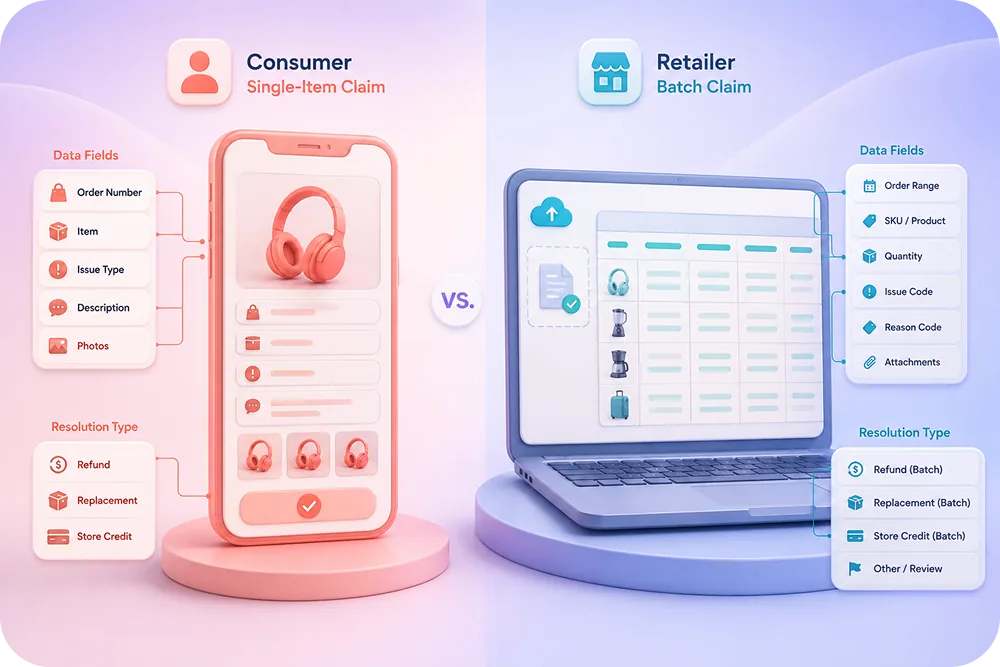
A consumer who bought a faulty blender online wants a replacement shipped to their door. A retailer who received 50 damaged units in a pallet shipment wants a credit note and a supplier investigation.
Same product. Same defect. Completely different resolution paths.
B2C claims: speed and simplicity
Consumers expect a fast, low-friction experience. They want to submit a claim through a self-service portal, upload a photo, and get a resolution within hours. The typical outcomes are refunds, replacements, store credit, or repairs.
B2C claim volumes tend to be high but individual claim values are low. Automation matters here because manually reviewing hundreds of small claims is not cost-effective.
B2B claims: complexity and documentation
Retailer and distributor claims are fewer in number but far more complex. A single B2B claim might cover dozens of units, require purchase order references, involve credit memos in the ERP system, and trigger a supplier chargeback process.
B2B claimants also expect different communication. Instead of automated status emails, they may need direct contact with an account manager, batch claim submissions, and detailed documentation for their own internal processes.
According to Gartner's supply chain research, B2B returns and claims processes are among the least digitized areas of wholesale operations, with most still handled through email and spreadsheets.
The Problem With Running Two Systems
Brands that sell both B2C and B2B often end up with a consumer returns tool (like Loop or Narvar) for their DTC channel and a manual email/spreadsheet process for wholesale claims. This creates several problems:
Data fragmentation
If a product has a recurring defect, B2C claims show it in one system and B2B claims show it in another. Nobody connects the dots. The analytics that could catch a batch defect early get split across tools.
Duplicated work
Support teams handle the same types of issues (damaged goods, missing parts, warranty failures) in two completely different interfaces. Training costs double. Reporting takes manual effort to consolidate.
Inconsistent resolution policies
Without a shared workflow engine, B2C and B2B claims may get different treatment for the same product defect. That inconsistency makes it harder to negotiate with suppliers or enforce warranty SLA agreements.
Slower supplier recovery
When B2B claims data lives in spreadsheets and B2C claims live in a separate tool, the supplier recovery process becomes manual. Brands leave money on the table because they cannot produce consolidated defect reports to support chargebacks.
What a Unified Hybrid Claims Platform Looks Like
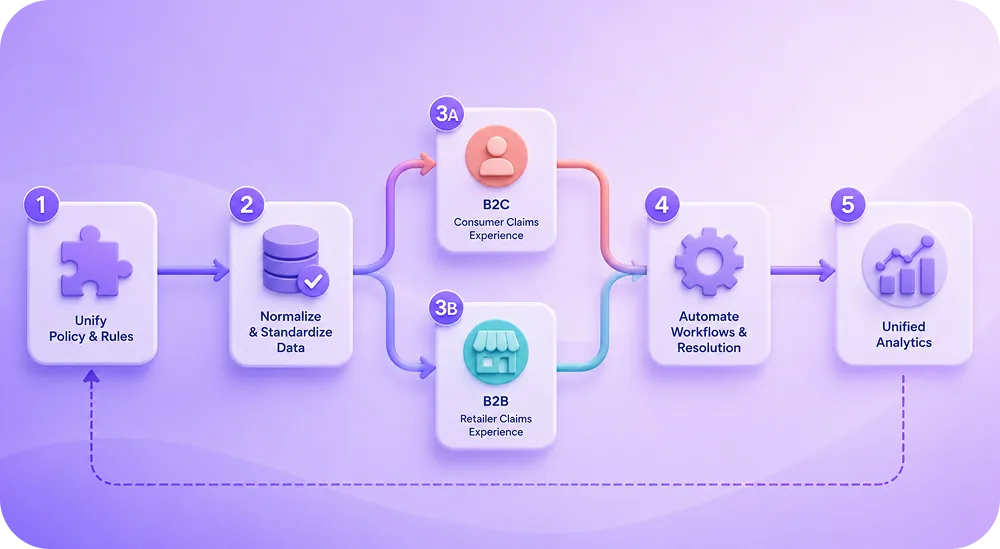
A hybrid claims platform handles both B2C and B2B claims in one system, with separate workflows for each. Here is what that looks like in practice:
Channel-aware routing
When a claim comes in, the system identifies the claimant type (consumer, retailer, distributor) and routes it through the appropriate workflow. A B2C claim might go through an automated approval flow. A B2B claim might require manual review, batch processing, and ERP integration.
Shared product data
Both claim types feed into the same product and defect database. If a specific SKU starts generating claims from both consumers and retailers simultaneously, the system flags it immediately. This is where warranty analytics becomes powerful.
Configurable workflows per channel
The workflow engine supports different approval chains, resolution types, and communication templates for each channel. B2C claims can auto-approve under a certain value threshold. B2B claims can require manager sign-off and generate credit memos.
Unified reporting
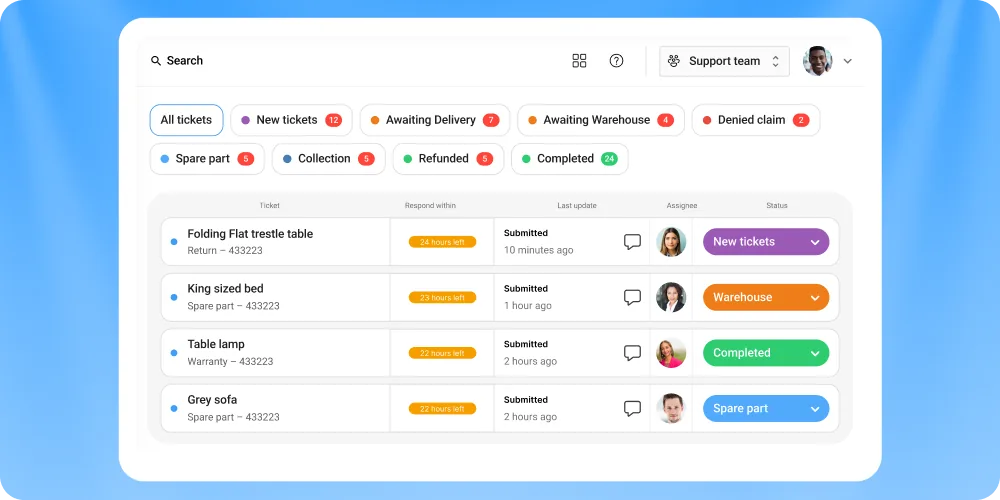
One dashboard shows claim volumes, resolution rates, defect patterns, and supplier performance across all channels. No more merging spreadsheets.
How AI Changes Hybrid Claims Processing
Managing hybrid claims manually is time-consuming enough. Adding AI to the process changes the economics entirely.
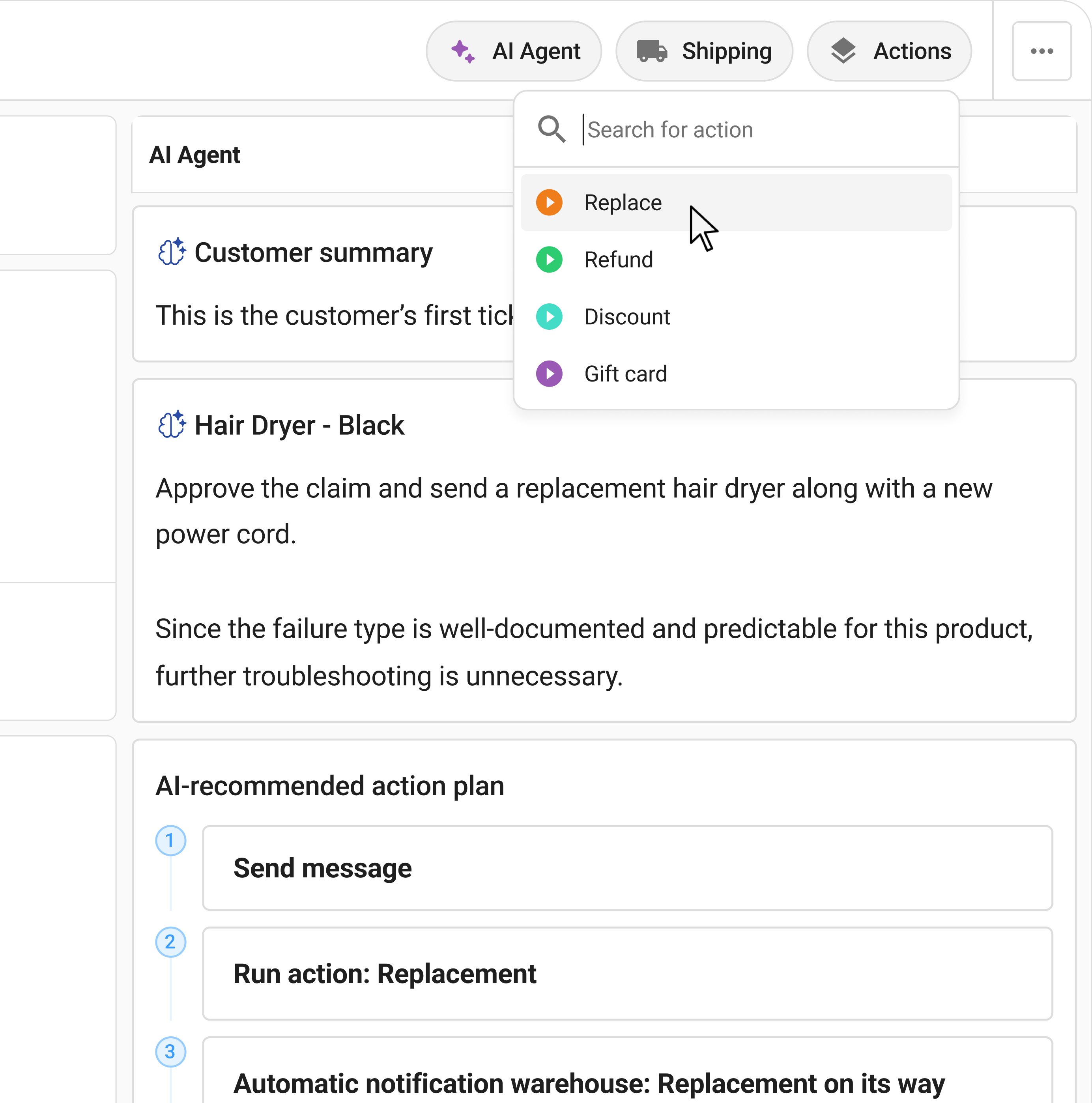
Claimlane's AI Agent, the first AI agent purpose-built for warranty claims and returns, analyzes product images and videos submitted with claims, applies warranty rules per product and supplier, and recommends or auto-approves resolutions. This works across both B2C and B2B claim types.
For B2C claims, the AI Agent can review a consumer's photo of a damaged product, check the warranty period, and approve a replacement automatically. For B2B claims, it can assess batch defect evidence, cross-reference against supplier agreements, and flag claims that need escalation.
The result: support teams spend less time on routine decisions and more time on complex cases that genuinely need human judgment.
"With Claimlane there is no need to write many emails back and forth, as customers cannot submit claims without all the needed information."
B2C Claim Workflows: Best Practices
B2C claims are about speed and self-service. The goal is to resolve the majority of claims without any human intervention.
Self-service submission
Customers should be able to submit claims through a branded self-service portal that collects all required information upfront: order number, product photos, description of the issue, and proof of purchase. This eliminates the back-and-forth emails that slow down resolution.
Automated approval rules
Set value thresholds for automatic approvals. Claims under a certain amount for products within the warranty period can be auto-approved and resolved without agent review. Claimlane's AI Agent goes further by analyzing submitted images to verify damage before approving.
Resolution options
B2C customers typically get refunds, replacements, store credit, or repair services. The workflow should automatically determine the best resolution based on product type, claim reason, customer lifetime value, and inventory availability.
Automated communication
Status emails should fire at every stage: claim received, under review, approved, replacement shipped. Customers who feel informed are less likely to contact support for updates.
B2B Claim Workflows: Best Practices
B2B claims require more structure, documentation, and integration with financial systems.
Batch claim submission
Retailers often need to submit multiple claims at once. A B2B workflow should support batch uploads, bulk approvals, and grouped processing. This is fundamentally different from the one-at-a-time consumer model.
Purchase order and credit memo integration
Every B2B claim needs to tie back to a purchase order. When a claim is approved, the system should generate or trigger a credit memo in the ERP. Manual credit note creation is one of the biggest time sinks in B2B claims processing.
Supplier forwarding
Many B2B claims are ultimately the supplier's responsibility. The platform should support forwarding claims to suppliers with all documentation attached, tracking supplier response times, and managing the chargeback process.
Account-level visibility
B2B partners need to see their own claim history, outstanding claims, and resolution status. A partner portal (separate from the consumer self-service portal) gives retailers visibility without requiring support team involvement.
Building a Unified Claims Workflow
Here is a step-by-step approach to unifying B2C and B2B claims in one platform:
Step 1: Map existing workflows
Document every current B2C and B2B claim path. Include triggers, approval steps, resolution types, communication touchpoints, and system integrations. Identify where workflows overlap and where they diverge.
Step 2: Define claimant types
Create distinct claimant categories: end consumer, retailer, distributor, marketplace partner. Each type gets its own submission method, workflow rules, and resolution options.
Step 3: Configure shared and separate workflows
Some steps are shared (damage assessment, product identification, defect categorization). Others are channel-specific (refund vs. credit memo, self-service vs. account manager). Build the workflow engine to branch at the right points.
Step 4: Connect financial systems
B2B claims almost always require ERP integration. Connect the claims platform to Business Central, SAP, or whatever financial system handles credit memos and supplier payments. B2C claims may need Shopify or WooCommerce integration for refund processing.
Step 5: Unify analytics
Set up a single analytics dashboard that shows defect trends, claim volumes, and resolution metrics across all channels. This is the data that feeds into supplier quality reporting and product improvement decisions.
Real-World Example: F. Engel's B2B Claims Transformation
F. Engel, a Danish workwear manufacturer, sells through a network of retailers and distributors across Europe. Before adopting a unified claims platform, their B2B claims process was entirely email-based. Retailers would send photos, descriptions, and order references in separate email threads. The claims team had no centralized view of which products were failing or which suppliers were responsible.
After implementing Claimlane, F. Engel moved both their B2B retailer claims and consumer warranty claims into one system. Retailers now submit claims through a structured portal that collects all required documentation upfront. The claims team sees both B2C and B2B claims on a single dashboard, and defect data feeds directly into supplier conversations.
Measuring Hybrid Claims Performance
Once B2C and B2B claims run through the same platform, new metrics become possible:
Cross-channel defect rate
Track defect frequency per SKU across both consumer and retailer claims. A product that generates claims from both channels simultaneously is a stronger signal than either channel alone.
Channel-specific resolution time
B2C claims should resolve faster (often same-day with automation). B2B claims may take longer due to approval requirements. Benchmark each channel separately but report them together.
Supplier recovery rate
Measure what percentage of claim costs are recovered from suppliers through chargebacks and credit notes. Unified data makes these supplier recovery claims stronger.
Cost per claim by channel
B2C claims should trend toward near-zero cost with automation. B2B claims will always carry some manual cost, but that cost should decrease as workflows become more structured.
Claimlane: Purpose-Built for Hybrid Claims
Claimlane was built from the ground up to handle both B2C and B2B claims from one platform. Here is what makes it different from consumer-only returns tools:
Configurable claim workflows
Claimlane's workflow engine lets brands define separate claim paths for consumers, retailers, and distributors. Each workflow can have its own approval rules, resolution types, communication templates, and escalation paths.
AI-powered claim assessment
Claimlane's AI Agent, the first AI agent purpose-built for warranty claims and returns, works across both channels. It analyzes photos and videos, checks warranty rules, and recommends actions. For B2C, it can auto-approve straightforward claims. For B2B, it can pre-categorize and triage batch claims to speed up manual review.
B2B-specific features
Supplier forwarding, credit memo generation, batch claim processing, and supplier quality reporting are all built in. These are not afterthoughts bolted onto a consumer returns tool.
Unified analytics
The analytics dashboard shows claim patterns across all channels. Spot a defective batch before it becomes a recall. Track supplier performance with data from both consumer and retailer claims.
75+ integrations
Claimlane connects to Shopify, WooCommerce, Business Central, SAP, Zendesk, and dozens of other systems through its integrations hub. B2C and B2B systems can run in parallel without manual data transfer.
"It was amazing how easy it was to roll out the Claimlane platform. The amount of communication and the manuals that Claimlane provided, made the implementation process much easier. From our managers' perspective, this was a huge advantage."
Common Pitfalls When Merging B2C and B2B Claims
Forcing B2B partners into a B2C-style portal
Retailers and distributors have different expectations. Do not make them use the same self-service form designed for end consumers. Build a separate submission experience that supports batch claims, PO references, and account-level views.
Ignoring financial system integration
B2B claims that do not connect to the ERP create manual accounting work. Every approved B2B claim should automatically trigger the appropriate financial transaction: credit memo, debit note, or supplier chargeback.
Applying the same SLA to both channels
B2C customers expect resolution in hours. B2B claims may require days for investigation and approval. Set channel-specific SLAs and measure them independently.
Not using claim data for product improvement
The biggest advantage of unified claims data is visibility into product quality trends. If the claims team is not sharing defect data with product and sourcing teams, the system is only solving half the problem.
Industries Where Hybrid Claims Matter Most
Consumer electronics
Electronics brands sell through both DTC channels and retail partners. Warranty claims from consumers and batch defect claims from retailers need unified tracking to catch firmware issues, manufacturing defects, and shipping damage patterns.
Outdoor and sporting goods
Outdoor brands like Black Diamond sell direct-to-consumer and through specialty retailers. A warranty claim on a climbing harness carries safety implications that require consistent handling regardless of the channel.
Furniture and home goods
Furniture brands deal with complex claims involving damage assessment, repair coordination, and high-value replacements. Both B2B furniture claims and consumer warranty claims benefit from visual evidence review and structured workflows.
DIY and hardware
DIY and hardware brands like Davidsen manage claims from professional buyers, retail customers, and trade accounts. Each segment has different expectations for resolution speed and documentation.
FAQ
Conclusion
Brands that sell through both direct-to-consumer and wholesale channels cannot afford to treat claims as two separate problems. The product data, defect patterns, and supplier accountability overlap too much.
A unified hybrid claims platform like Claimlane brings B2C and B2B workflows into one system, with channel-specific routing, AI-powered assessment, and analytics that work across both sides. The result is faster resolution for every claimant, stronger data for product improvement, and more effective supplier recovery.
Book a demo to see how Claimlane handles hybrid B2C and B2B claims.