.webp)
Voice AI agents that handle inbound calls have been around for years. Most of them were bad. The ones launching in 2026 are different. They answer status questions, handle returns triage, and check warranty eligibility well enough that brands are starting to put them on the front line. The catch is what happens after the call. Voice handles the front door. Resolution logic still has to live somewhere.
This article covers what voice AI actually does well in ecommerce customer service this year, where it still fails, and how brands are pairing it with text-based AI agents to close the loop.
- Voice AI in 2026 handles order status, simple returns triage, and warranty eligibility well. Complex disputes and emotional cases still need a human.
- The split that works: voice on the front door, text-based AI for the resolution logic, agents for the edge cases.
- Voice AI deflects 30-50% of routine calls when paired with strong order and claims data.
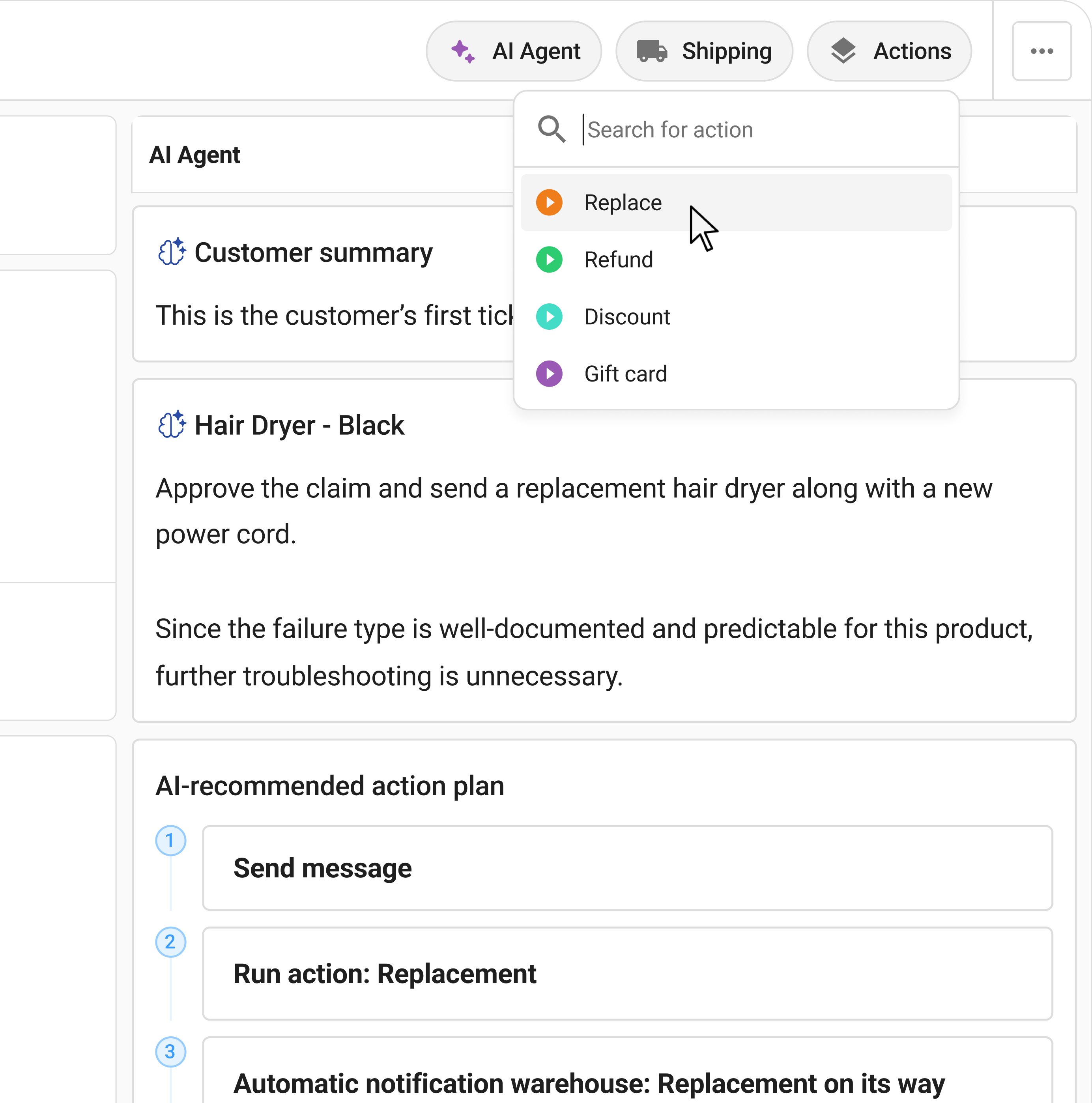
- Claimlane's AI Agent, the first AI agent purpose-built for warranty claims and returns, handles the resolution side and feeds the right answer back to voice or text channels.
What changed in voice AI between 2024 and 2026
Three shifts made voice usable in ecommerce.
First, latency dropped. Sub-300ms response times now feel like talking to a person. The early voice AI tools paused for two to three seconds between turns, which is exactly long enough to make a customer ask "hello? are you there?".
Second, voice AI started reading structured data. Order ID, tracking number, customer email, claim status. The agent can pull the actual answer instead of repeating a script. "Your order shipped Tuesday and is expected Friday" is a different conversation from "please hold while I check".
Third, handoff to text and to humans got cleaner. A voice call can now seamlessly hand to an SMS conversation, a self-service portal, or a live agent without making the customer start over. That single change is what unlocked the rest.
Where voice AI works in ecommerce customer service today
The call types that voice handles well in 2026:
- Order status checks. "Where is my order" is the highest-volume call type for most ecommerce brands. Voice AI resolves it without a human in the loop.
- Delivery delay updates. When a carrier delays a package, the customer wants context. Voice AI pulls tracking data and gives a coherent answer.
- Returns triage. "I want to return this" gets routed correctly. The AI confirms eligibility, generates a return label, and texts it to the customer.
- Warranty eligibility. "Is this still under warranty" is a clean lookup against order data and warranty terms. Voice handles it.
- FAQ answers. Shipping policy, returns window, sizing questions. The AI reads from a knowledge base and answers in conversational tone.
- Appointment booking. Repair drop-offs, fitting appointments, in-store pickup confirmations.
The pattern: anything that maps to a structured database lookup and a fixed set of next actions is voice-ready. About 50-70% of inbound call volume for a typical ecommerce brand fits this pattern.
For the wider context on automation in customer service, see customer service automation software platforms, contact center automation technologies, and ecommerce automation.
Where voice AI still fails
The call types where voice AI is not ready in 2026:
- Disputed warranty claims. When the customer disagrees with the policy, the conversation needs judgment.
- Emotional escalations. A customer who is upset needs acknowledgment a voice AI cannot consistently provide.
- Complex repair coordination. Multi-step repair with parts ordering, technician scheduling, and customer follow-up is too branched for current voice.
- High-value retention conversations. A VIP customer threatening to churn needs the best agent available, not an AI.
- Multi-product or multi-order claims. Voice handles one record at a time. Batch claims still need agents or a structured portal.
Brands that push voice AI into these categories see customer satisfaction drop fast. The right answer is to route these calls to humans early, before the customer feels they are being kept from one.
The split that works: voice front door, text-based AI resolution
This is the architecture most ecommerce brands are landing on in 2026. Voice AI on the front door catches the easy questions. Claimlane's AI Agent handles the resolution logic where claims, returns, and warranty cases need real decisions. Human agents work the cases that need judgment.
Davidsen, the Danish DIY and hardware retailer, runs this model. The team went from five agents handling claims to one or two using Claimlane, because the AI does the reading and reasoning before the agent gets involved. The Davidsen case study has the full setup, and the MaxGaming case study covers the same architecture applied to high-SKU gaming retail.
"Before Claimlane, our entire customer service team of 5 agents was involved in claims handling, with additional seasonal help from other departments. Today, we have 1-2 agents who can solve everything in Claimlane."
Use case 1: order status calls
The most common call type. The pattern: customer calls, voice AI greets, asks for order number or matches the caller ID to a customer record, pulls the tracking info, and reads it back. If the customer asks a follow-up, the AI handles it. If the package is delayed beyond a threshold, the AI offers a resolution: wait, refund, replacement.
This is where pairing matters. The voice AI does the call. Claimlane handles the resolution flow if the customer chooses a refund or replacement. The customer never has to repeat themselves. See reduce where is my order queries and how to reduce claim resolution time for the operations side.
Use case 2: returns triage
A customer calls to start a return. Voice AI confirms the order, the product, and the return reason. If the reason is sizing or buyer's remorse, the AI generates a return label and texts it. If the reason is "the product is defective", the AI escalates to a warranty flow because the resolution path is different.
The escalation is where text-based AI takes over. Claimlane's AI Agent reads the photo the customer submits through the self-service portal, checks warranty terms, and recommends repair, replacement, or refund. The customer gets a structured answer in minutes. For more on the returns triage angle, see audit your returns process, how to automate returns, and efficient returns management system.
Use case 3: warranty eligibility
A customer asks "is my product still under warranty". The voice AI looks up the order, checks the purchase date against the warranty terms for that SKU, and answers. If the answer is yes and the customer has a defect, the AI hands off to the warranty claim flow. If the answer is no, the AI explains the policy and offers paid repair options where they exist.
For the warranty management context, see warranty management software, warranty claims processing, and warranty tracking software.
How Claimlane's AI Agent fits with voice AI
Voice AI is the channel. Claimlane is the decision layer that runs underneath returns and warranty cases regardless of how the customer reached out.
Claimlane's AI Agent, the first AI agent purpose-built for warranty claims and returns, reads product photos and videos, applies warranty rules per product and supplier, and recommends or auto-approves resolutions. It works the same way whether the customer started on a voice call, in a chat, in the self-service portal, or in person at a store.
The pattern in practice:
- Customer calls. Voice AI confirms the order and the issue.
- Voice AI asks for a photo and texts the customer a link to the self-service portal.
- Customer uploads the photo. Claimlane's AI Agent reads it.
- The AI checks warranty rules through the workflows engine.
- Resolution is recommended or auto-approved. The customer gets a text update.
- If a human agent is needed, they get a pre-triaged case instead of starting from zero.
This is the architecture that gets brands the 30-50% call deflection numbers without dropping customer satisfaction.
How AI changes claim economics
For brands considering the broader AI stack, see AI returns management ecommerce, AI warranty claims automation, AI image recognition warranty claims, AI agents post-purchase support, and ecommerce AI agents.
Claimlane is rated 4.8/5 on G2.
Industries where voice AI works best in 2026
Gaming and e-sports retail. High SKU count, technical product questions, and warranty-heavy returns. MaxGaming is the proof point here.
Outdoor and sporting goods. Warranty calls are common and the questions are repetitive enough for voice. Pair with a strong returns platform to handle the resolution side. See the Black Diamond case study on the warranty workflow side.
Furniture. Status calls on long-lead-time deliveries dominate inbound volume. Voice AI handles them well. See furniture returns management.
Baby and nursery. Sleep-deprived parents calling at 2am about a missing part. The voice AI does not get tired. The text-based AI handles the warranty case in the morning. See the Luksusbaby case study.
DIY and hardware. Davidsen-style retailers with high call volume on stock checks, order status, and warranty eligibility. See the Davidsen case study.
Common mistakes brands make with voice AI
- Putting it on the disputed-warranty queue. Voice AI cannot handle a frustrated customer who disagrees with a policy decision. Route those calls to humans directly.
- Not connecting it to order and claims data. A voice AI without live data sounds like a 2008 IVR. Connect it to the order system and the returns platform before launch.
- Skipping the escalation flow. Customers who say "I want to speak to a human" should reach one within 15 seconds. Anything longer drops satisfaction sharply.
- Ignoring after-call follow-up. A call that resolved with "we will text you a return label" needs the text to fire within 60 seconds. The integration matters as much as the call.
- Letting voice handle multi-product claims. A customer with three defective items needs the structured submission flow. Hand off to the portal early.
For more on the customer-effort side, see reduce customer effort claims and returns, customer service workflows for returns, and notify customers returns process.
Measuring voice AI performance
- Call deflection rate. Percentage of inbound calls resolved without a human. Healthy range: 30-50%.
- Customer satisfaction on AI-handled calls. Should be within 5 points of human-handled calls. Wider gap means the routing is too aggressive.
- Handoff success rate. Percentage of calls that escalate to a human or to a text flow without the customer dropping. Target above 95%.
- Average handle time on AI calls. Should be 30-60% shorter than human-handled calls for the same query type.
- Repeat-call rate within 7 days. Customers calling back about the same issue means the resolution did not stick.
For the broader measurement set, see returns and warranty KPIs and returns analytics events to track.
FAQ
Conclusion
Voice AI in 2026 is finally good enough for the front door of ecommerce customer service. The brands seeing the biggest gains pair it with a text-based AI agent for the resolution side, and keep humans for the cases that genuinely need judgment. Voice does the channel. The AI Agent does the decision. Agents do the work that pays them well.
Book a demo to see how Claimlane's AI Agent pairs with voice AI on the front line.