.webp)
Why exchange policies matter more than they used to
Return rates keep rising. Refunds keep killing margin. The middle path that protects revenue and customer trust at the same time is the exchange. Done well, an exchange policy keeps the order, keeps the customer, and gives the operations team a clean process to follow.
This article covers what a working exchange policy looks like in 2026, when to push exchange over refund, the policy language to use, the stock and reverse-pick flow behind the scenes, and the templates that actually convert.
- An exchange policy keeps revenue in the business when sizing, color, or fit drives the return.
- The policy works only if stock checks, reverse picks, and customer messaging are automated.
- Templates should make the exchange option clearly easier than the refund option.
- Claimlane runs exchange flows through the self-service portal, with stock, ERP, and supplier checks built in.
What an ecommerce exchange policy is
An exchange policy is the written rule for when a customer can swap a product for a different size, color, variant, or different SKU after purchase. It sits next to (and sometimes inside) the return policy and the refund policy, but it covers a specific customer intent: keep the brand, change the item.
The three policies often get mixed up. A clean split: refund returns money, store credit keeps the money in the shop for later, exchange swaps the product now. For a side-by-side on the money side, see store credit vs refund.
Exchange vs refund vs store credit
For full templates and policy language, see return policy templates for ecommerce and shopify return policy templates.
When exchanges beat refunds
Exchanges work best when the product is right and the variant is wrong. Fashion and footwear are the classic case. Sizing and color drive 60-70% of fashion returns. If the customer wanted the product but picked the wrong size, an exchange keeps the revenue and ends the loop.
Exchanges also work for:
- Furniture variants: different finish or fabric
- Electronics accessories: wrong cable type, wrong color
- Outdoor gear: wrong size of jacket, glove, or footwear
- Baby products: age range or color
Exchanges fail when the customer rejects the brand itself, when the product is defective (that's a warranty case, not an exchange), or when stock for the requested variant has already sold through.
The exchange policy framework
A working exchange policy answers six questions in plain language. Customers should not need to email support to figure them out.
1. Who qualifies for an exchange
All customers, or members only? Time window: 30, 60, 90 days from delivery? Original receipt or order email required? Original packaging required?
Keep it simple. The more conditions, the more support tickets.
2. What products are eligible
Most categories yes, but list the exceptions: final sale items, intimates, customized products, gift cards. See final sale policies for ecommerce for how to handle this category cleanly.
3. What customers can exchange for
Same SKU, different variant only? Or any product in the same category? Or any product in the catalog with a price difference paid or credited?
The broader you go, the higher the conversion to exchange instead of refund. The catch: stock checks become harder.
4. Who pays for shipping
Four models in the market:
- Free both ways: brand absorbs cost (highest exchange conversion)
- Free outbound, paid return: customer pays to send back, brand ships replacement
- Pre-paid return label fee: flat fee deducted from refund or order
- Customer pays both ways: rare and drives refund instead
For the broader cost trade-off, see free returns pros and cons.
5. How fast the exchange ships
The modern customer expects the new item to ship before the old one arrives back. This is called a forward exchange or instant exchange. It's the single biggest conversion lift you can make if your policy currently waits for the return to arrive first.
6. How the customer requests it
Self-service portal, contact form, email. Self-service wins on every metric: faster resolution, lower support cost, higher exchange conversion. Claimlane's self-service portal handles the customer-facing side and pushes the request straight into the right workflow.
Stock checks: the part most policies miss
A customer asks to exchange for a size M. Size M sold out yesterday. What now? If the policy doesn't define this, the customer either gets ignored or gets an email back two days later. Both kill the experience.
The fix is a stock check at the moment of request. When the customer opens the exchange flow, the portal already knows which variants are in stock. Out-of-stock variants either don't show, or show with an alternative (store credit, waitlist signup, different variant suggestion).
This only works when the returns tool and the inventory system talk to each other in real time. Most pure-play return tools don't do this well. Claimlane's integrations connect with the ecommerce platform, the ERP, and the warehouse stack, so the stock check is live.
Reverse picks and operations
On the back end, an exchange is a return plus an outbound order. The warehouse needs to know:
- The return is coming (pre-arrival manifest, expected SKU and quantity)
- The outbound order is ready (different SKU, same customer, same address)
- The link between the two (so the outbound doesn't ship if the return never arrives, in a forward exchange the rule may be reversed)
- Quality check on the return before restocking
Claimlane's workflows handle the orchestration. The return triggers, the outbound queues, the QC step routes to the warehouse, and the customer gets status updates the whole time. For the customer-side messaging pattern, see how to notify customers in the returns process.
Common exchange policy mistakes
Mistake 1: Hiding the exchange option
The refund button is big and obvious. The exchange option is buried three clicks in. Customers pick refund because it's easier. Fix the UI before you fix the policy.
Mistake 2: Asking for too much information
Form fields the brand doesn't actually use. Customers abandon. Keep the form to the four things you really need: order number, product, reason, requested variant.
Mistake 3: Long approval times
A two-day approval for an exchange is a refund waiting to happen. By the time approval lands, the customer has already requested a refund through PayPal or the credit card company. Auto-approve where you can.
Mistake 4: No stock visibility
The customer requests an exchange for an out-of-stock variant. The system accepts it. Two days later, support emails to say it's not available. The customer is angry and asks for a refund. Stock checks at request time prevent this entirely.
Mistake 5: Mixing exchange with warranty
A defective product is not an exchange. It's a warranty claim with photos, evidence, and supplier follow-through. Customers can't tell the difference, but your operations team should. Route them differently. For the warranty side, see warranty management software.
Exchange policy templates
Template A: Fashion brand, 60-day window
We're happy to exchange unworn items within 60 days of delivery for a different size, color, or product. To start an exchange, visit our returns portal with your order number. Original tags must be attached. Sale items marked Final Sale cannot be exchanged. Shipping is free both ways for exchanges within the EU.
Template B: Furniture brand, 30-day window
Furniture can be exchanged within 30 days of delivery for the same product in a different finish, color, or fabric. Exchanges for a different model are subject to a restocking fee equal to outbound and return shipping. Open the exchange request through our customer portal. Our team confirms availability and books pickup within one business day.
Template C: Electronics accessories, 14-day window
Accessories can be exchanged within 14 days of delivery if the product is unused and in original packaging. To request an exchange, log in to your account and select the order. The replacement ships the same day we receive your return. Custom-cut cables and engraved items are non-exchangeable.
For more language patterns and the broader policy frame, see ecommerce return policy strategies and return policy generators for ecommerce.
Forward exchange (instant exchange)
The new product ships before the original return arrives. Customer experience: same as a normal order. They get the new item in two days, send the old one back, and never feel the wait.
This is a conversion lift, not a logistics nightmare, when three things are true:
- The customer's return rate flag is clean (no chargeback history, no fraud pattern)
- Stock for the requested variant is available
- The return label is generated and tracked so the system can flag missing returns
For brands with strong inventory data and low fraud rates, forward exchange lifts retention by 8-15% on the customers it touches. For brands with weaker data, start with a held exchange (ship after return arrives) and graduate.
For brands worried about misuse, return fraud in ecommerce covers detection patterns. Returnless refunds covers the opposite end of the trust spectrum.
How AI fits into exchanges
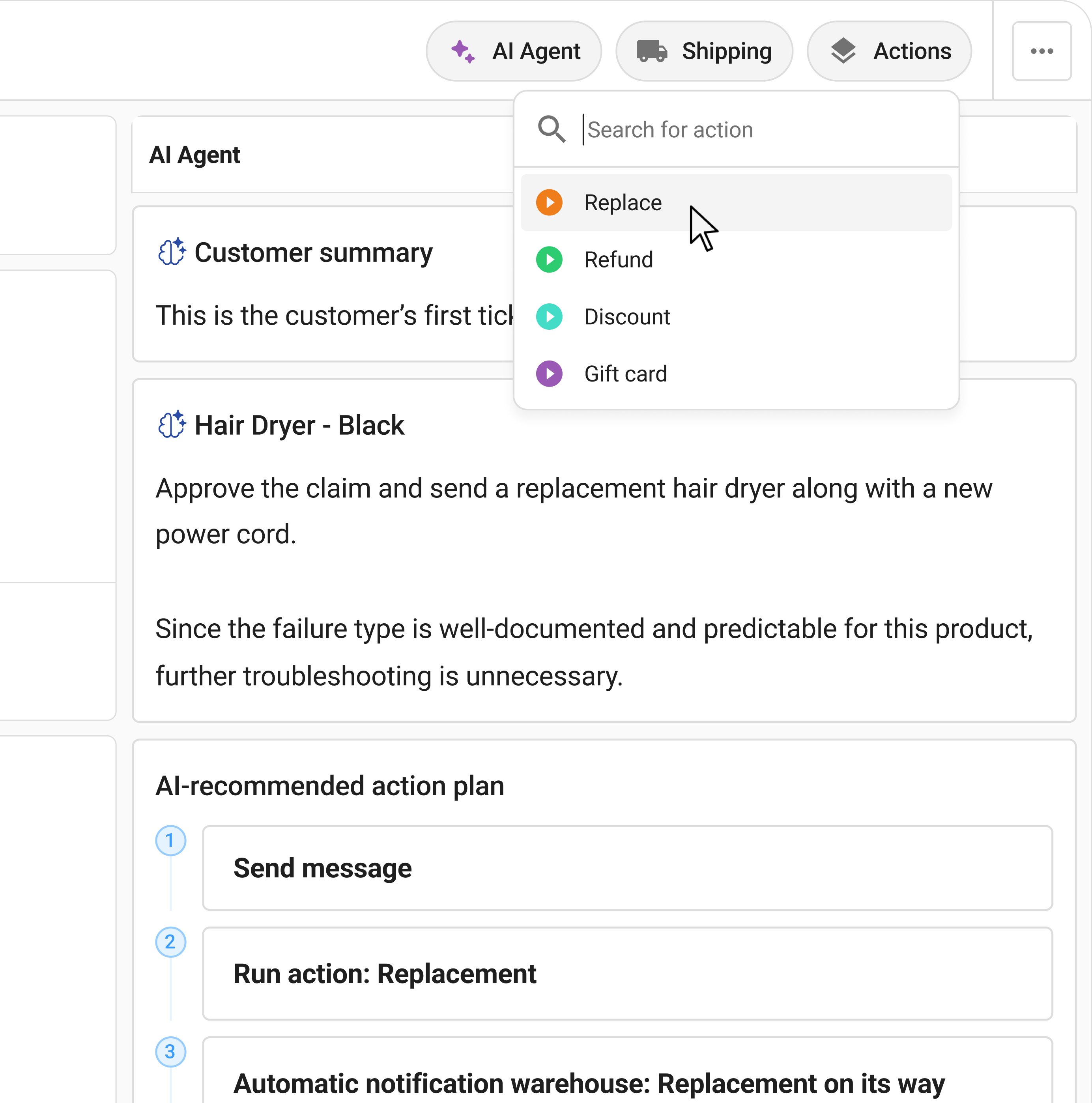
For exchanges, AI plays a smaller role than in warranty. The exception is photo-based exchanges where the customer says the item arrived damaged and wants a different one. That's a warranty-adjacent case, and Claimlane's AI Agent, the first AI agent purpose-built for warranty claims and returns, reads the photo, confirms eligibility, and routes the exchange or warranty case automatically.
For straight sizing exchanges, the bigger wins come from the portal design and stock check, not AI. For predictive sizing recommendations to reduce the exchange volume in the first place, see AI size recommendations for online stores.
Metrics that show your policy is working
Track five things month over month.
- Exchange-to-refund ratio: higher is better; target 35-50% for fashion brands
- Time from request to outbound ship: target under 24 hours for forward exchange, under 5 days for held exchange
- Stock-check success rate: how often the customer's requested variant is in stock at request time
- Exchange repurchase rate: how many exchange customers buy again within 90 days
- Support tickets per exchange: lower is better; high numbers point to policy or UI gaps
Returns and warranty KPIs and returns analytics events to track cover the broader measurement set. Ecommerce returns time to resolution covers the speed dimension.
Why brands run exchanges through Claimlane
Claimlane handles exchange flow as part of one returns and warranty platform. Customers request through the self-service portal, the system checks stock, the workflow ships the outbound and routes the return, and the operations team sees both sides in one view.
"Our customers used to wait up to two weeks for a resolution. With Claimlane, most claims are resolved within 24 hours. The impact on customer satisfaction has been significant."
GrejFreak (case study), Coolshop (case study), and Babysam (case study) all use Claimlane for combined returns, exchanges, and warranty claims.
For a wider tool comparison, see best returns software for ecommerce and return management software. For the broader returns playbook, see how to reduce returns and how to automate returns.
FAQ
Conclusion
A working exchange policy is short, easy to read, and easier to use than the refund path. The hard part is not the policy text. It's the stock checks, the reverse picks, and the customer messaging behind the scenes. Get those right and exchange becomes a revenue retention tool, not an operations headache.
To see how Claimlane runs exchanges, returns, and warranty claims in one platform, book a demo.