
.webp)
A return policy is one of the most-read pages on any Shopify store. Customers check it before buying, reference it when something goes wrong, and judge the brand by how clearly it communicates. Yet many Shopify merchants treat it as an afterthought: a block of legal text copied from a template and buried in the footer.
That approach leaves money on the table. A well-crafted Shopify return policy reduces support tickets, increases purchase confidence, prevents disputes, and can even turn returns into exchanges that preserve revenue.
This guide covers everything Shopify merchants need: policy structure, ready-to-use templates, configuration steps, and automation strategies for scaling return operations.
TL;DR
- 67% of shoppers check the return policy before buying. A clear, fair policy is a conversion tool, not just legal boilerplate.
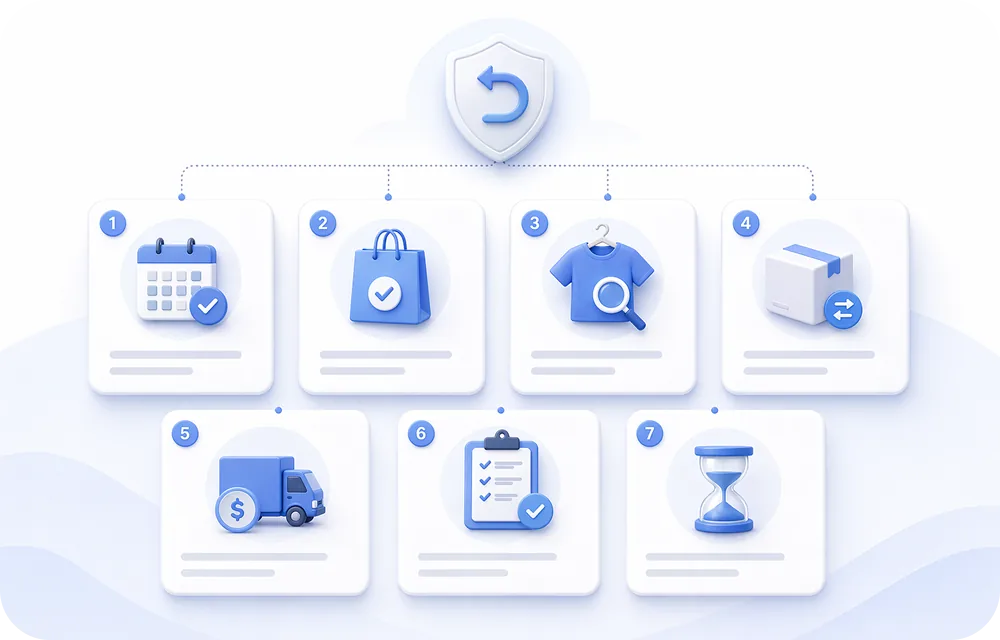
- Every Shopify return policy needs seven elements: return window, eligible items, condition requirements, resolution options, shipping costs, process steps, and timeline.
- Automation is essential for scale. Self-service portals, rule-based approvals, and exchange-first flows reduce support tickets and retain revenue.
- Claimlane integrates directly with Shopify to add AI-powered claims assessment, warranty management, and supplier recovery on top of native return features.
Why the Return Policy Matters for Shopify Stores
Purchase Confidence
67% of online shoppers check the return policy before purchasing. If the policy is unclear, overly restrictive, or hard to find, customers bounce. A clear, fair return policy functions as a conversion tool.
Dispute Prevention
Vague policies lead to chargebacks. When customers don't understand the return process, they go straight to their credit card company. Clear policies with explicit timelines and conditions reduce chargeback rates significantly.
Brand Perception
The return experience shapes how customers feel about the brand. A frustrating return erases the goodwill earned during purchase. A smooth return builds loyalty that leads to repeat purchases.
Legal Compliance
Different regions have different requirements. EU consumers have a 14-day withdrawal right. Australian consumer law mandates refunds for faulty products. Shopify merchants selling internationally need policies that comply with local regulations.
What to Include in a Shopify Return Policy
Every Shopify return policy should cover these elements:
Return Window
How many days after delivery can customers initiate a return? The industry standard is 30 days, but some brands offer 60 or 90 days. Longer windows actually reduce returns because the urgency to decide disappears (the "endowment effect" strengthens over time).
Eligible vs. Ineligible Items
Which products can be returned? Common exclusions include:
- Final sale items
- Personalized or custom products
- Hygiene-sensitive products (underwear, swimwear, earrings)
- Perishable goods
- Digital products
- Clearance items (if applicable)
Condition Requirements
What condition must the product be in? Typical requirements:
- Unworn and unwashed
- Original tags attached
- Original packaging included
- No signs of use or damage
Return Options
What resolution options are available?
- Full refund to original payment method
- Store credit (often with a bonus incentive)
- Exchange for different size/color
- Exchange for different product
Shipping Costs
Who pays for return shipping? Options include:
- Free returns (brand pays)
- Customer-paid returns
- Free returns for defective items only
- Flat-rate return shipping fee
- Restocking fee for certain categories
Process Steps
How does the customer initiate a return? Provide clear, numbered steps. Avoid vague instructions like "contact us." Instead: "Visit our returns portal at [URL], enter your order number, select the items to return, and print your prepaid label."
Timeline
How long does the refund take after the return is received? Set realistic expectations: "Refunds are processed within 5 business days of receiving the return. It may take an additional 3 to 5 business days for the refund to appear on your statement."
Contact Information automation strategies for scaling return operations.
How can customers reach support if they have questions? Include email, chat availability hours, and expected response times.
Shopify Return Policy Templates
Template 1: Standard 30-Day Return Policy
📋 Example: Standard Return Policy
We accept returns within 30 days of delivery. Items must be unused and in original packaging.
How to start a return:
- Visit our returns portal
- Enter your order details
- Select items and resolution
- Print return label
- Ship within 7 days
Refunds: Processed within 5 business days
Template 2: Premium/Extended Return Policy
⭐ Premium Return Policy
Built for conversion and customer trust.
Return window: 90 days
Free returns: Yes
Instant store credit: +10% bonus
- Go to returns portal
- Select your order
- Choose refund, exchange, or credit
- Print label and ship
Refund timeline: 3–5 business days
Template 3: Restrictive/Cost-Conscious Policy
📦 Cost-Conscious Return Policy
Designed to reduce return costs and protect margins.
Return window: 14 days
Return shipping: Paid by customer
Restocking fee: 15%
Refund type: Store credit (default)
- Items must be unused with original packaging
- Defective items reported within 48 hours
- Final sale items are non-returnable
⚠️ Stricter policies reduce returns but may impact conversion rates.
Setting Up Returns on Shopify
Shopify's Built-In Return System
Shopify offers native return management through the admin panel:
- Enable self-serve returns: Go to Settings > Customer accounts > Enable "Customer accounts." Then in Settings > Checkout, turn on "Self-serve returns."
- Create return rules: Navigate to Settings > Policies > Return rules. Set the return window, final sale conditions, and restocking fees.
- Add the policy page: Go to Settings > Policies > Refund policy. Paste or write the policy. Shopify auto-links it in the footer.
- Process returns: When a customer requests a return, it appears in Orders > Returns. Create a return, issue a return label, and process the refund once received.
Limitations of Shopify's Native Returns
Shopify's built-in system works for low-volume stores but lacks:
- Automated approval rules
- Photo/video evidence collection
- Exchange management
- Warranty claim processing
- Supplier recovery tracking
- Advanced analytics
For growing stores, a dedicated returns management platform fills these gaps.
Integrating Claimlane with Shopify
Claimlane integrates directly with Shopify to automate returns processing. Rated 4.8/5 on G2 (read reviews), Claimlane adds enterprise-grade claims management to any Shopify store:
- Self-service portal: Customers submit returns with photos and reason codes without contacting support
- Automated rules: Set conditions for instant approvals, exchanges, and store credit offers
- Warranty management: Track warranty claims per product and supplier
- AI-powered assessment: Claimlane's AI Agent evaluates product images, applies rules, and recommends resolutions
- Supplier recovery: Automate supplier chargebacks for defective products
Best Practices for Shopify Return Policies
Make the Policy Easy to Find
Place links to the return policy in:
- Footer navigation
- Product pages (near the "Add to Cart" button)
- Cart and checkout pages
- Order confirmation emails
- FAQ page
Use Plain Language
Avoid legal jargon. Write at a reading level any customer can understand. Replace "The purchaser shall initiate the merchandise return process within the stipulated timeframe" with "Start your return within 30 days of delivery."
Offer Exchanges and Store Credit First
When customers initiate a return, present exchanges and store credit as the default options. A 10% bonus on store credit converts 20% to 30% of refund requests into retained revenue.
Automate Where Possible
Manual return processing doesn't scale. Automate:
- Return request approvals for standard cases
- Return label generation
- Refund processing
- Exchange fulfillment
- Customer status notifications
Claimlane's workflow automation handles these steps based on configurable rules.
Track Return Reasons
Capture structured return reason data (not free-text "Other"). Common categories:
- Wrong size/fit
- Didn't match description
- Changed mind
- Defective/damaged
- Arrived too late
- Better price found
This data feeds product improvements, listing updates, and predictive analytics.
Review and Update Quarterly
Return policies should evolve with the business. Review quarterly based on:
- Return rate trends
- Common return reasons
- Customer feedback
- Competitive landscape
- Seasonal patterns
Shopify Return Policy by Industry
Fashion and Apparel
Highest return rates (20% to 30%). Sizing issues dominate. Best practices: size guides with measurements, fit recommendation tools, and generous exchange policies. Consider free exchanges but charge for refund returns.
Electronics
Moderate return rates but high cost per return. Extended warranty claims are common. Best practices: clear compatibility information, setup guides, and separate processes for defective vs. "changed mind" returns.
Home and Furniture
Logistics-heavy returns. Furniture returns involve bulky shipping and damage risks. Best practices: detailed dimensions and room mockups, strict packaging requirements for returns, and inspect-on-delivery policies.
Beauty and Cosmetics
Hygiene restrictions limit return eligibility. Best practices: clear "opened vs. unopened" policies, sample/trial sizes, and shade-matching tools to reduce color-mismatch returns.
Handling Common Return Scenarios on Shopify
Customer Wants a Refund After the Return Window
Options: decline with empathy, offer store credit as a goodwill gesture, or approve if the customer is high-value. Document the decision for consistency.
Item Arrives Damaged
Request photos within 48 hours. Use damaged-in-transit claims processes. Offer immediate replacement without requiring the damaged item's return (for low-cost items).
Suspected Return Fraud
Watch for return fraud patterns: serial returners, wardrobing, empty box returns. Use photo evidence requirements and tracking data to flag suspicious activity.
International Returns
International returns are expensive. Options: provide local return addresses in major markets, offer "keep it" refunds for low-value items, or use regional return centers.
Swoon Furniture, Henry Currer, Head of Operations:
"Claimlane helps us capture every customer issue, resolve it for the customer, and feed that back to the supply chain to drive continuous improvement."
Claimlane helps us capture every customer issue, resolve it for the customer, and feed that back to the supply chain to drive continuous improvement.
Henry Currer, Head of Operations — Swoon Furniture