
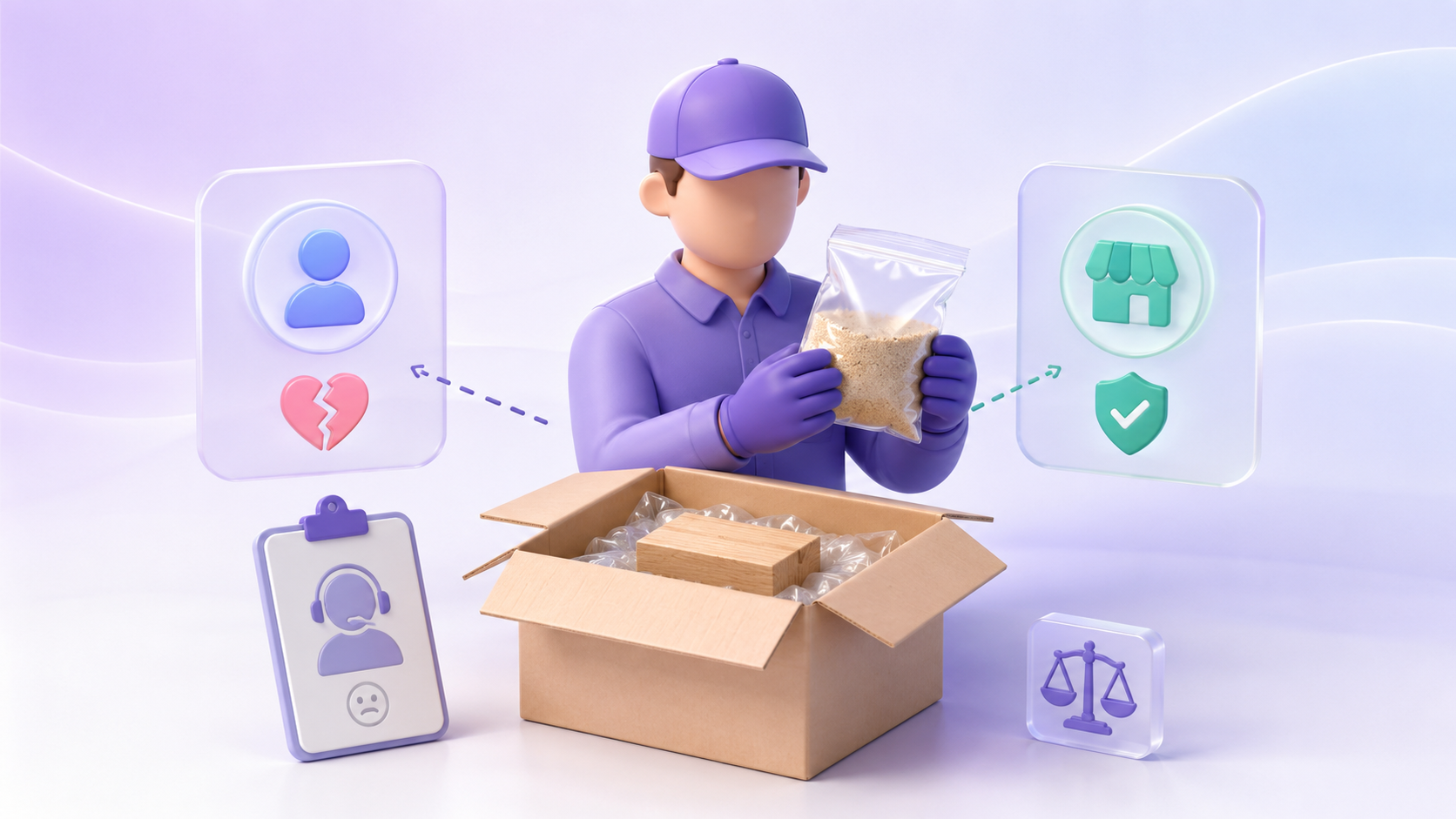
A parcel arrives back at the warehouse. The receiving agent opens it. There is nothing inside, or there is a block of wood the right weight.
At that moment the case is already unwinnable. The customer says they packed it. The brand says they did not. Two parties, one open box, zero evidence, and a customer service agent holding the bag.
Every control that decides this case happened before the box was sealed, which is why brands that put their fraud budget in the warehouse keep losing.
This one is written for warranty-heavy brands in electronics, sporting goods, furniture and baby products, where the unit is serialised, the value is high enough to be worth stealing, and a claim can arrive months after the sale.
Autopsy of one empty box claim
A fairly typical case, reconstructed.
A customer orders a 600 euro item. It ships. It is delivered. Eleven days later the customer opens a return, selects 'changed my mind', prints the label and drops a sealed parcel at a pickup point.
The parcel arrives at the warehouse eight days later. It weighs roughly what the product weighs. It is opened. Inside is the original packaging, the manual, and a bag of sand.
The brand refuses the refund. The customer disputes the charge with their bank. The bank asks the brand for evidence that the item was not in the box. The brand has a photograph taken by a receiving agent of an open box with sand in it, which proves nothing about what the customer sealed.
The brand loses the chargeback, refunds the 600 euros, writes off the item, and pays the chargeback fee on top. Total exposure is well above the ticket price, and the mechanics of why the representment failed are covered in payment reversals and chargebacks.
The three moments where the case was already lost
A weight check tells a brand that something is wrong. It does not tell them who.
Control one: bind the unit before it ships
Serial capture at fulfilment is the single highest-value control against this fraud, and it is the one most brands skip because it slows the pick by four seconds.
Once a serial is bound to an order, the argument changes completely. The brand is no longer claiming the box was empty. It is stating that unit 4471-XB-9920 was shipped to this address and has not come back, which is a verifiable fact rather than a receiving agent's word.
It also closes the swap variant, where the customer returns a genuinely present but different, cheaper or already-broken unit. Without serials, a swap is invisible. With serials it is a mismatch on arrival. The serial number tracking and serialised defect tracking pieces cover the implementation properly.
The same binding is what makes product registration and proof of purchase work later, which is why brands that do it for fraud usually keep it for warranty.
Control two: make the claim carry its own evidence
The fraudster is not returning a product. They are returning a photograph of a process nobody documented.
A return or claim form that asks for a dropdown reason and nothing else is an invitation. A form that asks the customer to photograph the item, confirm the serial and confirm the contents before the label is issued changes the risk calculation before the fraud is committed, because the fraudster now has to lie on the record rather than stay silent.
That intake belongs in a self-service portal where photos, video, serial numbers and order details arrive attached to the claim rather than in an inbox. It is the same intake that makes the honest claims faster, which is the part brands worry about and should not.
BabySam runs the same pattern on the claims experience side, and the BabySam case is worth reading next to it.
Control three: score the pattern, not the person
One empty box is an incident. Four empty boxes from three addresses sharing a payment method is a pattern, and no receiving agent will ever see it.
Pattern detection is where AI earns its place in this process. Claimlane's AI Agent, the first AI agent purpose-built for warranty claims and returns, analyses product images and videos, applies warranty rules per product and supplier, and recommends or auto-approves resolutions. On the fraud side, the AI Agent reviews the evidence attached to the claim and flags the cases where the image, the serial and the stated fault do not agree.
That is a different job from a risk score on a payment. It is a comparison between what the customer said, what the customer photographed, and what the brand knows about the unit. The specifics are in AI return fraud detection and AI image recognition for warranty claims.
The adjacent fraud types share the same detection surface. Wardrobing, triangulation fraud and first-party fraud all get caught by the same discipline of evidence at intake plus pattern scoring across claims, which is the argument in return fraud prevention.
The warranty version, which is worse
The returns version has a clock on it. A 30 day window limits the exposure and gives the brand a reason to refuse.
The warranty version has no clock. A claim arrives fourteen months after purchase on a serial that was never registered, for a fault nobody can verify, on a unit that may never have existed. There is no return window to hide behind and no parcel to weigh.
Without serial binding at the point of sale, a brand cannot tell a genuine two-year warranty claim from an invented one, and the honest answer is that most brands pay both. The scale of that is covered in warranty fraud explained and AI warranty fraud detection.
Registration at purchase closes it. A unit that was registered is a unit the brand can verify, and a claim on an unregistered serial is a claim that deserves a question before it deserves a refund.
Guardrails: what happens when the model is wrong about a real customer
Treating every empty box as fraud is how brands lose ten good customers to catch one bad one.
Carrier theft is real. Picking errors are real. A parcel that left the warehouse without the item in it is the brand's own fault, and a fraud model that never considers that possibility will accuse the customer every time.
So the rules stay in front of the model. The AI flags, the rule decides, and a person reviews anything above the value threshold the brand sets. Human-in-the-loop is not a courtesy on high-value cases, it is the control that keeps the false positive from becoming a public one.
Every decision carries an audit trail: which image, which serial, which rule, which score, who overrode it. Override controls run both ways, and a rejected flag is training data. The full position is in AI agent guardrails, and the automation thresholds by claim type sit in AI claim auto-approval.
The stack side matters here too. Fraud signals are worth little if they live apart from the order, the payment and the helpdesk conversation, which is why the integrations layer runs alongside Shopify, BigCommerce, Zendesk and Gorgias rather than in a silo next to them.
What one quarter of this costs
The finance-readable number is fraud-prevented losses, and it is the one number in aftersales that a CFO will fund without a business case, because every euro of it is pure margin. Unlike a genuine defect, there is no supplier to recover from and no product to resell. It is a straight write-off, and the defective product write-offs piece covers what happens to it in the ledger.
The cost of doing nothing here compounds quietly. Fraud rings share the brands that do not check, and a brand that has no serial binding and no evidence at intake is on that list whether or not anyone has told them.
One more quarter of unbound units means one more quarter of claims that cannot be disproved, and the ones already in flight cannot be fixed retroactively. The evidence either exists at the moment of shipment or it does not.
Book a demo and bring the last empty-box case that was written off.