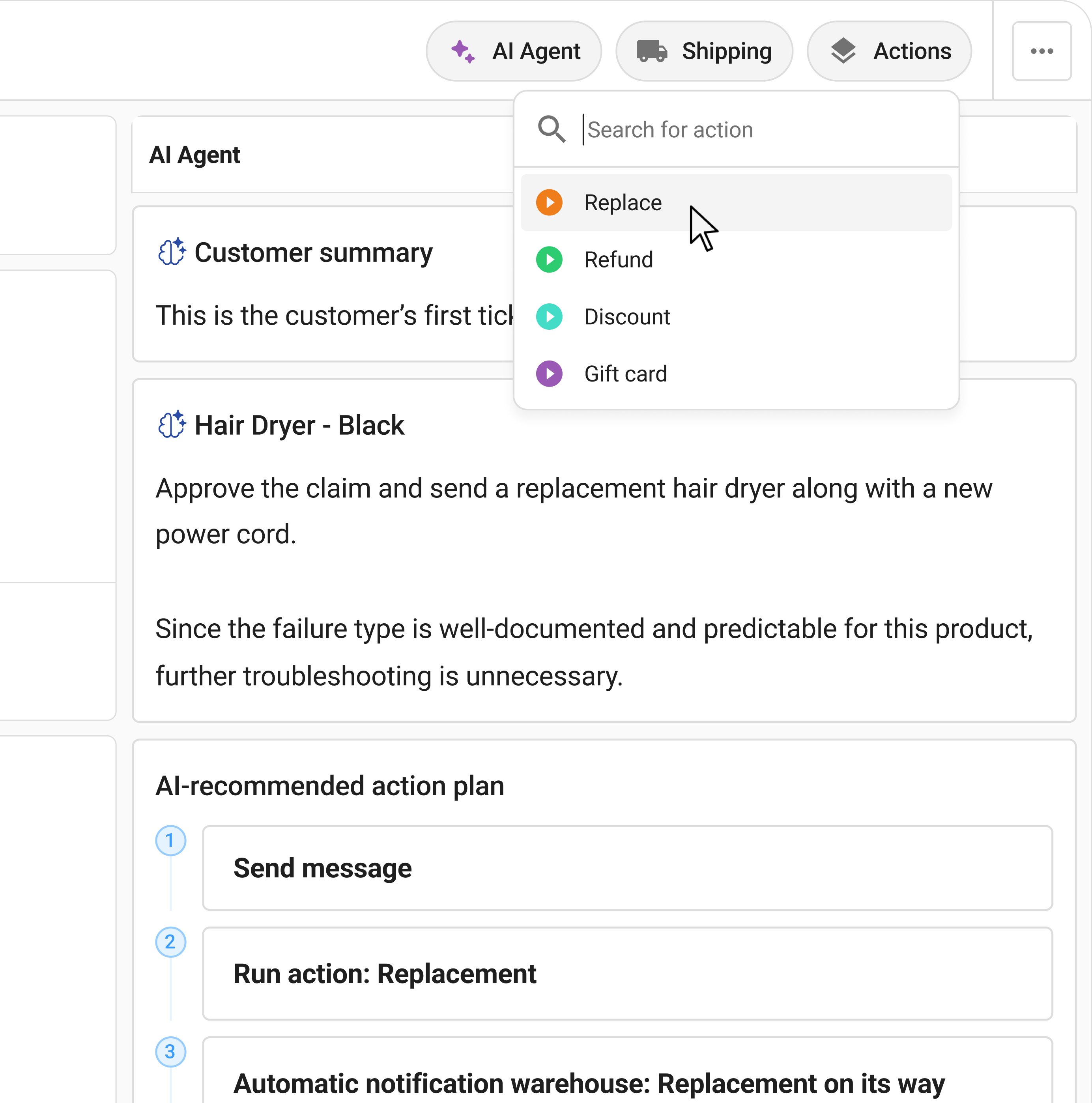
.webp)
What are ecommerce returns solutions?
Ecommerce returns solutions, sometimes referred as ecommerce returns apps, are software platforms that streamline how online retailers handle returns, exchanges, refunds, warranty claims, repairs, and spare parts requests. Instead of managing each case through email or manual tickets, a returns platform centralizes the workflow. The customer files the request through a branded portal. The system applies the brand's policy rules. It generates the shipping label. It routes the case to the right team or supplier.
Most platforms cover four core capabilities:
- Self-service return portal
- Rules-based return approvals
- Shipping label generation
- Refunds, exchanges, and store credit
Full post-purchase platforms extend further into warranty claims, repair workflows, and spare parts management. The category is fragmented. Most vendors specialize in one or two of these pillars. A small group covers all five.
Below: how the leading platforms compare, who each one fits, and how to choose.
Product returns are an unavoidable part of ecommerce. As online shopping continues to grow, return rates are increasing across nearly every retail category. Apparel brands often see return rates above 25 percent. Electronics and consumer goods retailers also deal with frequent returns. The causes are shipping damage, product defects, and incorrect orders.
Managing these returns manually quickly becomes expensive and hard to run. Customer support teams spend hours processing requests, warehouses struggle to handle reverse logistics, and brands lose revenue through refunds and wasted effort.
This is why many ecommerce companies now rely on returns automation software. These platforms streamline the return process through customer self-service portals, rules-based approvals, and integrated shipping workflows.
Modern returns software also goes far beyond simple return requests. Many platforms now support exchanges, store credits, fraud detection, and reverse logistics automation.
This guide covers the best returns software for ecommerce in 2026. It explains how each platform helps online retailers cut costs and improve the post-purchase experience.
What Is Ecommerce Returns Management Software?
Returns management software helps ecommerce businesses streamline the process of handling product returns, exchanges, and refunds.
Instead of managing returns through emails or manual support tickets, customers can submit return requests through self-service portals that connect directly with ecommerce systems.
How Returns Software Is Defined
These platforms centralize the entire returns process in a single system.
These platforms typically manage:
- Return requests
- Return authorizations (RMA)
- Shipping labels
- Refunds and exchanges
- Warehouse return processing
By streamlining these workflows, ecommerce companies can significantly reduce the operational burden of returns.
How Returns Automation Works
Most returns platforms follow a structured workflow.
Return request portals
Customers initiate a return through a branded self-service portal.
Rules-based approvals
Return rules determine whether the request should be approved.
Label generation
Approved returns generate shipping labels instantly.
Refund or exchange workflows
Once the return is received, the system processes a refund, replacement, or store credit.
Difference Between Returns Software and Reverse Logistics Platforms
Returns software focuses primarily on the customer-facing return process.
Reverse logistics platforms extend further into warehouse operations, transportation networks, and product inspection workflows.
Some enterprise platforms combine both capabilities.
Who Needs Returns Software
Returns software is used across many ecommerce business models.
Common users include:
- Shopify stores
- Direct-to-consumer brands
- Ecommerce marketplaces
- Enterprise retailers managing high return volumes
Any company processing hundreds or thousands of returns per month can benefit from a structured returns workflow.
Why Ecommerce Businesses Need Returns Automation
Returns management has become a critical operational capability for ecommerce companies.
Without the right system, returns quickly become expensive and difficult to manage.
Reduce Operational Costs
Manual returns processing requires significant customer support resources.
The right platform eliminates repetitive tasks like return approvals, label generation, and refund processing.
Improve Customer Experience
Customers expect a smooth return experience when shopping online.
Self-service portals allow customers to submit return requests instantly without contacting support.
Refunds and Exchanges Without Manual Work
Returns software can issue refunds, store credits, or product replacements without manual steps.
This sharply speeds up resolution times.
Reduce Fraudulent Returns
Many platforms include return fraud detection tools that analyze patterns and flag suspicious requests.
Gain Insights From Returns Data
Returns analytics help brands identify common product issues, sizing problems, or manufacturing defects.
This information can be used to improve product design and reduce future return rates.
Key Features to Look for in Returns Software
Choosing the right returns platform requires evaluating several core capabilities.
Self-Service Return Portals
Customers should be able to submit return requests through a branded portal connected to their order history.
Rules-Based Return Approvals
Return rules let brands approve or reject returns based on predefined criteria.
Exchange and Store Credit Workflows
Many brands prioritize exchanges instead of refunds to protect revenue.
Returns software should support exchange-first workflows.
Shipping Label Generation
Approved returns should generate return shipping labels instantly.
Return Fraud Prevention
Advanced platforms use data analysis and AI to detect suspicious return activity.
Integration With Ecommerce Platforms
Returns software must integrate with platforms like:
- Shopify
- WooCommerce
- BigCommerce
- Magento
For custom setups, look for a platform with an open API, so your team can connect returns data to tools outside the standard integrations.
Analytics and Reporting
Returns analytics provide insights into product issues and customer behavior.
Reverse Logistics Workflows
Enterprise platforms may also support warehouse workflows and reverse logistics processes.
Best Returns Software for Ecommerce in 2026
Below are some of the most widely used returns platforms for ecommerce companies.
Claimlane
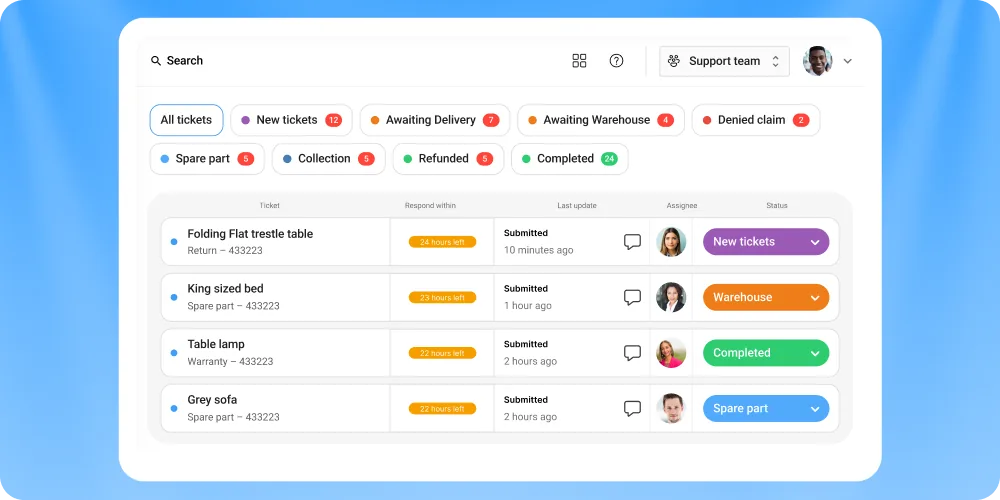
Claimlane is a post-purchase operations platform that handles returns, warranty claims, damage claims, repairs, and spare parts from a single system. It is the only platform in this comparison that covers all five post-purchase pillars in one workflow. Other platforms make brands stitch together a returns app, a warranty tool, and a separate repair tracker.
Used by Davidsen, Black Diamond, MaxGaming, Konges Sløjd, Luksusbaby, and 100+ ecommerce brands across Europe and the US.
Capabilities
- Delivery issue claim automation
- Visual damage verification
- Automated replacement workflows
- Warranty and repair management
- Supplier claim forwarding
- Branded self-service claim portals
- Aftersales analytics and reporting
Claimlane helps companies handle operational problems that occur after delivery while reducing manual support workload.
Pricing
Pricing typically starts around $800 per month depending on shipment volume and operational complexity.
Use Cases
- Brands managing returns and warranty together (electronics, outdoor gear, furniture, baby products)
- Retailers running supplier-driven claim recovery
- B2B and B2C aftersales operations in one workflow
- High-volume ecommerce operations needing a single source of truth for post-purchase
Proof Points
- MaxGaming cut complex RMA resolution time by 77% using Claimlane's AI Agent.
- Davidsen reduced claims staffing from 5 to 1-2 agents.
- GrejFreak hit ROI almost immediately.
Loop Returns
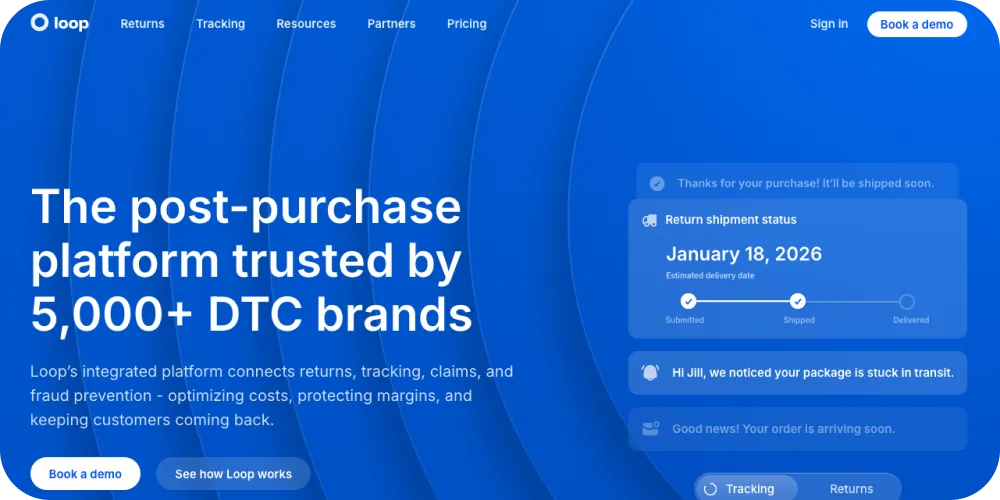
Loop Returns is one of the most widely used returns platforms among Shopify brands.
The platform focuses on exchange-first workflows designed to reduce refund rates.
Capabilities
- Automated return portal
- Exchange-first return workflows
- Shopify integrations
- Return analytics
Pricing
Loop Returns uses subscription pricing based on order volume.
Use Cases
- Shopify DTC brands
- Apparel retailers
- Ecommerce brands prioritizing exchanges over refunds

ReBOUND Returns
ReBOUND Returns is a global returns management platform designed for large ecommerce retailers handling high volumes of international returns.
The platform simplifies reverse logistics. It connects retailers with global carrier networks and regional return hubs. Brands process returns closer to the customer and cut cross-border shipping costs.
ReBOUND is commonly used by enterprise retailers operating across multiple markets.
Capabilities
Global returns network
Localized return hubs
Carrier integrations
Automated return portals
Cross-border logistics management
Returns analytics and reporting
Pricing
ReBOUND typically offers enterprise pricing based on return volume, geographic coverage, and logistics requirements.
Use Cases
Global ecommerce retailers
Brands managing international returns
Enterprise retailers with cross-border shipping operations
AfterShip Returns
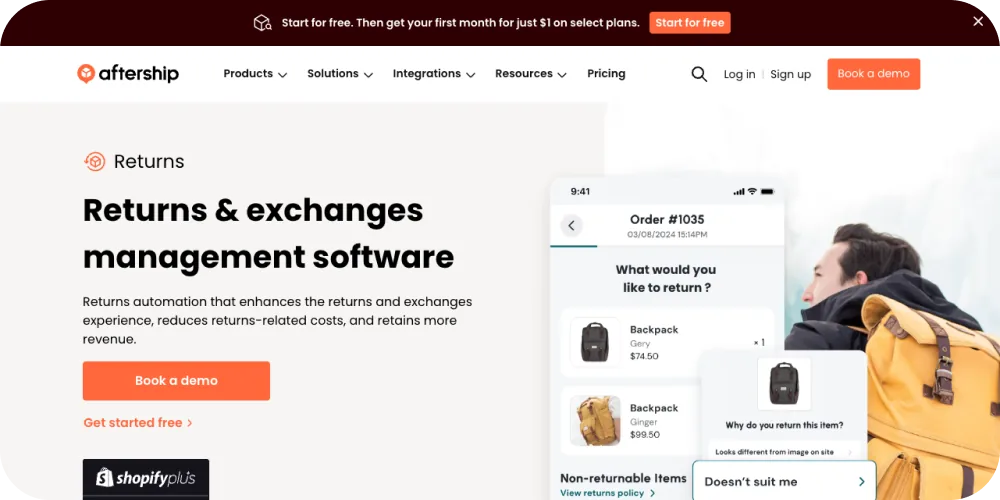
AfterShip Returns helps ecommerce brands speed up return approvals and logistics.
Capabilities
- Branded return portal
- Automated return approvals
- Carrier integrations
- Return analytics
Pricing
Tiered pricing plans depending on order volume.
Use Cases
- Shopify stores
- Mid-market ecommerce brands
Narvar
Narvar offers enterprise returns management combined with a broader post-purchase experience platform.
Capabilities
- Enterprise return management
- Reverse logistics network
- Customer experience tools
Pricing
Enterprise pricing depending on retailer size.
Use Cases
- Large ecommerce retailers
- Global brands
Reverselogix
Reverselogix is a reverse logistics platform that handles returns, warranty claims, and repair workflows from a single system. The platform focuses on the back-end side of returns: warehouse routing, supplier coordination, and repair tracking. Commonly used by mid-market and enterprise retailers with complex multi-step claim processes.
Capabilities
- Returns management
- Warranty claim workflows
- Repair tracking
- Warehouse-level reverse logistics
- Returns analytics
Pricing
Enterprise pricing based on return volume and module configuration.
Use cases
- Mid-market and enterprise retailers
- Brands with complex repair workflows
- Operations teams focused on reverse logistics efficiency
For brands evaluating alternatives, see Reverselogix alternatives.

Happy Returns
Happy Returns focuses on making returns easier through a physical drop-off network.
Capabilities
- Box-free returns
- Drop-off locations
- Fast refund processing
Pricing
Pricing varies depending on retailer volume.
Use Cases
- Retailers with high return volumes
- Brands seeking convenient return options
ReturnGo
ReturnGo provides returns tools designed specifically for Shopify merchants.
Capabilities
- AI-based return rules
- Refund workflows
- Shopify integrations
Pricing
Subscription pricing depending on store volume.
Use Cases
- Shopify brands
- Small to mid-size ecommerce stores

ZigZag Global
ZigZag focuses on international returns management and cross-border logistics.
Capabilities
- International returns
- Global carrier integrations
- Cross-border logistics
Pricing
Enterprise pricing based on return volumes.
Use Cases
- Global ecommerce brands
- Cross-border retailers
Comparison of the Best Ecommerce Returns Software
Claimlane is the only platform in this group covering all five post-purchase pillars in one system. Brands managing post-purchase across multiple categories run one workflow. Other tools force them to stitch together a returns app, a warranty tool, and a repair tracker.
Loop Returns is built for Shopify DTC brands focused on exchange-first returns. Warranty and repairs are not in scope.
AfterShip Returns plugs into the AfterShip tracking stack and handles returns and lightweight damage claims. Warranty and repair workflows are not part of the core product.
Narvar is enterprise-grade for large retailers wanting returns plus post-purchase tracking and customer experience. Warranty and repair workflows are not part of the core product.
Reverselogix covers returns, warranty, and repairs. The platform is aimed at mid-market and enterprise. Spare parts is not a managed module.
Returns Software for Different Ecommerce Platforms
Best Returns Software for Shopify
Popular options include:
- Loop Returns
- ReturnGo
- AfterShip Returns
These platforms offer native Shopify integrations.
Best Returns Software for WooCommerce
WooCommerce merchants often rely on AfterShip Returns or custom integrations.
Best Returns Software for BigCommerce
Enterprise tools like Narvar or ZigZag Global often support BigCommerce environments.
Best Returns Software for Magento
Magento retailers typically use enterprise returns platforms with advanced reverse logistics capabilities.
How Returns Software Reduces Ecommerce Return Rates
Returns platforms do more than process returns. They also help reduce return rates.
Exchange-First Strategies
Encouraging exchanges instead of refunds protects revenue.
Smart Return Rules
Automation rules prevent unnecessary returns.
Return Fraud Detection
Platforms can detect suspicious behavior patterns.
Data-Driven Product Improvements
Returns data helps brands identify recurring product problems.
How to Choose the Best Returns Software for Your Store
Selecting the right returns platform depends on several factors.
Consider Order Volume
Higher order volumes require more automation and analytics.
Integration With Your Ecommerce Platform
Ensure the software integrates with your existing technology stack.
Reverse Logistics Capabilities
Some platforms support warehouse workflows and inspection processes.
Workflow and AI Features
The right workflows sharply reduce workload.
Pricing vs ROI
Returns software should reduce operational costs while improving customer satisfaction.
Implementation Guide: Setting Up Returns Software
Implementing returns software typically involves several steps.
Connect Ecommerce Platform
Integrate the returns platform with your ecommerce store.
Configure Return Policies
Define eligibility rules for returns and exchanges.
Set Your Return Rules
Create rules to approve or reject return requests.
Configure Exchange and Refund Workflows
Define how refunds and replacements should be handled.
Monitor Returns Analytics
Use analytics dashboards to track return trends and operational performance.
Returns Software vs Manual Returns Processing
Cost Comparison
Manual returns processing requires significant support resources.
A structured system reduces operational costs.
Customer Experience Differences
Self-service portals offer faster and more convenient return experiences.
Operational Efficiency
Returns software sharply improves operational efficiency.
Future Trends in Ecommerce Returns Technology
Returns technology continues to evolve rapidly.
AI-Powered Return Decision Engines
AI systems will increasingly handle return approvals and fraud detection.
Sustainable Returns Management
Brands are exploring ways to reduce environmental impact through optimized reverse logistics.
Local Drop-Off Return Networks
Drop-off networks allow customers to return products without shipping labels.
Reverse Logistics Technology
Warehouse robotics will play a growing role in returns processing.