
.webp)
Final sale policies are one of the most misunderstood tools in ecommerce. Done well, they protect margins on products where returns don't make economic sense. Done poorly, they erode customer trust and trigger chargebacks.
A final sale policy states that once a customer completes a purchase, that transaction cannot be reversed through returns, exchanges, or refunds. It sounds simple, but the legal landscape, customer expectations, and operational implications make it anything but.
This guide covers what final sale actually means, when it makes sense, how laws vary across regions, and how to write a policy that protects the business without alienating buyers.
TL;DR
- Final sale policies restrict returns, exchanges, and refunds on specific product categories like clearance, custom items, and hygiene-sensitive goods.
- Legal requirements vary by region. The EU and UK mandate a 14-day cooling-off period that cannot be waived, while U.S. brands have more flexibility with proper disclosure.
- Clear communication is everything. Display the final sale designation on product pages, cart, checkout, and confirmation emails to reduce chargebacks and disputes.
- Claimlane helps brands track claims data by product category, making it easy to identify which items genuinely need final sale protection and which benefit from flexible return policies.
What Does Final Sale Mean?
Final sale means the customer agrees that the purchase is permanent. There are no returns, no exchanges, and no refunds once the transaction completes.
The terms "final sale" and "all sales are final" are used interchangeably. Both communicate the same thing: the buyer takes full ownership of the product with no option to reverse the purchase.
This differs from a standard return policy where customers typically have a window (14, 30, or 60 days) to send items back for a refund or exchange.
When Final Sale Applies
Most ecommerce brands don't apply final sale universally. Instead, they use it selectively for specific product categories or situations:
- Clearance and markdown items
- Customized or personalized products
- Perishable goods (food, flowers, certain cosmetics)
- Intimate apparel and swimwear (for hygiene reasons)
- Digital products and downloadable content
- Gift cards and store credit
- Items sold at deep promotional discounts
Legal Requirements by Region
Final sale policies are legal in most jurisdictions, but with important caveats. The rules vary significantly by country and even by state within the U.S.

United States
There is no federal law requiring ecommerce businesses to accept returns. Brands can legally adopt an "all sales are final" policy. However, state laws add requirements:
- California requires businesses with non-standard return policies to post them conspicuously. Under California Civil Code Section 1723, failure to display the policy means customers are entitled to a full refund within 30 days.
- Massachusetts mandates clear and conspicuous disclosure of return policies before the transaction completes.
- New York requires posted refund policies. Without one, the default is that customers can return items within 30 days.
The pattern is clear: brands can restrict returns, but they must tell customers before checkout.
European Union
The EU Consumer Rights Directive gives online shoppers a 14-day cooling-off period for most purchases. This is a mandatory right that cannot be waived by a "final sale" label. Exceptions exist for:
- Sealed goods that have been opened (hygiene reasons)
- Customized or made-to-order products
- Digital content once downloading begins (with consumer consent)
- Perishable goods
EU-based ecommerce brands need to be careful about labeling items as final sale when the cooling-off period still applies.
United Kingdom
Post-Brexit, the UK maintains similar consumer protection through the Consumer Contracts Regulations 2013. The same 14-day cancellation right applies for online purchases, with similar exceptions for hygiene-sensitive and customized products.
Australia
Australian Consumer Law provides automatic guarantees that cannot be excluded by a "no refund" policy. If a product is faulty, not as described, or doesn't do what it's supposed to, customers have the right to a remedy regardless of any final sale policy.
Whether customers are shopping in-store or online, their expectations are, quite rightly, increasing every day. We, therefore, decided the time was right to invest in our vital online aftercare service, something which many retailers often overlook, despite its power to make or break a retailer's reputation if they do not get it spot-on.
Elisa Schjødt Frank, Head of Customer Success — Matas
Why Ecommerce Brands Use Final Sale Policies
Final sale policies exist for practical business reasons, not just to avoid dealing with customers.
Protecting Margins on Discounted Inventory
Clearance items are already sold at reduced margins. Adding return processing costs on top of a 50% markdown can turn a break-even transaction into a loss. Final sale on clearance helps brands manage the true cost of returns.
Reducing Return Fraud
Return fraud costs U.S. retailers billions annually. Wardrobing (buying, wearing, and returning), empty box fraud, and receipt manipulation all become harder when certain categories are marked as final sale.
Handling Non-Resalable Products
Customized items, products with broken hygiene seals, and perishable goods cannot be resold. Accepting returns on these items means absorbing a total loss. Final sale is the only economically viable approach.
Encouraging Deliberate Purchases
When customers know they can't return an item, they tend to research more carefully before buying. This reduces impulse purchases and the associated bracketing behavior that drives up return volumes.
When Not to Use Final Sale
Final sale policies make sense in specific situations but can backfire when applied too broadly.
High-Consideration Purchases
For expensive items like electronics, furniture, or premium fashion, customers expect return flexibility. Removing that safety net reduces purchase confidence and hurts conversion rates.
New Customer Acquisition
First-time buyers are already taking a risk ordering from an unfamiliar brand. A final sale policy on their first purchase creates friction. Consider restricting final sale to repeat customers or loyalty members who already trust the brand.
Products with Known Quality Issues
If a product has a history of quality complaints or defects, slapping a final sale label on it creates a customer service nightmare. Fix the product first.
Warranty-Eligible Products
Products that carry a warranty should generally not be marked as final sale for returns related to defects. The warranty obligation exists separately from the return policy. A customer who receives a defective product still has rights under warranty law, regardless of any "all sales final" label.
How to Write a Final Sale Policy
A well-written final sale policy is clear, specific, and placed where customers will actually see it.
Essential Elements
Every final sale policy should include:
- A clear statement that the item is non-returnable, non-exchangeable, and non-refundable
- Which products are covered (don't apply it vaguely; list specific categories)
- Exceptions (defective items, shipping damage, wrong item sent)
- Where the policy is disclosed (product page, cart, checkout, confirmation email)
- Contact information for questions or disputes
Sample Policy Language
Here's a template that balances firmness with clarity:
"Items marked as Final Sale cannot be returned, exchanged, or refunded. This applies to all clearance items, personalized products, and items from the Intimates collection. If you receive a defective or incorrect item, please contact us within 7 days of delivery at support@[brand].com. We will arrange a replacement or refund for verified defects."
Where to Display It
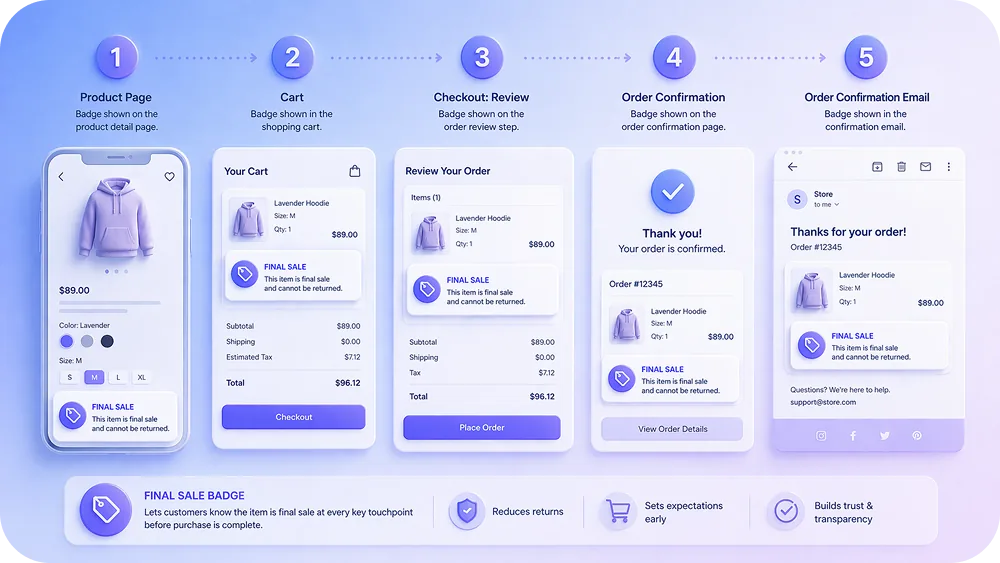
Disclosure is not optional. Brands should display the final sale designation in all of these locations:
- Product detail page: Near the "Add to Cart" button, not buried in a footer
- Shopping cart: A reminder before checkout
- Checkout page: A checkbox or acknowledgment before payment
- Order confirmation email: Reinforcing the terms post-purchase
- Return policy page: Comprehensive details with the full policy
The more visible the policy, the fewer disputes and chargebacks.
Final Sale and Chargebacks
One of the biggest risks of final sale policies is chargeback exposure. If a customer feels stuck with an unwanted product, they may file a chargeback through their credit card rather than accepting the final sale terms.
How to Reduce Chargeback Risk
- Document consent: Require an explicit checkbox at checkout confirming the customer understands the item is final sale
- Keep confirmation records: Save the order confirmation with the final sale disclosure
- Respond quickly to disputes: When a customer contacts support, resolve issues proactively before they escalate to a chargeback
- Accept defective returns anyway: A chargeback costs $25 to $100 in fees plus the product cost. Accepting a return on a genuinely defective product is almost always cheaper.
Chargeback Win Rates
Merchants who can prove clear disclosure of final sale terms at checkout win disputes at higher rates. The documentation trail (screenshots of the product page, checkout acknowledgment, and confirmation email) becomes the defense.
Final Sale vs. Store Credit Policies
Some brands take a middle path: instead of a hard "no refunds" stance, they offer store credit as an alternative to cash refunds. This approach keeps revenue in the ecosystem while still giving customers a sense of recourse.
When Store Credit Works Better
- The customer is loyal and likely to repurchase
- The item was on moderate (not deep) discount
- The brand has a wide product catalog for credit redemption
- The goal is retention, not just margin protection
When Final Sale Is the Right Call
- Deep clearance (70%+ off) where any return creates a loss
- Customized or personalized items with zero resale value
- Hygiene-sensitive products that cannot be resold
- Digital goods or consumables
Communicating Final Sale Without Losing Customers
The way a brand communicates final sale matters as much as the policy itself.
Frame It as a Benefit
Instead of leading with restriction, lead with value. "Final sale items are priced at our deepest discounts because they're non-returnable" reframes the trade-off. Customers understand they're getting a better price in exchange for the no-return condition.
Use Visual Cues
A small badge or icon on final sale items (like a tag icon with "Final Sale") makes the designation visible without requiring customers to read fine print. Consistent visual treatment across the site builds familiarity.
Provide Detailed Product Information
If customers can't return the product, give them everything they need to buy with confidence: detailed size charts, high-resolution photos from multiple angles, customer reviews, fabric composition, and honest product descriptions.
Offer Pre-Sale Support
Live chat or virtual consultations for final sale items give customers a chance to ask questions before committing. This reduces buyer's remorse and the resulting support tickets.
Final Sale Policies by Industry
Different industries approach final sale with different norms.
Fashion and Apparel
Final sale is most common on clearance and seasonal markdown inventory. Some brands apply it to sale items below a certain price threshold. The main challenge is sizing: when customers can't try on clothes, final sale increases the risk of keeping an item that doesn't fit.
Beauty and Personal Care
Hygiene regulations make final sale a near-universal standard for opened products. Most beauty retailers accept returns only on unopened, sealed items.
Food and Beverage
Perishable goods are almost always final sale by necessity. The exception is spoiled or damaged products, which should still be covered under a quality guarantee.
Electronics
Final sale is rare in electronics because defect rates and compatibility issues make returns a normal part of the purchase cycle. Brands in the electronics industry typically offer return windows instead. Some apply final sale only to open-box or refurbished items.
Furniture
Custom and made-to-order furniture is frequently final sale. Stock furniture usually includes a return option given the high price point and the difficulty of assessing items online. Brands in the furniture industry often compromise with a restocking fee rather than full final sale.
How Final Sale Interacts with Warranty Obligations
A critical distinction that many brands overlook: a final sale policy does not eliminate warranty obligations.
If a product is defective, the customer has the right to a remedy under warranty law in most jurisdictions, regardless of whether the item was marked as final sale. This applies to both statutory warranties (automatic consumer protections) and express warranties (promises made by the brand).
Brands should ensure their warranty claims process remains accessible even for final sale items. A self-service claims portal makes this manageable at scale without burdening the support team.
Building a Final Sale Policy: Step by Step
Step 1: Identify Eligible Categories
Map every product category and determine which ones make economic sense as final sale. Consider return processing costs, resale potential, and customer expectations.
Step 2: Check Legal Requirements
Review the consumer protection laws in every market where the brand sells. Work with legal counsel for cross-border ecommerce.
Step 3: Write the Policy
Use the template above as a starting point. Be specific about which products are covered, what exceptions exist, and how to handle defective items.
Step 4: Implement Disclosure Touchpoints
Add final sale designations to product pages, cart, checkout, and confirmation emails. Require explicit acknowledgment at checkout.
Step 5: Train the Support Team
Support agents need clear escalation paths for final sale disputes. Define when to make exceptions (e.g., defective products, shipping errors) and when to hold firm.
Step 6: Monitor and Adjust
Track chargeback rates, customer satisfaction scores, and conversion rates on final sale items. If chargebacks spike or conversion drops significantly, revisit the policy scope.
Platforms like Claimlane help brands track claims data across product categories, making it easier to identify which items genuinely need final sale protection and which might benefit from a more flexible return policy. Claimlane is rated 4.8/5 on G2 (read reviews).
Common Mistakes with Final Sale Policies
Burying the Disclosure
Putting the final sale notice only in the terms and conditions page, where nobody reads it, is both legally risky and ethically questionable. Disclosure must be visible at the point of purchase.
Applying It Too Broadly
Marking all products as final sale to avoid dealing with returns is short-sighted. It tanks conversion rates and invites chargebacks. Reserve final sale for categories where it makes genuine business sense.
Ignoring Defective Products
Refusing to accept returns on defective products, even when marked as final sale, violates consumer protection laws in most markets. Always have a defect exception.
No Escalation Path
Customers who feel trapped with no recourse will find one through chargebacks, negative reviews, or social media complaints. Providing a clear path for legitimate issues (wrong item, defect, damage) protects both the customer and the brand.
Final Sale Policy Template
Here's a comprehensive template brands can adapt:
Final Sale PolicyItems marked as "Final Sale" on our website are sold as-is and are not eligible for return, exchange, or refund. Final sale applies to the following product categories:
- All clearance and markdown items
- Personalized and custom-made products
- Intimates and swimwear
- Gift cards
Exceptions:If a final sale item arrives defective, damaged during shipping, or is not the item you ordered, please contact us within 7 days of delivery at support@[yourbrand].com. We will verify the issue and provide a replacement or refund as appropriate.
Important: By completing your purchase of a final sale item, you acknowledge and agree that the item is non-returnable. Final sale items are clearly marked on the product page and in your shopping cart.
Final Sale Policy Template
Items marked as "Final Sale" on our website are sold as-is and are not eligible for return, exchange, or refund. Final sale applies to the following product categories:
- All clearance and markdown items
- Personalized and custom-made products
- Intimates and swimwear
- Gift cards
Exceptions
If a final sale item arrives defective, damaged during shipping, or is not the item you ordered, please contact us within 7 days of delivery. We will verify the issue and provide a replacement or refund as appropriate.
By completing your purchase of a final sale item, you acknowledge and agree that the item is non-returnable. Final sale items are clearly marked on the product page and in your shopping cart.