.webp)
Managing returns through email threads, spreadsheets, and manual label generation works until it doesn't. For most ecommerce brands, that breaking point comes somewhere between 50 and 200 returns per month. After that, the operational overhead becomes unsustainable without dedicated software.
Return management software automates the process of receiving, processing, and resolving product returns. The best platforms go further: they handle warranty claims, forward defective products to suppliers, provide analytics on return patterns, and turn what's traditionally a cost center into a source of operational intelligence.
This guide covers what to look for, how to evaluate platforms, and where the major options differ.
What Return Management Software Does
At its core, return management software replaces manual returns handling with structured, automated workflows. The typical feature set includes:
- Self-service return portal. Customers initiate returns without emailing support. They select the order, choose a reason, upload photos if needed, and receive a return label or instructions.
- Automated approval rules. Set policies by product type, order value, return reason, or customer history. Returns that meet the criteria get approved automatically.
- Return label generation. Integration with shipping carriers to generate prepaid return labels.
- Status tracking. Both the customer and the operations team can see where the return is in the process.
- Refund and exchange processing. Automate refunds, store credit issuance, or exchange initiation.
- Analytics and reporting. Track return rates, reasons, processing times, and costs.
More advanced platforms add:
- Warranty claims management. Handle product defect claims with photo evidence and warranty rule validation.
- AI-powered assessment. Analyze product images to assess defects and recommend resolutions.
- Supplier forwarding. Package claims with documentation and route them to suppliers for cost recovery.
- Repair and spare parts tracking. Manage the full repair lifecycle, not just refund/exchange.
Why Generic Helpdesks Don't Work for Returns
Many brands try to manage returns through their helpdesk (Zendesk, Freshdesk, Gorgias). While helpdesks excel at conversation management, they lack the operational infrastructure returns need:
- No structured claims intake (product selection, defect photos, serial numbers)
- No automated policy enforcement per product or category
- No warranty rule validation
- No supplier forwarding workflow
- No returns-specific analytics
- No self-service portal for customers
For brands where returns and warranty claims make up a significant portion of support volume, the helpdesk handles the conversation while a returns platform handles the operation. Zendesk vs. Claimlane explains this division in detail.
Key Features to Evaluate

Self-service portal quality
The self-service portal is the customer-facing part of the platform. It should:
- Look like part of the brand (customizable design)
- Pull order data automatically (from Shopify, BigCommerce, WooCommerce, etc.)
- Guide customers through reason selection and evidence upload
- Display return status without needing to contact support
- Support multiple languages for international brands
A good portal reduces support tickets by 40-60%. A bad one generates more tickets than manual email returns.
Workflow automation depth
Basic platforms offer simple if/then rules: if return reason = "wrong size," auto-approve. Advanced platforms like Claimlane offer multi-step workflows that route claims based on product type, defect category, warranty status, supplier, and customer history.
The depth of workflow automation determines how much manual work the operations team still needs to do. More automation = lower cost per return.
AI capabilities
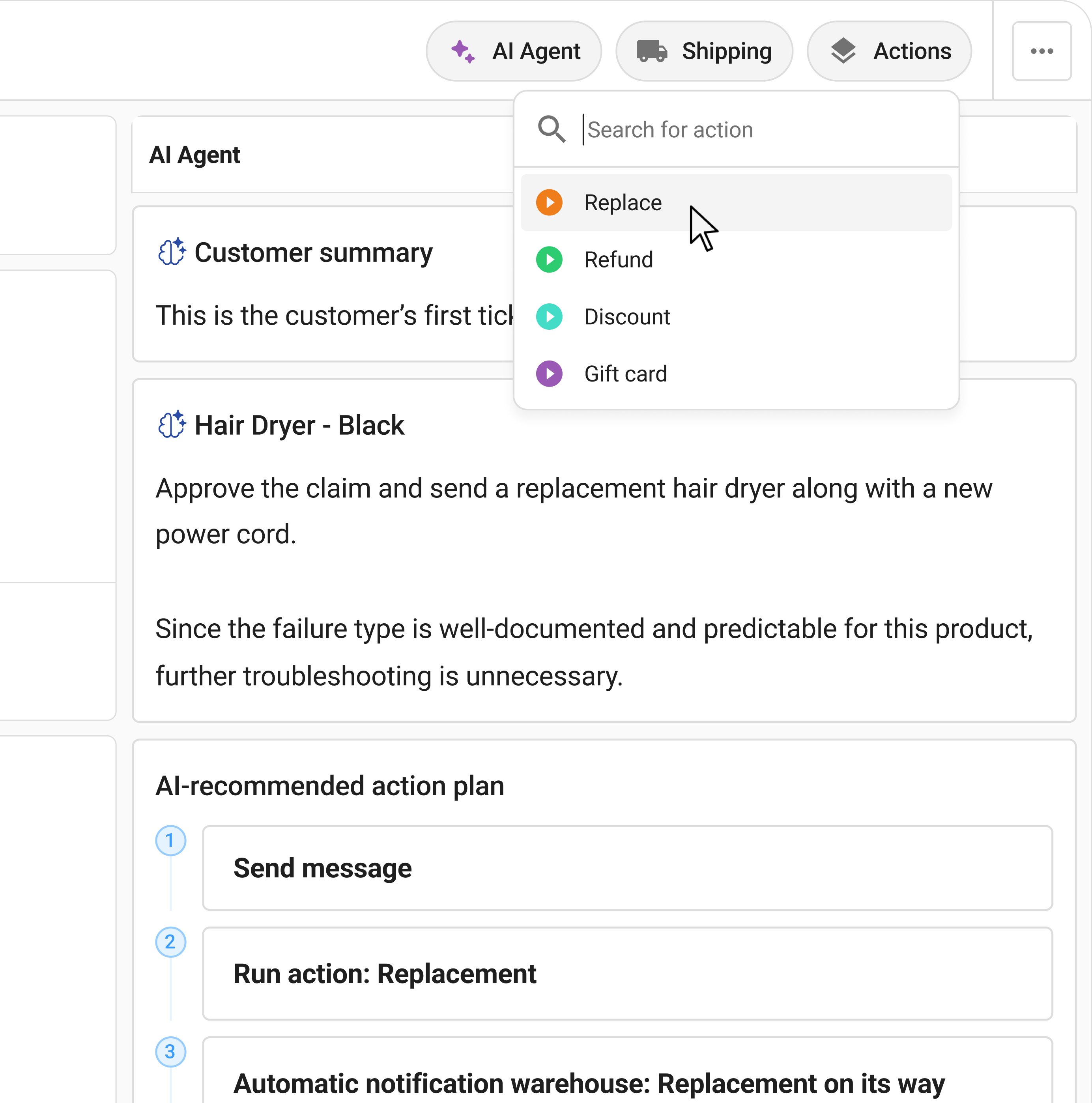
AI in returns management is moving fast. Claimlane's AI Agent, the first AI agent purpose-built for warranty claims and returns, analyzes product images and videos, applies warranty rules per product and supplier, and recommends or auto-approves resolutions.
This matters most for brands handling warranty claims where visual assessment of defects is required. Without AI, a human agent needs to look at every photo and make a judgment call. With AI, the agent only handles edge cases.
MaxGaming resolved complex RMA cases 77% faster using Claimlane's AI agents across 30,000+ SKUs and 200+ brands.
Integration ecosystem
Return management software needs to connect to:
- Ecommerce platforms: Shopify, BigCommerce, WooCommerce, Magento
- Helpdesks: Zendesk, Freshdesk, Gorgias
- ERPs: NetSuite, Microsoft Dynamics, SAP
- Shipping carriers: For label generation and tracking
- Email marketing: For post-return communication
Claimlane offers 75+ integrations covering ecommerce platforms, ERPs, helpdesks, and shipping providers.
Analytics and reporting
The best return management software turns returns data into business intelligence. Analytics should track:
- Return rate by product, category, and SKU
- Most common return reasons
- Average processing time
- Cost per return
- Supplier defect rates
- Seasonal patterns
Returns analytics that connect claims data with product and supplier performance help brands fix root causes, not just process symptoms.
Warranty and claims support
This is where return management platforms diverge most. Some only handle standard returns (wrong size, changed mind). Others, like Claimlane, handle the full after-sales spectrum: warranty claims, repairs, replacements, spare parts, and supplier cost recovery.
For brands selling products with warranties (electronics, furniture, outdoor gear), warranty support isn't optional. It's the core use case.
Platform Comparison: Return Management Software
How to Evaluate Return Management Software

Step 1: Define your return types
Before evaluating platforms, categorize the types of returns the brand handles:
- Change of mind / wrong size: Simple returns that need label generation and refund processing
- Defective / damaged: Requires photo evidence, defect categorization, and potentially supplier escalation
- Warranty claims: Requires warranty validation, repair tracking, and long-term case management
- B2B returns: Requires documentation trails, batch processing, and supplier communication
Brands that only handle simple consumer returns can get by with basic platforms. Brands handling warranty claims, repairs, and B2B operations need a platform built for complexity.
Step 2: Map your integration needs
List every system the returns platform needs to connect to. Common integration requirements:
- Ecommerce platform (Shopify, BigCommerce, WooCommerce)
- Helpdesk (Zendesk, Gorgias, Freshdesk)
- ERP (NetSuite, Dynamics 365)
- Shipping carriers
- Accounting software
Step 3: Calculate your cost per return
Understand the current cost of returns before evaluating software. This gives a baseline for ROI calculations. The right platform should reduce cost per return through automation, faster processing, and fewer support tickets.
Davidsen went from 5 agents to 1-2 agents handling claims after implementing Claimlane. GrejFreak achieved ROI almost immediately.
Step 4: Run a pilot
Most platforms offer demos or trials. Test with real return scenarios:
- Submit a return as a customer through the portal
- Process it as an agent through the backend
- Check the analytics output
- Test the integration with the ecommerce platform
- Try a warranty claim workflow if applicable
Step 5: Evaluate scalability
Return volume isn't static. Holiday seasons, new product launches, and business growth all increase volume. The platform needs to handle 3-5x normal volume during peak periods without degradation.
When to Switch from Manual to Software
Signs that manual returns management has hit its limit:
- More than 50 returns per month
- Customer service team spending 30%+ of time on returns
- No visibility into return reasons or patterns
- Supplier cost recovery is inconsistent or nonexistent
- Customers complaining about return process speed
- Warranty claims handled through email with no structured workflow
- Return data lives in spreadsheets, not connected systems
The cost of return management software is almost always less than the cost of the manual labor, errors, and missed supplier recoveries it replaces.
Return Management Software for Different Business Models
DTC brands
Direct-to-consumer brands need strong self-service portals, exchange incentives, and brand-customizable interfaces. The return experience is a direct reflection of the brand.
Multi-brand retailers
Retailers carrying multiple brands need the ability to set different return policies per brand and route warranty claims to the correct supplier. Claimlane's supplier forwarding handles this automatically.
Coolshop, a multi-brand retailer, uses Claimlane to manage claims across hundreds of brands.
B2B operations
B2B returns require documentation trails, bulk processing, and structured supplier communication. Platforms need to support B2B claim flows with purchase order references, batch RMAs, and credit note tracking.
F. Engel uses Claimlane to manage B2B returns with the structure and documentation that business customers require.
FAQ: Return Management Software
Related: returns management system, what a returns management system is.