Warranties sound simple on paper. A customer buys a product. Something goes wrong. The brand fixes it or replaces it.
In reality, warranty management gets messy fast. Spreadsheets fall apart at scale. Email threads lose context. Suppliers chase brands for documentation that lives in someone's inbox. By the time the brand has 200 active warranties, manual tracking costs more than the product margins it's supposed to protect.
This guide covers the best warranty tracking software in 2026, what each platform does well, where each falls short, and how to pick the right fit based on volume, complexity, and category.
TL;DR: Best warranty tracking software in 2026
What is warranty tracking software?
Warranty tracking software is a system that captures warranty registrations, manages claims, and analyses what happens with products after they ship. Instead of warranty data living across inboxes, spreadsheets, and shared folders, everything lives in one structured workflow.
Customer details, product serial numbers, purchase dates, and proof of purchase captured at the start.
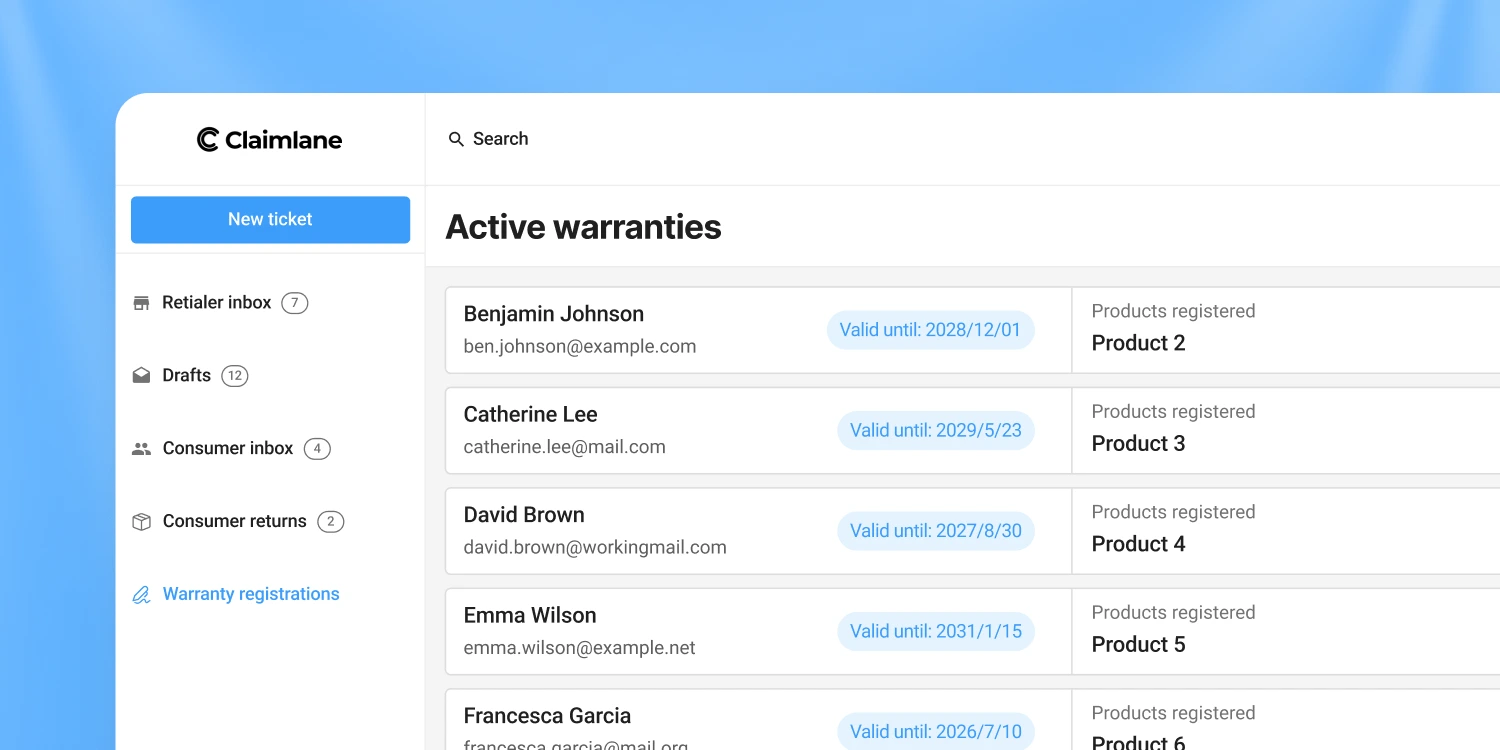
Active, expired, and expiring warranties visible in a single view with automated reminders.
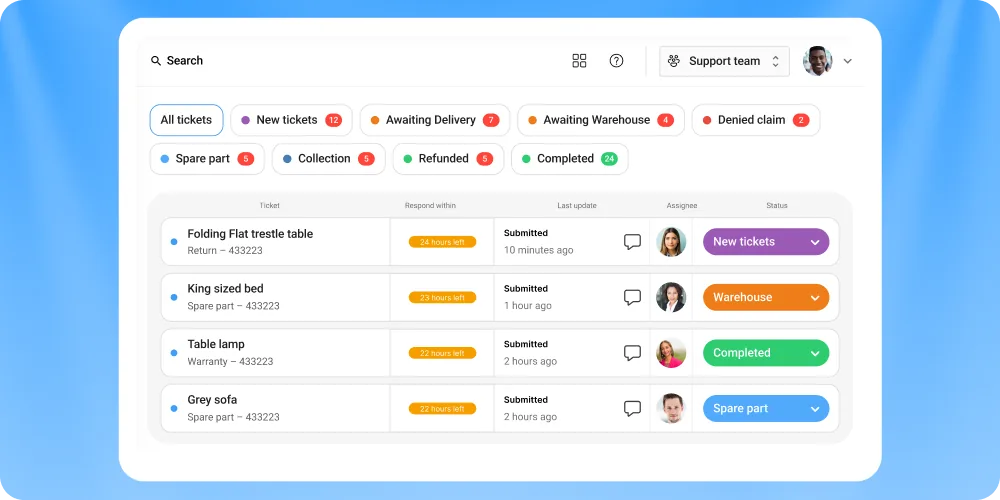
Structured intake from customers with photos, defect codes, and resolution paths.
Pattern data on claim frequency, failure types, supplier performance, and resolution time.
The point isn't record-keeping. The point is visibility. When warranty activity is tracked end-to-end, patterns appear, costs become controllable, and decisions get easier to justify with data.
Why brands trust Claimlane for warranty tracking
Two badges for returns and warranty management.
Use Claimlane for structured warranty workflows across furniture, electronics, outdoor gear, and more.
Native connections with Shopify, Magento, ERPs, helpdesks, and shipping carriers.
Davidsen claims team reduction
Cut warranty claims handling from 5 agents to 1-2. Read the case study →
MaxGaming RMA resolution
Resolves complex RMA cases 77% faster across 30,000+ SKUs. Read the case study →
Onyx Cookware return on investment
9x return on Claimlane investment in the first year of warranty automation.
The 6 best warranty tracking software platforms in 2026
1. Claimlane
Claimlane is a warranty management platform built for retail and ecommerce brands handling warranty claims at scale. It covers the entire warranty lifecycle from registration to claim resolution, with structured workflows that connect customer intake, supplier coordination, and operational analytics.
Why brands choose Claimlane
Most warranty platforms target manufacturing OEMs. Claimlane is purpose-built for ecommerce brands with multi-channel sales, retailer relationships, and customer-facing claim portals.
Most brands need both. Claimlane handles them as a single connected workflow rather than two separate tools that don't talk to each other.
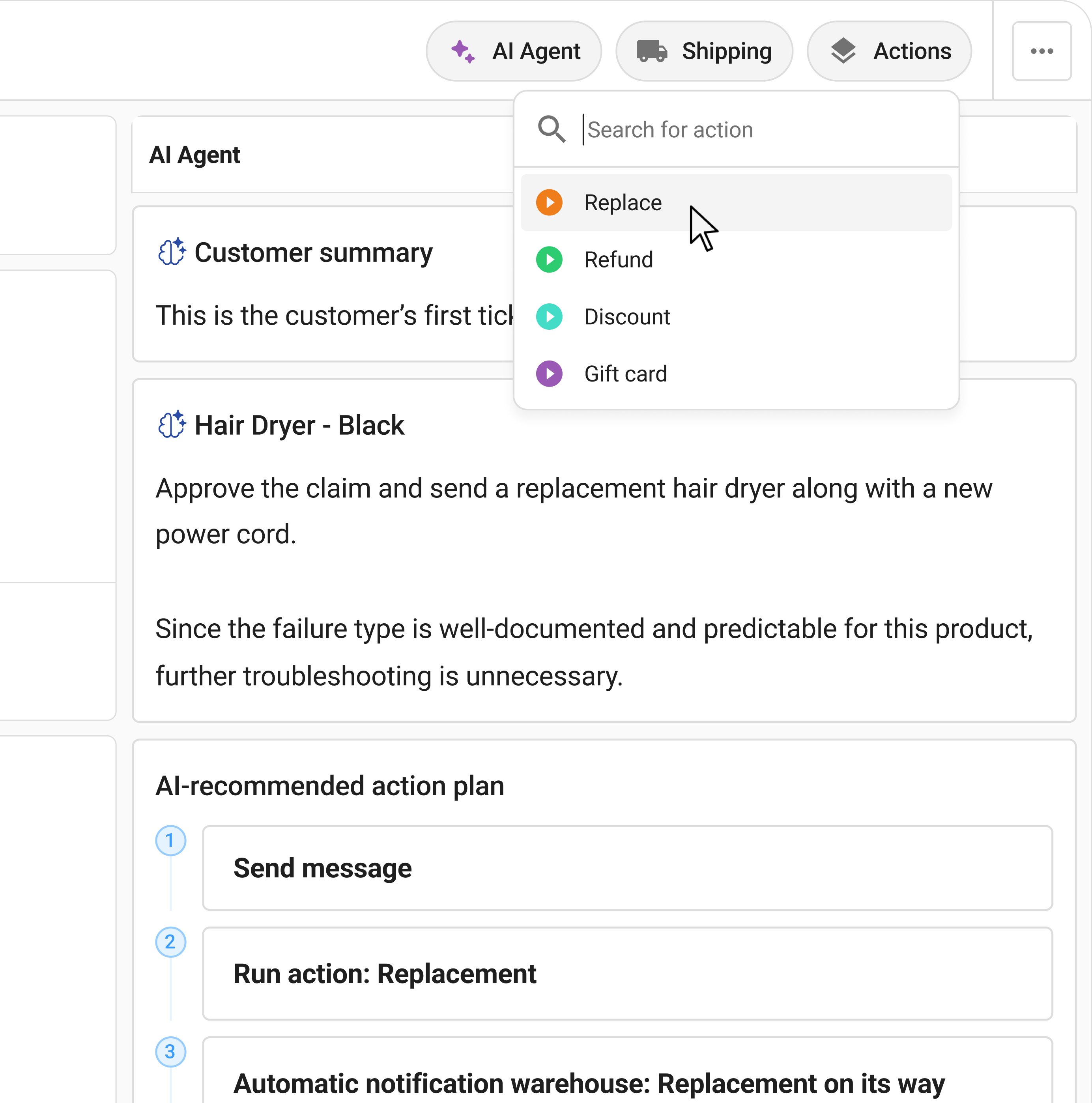
First AI Agent purpose-built for warranty claims. Validates eligibility, requests missing docs, flags suspicious claims, suggests resolutions on every ticket.
Most platforms ignore the supplier side. Claimlane handles supplier forwarding, credit note tracking, and recovery analytics natively.
Pros and cons
- End-to-end workflow from registration to resolution
- Returns + warranty + supplier in one platform
- AI Agent purpose-built for warranty
- 75+ integrations including Shopify, Magento, ERPs
- Strong analytics on supplier and product patterns
- Used by 8000+ brands across categories
- Best fit at 50+ claims/month volume threshold
- Not designed for industrial OEM scale (use Tavant or Mize)
- Custom pricing rather than transparent SaaS tiers
- Implementation requires process clarity
Use cases and case studies
Reduced warranty claims team from 5 agents to 1-2 through structured workflow automation and supplier coordination.
Resolves complex RMA cases 77% faster across 30,000+ SKUs using Claimlane's AI Agent.
Moved aftersales from cost centre to retention lever with structured warranty and returns workflows.
Automated warranty claim and repair workflows across a global outdoor gear catalogue.
Core features
Branded customer-facing portal or B2B internal registration. Captures customer info, SKU, serial number, purchase date, retailer details, proof of purchase, coverage type, and custom fields.
Active, expired, and expiring warranties visible in one dashboard. Automated reminders before expiry. Filter by product line, region, or customer. Export for compliance reporting.
Customer-facing portal walks customers through structured intake. Captures defect codes, photos, videos, usage details, eligibility status, and resolution outcomes.
Validates warranty eligibility, requests missing docs, flags duplicate claims, suggests resolutions, routes to right team. Handles repetitive parts of claim processing.
Forward complete claims to suppliers in one click. Track supplier responses, manage credit notes, and surface supplier performance patterns.
Dashboards on claim frequency by SKU, common failure reasons, average resolution time, cost per claim, warranty usage rates, regional trends.
Pricing
Available on the Claimlane pricing page. Custom pricing based on volume and requirements.
Product in action
For brands wanting to see the platform handle real warranty workflows, book a Claimlane demo and we'll walk through your specific use cases. (Or see Claimlane's full integrations list for the broader picture of how it connects to your existing stack.)
2. Tavant Warranty
Tavant Warranty is an enterprise warranty management platform built for industrial OEMs and large manufacturers. Used by automotive, electronics, and heavy equipment manufacturers handling warranty across global supply chains.
Best for: Manufacturing OEMs with multi-tier service networks.
Strengths: Industrial-scale warranty handling, supplier recovery, predictive analytics, integration with manufacturing ERPs.
Limitations: Built for OEM scale rather than ecommerce. Implementation typically takes months. Pricing reflects enterprise contracts.
Pricing: Custom enterprise pricing.
3. After, Inc.
After, Inc. focuses on extended warranty programs and service contract administration. Common in consumer electronics and appliance categories where extended warranty selling is a meaningful revenue stream.
Best for: Brands running extended warranty programs as a revenue line.
Strengths: Service contract administration, extended warranty analytics, consumer-facing warranty experiences.
Limitations: Less focused on the operational warranty workflow side. Better as a complement to a returns platform than a replacement.
Pricing: Custom enterprise pricing.
4. Mize Warranty
Mize is an enterprise warranty management platform for B2B manufacturers with field service networks. Strong fit for manufacturers handling warranty across distributor networks and service technicians.
Best for: B2B manufacturers with service network coordination needs.
Strengths: Field service integration, dealer warranty tracking, knowledge management for service technicians.
Limitations: Built for industrial operations. Less direct fit for ecommerce or DTC brands.
Pricing: Custom enterprise pricing.
5. Clyde
Clyde is a Shopify-focused extended warranty platform that lets DTC brands sell extended warranties at checkout. Different category from full warranty management — it's a revenue add-on rather than an operational platform.
Best for: DTC brands on Shopify wanting to add extended warranty as a checkout upsell.
Strengths: Shopify-native integration, customer-facing warranty selling, analytics on attach rates.
Limitations: Doesn't handle warranty claim workflows or supplier coordination. Pairs with a returns/warranty platform like Claimlane rather than replacing it.
Pricing: Revenue share model based on warranty premiums sold.
6. Verde Technology
Verde Technology offers warranty registration and claim tracking for mid-market manufacturers. Less full-featured than Tavant or Mize but easier to implement.
Best for: Mid-market manufacturers needing warranty registration and basic claim tracking.
Strengths: Faster implementation than enterprise platforms, focused feature set, mid-market pricing.
Limitations: Less depth on supplier coordination, analytics, and AI-driven workflows than enterprise alternatives.
Pricing: Custom mid-market pricing.
Why spreadsheets stop working at scale
Most brands start with spreadsheets for warranty tracking. They're familiar, flexible, and easy. For a while, they work.
Every registration or claim has to be typed by someone. Mistakes creep in. Fields get skipped. Formats change row to row. Fixing data takes time that should go to solving real problems.
One person has the latest version. Someone else is working from a copy. Updates lag behind reality. When a customer asks for an update, the team double-checks everything.
Basic counts are easy. Meaningful analysis is not. Understanding fault reasons, claim trends, or product performance means building pivot tables and separate reports. Most teams don't have time, so the insights never happen.
What works for 50 claims breaks at 500. What works for one region collapses across multiple markets or partners. At that point, spreadsheets stop saving time and start creating risk.
This is usually the moment teams start looking for warranty tracking software. Not because they want something new, but because the old way is holding the operation back. (See how to build a warranty workflow that scales for more.)
How to choose the right warranty tracking software
Ecommerce and retail: Claimlane. Industrial OEM: Tavant or Mize. Extended warranty programs: After, Inc. Shopify warranty selling: Clyde. Mid-market manufacturer: Verde. The wrong category fit makes everything else harder.
Most warranty cases involve a return or replacement. If the platform doesn't handle returns alongside warranty, the team ends up running two disconnected workflows.
Most warranty defects originate upstream from suppliers. Brands recovering supplier credit need a platform that handles supplier forwarding, credit notes, and recovery analytics natively.
Shopify, Magento, ERPs, helpdesks, shipping carriers. Integration depth determines how automated the workflow can be. Shallow integrations create data silos and manual handoffs.
Modern platforms use AI for claim eligibility, fraud detection, and resolution suggestions. Brands at scale see 30-70% reduction in manual claim handling time when AI handles the routine cases.
The bottom line
Warranty tracking software earns its place when warranty volume passes the point where manual workflows pay off. For most brands, that threshold is around 50-100 claims per month. Above it, structured warranty management isn't an incremental improvement — it's the difference between a controllable operation and chaos.
For ecommerce and retail brands, Claimlane is the strongest fit because it handles warranty alongside returns and supplier coordination as a single connected workflow. For industrial OEMs, Tavant and Mize cover the manufacturing-scale needs. For extended warranty programs, After, Inc. and Clyde cover the revenue-add-on category.
The most expensive choice is staying in spreadsheets long after they've stopped working. By the time the operation is at 200+ claims a month, manual tracking costs more than any software does.
For brands ready to move past spreadsheets, book a Claimlane demo to see structured warranty management in action.