.webp)
Every ecommerce brand reaches a point where managing returns through the ERP stops working. Orders come back faster than agents can create return orders. Photos pile up in email inboxes with no connection to claim records. Suppliers never see the defect data that would justify a credit note.
The question is not whether to keep the ERP. The ERP is essential for finance, inventory, and order management. The question is whether to add a dedicated returns management platform alongside it.
This guide compares the two approaches across every dimension that matters: features, workflow, data quality, customer experience, supplier management, and total cost of ownership.
- ERPs handle financial transactions (credit memos, inventory) but lack self-service portals, photo evidence, AI assessment, and supplier claims workflows.
- Dedicated returns platforms like Claimlane automate the entire claims lifecycle from customer submission to supplier cost recovery.
- The best approach is integration: keep the ERP for finance and add a returns platform for claims operations.
- Brands processing 50+ returns per month see the strongest ROI from adding a dedicated platform.
When This Comparison Matters
Small brands with fewer than 20 returns per month can usually manage with their ERP and a shared inbox. The manual work is tolerable when volume is low.
But as brands scale past 50 returns or claims per month, three problems emerge simultaneously:
- Agent time compounds. Each claim takes 20-45 minutes of manual work in the ERP. At 100 claims per month, that is a full-time role spent on data entry.
- Customer experience degrades. Without self-service, customers wait for email replies. Resolution stretches from days to weeks.
- Quality data disappears. Unstructured return data in the ERP tells finance how much was refunded, but it cannot tell product teams which products are failing or which suppliers are responsible.
The comparison below assumes a brand that has outgrown manual ERP returns and is evaluating whether to build internal workarounds or adopt a purpose-built platform.
| Feature | ERP (Native) | Returns Management Platform |
|---|---|---|
| Return order creation | Manual, agent-initiated | Auto-created from submission |
| Self-service portal | Not available | ✓ Branded, multilingual |
| Photo/video evidence | Not supported | ✓ Collected at submission |
| Warranty validation | Manual date check | ✓ Automated rules engine |
| AI claim assessment | Not available | ✓ Image analysis + auto-approval |
| Credit memos | Manual posting | ✓ Auto-triggered via integration |
| Status notifications | Not automated | ✓ At each workflow stage |
| Supplier claims | Not available | ✓ Built-in with evidence |
| Analytics | Financial reports only | ✓ Claim rates, defects, suppliers |
| Repair tracking | Not available | ✓ Full repair workflow |
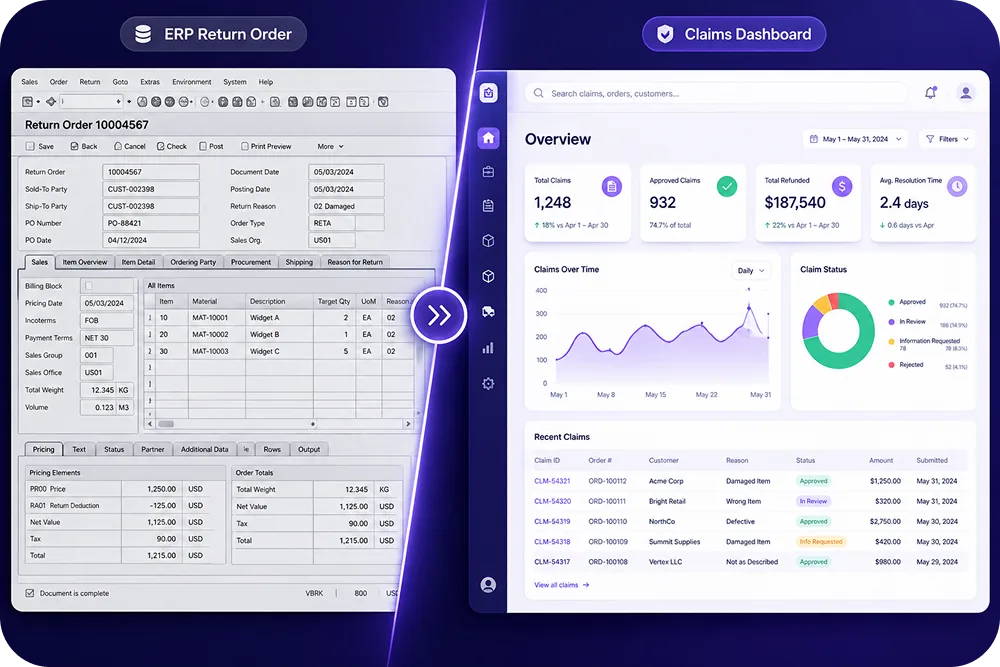
Customer Experience: ERP vs Returns Platform
The ERP Experience
A customer with a broken product emails support. An agent responds within hours (or the next day). The agent asks for order details, photos, and a description of the problem. The customer emails photos. The agent manually creates a return order in the ERP, verifies warranty dates, and emails the customer a return label. Days pass. The customer hears nothing until the refund or replacement arrives. Total time: 1-3 weeks.
The Returns Platform Experience
The customer visits a branded self-service portal, enters the order number, selects the product and defect type, uploads photos, and submits the claim. Claimlane validates the warranty, the AI Agent assesses the photos and recommends a resolution, and the customer receives an automated confirmation email within minutes. Resolution often happens the same day. Automated status updates keep the customer informed throughout.
The difference is not incremental. It is a fundamentally different experience that reduces customer effort and increases satisfaction.
Workflow Depth: What Happens After the Claim Lands
ERPs treat a return as a transaction: create return order, receive item, post credit memo. Done. Returns management platforms treat it as a workflow with multiple paths:
Claim Routing
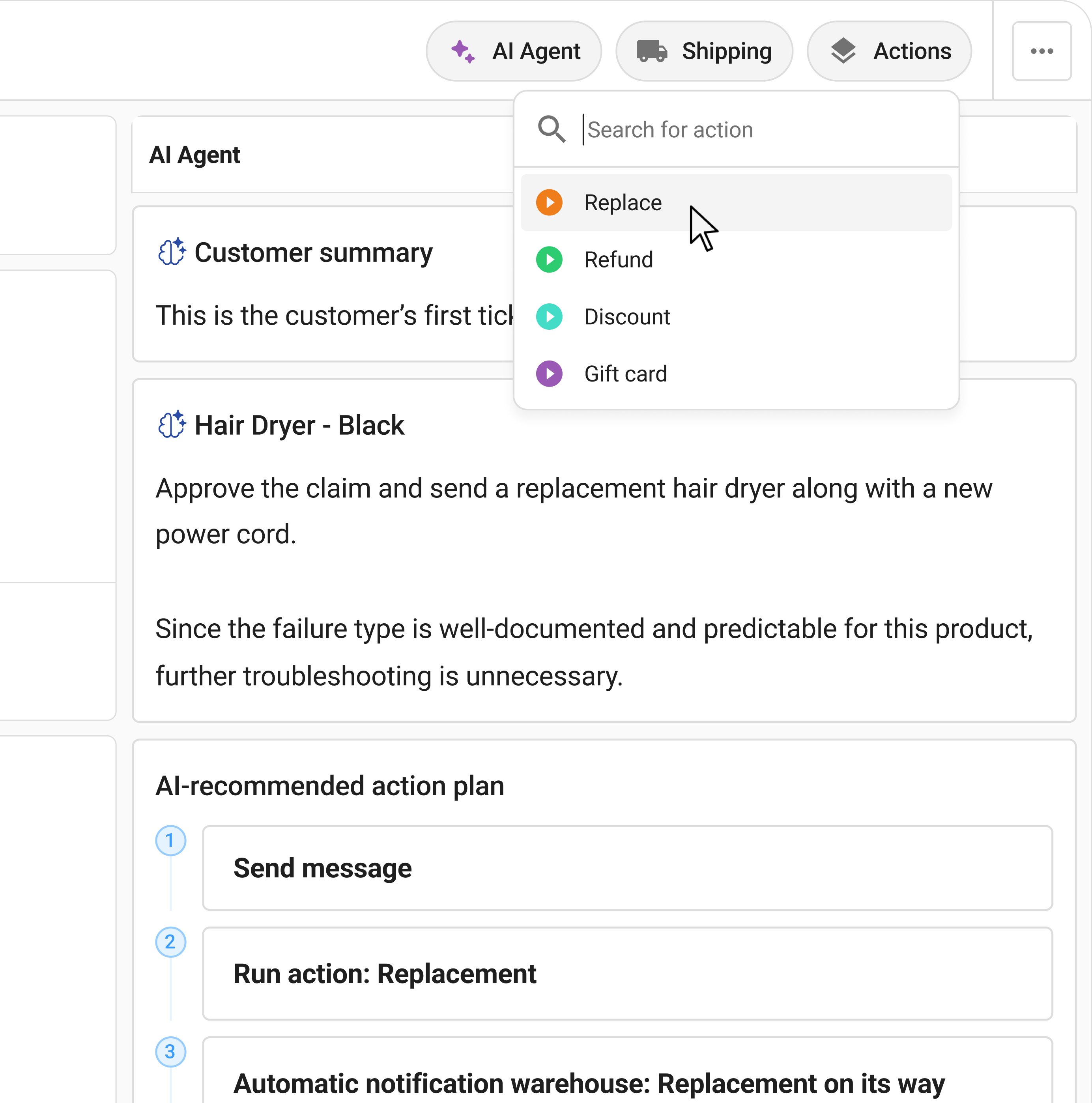
Different claims need different handling. A cosmetic scratch on a low-value item might qualify for auto-approval. A functional failure on a high-value product might need manager review. A supplier defect needs to be forwarded. Claimlane's workflow automation routes claims based on product, defect type, value, and customer history.
Resolution Options
ERPs offer refund or replacement. A returns platform offers refund, replacement, repair, spare part, store credit, or rejection, each with its own sub-workflow. Repair workflows, for instance, track the item through intake, diagnosis, repair, quality check, and return to customer.
Supplier Forwarding
When the defect is the supplier's responsibility, Claimlane forwards the claim with all evidence attached. The supplier resolves it in the same platform. The brand tracks supplier chargebacks and cost recovery automatically.
Data and Analytics: The Deciding Factor
This is where the comparison becomes most lopsided.

What the ERP Tells You
- Total credit memos issued this month
- Return values by customer
- Inventory adjustments
What a Returns Platform Tells You
- Claim rate per SKU (normalized by units sold)
- Top defect types across product lines
- Mean time to failure by product category
- Supplier defect rates and cost recovery
- Resolution time by claim type
- Customer satisfaction trends post-claim
Claimlane's analytics dashboard captures all of this through the structured data collected during the claims process. This data feeds directly into product quality improvement cycles, supplier management decisions, and operational efficiency tracking.
For the full picture on which metrics to prioritize, see the guide on returns analytics events to track.
- Total credit memos
- Return values by customer
- Inventory adjustments
- Claim rate per SKU
- Defect type distribution
- Supplier defect rates
- Mean time to failure
- Cost per claim
- Resolution time trends
Supplier Management: Where ERPs Fall Silent
Supplier cost recovery is one of the largest uncaptured savings in ecommerce operations. When a product fails because of a manufacturing defect, the brand pays for the replacement and the return shipping. The supplier should reimburse those costs.
ERPs track purchase orders and vendor payments, but they have no workflow for:
- Sharing claim evidence with suppliers
- Letting suppliers review and respond to claims
- Tracking claim resolution per supplier
- Calculating total cost owed by each supplier
A returns platform closes this loop. Claimlane's forward-to-supplier feature sends the claim with all documentation to the supplier, tracks their response, and reports on cost recovery by supplier. This data also strengthens supplier quality scoring and contract negotiations.
"Claimlane has helped us become far more structured in our claims management, which is not just about saving time but about getting real visibility into what's happening with our products in the market."
— Simone Andersen, Customer Service Manager, Coolshop
Integration: The Best of Both Worlds
The strongest approach is not choosing between an ERP and a returns platform. It is using both.
Claimlane integrates natively with Business Central and connects to 75+ platforms including Shopify, WooCommerce, Zendesk, and major shipping providers. The integration means:
- Claims data flows in from customer submissions, ecommerce platforms, and email
- Financial transactions flow out to the ERP (credit memos, inventory updates, replacement orders)
- Product data flows between both systems so warranty rules and order history are always current
The ERP remains the system of record for finance. The returns platform becomes the system of record for claims.
Cost Comparison: Build vs Buy
The Hidden Cost of ERP-Only Returns
Brands that stick with ERP-only returns pay in three ways:
- Agent labor. 20-45 minutes per claim at agent hourly rates. At 200 claims per month, this is equivalent to 1-2 full-time positions.
- Customer churn. Slow, opaque resolution drives customers to competitors. Even a small increase in post-return churn adds up.
- Unrecovered supplier costs. Without a supplier claims workflow, brands absorb defect costs that should be charged back. Supplier chargebacks can recover significant amounts when backed by structured data.
The Cost of Adding a Returns Platform
Dedicated platforms like Claimlane charge a monthly subscription based on claim volume. The ROI math is straightforward: reduced agent time, recovered supplier costs, and lower churn typically exceed the platform cost within the first quarter.
AI Capabilities: The Widening Gap
The gap between ERPs and dedicated returns platforms is growing fastest in AI. ERPs are adding generative AI features for natural language queries and report generation. Returns platforms are adding AI that directly handles claims.
Claimlane's AI Agent, the first AI agent purpose-built for warranty claims and returns, does things no ERP can:
- Analyzes product photos and videos to assess damage
- Applies product-specific and supplier-specific warranty rules
- Recommends resolution (refund, replace, repair, reject) with reasoning
- Auto-approves claims that meet predefined criteria
- Learns from historical claim patterns to improve accuracy
This is not theoretical. Brands like MaxGaming report 77% faster resolution times after implementing Claimlane's AI. The technology gap between ERP after-sales capabilities and purpose-built platforms will continue to widen.
Who Should Stay ERP-Only
Not every brand needs a dedicated returns platform. The ERP-only approach works when:
- Monthly return and claim volume is under 20
- Products do not have warranty periods (fashion, consumables)
- The brand has a single sales channel
- Supplier cost recovery is not a priority
- The support team has capacity to handle manual processing
For everyone else, the integration approach delivers better customer experience, stronger analytics, faster resolution, and higher cost recovery.
Who Should Add a Returns Platform
Add a dedicated platform when:
- Volume exceeds 50 returns or claims per month
- Products carry warranty periods or quality guarantees
- The brand sells through multiple channels (DTC, wholesale, marketplace)
- Supplier defects are a meaningful cost driver
- Product teams need quality data from returns
- Customer satisfaction with the returns process is below target
For warranty-heavy brands in industries like outdoor and sporting goods, electronics, furniture, and baby and nursery, the case is especially strong.
Claimlane is rated 4.8/5 on G2.
How to Evaluate Returns Management Software
When comparing platforms, prioritize these criteria:
- ERP integration depth. Does it connect natively to your ERP, or require custom middleware?
- Customer self-service. Is the portal brandable, multilingual, and mobile-friendly?
- AI capabilities. Can it assess claims from photos and apply business rules automatically?
- Supplier workflows. Can suppliers receive, review, and resolve claims in the same system?
- Analytics. Does it provide operational metrics (claim rates, defect types, supplier performance), not just financial summaries?
- Time to value. How quickly can you go live? Claimlane typically launches within weeks, not months.
For the warranty-specific landscape, see the best warranty management software guide.