
Most warranty and returns processes start with an email. The customer writes "my product is broken," attaches a blurry photo, and a support agent spends the next 15 minutes asking clarifying questions: What's the order number? Which product? When did they buy it? Can they send a better photo?
A self-service claims portal eliminates this back-and-forth. The customer fills out a structured form that collects everything the brand needs upfront: product information, defect details, photos, and purchase data. The claim arrives complete, ready for review or automated processing.
For brands handling more than a handful of warranty claims or returns per week, a self-service portal isn't a nice-to-have. It's the foundation that makes everything else possible: automated workflows, AI-powered processing, supplier forwarding, and analytics.
Why Self-Service Claims Portals Matter
They reduce support workload
Every claim handled through email requires an agent to manually collect information, classify the issue, and initiate the resolution. Research shows that manually managing a warranty return requires an average of 10 touchpoints, takes 15 minutes, and costs the company $5 per claim just in handling time.
A self-service portal cuts the touchpoints from 10 to 2-3 and reduces handling time from 15 minutes to under 2 minutes for straightforward claims.
They improve data quality
Unstructured emails produce inconsistent data. One customer writes "the leg is wobbly," another writes "product defective please help." Neither provides enough information for efficient processing.
Structured intake forms with required fields (product selection, defect category dropdown, mandatory photo upload, order number) produce clean, consistent data that feeds warranty analytics and enables automated decision-making.
They speed up resolution
When claims arrive complete, there's no waiting for the customer to respond to follow-up questions. The claim can be validated, classified, and resolved in minutes instead of days.
They enable automation
Automation requires structured data. A claims portal that collects standardized information makes it possible to:
- Auto-validate warranty eligibility based on purchase date
- Auto-classify defect types based on category selections and photos
- Auto-route claims to the correct resolution path
- Auto-forward claims to suppliers with complete documentation
Without a portal, automation is impossible because the data is too inconsistent to process programmatically.
Can I run multiple return portals for different stores?
Yes, but the way you set it up matters more than whether you can. Most brands managing several stores end up either with portals that look unified but fragment operations behind the scenes, or with portals that share one operational backend but feel like a different experience for each brand. The second option is what most teams want and rarely achieve on the first try.
Three multi-portal patterns come up most often:
Multi-brand retailers. One company owns several brands. Each brand needs its own visual identity, its own policies, and its own customer experience, but the operations team wants every claim landing in one inbox.
Multi-region storefronts. One brand selling in several countries. Each region needs its own language, currency, return rules, and local carrier integrations, but the global ops team needs unified analytics.
B2B plus B2C flows. The same product line sold to retail customers and to wholesale partners. Each audience needs different intake forms and different documentation requirements, but the team resolving claims is often the same.
Marketplace plus DTC. Returns from Amazon, eBay, or Faire mixed with returns from the brand's own website. Each channel has its own policy quirks but the warehouse processes them all the same way.
The "multiple disconnected portals" problem
If each store runs a separate portal on a separate platform, the brand ends up with what most multi-brand retailers eventually call the portal sprawl problem:
Operations teams log into 3 to 5 different tools per day to process claims.
Cross-brand analytics is impossible because the data lives in separate systems.
Supplier-attributed defects can't be aggregated, so chargeback recovery is weak.
Staffing decisions are guesswork because volume by brand is hard to compare.
Tooling cost adds up: a separate licence, a separate integration, a separate support contract for each brand.
The single-pane-of-glass setup
The cleaner architecture is one platform backend with multiple branded portals on top. Each store gets its own branded customer experience. Operations sees everything in one inbox.
| Dimension | Separate portals per store | One backend, multiple branded portals |
|---|---|---|
| Customer experience | Branded per store | Branded per store |
| Ops inbox | One per store (3 to 5 tools per day) | Single unified inbox |
| Cross-brand analytics | Manual export and stitching | Native dashboards |
| Supplier recovery | Fragmented per portal | Aggregated by supplier across brands |
| Workflow rules | Configured separately per portal | Set once, apply per brand or globally |
| Integration cost | Pays per store | One integration, multiple connected stores |
| Onboarding new store | Full new implementation | Clone existing config, change branding |
What the single-pane-of-glass setup needs
For the backend to actually serve multiple stores well, the platform needs four capabilities:
Per-store branded portals. Each store gets its own URL or subdomain, its own colors, its own logo, its own language defaults.
Per-store policy rules. Return windows, accepted reasons, eligibility logic, and resolution options configured independently for each brand.
Per-store integrations. Each portal connects to its own Shopify store, ERP, helpdesk, and carrier accounts.
Unified ops view. A single inbox where agents see claims across all stores, with filters to focus on one brand when needed. Cross-store analytics, supplier recovery, and workflow rules.
Claimlane is built around this pattern. Brands like Davidsen run multiple branded portals from one backend, with operations teams resolving claims across stores from a single view. The setup means a new store can launch with a branded portal in days, not months.
Core Features of an Effective Claims Portal

Product identification
The customer needs to identify what they bought. Best approaches:
- Order lookup: Customer enters an order number or email, and the system pulls the order details automatically from Shopify, WooCommerce, or the ERP via integrations
- Product selection: If no order lookup is available, a searchable product catalog lets the customer find and select their product
- Serial number or barcode scan: For registered products, the customer enters or scans a serial number that links to their warranty registration
Automatic order matching is the gold standard. It eliminates manual data entry errors and validates that the purchase falls within the warranty period.
Defect classification
A dropdown or guided selection that helps the customer categorize their issue:
- Defect type: Broken component, material failure, cosmetic damage, doesn't function, missing parts
- Severity: Product unusable, partially usable, cosmetic only
- When it happened: Within first use, after X weeks/months, gradually over time
Standardized categories enable returns analytics at scale. When every claim is tagged with a consistent defect type, patterns emerge that drive product quality improvements.
Photo and video upload
Visual evidence is critical for:
- Validating that the defect exists
- Classifying the defect type and severity
- Supporting supplier recovery claims
- Training AI models for automated classification
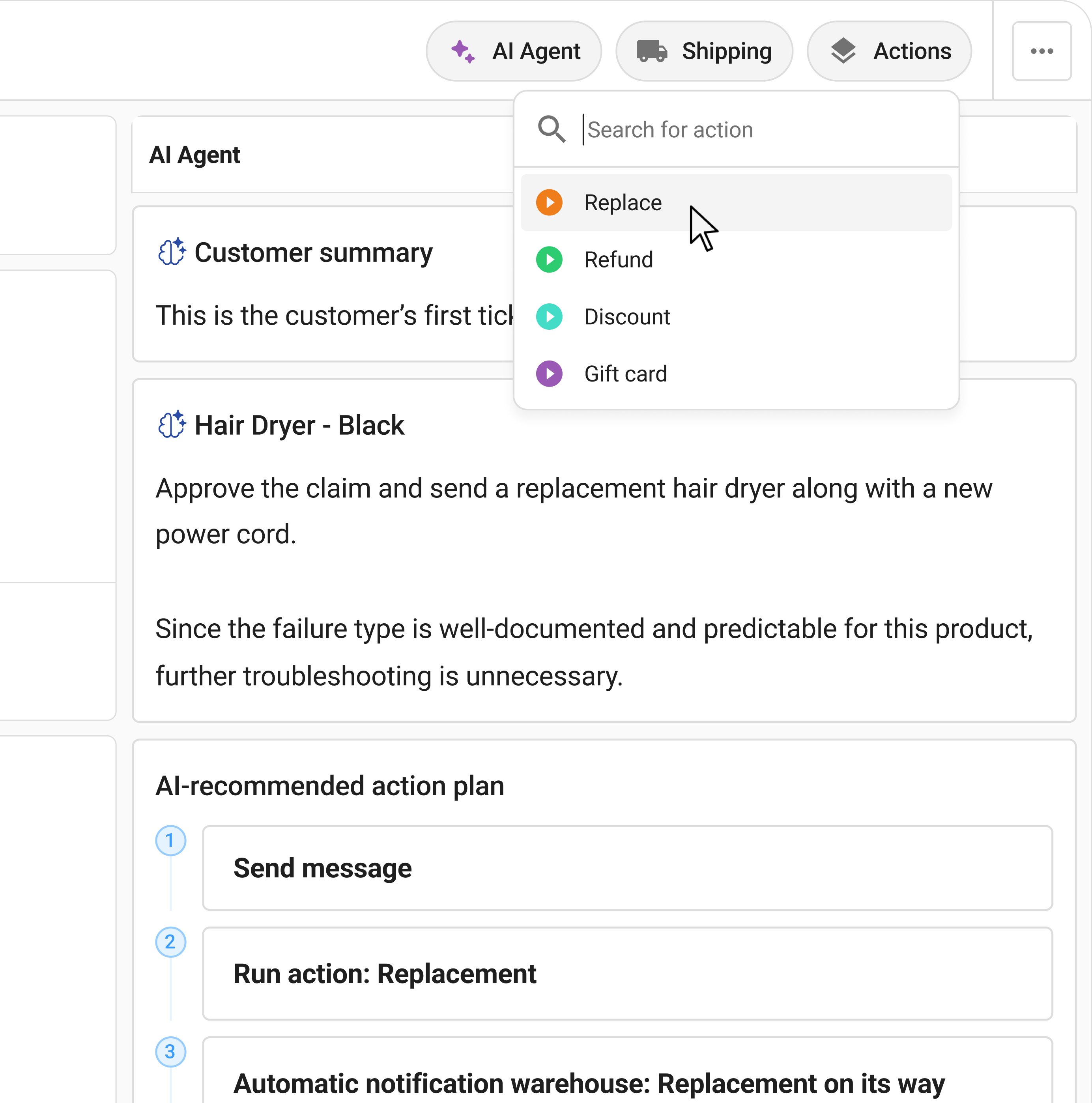
Require at least one photo. Encourage video for complex defects. Claimlane's AI Agent, the first AI agent purpose-built for warranty claims and returns, analyzes these images automatically to validate claims and recommend resolutions.
Customer communication
The portal should keep the customer informed:
- Confirmation: Immediate acknowledgment that the claim was received
- Status updates: Automatic status emails when the claim moves through stages
- Resolution notification: Clear communication of the outcome (replacement shipped, repair scheduled, refund processed)
Customers don't want to chase updates. Proactive notification systems reduce inbound support contacts by 40-60%.
Claim tracking
A customer-facing dashboard where the claimant can check status, view messages, and see resolution details without contacting support. This is table stakes for a modern customer experience.
Step-by-Step: Setting Up a Claims Portal

Step 1: Define your claim types
Before building the portal, decide what types of claims it will handle:
- Warranty claims: Product defects within the warranty period
- Returns: Change-of-mind or preference returns
- Repairs: Products that need fixing rather than replacing
- Spare parts requests: Replacement components for products with fixable issues
Each claim type may need a different intake form with different required fields. A warranty management platform like Claimlane handles multiple claim types within a single portal.
Step 2: Configure product and order integration
Connect the portal to your ecommerce platform or order management system:
- Shopify: Automatic order lookup by email or order number
- WooCommerce: Same functionality via API integration
- ERP systems: For B2B and multi-channel brands
Claimlane's 75+ integrations make this connection straightforward. Once connected, the portal auto-populates product details, purchase dates, and warranty terms based on the order.
Step 3: Build the intake form
Design the form to collect everything the team needs in one submission:
Required fields:
- Product/order identification
- Defect category (dropdown)
- Defect description (text, with character minimum)
- Photo evidence (at least one photo required)
Optional but valuable fields:
- Video upload
- Batch or serial number
- Preferred resolution (repair, replacement, refund)
- Contact preferences
Keep the form as short as possible while still collecting complete information. Every additional field increases abandonment rates.
Step 4: Set up automated routing
Once a claim is submitted, workflow rules determine what happens next:
- Claims under $50 auto-approve for replacement
- Claims with safety-related defect categories escalate to the quality team
- Claims from VIP customers route to a senior agent
- Claims matching known defect patterns fast-track to the appropriate resolution
Step 5: Configure customer communication
Set up automatic emails for each stage:
- Claim received confirmation
- Claim under review
- Resolution decision (approved/denied/need more info)
- Shipment/repair/refund notification
- Follow-up satisfaction check
Automatic status emails reduce "where's my claim?" inquiries by keeping the customer informed proactively.
Step 6: Brand the experience
The portal should look and feel like part of the brand, not a generic third-party tool:
- Match colors, fonts, and logo to the brand's website
- Use the brand's tone of voice in form labels and confirmation messages
- Place the portal on the brand's domain (or a branded subdomain)
A branded self-service portal feels professional and trustworthy. A generic form with no branding feels like an afterthought.
Step 7: Test and iterate
Before launch:
- Submit test claims for each claim type
- Verify that routing rules work correctly
- Check that automated emails send at the right stages
- Test on mobile (most customers submit claims from phones)
After launch, monitor:
- Form completion rate (how many start the form vs complete it)
- Average time to submit a claim
- Percentage of claims that arrive with complete documentation
- Customer satisfaction scores on the claims experience
Common Mistakes to Avoid

Making the form too long
Every field beyond the essentials adds friction. If the abandonment rate is high, the form is probably asking for too much. Start with the minimum viable form and add fields only when data shows they're needed.
Not requiring photos
Photos are the single most valuable piece of claim data. They validate the defect, enable AI classification, and support supplier recovery. Making photos optional means half of claims will arrive without them, requiring follow-up.
Hiding the portal
If customers can't find the claims portal, they'll email support instead, defeating the purpose. The portal should be:
- Linked from the website footer
- Linked from order confirmation emails
- Linked from the contact/support page
- Findable via Google search for "[brand name] warranty claim"
No mobile optimization
Over 60% of claims are submitted from mobile devices. A portal that doesn't work well on phones creates frustration and increases support contacts. The photo upload feature is especially critical on mobile, as customers take photos with their phone camera.
Forgetting the B2B flow
If the brand serves both B2C and B2B customers, the portal needs to accommodate both. B2B claims often involve bulk submissions, different documentation requirements, and supplier forwarding. A single portal with different flows based on customer type handles this cleanly.
Measuring Portal Success

Key metrics to track:
- Portal adoption rate: What percentage of claims come through the portal vs email/phone?
- Form completion rate: Of customers who start the form, how many submit it?
- First-contact resolution rate: How many claims are resolved without follow-up?
- Average handling time: Time from claim submission to resolution
- Customer satisfaction (CSAT): Post-resolution survey scores
- Support ticket deflection: Reduction in email/phone inquiries about claims
GrejFreak achieved ROI almost immediately after implementing Claimlane, largely because the self-service portal drastically reduced the manual handling time per claim.
How Claimlane's Portal Works
Claimlane's self-service portal is purpose-built for warranty claims and returns:
- Automatic order matching via Shopify, WooCommerce, and ERP integrations
- Structured intake forms with customizable fields per claim type
- Mandatory photo/video upload with AI analysis by Claimlane's AI Agent
- Real-time warranty eligibility check based on purchase date and product rules
- Automatic status notifications to keep customers informed
- Multi-language support for brands selling across regions
- Branded experience matching the brand's visual identity
The portal connects directly to Claimlane's workflow engine, supplier forwarding, and analytics dashboard, creating a complete claims management system from a single customer-facing entry point.
OnyxCookware and Cult both use Claimlane's portal to handle claims with minimal manual intervention, ensuring every claim arrives with the data needed for fast resolution.